Wyatt Ellis
He’s Got It In Him
Photos Courtesy of Teresa Ellis
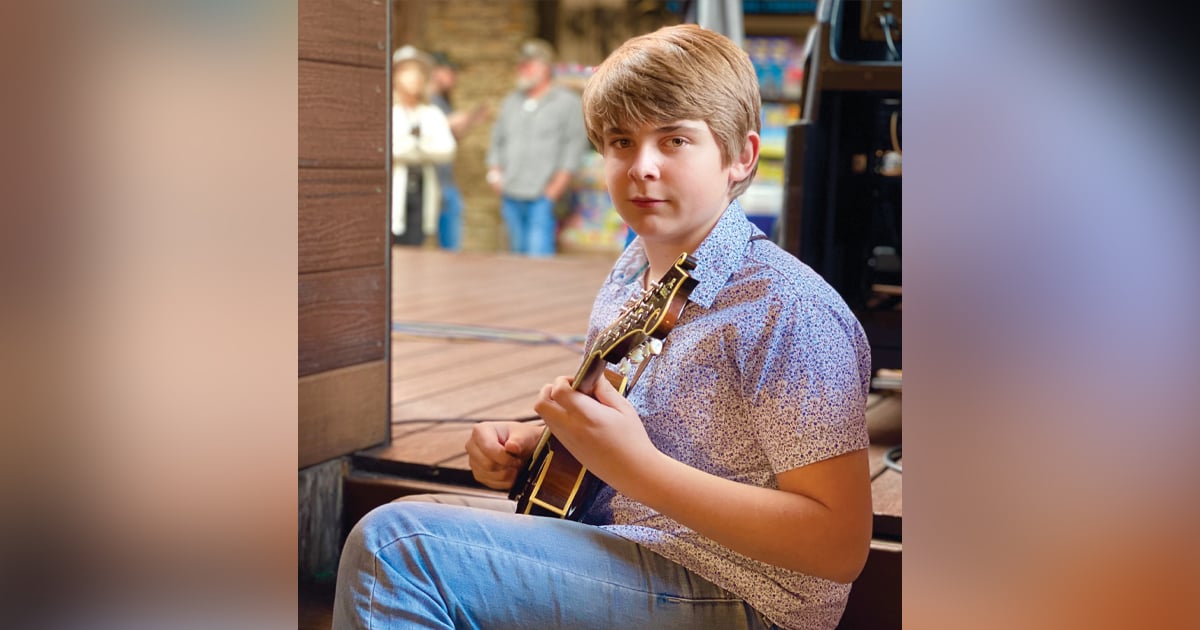
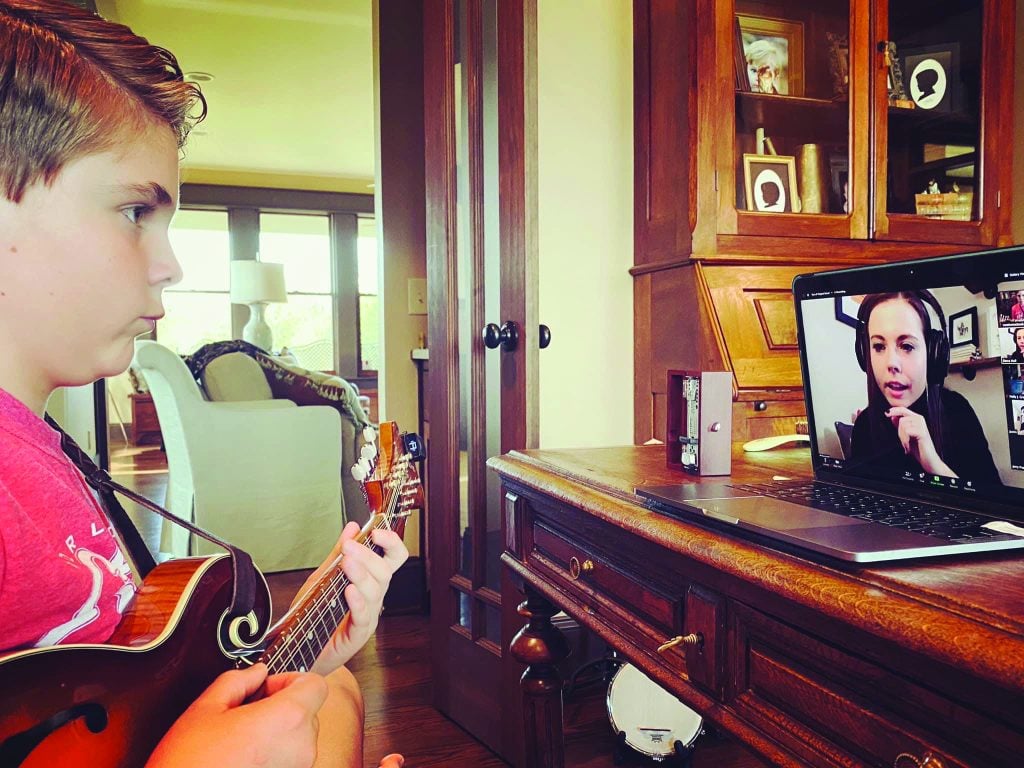
The last few years of Wyatt Ellis’ young life have been remarkable in several different ways. Before the pandemic he was spending upwards of three hours a day shuttling between Boy Scouts, Taekwon-Do, soccer practice, and squeezing in a weekly 30-minute mandolin lesson: pretty much the life of an active 10-year-old boy. Abruptly, most of that stopped, leaving him at home (fortunately with his mandolin). Since that time, Wyatt has been immersed in a whirlwind of lessons, mentors, and musical opportunities that would be the envy of any musician twice his age. He was awarded a nine-month Tennessee Traditional Arts apprenticeship in 2020 with Sierra Hull (herself very familiar with musical success at a young age). Wyatt was named the youngest-ever Gibson endorser in early 2021 and chosen as part of the Gibson Generation Group (“G3”) Class of 2023—a first for bluegrass and the mandolin. He was selected for the IBMA Kids On Bluegrass in 2021 and created his own virtual ensemble on mandolin, fiddle and guitar. In late 2021 he was tapped for another Tennessee Traditional Arts apprenticeship with noted vocalist, fellow East Tennesseean, and personal hero Paul Brewster.
For the past 18 months, Wyatt has virtually connected with some of the best artists in bluegrass right from his home in the Smokey Mountains. He has been part of Christopher Henry and David McLaughlin’s Monroe Style weekly Improvising Workshops since early in the pandemic. He has also attended virtual camps and used learning platforms like Artistworks and Banjo Ben Clark. He has taken private lessons on mandolin with Christopher Henry, David McLaughlin, Danny Roberts, Mike Compton, Alan Bibey, Lauren Price Napier, Jake Workman and Dominick Leslie; on guitar with Jake Workman and David Grier; on fiddle with Jason Carter and Deannie Roberts; on vocals with Michael Daves and Paul Brewster. There are so many amazing musicians keeping bluegrass alive—even online!
Drawn to the Monroe style, Wyatt collaborated with Roscoe Morgan (his first mandolin teacher) on a tune that placed first in the Monroe Mandolin Appreciation Society’s first annual Monroe Style Tune Writing Contest in 2020, and then accomplished a back-to-back win in 2021 with his solo-penned tune Shaconoge
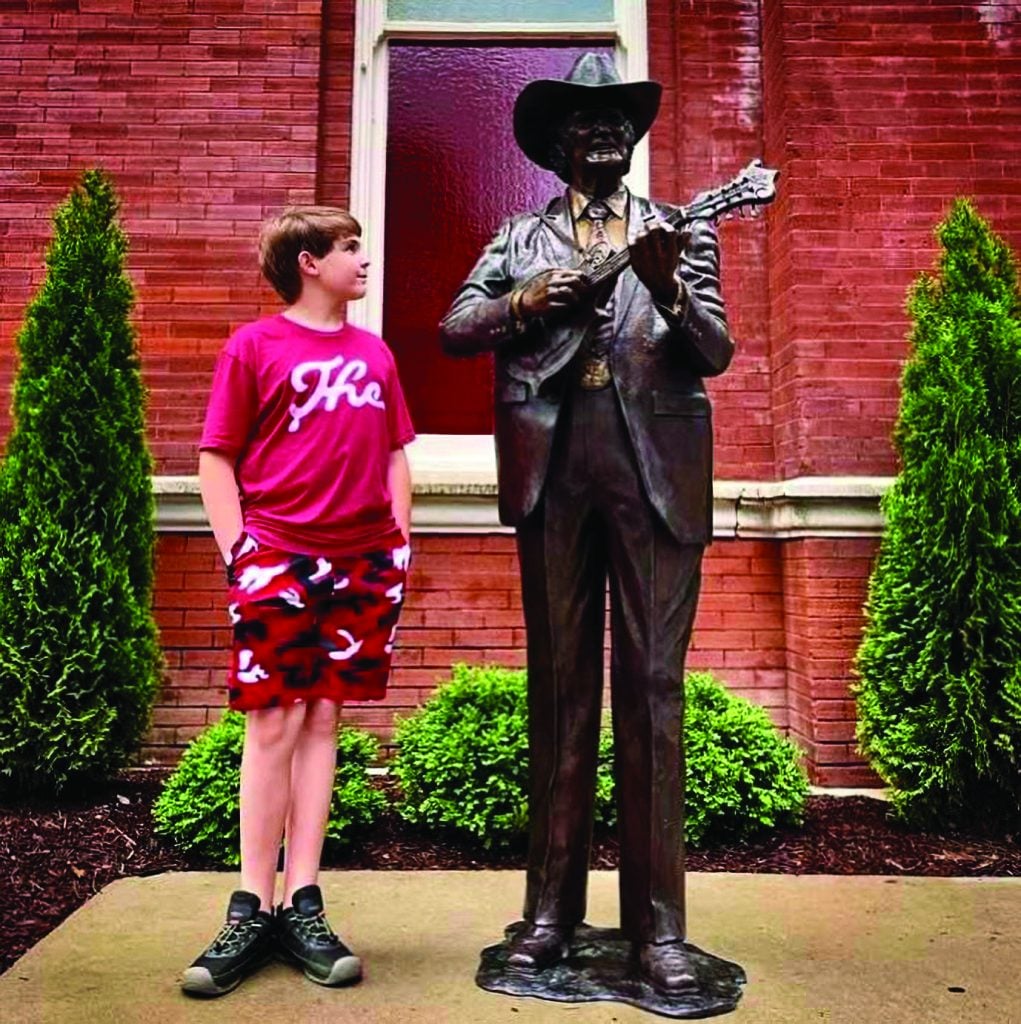
Although he’s quickly acquired proficiency on the mandolin, Wyatt’s musical skills began developing a bit earlier. At age 5 he started playing piano and got his first mandolin when he was 9. The mandolin lay essentially dormant until the fall of 2019, when Wyatt began attending local bluegrass jams. Those musical opportunities—and the connections to his newly found East Tennessee music family—evaporated six months later just as Wyatt’s “mandolin fever” started to build. At the same time, many musicians began to embrace video lessons as a way to generate revenue lost due to dwindling performances and tours. To ensure Wyatt’s musical momentum, his mother searched the online bluegrass musical community, connecting Wyatt with several artists and starting him down a musical pathway which neither Wyatt nor his parents could have anticipated.
Being as close-knit as it is, the bluegrass mandolin community began to be aware of this young man after his parents began posting videos of his playing on social media. On one of his very first Instagram videos, Ronnie McCoury chimed in with a ※Way to go Pal!” As a ten year old boy, that kind of encouragement from one of your heroes goes a long way. He was one of a handful of attendees at Mike Compton’s “Mini-Mon” Mandolin Camp in June of 2020. When the Tennessee Traditional Arts Commission approached Sierra Hull about participating in a mentor/apprentice program, Wyatt’s name was recommended by several artists.
“The timing was perfect,” Sierra recalls. “Normally my schedule would not have allowed for something so extensive, but since my tour had just been cancelled I knew I was going to be home for a few months. Due to the pandemic, we did the entire nine-month mentorship program virtually. I would create a video of whatever we were working on— traditional or progressive bluegrass music or songwriting—and send it to Wyatt. He would return a video showing what he had done to document our progress. Although Wyatt had been to one of my concerts in early 2020, we did not meet again face-to-face until the very end of the mentorship. In January of 20211 had him perform via video for the California Bluegrass Association’s Youth Academy Jam-a-Thon. I think that was actually his first public performance. In late summer 2021, he sat in with me and my band at an outdoor concert near Knoxville.” [Several videos of the post concert in-audience jam with Sierra, The Po’ Ramblin’ Boys, and Wyatt have been posted to YouTube.]
For the past 18 months Wyatt has been working with Christopher Henry on an intensive study of Monroe-style mandolin, on ear training, and has recently completed his 12-week course on bluegrass guitar. “ He has focus and a love for the music,” explains Christopher. “I’ve seen his right-hand technique and pick attack improve dramatically. He pays attention to musical details, practices effectively, and has a real appreciation of the Monroe style, demonstrated by the composition of his tunes. He really wants to make it sound right. And besides that, he can sing both lead and harmony.”
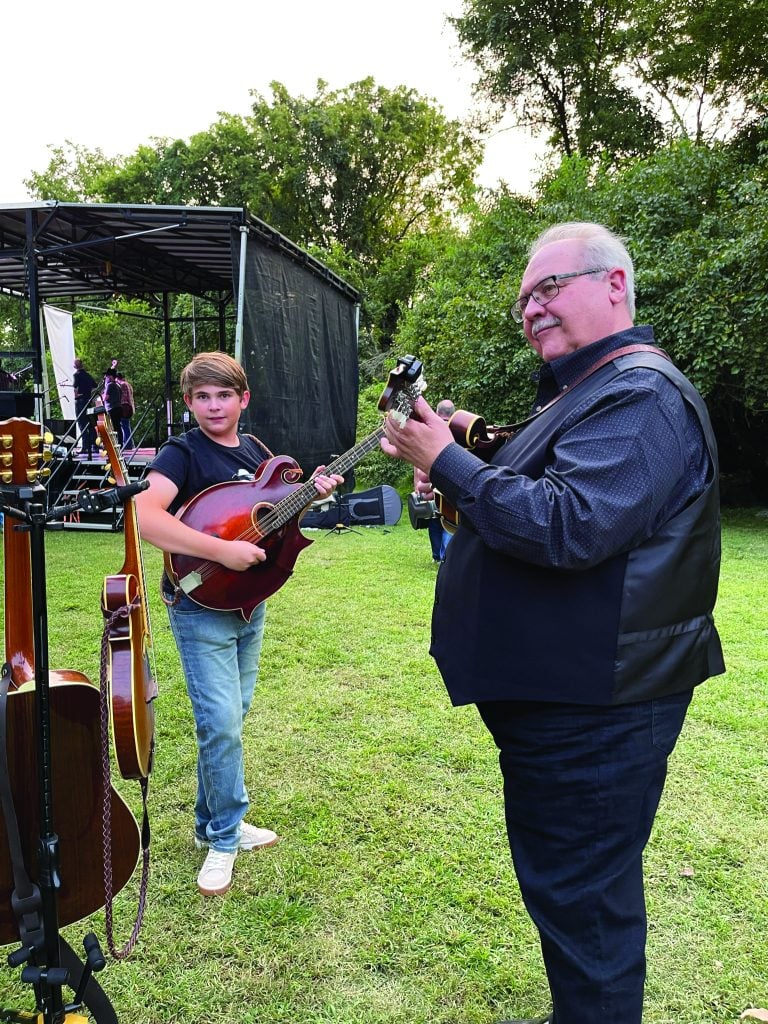
David Harvey, Gibson Original Acoustic Instruments (GOAI) department head and mandolin division master luthier, notes “Gibson is proud to have Wyatt Ellis as the youngest Gibson mandolin endorsing artist and we welcome him into the Gibson Generation Group (“G3”) Class of 2023 as our first bluegrass artist and as our first mandolinist. What impressed us—in addition to Wyatt’s talent and high motivation for personal musical excellence—has been his family’s remarkable support.”
“The Gibson Generation Group is a recognition, mentoring, and career development program for the next generation of world musicians. Wyatt— and the rest of the Gibson Generation Group Class of 2023—represents the best of our next generation of musicians.”
Since early 2020, Jake Workman (another artist familiar with musical success at an early age) has been tutoring Wyatt in mandolin and recently added guitar to the coursework. “I’ve taught many kids and adults over the years, and the better students—the ones that continue to move forward—asked questions and weren’t afraid to make mistakes. Wyatt loves the music and eats it up daily.”
Although not officially one of Wyatt’s instructors, Scott Napier frequently gets together with Wyatt to trade licks, and occasionally invites Wyatt to sit in with Zink and Company when they play at Ole Smoky’s in Gatlinburg. “Despite the short time Wyatt’s been playing, he has the ability to jump in and figure a tune out,” Scott notes. “He plays with confidence, even when he doesn’t immediately know the tune. He knows what he currently can and cannot do and—most importantly—knows that he can figure it out. This last August, at the end of the Bobby Osborne Mandolin Roundup (the one-day mandolin camp I run as a part of Bobby Osborne’s Osborne Brothers Hometown Bluegrass Festival) we traditionally have a finale. We were looking at ‘Say Old Man,’ a tune with five parts. Wyatt remarked ‘the tune’s not hard, there’s just a lot of parts to remember.’ He learned the tune in 15 minutes to play on stage that night. That’s playing with confidence. It’s like the old saying,” Scott explains: “he’s got it in him. Wyatt’s definitely got it in him.”
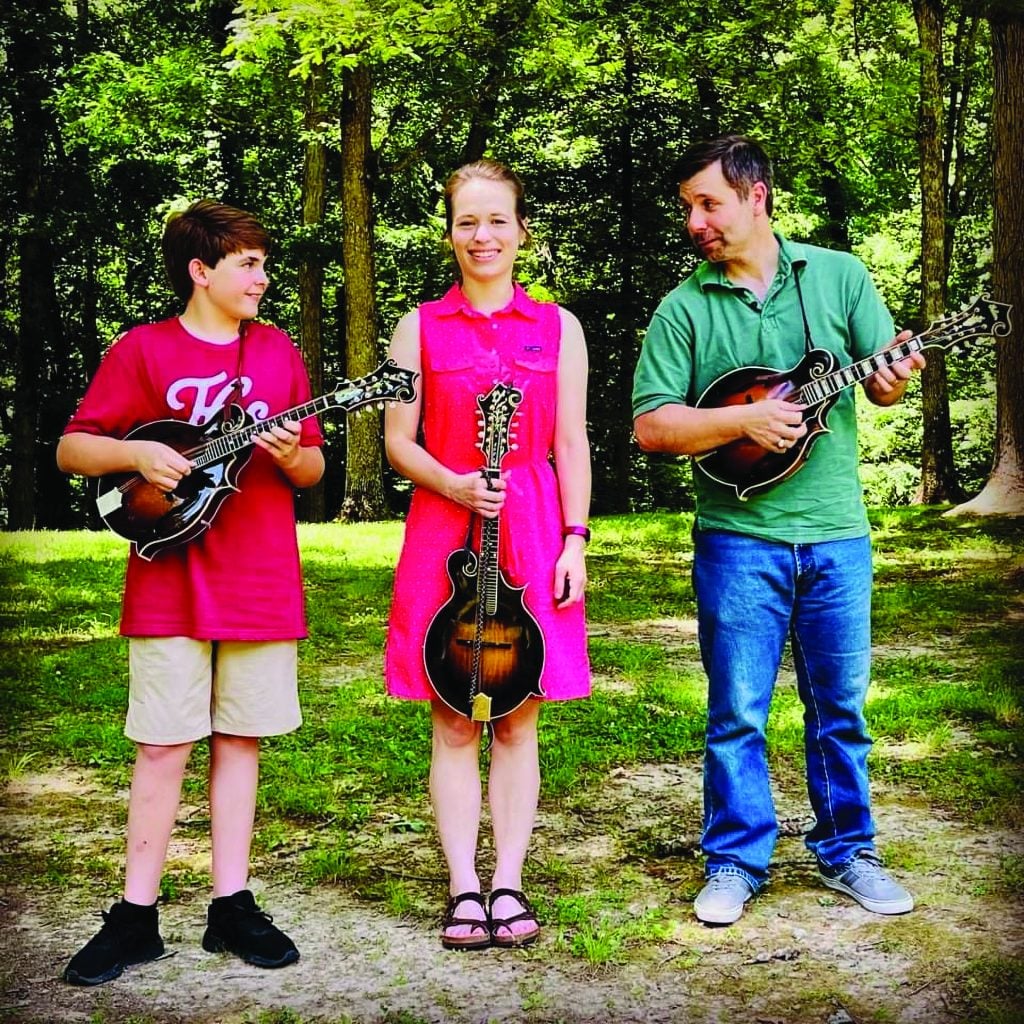
Scott continues: “Lauren [Price Napier] and I met Wyatt in a local park for a picking picnic when we first started to play together. I was playing my normal volume and Wyatt was playing well, but not as loudly. The next time we got together he had figured out what to adjust in his hand to increase volume without sacrificing tone. That may have been something he learned in one of his lessons, but he applied it and made it his own. Wyatt adapts.” Scott adds, “Wyatt has a super support system in his mom, Teresa. She sees how much Wyatt loves the music and she’s there to help and make sure everything goes as smoothly as possible.”
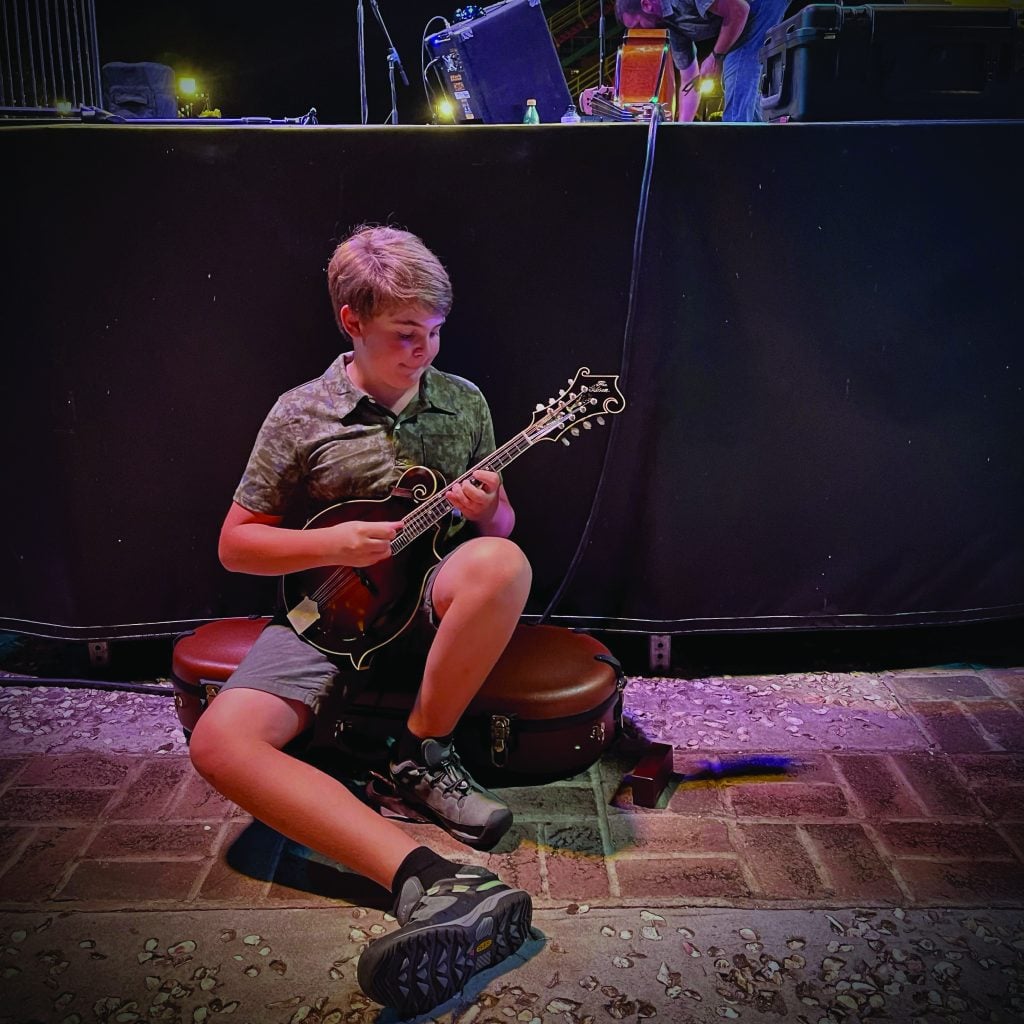
In addition to picking with Scott and Sierra, Wyatt has had the opportunity to perform on stage with a few more of his heroes as he ventured out to camps and events in 2021. He performed at the Station Inn with David Harvey and Fireball Mail. He attended Alan Bibey’s Mandolin camp and performed onstage with Bibey—one of his greatest mandolin heroes. He was also invited to play on stage with The Grascals in Cherokee, North Carolina and most recently opened the show for Hawktail with Dan Boner at ETSU.
IN CLOSING, A FEW WORDS FROM WYATT:
You’ve now had your Gibson Master Model F5L for a year. What has it taught you?
It’s definitely changed my style, but I’m not sure exactly how to put it into words. It’s really a jump in quality and in playability. Mosty, the sound of the instrument is different, more full. It has more bass and more midrange than my F5G. It has a varnish finish, where the F5G has a lacquer finish, and it has a smaller neck, which I really like. Thanks to David Harvey of Gibson for helping me to find it. And thanks to George Gruhn over in Nashville, I’ve had the opportunity to play quite a few Loars and a Fern or two. I’m still trying to sort out how to best describe them all. Every mandolin I’ve played has its own voice.
Any activities besides playing mandolin?
Well, after breaking my right wrist twice playing soccer, I got a concussion in late 2019. Then the pandemic came. Now, instead of sports, I play a lot of music and do a lot of fishing. I have realized what I truly love. I listen to a lot of different bluegrass on YouTube. My favorite bands are the Johnson Mountain Boys, The Osborne Brothers, and The Del McCoury Band. I’ve just started listening to some old country and blues. I really love David McLaughlin’s playing with the Johnson Mountain Boys and Ronnie McCoury’s playing with Del.
You’ve been writing tunes; where does that inspiration come from?
I’m not always sure. I’ve written tunes after hearing birds outside or humming a melody riding down the road. Danny Roberts helped me to realize I could write my own tunes pretty easily. The tune Shaconoge [Cherokee for “Land of Blue Smoke”] resulted from me just thinking about writing something in the style of Bill Monroe but with a kind of Native American feel, perhaps those were the ancient tones that inspired Bill Monroe.
You’ve been working intensively with Christopher Henry on note-for-note Monroe-style mandolin. How is that going?
The way Chris exposes every detail has helped me to really appreciate and respect Monroe’s style, which is a whole right-hand-and-timing thing. Working with Christopher and David [McLaughlin] moved me from learning from tab to relying more on my ear and really opened my Monroe-style vocabulary. When I played piano I would read standard notation and when I first started mandolin I played from tab. I’d go to local jams and pick out tunes and improvise a little. But when I started to learn how to rely on my ears my learning and playing exploded. It was probably one of my biggest musical jumps. I was able to learn note-for-note breaks much more quickly and with a better sense how the breaks were constructed and how the tune should feel. Paper just doesn’t tell you all of that.
When you were at the Monroe Mandolin Camp, you got the opportunity to watch Compton. Anything about that?
Yes. Mike has a great rhythmic right hand, and he has a lot of Mississippi blues influence in his playing as well. He’s an expert on how Monroe’s style changed over the years and is great in being able to detail those changes. Monroe’s 30s style had a lot of old-time feeling with shuffles, but you can hear some of Monroe s signature bluegrass licks in his earlier style. Over the past l8 months in our online lessons Mike’s been stressing the importance of rhythm, timing, and musicality, as well as listening to and learning from other musical genres.
So what’s next for you? Thinking of being in a band or taking part in any contests?
I like playing solo, but I would like to be involved in a band. It’s an entirely different experience, and I think I play better when I play with other people. You can pick alone, but even if you play with just a guitar, it s better. I think I can improvise more when I play with other instruments. I’m very excited to be working on my singing with Paul Brewster; we’ve been studying a lot of the Osborne Brothers vocal arrangements. As for contests, Winfield might be fun one day. I’m not a kid that has grown up doing contest circuits. I started playing mandolin right when everything closed down. I think my mom and I may go to Galax and possibly check out Winfield this year, I really don’t know what that life is about or if I would even like it. I recently began working with Justin Moses on my first recording project. I*ve written a lot of tunes and he*s helping me sort them out.
Over the past two years—with the assistance of the bluegrass mandolin community, social media, and technology coupled with his drive and fascination for the Monroe style of mandolin—Wyatt has emerged as a young musician to watch as a proponent for the next generation of bluegrass. He certainly seems to have it in him.