
Home > Articles > The Artists > Trey Hensley
Trey Hensley
Couldn’t Outrun The Blues If He Tried
Blues and bluegrass go together like bourbon and branch water, and Trey Hensley fully embraces that musical connection. Nearly everything he’s done since starting out confirms that the blues and its kissin’ cousins, deep country and bluegrass, provide the foundation for his rootsy, fresh-from-the-mill bluegrass vocals and major league guitar chops. Even his stellar new solo CD is titled, Can’t Outrun The Blues.
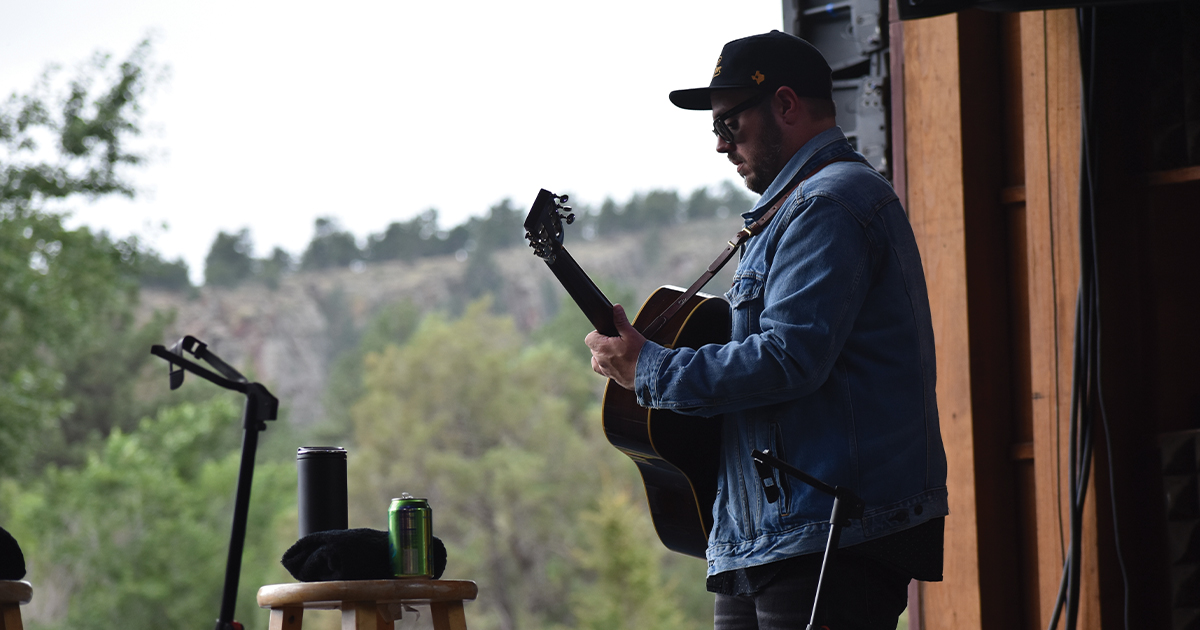
Hensley’s dark-whiskeyed, baritone voice is one living “daddy that walks the line” between hardcore country and spike-driving bluegrass, hitting it with poise and professionalism. Acclaimed as one of the top flatpickers of our time, he’s a two-time IBMA Guitarist of the Year, has won a Grammy for his work with living blues legend Taj Mahal, and created a powerfully unique duo sound in bluegrass of flatpicking guitar and Dobro when Hensley partnered with resophonic guitar master Rob Ickes, another multi-time IBMA winner. They got a completely unexpected Grammy nomination for their first CD, too.
Background
Born Sept. 27, 1990, in Johnson City, Tennessee, Trey Aaron Hensley grew up in nearby Telford, Tennessee, not far from the storied Tennessee/Virginia line. His family appreciated music, but barely played it themselves. He remembers his father, an auto mechanic by trade, owning a banjo and picking up a few tunes on it. But putting in long hours, even after work in his backyard garage, to make a living for his family didn’t leave time for his dad, Jackie, to learn much more than a couple tunes.
As his son recalls, “My dad did play a little bit of banjo when I was a kid. He’s always been a car mechanic, and that was his, you know, job for 40 years. And he had a garage out back of our house that he would also work on cars even when he got home. I don’t think he’s ever had the time to really sit down (and learn to play). And I know my dad had the Earl Scruggs instructional book. So everything was Earl Scruggs. I remember he learned “Cripple Creek” and “Home Sweet Home,” and a couple of other little tunes. I always thought he was a good banjo player, but then one day he just kind of packed it up and called it a day.”
Trey’s first music as a performer wasn’t bluegrass, but southern gospel, singing in a gospel group at just six years old. But his grandfather had a large collection of bluegrass, country, and blues records. Young Trey remembers fondly being in his grandfather’s house listening to George Jones, Hank Williams, and Waylon Jennings, “heavy country,” as he calls it. Ultimately, however, it was the Flatt & Scruggs records that caught young Hensley’s ear. But it wasn’t until several years later that he developed a serious interest in playing bluegrass after hearing Charlie Waller and Jimmy Martin—two of bluegrass guitar’s true legends—perform at a local festival.
“I grew up in a very musical home, and my parents were always very supportive. On weekends, we went to several festivals, that’s where I saw Jimmy Martin and Charlie Waller, and knew right then I wanted to play guitar,” he explains. “That changed it all for me.”
Marty Stuart—Johnny Cash—Tom T. Hall—Earl Scruggs
Trey proved to be a most adept student. Just a few months after Hensley learned the rudiments of guitar, around age 11, he went backstage at one of Marty Stuart’s concerts to play him a few tunes. Impressed, Stuart helped Hensley get the enviable invite to perform “Jimmy Brown the Newsboy” onstage at the Grand Ole Opry with Stuart and Earl Scruggs himself. Growing quickly as a player and a person, Trey was soon gigging with, or opening for, greats like Ricky Skaggs, Blue Highway, J.D. Crowe, and many others.

Given his obvious talents on guitar and vocals, it wasn’t long before one heavy country hero introduced Trey to a legendary Nashville songwriter and suggested he might want to record the prodigy. “It’s kind of a long, long story, but I met Tom T. (Hall) through Johnny Cash,” he relates. “I played at June Carter’s birthday. I met (Johnny and June Cash) through the Carter Family Fold. I grew up in East Tennessee, so we’re 20 minutes away from Bristol and all that. And you know, the Carter Fold is still going up there in Hiltons, Virginia. At the time, Johnny and June were coming in pretty often, so I got to know them pretty well. One time, Johnny kind of cornered Tom T. and said, ‘Uh, you need to let this kid come in (to Tom’s studio) and record an album.’ So we did. I mean, it literally was a few weeks later, I was in the studio with Tom T. And in true bluegrass fashion, we did that whole record in a day. I think it was 14 songs on it. Wow. And we mixed it that night, and we’re ready to go the next day.”
As a bedrock mentor and friend, Marty Stuart, who famously left home to join Lester Flatt’s band at just 14, also exerted profound influence on young Hensley’s early development. “That very first time, the very night that I met (Stuart) at the Appalachian Fair, I played these Carter Family tunes for him. And he took me aside. I remember that night clear as day. He took me aside, and he just told me, ‘Always follow your heart at what you do.’ The music business can be harsh. And you know, I was 10, I’d been playing for five months. And I had no plans other than getting to meet Marty that night,” Hensley recalls of his first encounter.
“I can’t say enough about Marty, obviously, because that changed everything. It changed my life. All of the opportunities that I had were directly in line with that. He saw something in me, and you know, he really helped me out a lot and continues to do so. I’ve remained close to Marty my whole life,” Hensley says.
“He’s always there if I need him for anything,” Hensley continues. “I grew up in the ‘90s watching CMT and all that stuff. And Marty, I loved him, being a Lester Flatt & Earl Scruggs fan. I remember a video that he had out in the ‘90s where he was playing Lester’s guitar, and I was an instant Marty Stuart fan when I saw him with that guitar.”
The Young Performer
Buoyed by his obvious talent and endless thirst for anything guitar-oriented, word spread quickly through the east Tennessee hills and beyond about young Trey Hensley. “I started getting pretty busy around that time. And so I would go to school during the week, and play shows every weekend. There wasn’t a real plan. Like I said, my dad is a car mechanic and he took over a role as manager. And he and my mom, they’ve always been super supportive. They did the best they could to make that happen. I know they both sacrificed a lot of time because we would just go every weekend. It was always something going on with me, with my music, and then Monday morning, I would go back to school all week. My senior year of high school, I basically co-op’ed out of school and just toured a bunch. It was a very atypical childhood.”
Was it a natural progression for Trey at that point that he knew he wanted to be a touring professional musician? “It was. I think I got bit by the performing bug, not that I liked getting out in front of people necessarily. It was more or less just getting to pick with people that I really enjoyed playing with. I think that’s always been the biggest thing for me is I love playing guitar,” says Hensley, who has a guitar in every room of his house ready at a moment’s notice. “There’s something about playing live. It’s got this energy that you can’t get anywhere else. And I think I’ve always just liked that. And there are days where it’s like maybe you don’t feel like doing certain things. But I’ve always just felt like playing my guitar, and I think that’s at the core of everything I do. That’s it. It’s like I still really enjoy playing the guitar twenty-five years later. So there’s never been a moment where I didn’t want to do this.”

What were his first memories of guitar? “It is funny because I do remember a home video that my parents have of me, and I’m probably two or three, carrying a cardboard box around, strumming it like a guitar. And they laughed, because it looks like my left hand is fretting. But honestly, where my dad was a banjo player, I was around (playing a fretted instrument). So it’s not far-fetched to think that I had seen him playing. And to be perfectly honest, I did want to play banjo. I wanted to play banjo first, and I liked singing, and then my dad said, ‘Well, you might want to take up guitar and learn some chords. So that was the beginnings of talking about if I might want to learn an instrument. When I went to the bluegrass festival and saw Jimmy Martin and Charlie Waller, two great guitar players, I didn’t know you could actually make a guitar solo happen, and that was it for me,” he explains. “I will have to credit that as my kind of lightning bolt moment.”
Ask Trey who his favorite guitarists and country or bluegrass recording artists growing up were, and not all of it was bluegrass. “Some of my favorites growing up? Well, obviously, I liked Flatt & Scruggs. I remember that even before I was playing. The very first thing I ever went and paid for with my own money was Flatt & Scruggs: Live At Carnegie Hall. They were huge in my world.”
“Somebody I just listened to a lot was Lefty Frizzell, like that was a big person. I remember just sitting and listening to Lefty Frizzell a bunch, and Waylon Jennings. I remember I got in trouble one time for, uh, for breaking a Waylon Jennings 45 rpm of ‘Luckenbach, Texas.’ I just ran the needle through it, you know. Those were some of my first memories of before I was playing, you know, just loving that music,” he adds.
And like most guitarists in the early 2000s, he was drawn simultaneously to the hyper-speed, finger-tapping electric guitarists of the day, including Eddie Van Halen and Randy Rhoads with Ozzy Osbourne. “Oh yeah, I could play (Van Halen’s revolutionary guitar piece) ‘Eruption,’ and Randy Rhoads’ solo to ‘Crazy Train’ and all that kind of stuff like Slayer and Iron Maiden. But I’ve always loved bluegrass more than really any other genre.”
As his interest grew and he started maturing, Trey spent time expanding his musical world at his local CD store, Cat’s Music. There, one big-hearted employee turned him on to recordings by Robert Plant and Alison Krauss.
“There was a guy there that was super cool, and I specifically remember because it was when Robert Plant and Alison Krauss’s first record (Raising Sand) was coming out. He said, ‘Well, I’m sure you’re gonna want to pre-order this Robert and Alison record.’ And I remember, oh, I love Alison, but I’ve never heard of Robert Plant. He stopped everything he was doing, and he picked out a copy of Led Zeppelin, the rock band’s debut album, and he opened it, and he gave it to me and said, ‘Here, you have to take this and listen to it,” Hensley relates. “So I remember that was a big moment.”
“And it’s funny because some of the stuff like Iron Maiden and all that I got into didn’t feel that different than bluegrass,” he explains thoughtfully. “There’s this sort of intensity that it had, and the guitar playing was so similar to me. It still kind of is. Like it might be played with different intention, but boy, it feels like bluegrass playing, and it just fit like there’s a common thread.”
Trey Hensley and Rob Ickes
As he developed as a musician and a touring professional, circumstances led him to one of the pivotal partnerships in his career as Rob Ickes & Trey Hensley. Trey first met the standout resophonic guitar master when Ickes was playing with Earl Scruggs at the Tennessee Theater around 2003, and they asked Trey to sit in. One thing led to another, and soon Rob and Trey were discussing other options to play together.
“We had talked about doing some duo shows, and I loved working with Rob. It felt like the feeling was very mutual. But Rob’s always had a lot going on. He’s always played a lot in the studio, and at the time he was still touring with Blue Highway,” Hensley explains. “He had just said it’d be fun to do something a little different, and you know, we honestly went into that record with no expectations.”
“That record” turned out to be the duo’s heralded debut CD, Before The Sun Goes Down, which went on to garner an entirely unexpected Grammy nomination that year. “It was literally three days in the studio of us just throwing songs around, and we all sat in the same room, everything’s live. Then, yeah, it was a total shock for that to be nominated for a Grammy. It wasn’t even on my radar. And it was funny because my daughter was a newborn. I mean, she was a week old, I think, at the time,” Hensley remembers.

“And I was changing her diaper, and I had my phone in the other room, and it just sounded like everybody I’d ever known was calling me at the same time. It was like just over and over and over and over again, and I was so frustrated thinking, ‘What do you people want?’ And it was everybody congratulating me on being nominated for a Grammy. That just totally blew my mind,” he says. “And yeah, (Rob and I) were talking, and it was, ‘ Why don’t we try to go forward with this?”
Ickes encouraged Hensley to move to Nashville, helping him get settled in with the local picking scene and introducing him to more big-name stars like Vince Gill. Their debut CD impressed Gill so much that he told Ickes he kept it in his car’s CD player for weeks, adding, “I never do that.”
Resettling from rural East Tennessee to Music City proved to be a big change for the younger guitarist. “It’s not very far, but it is a big jump if you grew up in a small town to move to a big city,” he says. But it also galvanized the two creative innovators to start a more formal relationship.
Moving to Nashville “solidified us starting this duo thing. We started touring that year, I guess 2015, and we hit it hard that year. I think we worked 130-some shows. We did Europe four times that year, we played in Australia,” Hensley says, still marveling at how quickly success came to the new project. “That was a crazy, crazy year. And we immediately started working on the next record. It really did solidify what we were doing.”
But Trey still felt he had options as a solo performer he wanted to explore, and after two more CDs, the Ickes collaboration became a secondary thing. They do still perform, though, when circumstances allow. But it was the vision of having full creative control that drove Hensley to step out on his own.
“I think the biggest thing for me is that I’d been talking about doing a solo record for years. And we’ve been so busy, which is a good thing. But we have been so busy that there was never any time for me to do it. And I was thinking, if I don’t ever do it, I’m gonna kick myself if I put this solo record off for several years.” Hensley says.
The New Solo Project
That level of control also allowed him to find his own voice and style of bluegrass for this project. One inspiration was Tony Rice, not just as the superlative flatpicker he was, but in how experimental Rice could be. One example is Rice’s version of “My Favorite Things” that jazz saxophone legend John Coltrane had turned into a powerful platform for extended solos.
“I went to the record store and tried to find John Coltrane, and it blew my mind that Tony was listening to that. Because there’s no guitar playing on it. I hated some of that stuff because it’s, ‘Where’s the guitar player?’ But once it hit, I saw how amazing it is, but it took me a long time. With blues stuff, it was kind of instant, he says, adding that he devoured blues music from sources as far-ranging as Eric Clapton and Robert Johnson.
“I remember probably being 16 or 17, and I drove around and had a Robert Johnson CD in my truck for a month, and every day I was just blown away by this. Then I remember going and getting Muddy Waters. And it almost hit me as hard as bluegrass did when I first heard it,” he tells Bluegrass Unlimited. “And there’s so many connections between the two. If you’ve heard bluegrass, you know we don’t get there without blues. Josh Graves and Earl Scruggs and all these people that were listening to Bill Monroe were all listening to blues players. You can’t not hear that influence.”
All these influences came together on his new record, Can’t Outrun The Blues. It also provided a platform for his expanding skills as a songwriter.“That’s been a new development for me, really. I haven’t written a ton, but the last several records that we did, I wrote a lot of songs on them. For (Can’t Outrun The Blues), I had all these songs stockpiled, and I just felt like I wanted to take them in my own direction and do my own thing with them,” Trey adds.
So how does the multifaceted performer see himself today? “I do consider myself a guitar player, and then maybe a singer, and then maybe a songwriter, just from the sheer fact that I love working on guitar. I practice every day, and that’s what I spend all my time doing.”
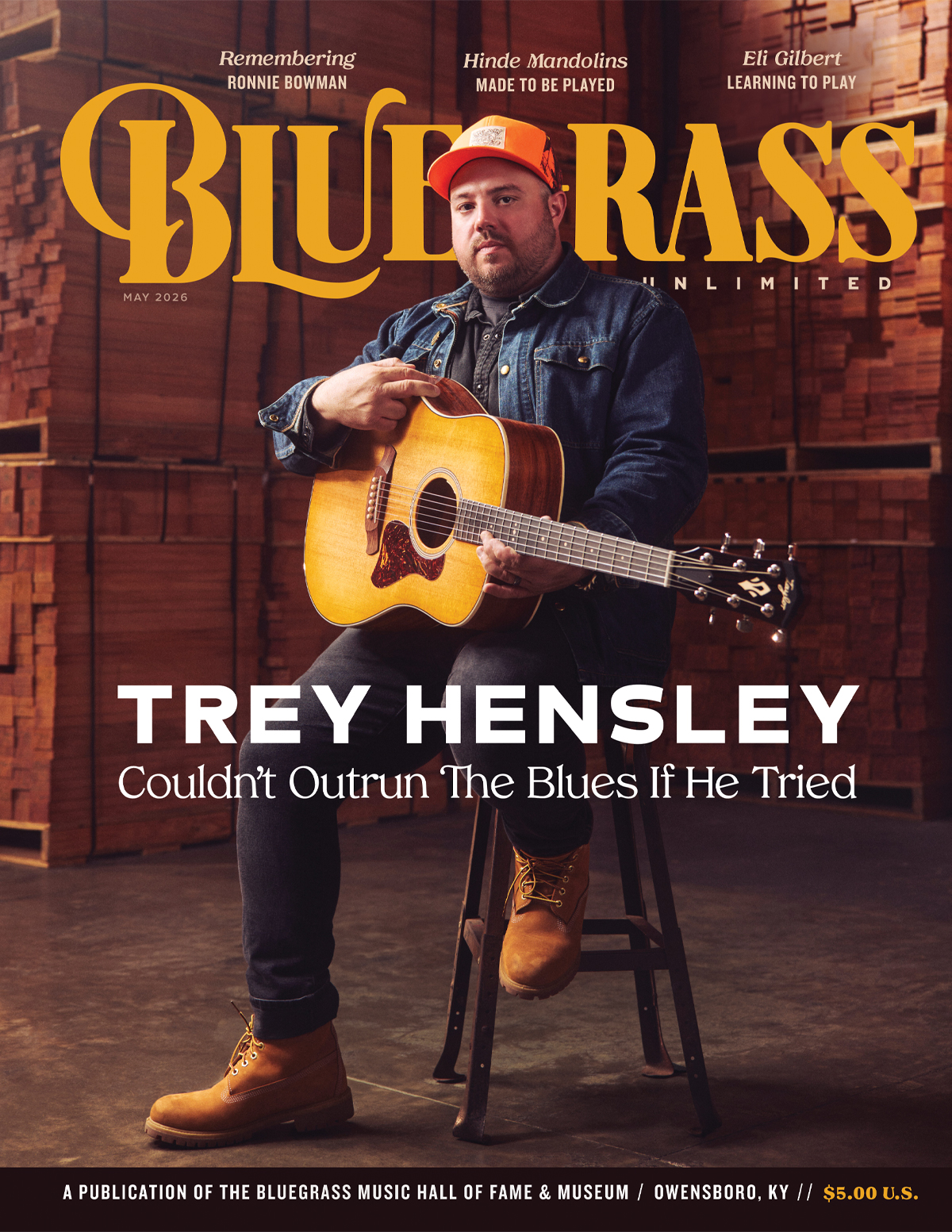
His guitar focus has led to his collaboration with one of the world’s most prominent acoustic guitar companies to develop and launch a signature guitar that meets his needs on-stage. Taylor Guitars designed the Trey Hensley Gold Label 510e model with Hensley to showcase Hensley’s defining tone through a deeper Dreadnought body, premium tonewoods, Taylor’s widely respected modern “V-Class” bracing, and his preferred Nickel Bronze strings. It’s the first flatpicking artist signature model for the company since its much-loved Dan Crary model.
So, what does Trey Hensley do for fun, anything like fishing or NASCAR? The question makes him laugh out loud. “Play guitar,” he replies. “I have a guitar out in every room. I just love playing guitar.”
