Snuffy Jenkins—A Legend in his Own Time
Reprinted from Bluegrass Unlimited Magazine
June 1987, Volume 21, Number 12
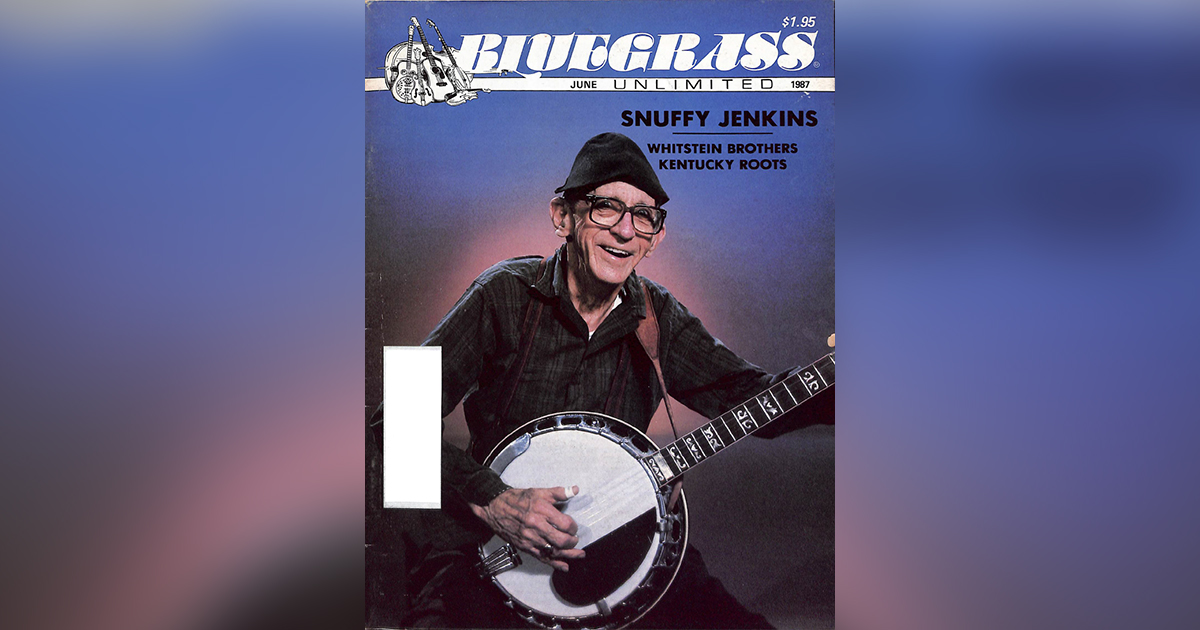
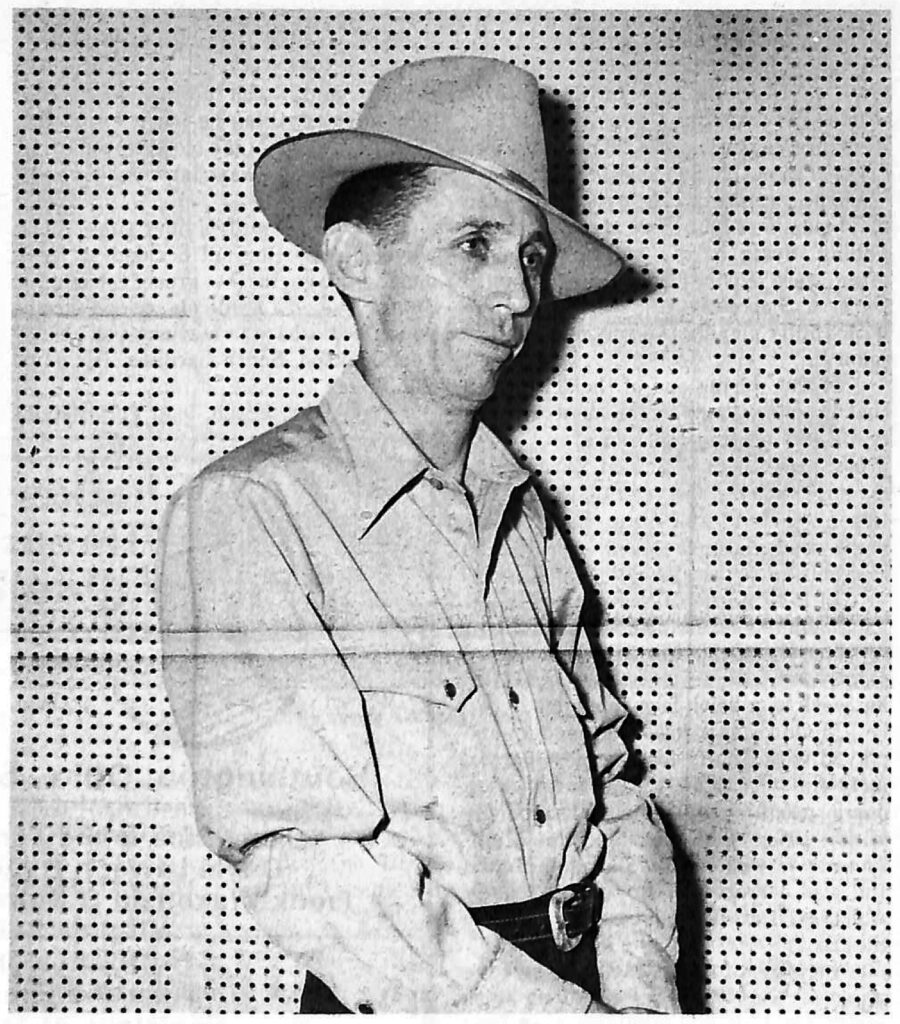
In the art of bluegrass and old-time country music, Snuffy Jenkins is most certainly a legend in his own time, and now at the age of seventy-eight continues to perform for audiences all over the United States.
While preparing to write this article, the late and great Don Reno came to mind. I did an interview with Reno in 1982 and he talked quite a lot about Snuffy. “He’s one of the finest gentleman I ever knew, and he really taught me how to play a banjo,” said Reno.
Dewitt “Snuffy” Jenkins was born October 27, 1908 in the rural community of Harris, North Carolina. His first experience before an audience was to clog dance for a sawmill company show at the age of five.
The first instrument Snuffy played was a fiddle. “I was too small to handle the bow, so I picked it like a mandolin,” says Snuffy. Soon after he learned to play guitar and along with his brother Verl, also a guitarist, the two began playing locally for social functions. There were little, if any, monetary rewards but Snuffy was gaining experience that would prove beneficial in years to come.
While only boys, Snuffy and Verl built two homemade banjos; one was from a wagon hub, and the other from a brake drum off an automobile. “We took an old brake drum to a machine shop and had it ground out, it made a pretty good homemade banjo, and I knew then I would have to have a real banjo,” recalls Snuffy.
In 1927, Snuffy purchased his first store-bought banjo an old Sears and Roebuck model. At this time Snuffy joined Rex Brooks and Smith Hammet, playing all over the Carolinas. Both Brooks and Hammet played five-string banjo using a three-finger style and taught it to young Snuffy.
Later, Snuffy organized the Jenkins String Band and in 1934 they were featured artists on the Crazy Water Barn Dance, a live program originating from the studios of WBT, a CBS affiliate, in Charlotte, North Carolina. This was the first time anyone had employed the full use of three-finger style banjo picking on the air.
J.E. Mainer also had a program on joined Parker’s Hillbillies. Shortly thereafter, Snuffy and Pappy formed a partnership that’s still in effect today.
Parker referred to himself on radio and stage as the Old Hired Hand. Byron Parker passed away in 1948 and Snuffy took over the band, changing the name to the Hired Hands in memory of Parker.
When Snuffy took over the band they were playing two radio programs every day and traveling a two-hundred-and-fifty-mile radius over both Carolinas and Georgia six days a week.
Things were a lot better than the war days Snuffy recalls. “Back then we had the show dates but couldn’t get the gas to travel. The government was rationing gasoline and we barely got enough to get to the radio station. Farmers, however, could purchase gas without coupons. Our largest audience was farmers; and we could always go up to a farmer’s house late at night and once they knew who we were, they would always provide gas for us to return to Columbia.”
Both the Hillbillies and the Hired Hands played primarily for school houses, during what today is referred to as the “Kerosene Circuit.” There was no electricity and they would pump two kerosene lamps and set one on each side of the stage. “When electricity had reached some of the remote areas, we started carrying a PA system and would set the microphones up on stage even if they didn’t have electricity, —it made things look good,” laughs Snuffy.
Since purchasing his first banjo sixty years ago, Snuffy has only used two other banjos. Shortly after, moving to Columbia in 1937, Snuffy met Fisher Hendley who headed up a band called the Aristocratic Pigs. Hendley had purchased a new banjo and sold Snuffy his gold-plated Mastertone Gibson.
Shortly thereafter, Snuffy’s brother spotted a Gibson Mastertone at a pawn shop in Spartanburg, South Carolina. After informing his brother about the banjo, Snuffy said, “I already have a good banjo.”
At the time, the banjo was worth $75 and the man at the pawn shop was asking only $40. So, Snuffy purchased his second Mastertone Gibson banjo. “I got back home and found that banjo sounded better than the one I bought from Fisher.”
Snuffy started using that banjo, and continues to perform with it today. He sold his other banjo in 1940 to Don Reno for $90.
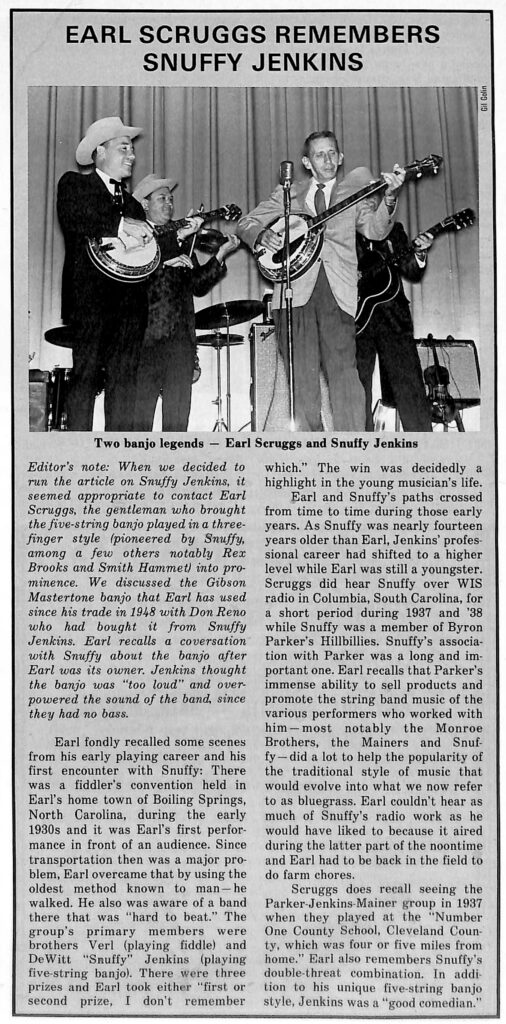
In 1948, Reno traded the banjo to Earl Scruggs for a 1934 model Mastertone. Both banjos went on to claim fame in the annals of bluegrass music. Scruggs took the banjo Snuffy had sold and used it all through the Flatt and Scruggs era. It is the legendary Granada —serial no-9584-3 that Earl Scruggs uses to this day.
“I received a phone call from Hank Williams Jr. sometime back wanting to buy my banjo. It’s worth a lot of money but, I didn’t really want to sell it so I made the price so high he turned it down,” says Snuffy.
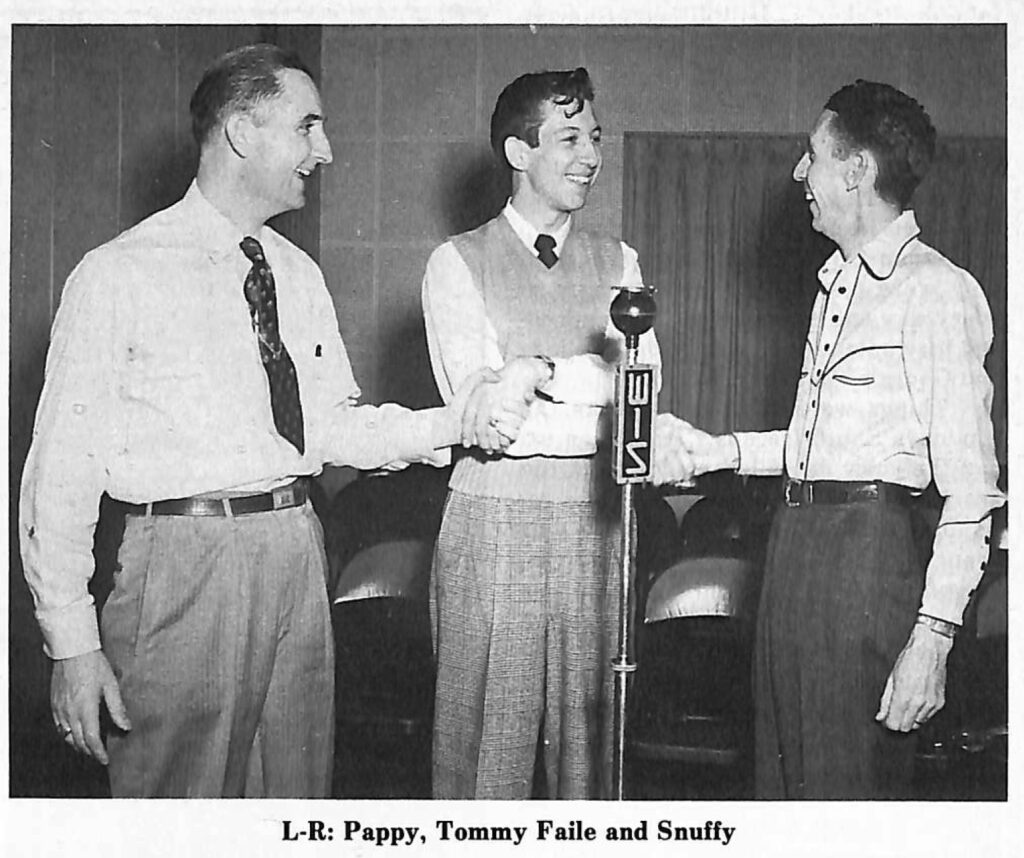
Tommy Faile was only a youngster when he was working for the Hired Hands in 1949. They entered Tommy in talent contest with more than seventy contestants, held in Charlotte, North Carolina and sponsored by Capitol Records. Tex Ritter was master of ceremonies.
After long hours of competition, the judges called it a tie between Tommy and a young singer from Martinsville, Virginia, named Jim Eanes.
Both Tommy and Jim received a cash award and the opportunity to record two songs each on Capitol Records. On February 26, 1949, the Hired Hands and Tommy Faile recorded six numbers for Capitol Records at the Armory Auditorium in Charlotte, North Carolina.
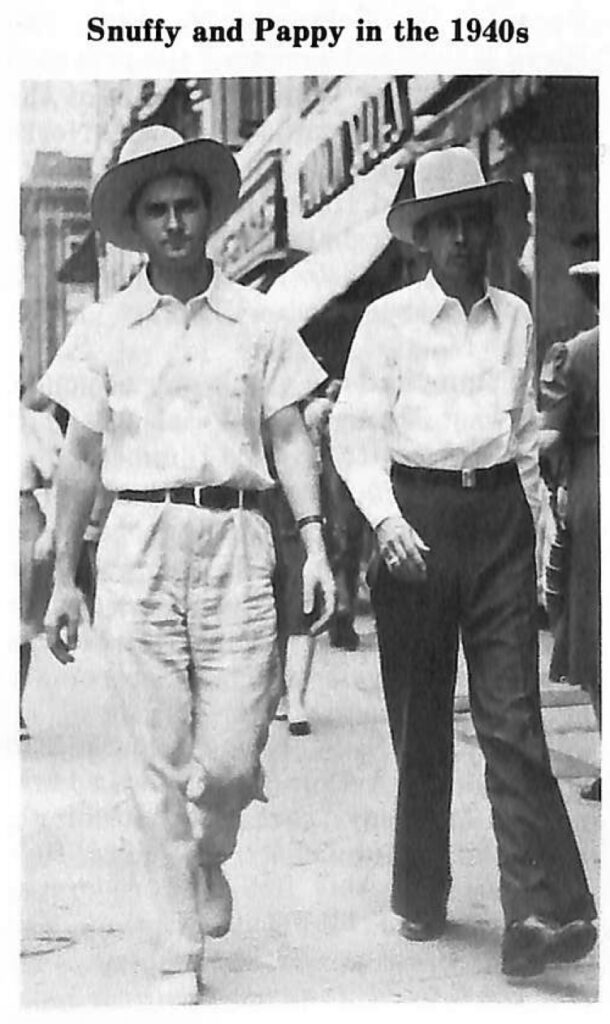
The Hired Hands at this time consisted of Snuffy on banjo; Pappy Sherrill, fiddle; Marion Kyzer, steel guitar; Ira Dimmery, bass; and Tommy Faile, guitar.
Tommy did the vocals on two songs, One was “There’s A Petal Missing” which was written by Ira Dimmery.
The Hired Hands then backed up Tex Ritter on two recordings, one being his famous “‘Cept’n Old Shorty.” The group also played for Jim Eanes on this Capitol recording session. Jim did his “Baby Blue Eyes” which has become a standard in bluegrass.
Tommy Faile later became lead singer for the Arthur Smith Show and remained for many years before forming a band and having his own TV show. He’s best remembered for first recording “The Brown Mountain Light” and writing “Phantom 309,” a number one hit for the late Red Sovine.
Comedy was always an integral part of both the Hillbillies’ and the Hired Hands’ stage shows. Along with the music, the show would include wholesome jokes and a live dramatic performance featuring the band members dressed in outlandish costumes.
The scripts were written by the band members but, there was a lot of ad- libbing. Some of the plays used most often were Hookeyville School, Snuffy Cures a Snakebite and Dead Or Alive with Snuffy playing the part of an undertaker.
It was during one of these routines that Dewitt was given the name of Snuffy. “I was playing the role of a woman; dress, pocketbook, and all. I kept wiping my nose with the sleeve of that dress and Byron started calling me Snuffy. The name stuck and today even my wife calls me Snuffy,” he recalls.
In 1941, Julian “Greasy” Medlin left vaudeville and the medicine-show circuit to join the Hillbillies. Greasy played guitar and bass but was most noted for his work as a black-face comedian.
Medlin was a master comedian and played with Snuffy for the most part of forty-one years. In 1981, there was a movie produced by the Smithsonian Institute titled “The Last Medicine Man.” The movie was centered around Medlin and was narrated by Roy Acuff. Snuffy and the Hired Hands also had a part in the film.
In May of 1982, Medlin played a week at the World’s Fair along with Snuffy and Pappy Sherrill. Then, on June 12, 1982, Medlin made his last stage performance at the Jones Brothers Bluegrass Festival. He was admitted to the hospital three days later, and passed away July 15,1982.
Today when Snuffy performs one of his comedy routines along with Pappy it’s funnier than ever.
WIS was the first television station in South Carolina, and Snuffy and his Hired Hands were featured live on the first day of broadcast—November 7, 1953.
“This was the largest audience I had ever played for but when I looked up all I saw was a huge camera,” says Snuffy. Snuffy quickly adjusted to this new media of entertainment.
The Hired Hands were featured on an early morning program titled Carolina In The Morning. Later they had a prime-time program on Wednesday night, and then a Sunday morning gospel program.
“I’ve never called my music anything other than country. We were playing bluegrass years before it received the name. On TV, I had an electric bass long before the Grand Ole Opry did, and featured Grady Lindler on a four-neck pedal-steel that was the envy of any Opry Star at the time,” states Snuffy.
Still Snuffy is quick to say that the country music you hear today is not related to anything he has ever played. “You hear some of the old stuff today but it’s not like we have always done it,” Snuffy emphasized.
In 1958, Snuffy’s long-time fiddle player Pappy Sherrill decided to leave music and go in the grocery business. Snuffy needed a fiddle player and hired a young boy who was stationed at nearby Fort Jackson, South Carolina. His name was Roger Miller.
Lacy Richardson, lead guitarist for the Hired Hands at the time, recalls his association with Miller. “Roger didn’t have a car so I would give him a ride to the TV station. All the time he would be doing these funny sounds that he later made famous on his million-selling record ‘Dang Me’.”
After a few months Miller was transferred and Pappy gave up the store business and returned to the Hired Hands. With the exception of only a few months, Snuffy and Pappy have been together for nearly fifty years.
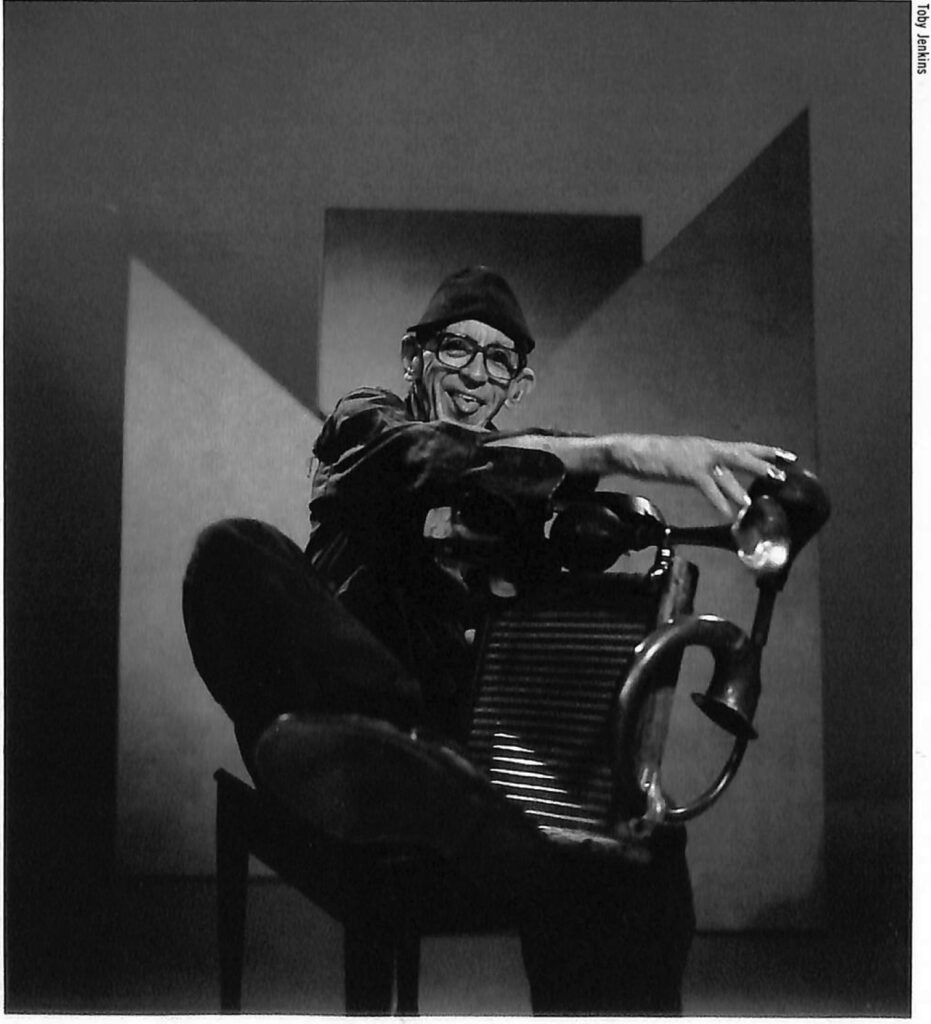
Anytime you attend one of Snuffy’s stage shows today you will hear him perform “Alabama Jubilee” on what Pappy refers to as Snuffy’s “confounded contraption.”
Snuffy made the instrument from an old washboard about forty years ago. “I built a little stand on the bottom of the washboard, then added a bicycle horn, frying pan and a cow bell.”
For the past forty years Snuffy has featured the washboard on a segment of most all of his shows. “There were not many people who played the washboard years ago, and today I’m one of a few who continues to play the washboard on a professional basis,” states Snuffy. Recently Snuffy and Pappy played Carnegie Hall, where Snuffy received a standing ovation for his unique skill on the washboard.
Today Snuffy seldom plays guitar on stage but, during his days on WIS television, sometimes he would put down his banjo and do some fine flattop picking.
In 1962, Snuffy and the Hired Hands recorded their first long-play album for Folk-Lyric Records. The band at this time was comprised of Snuffy, banjo and guitar; Homer “Pappy” Sherrill, fiddle; Julian “Greasy” Medlin, guitar; Ira Dim- mery, bass and Bill Rea, guitar.
Although the Hired Hands’ personnel changed from time to time, this album represents the true sound of the Hired Hands at its very best. Snuffy even included his “Talking Blues,” one of the numbers he sometimes did on guitar.
On August 14, 1966, before 10,000 fans of the Country Music Association of South Carolina, Snuffy, Pappy and Greasy were presented an honorary lifetime membership and a plaque stating the three represented over a century of continual country music performing.
For over forty years Snuffy has donated his talents freely to those in need. When not on the road performing, Dewitt became a regular fixture at hospitals and nursing homes in the Columbia area. Now at seventy-eight, Snuffy continues to entertain the elderly in nearby nursing homes whenever possible.
At the First Annual Thanksgiving Weekend Bluegrass Festival held at Myrtle Beach, South Carolina, in 1970, Snuffy and Pappy were presented a special award and plaque for their years of service to old-time country and bluegrass music in South Carolina.
Snuffy did not have a band at the time and he and Pappy were backed by Snuffy’s protege and old friend Don Reno with Red Smiley and the Tennessee Cutups on their portion of the four-day festival.
Midway through the Saturday afternoon program at the festival Charlie Moore made mention of Snuffy and Pappy’s contribution to his music, and read a lengthy letter from WIS praising them for being an asset to the success of WIS radio and television.
Then Don Reno, with tears in his eyes and thru a trembling voice said, “This is the greatest honor I’ve ever had in my music career for Red and our band to back Snuffy and Pappy on stage and to present them with this beautiful plaque.”
The First Annual Snuffy Jenkins Bluegrass Festival began in 1975, at Cliffside, North Carolina. The town is located near Snuffy’s hometown of Harris and the festival named in honor of this legendary entertainer. Today the festival has grown to be one of the Carolinas’ finest.
Snuffy has taken his music far from its humble beginning to the most cultural of today’s society. He and Pappy have played the Smithsonian Institute six times, the World’s Fair, Carnegie Hall, the New York Ballet and some of the largest art centers in the United States.
Recently RCA has released some of Snuffy’s vintage Bluebird recordings on two different long-play albums. Snuffy and Pappy, along with the Hired Hands, recorded for Rounder Records in its infancy. “We recorded the fifth album released by Rounder,” says Snuffy. A short time later the group was back in the studio recording a second album for the company.
In 1985, with so many bluegrass musicians and fans alike searching for the roots of bluegrass music, Old Homestead Records did some research and came up with an album containing sixteen cuts from old 78 rpm recordings of Snuffy and Pappy. The album truly represents its title, “Bluegrass Roots.”
“Many folks have given me credit for starting the three-finger style of banjo playing. I didn’t start it and today I’m sure no one else knows its origin, but I was the very first to take it on the air,” says Snuffy.
Both Earl Scruggs and Don Reno, have given Snuffy credit for his influence on their music. “I don’t claim to have taught either, but the two were around me a lot and I was always willing to help them,” Snuffy recalls.
Today, when fans visit Snuffy at his home in Columbia they will be lucky to find him there due to his rigid schedule of showdates. Still, if he’s home, all will be greeted with Snuffy’s famous, “You folks come on in and visit awhile.”