Notes & Queries – September 2021
Notes
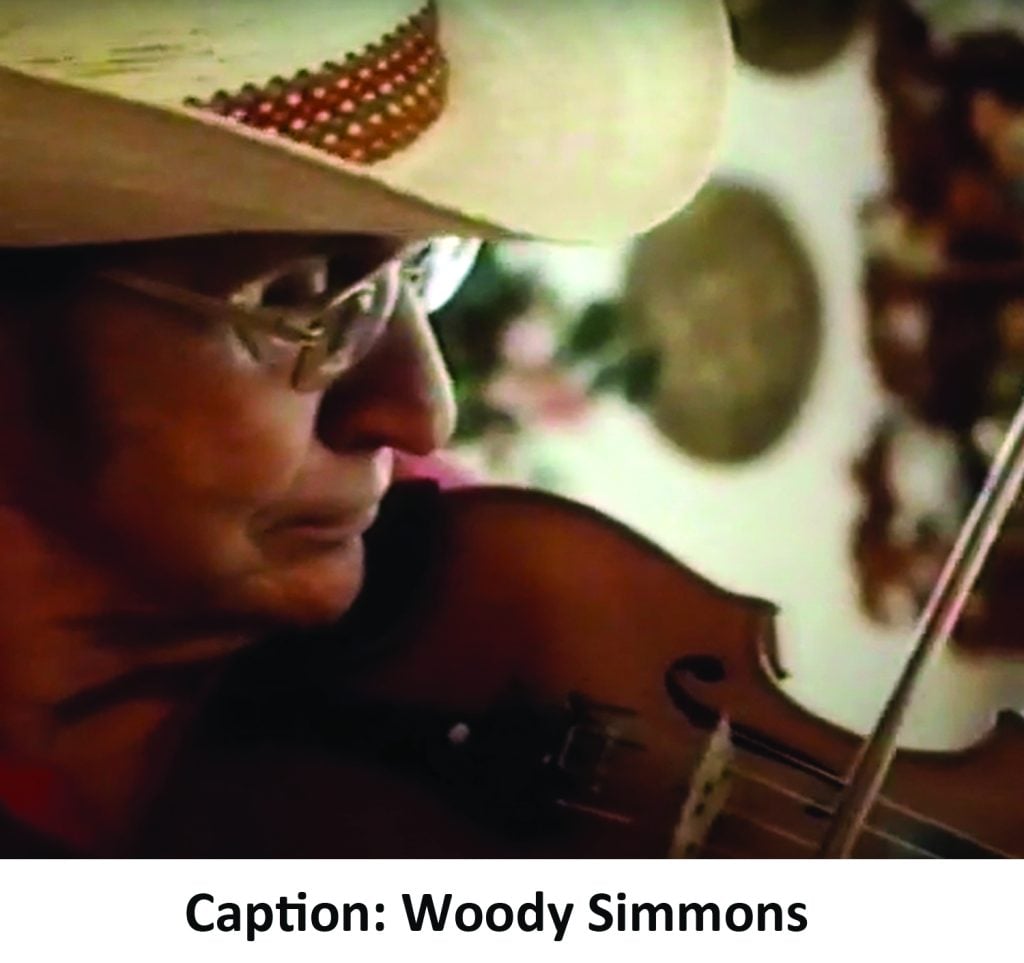
In response to the July “Notes & Queries” piece on West Virginia fiddler Woody Simmons, we received the following note from UK-subscriber Frank Weston: “I have just received your July issue where Gary Reid replies to a question on Woody Simmons. He might like to know that just two weeks ago a short clip of Woody receiving and playing with two visitors (one from the UK) was put up on YouTube. It is from a BBC UK TV programme made in the 1980s.” YouTube surfers can find the clip by typing in the following search: “Woody Simmons – Soldier’s Joy”. Frank further mentioned, “That YouTube channel has a number of audio and video clips of traditional musicians.”
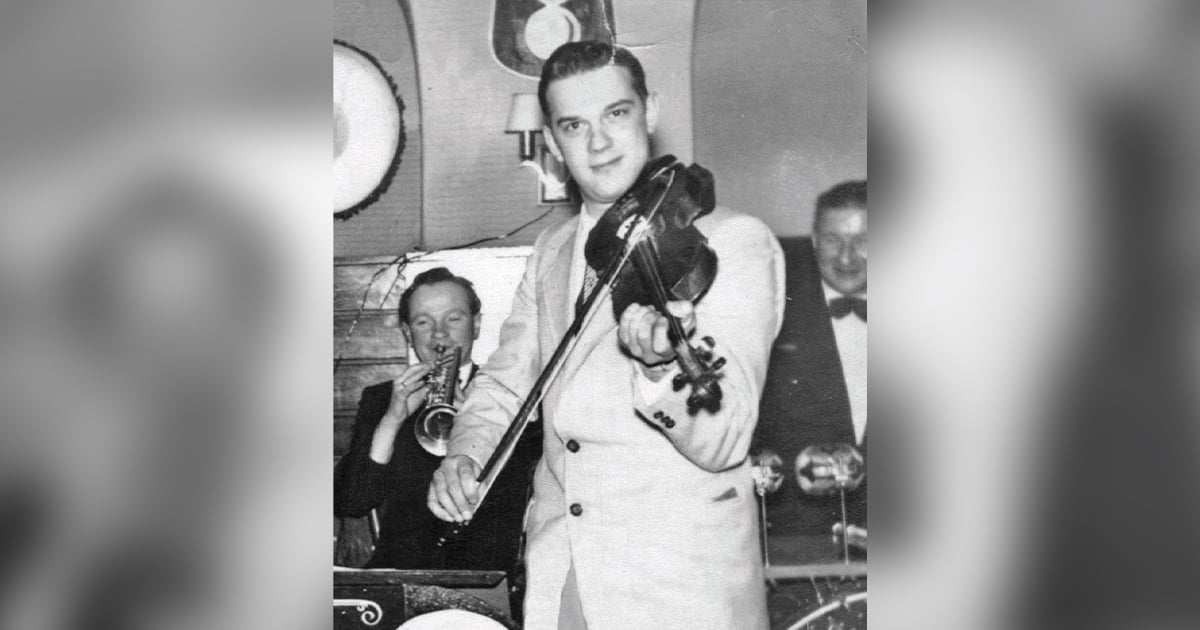
As a follow-up to the query in the May 2021 “Notes & Queries” concerning fiddle player Jimmie Grier, we had some new information come to light. A reader/picker from Rye Cove, Virginia, by the name of Michael Dingus reached out with details of Jimmie’s later work and this led us to one of his siblings, Sue Pooley, who verified previously printed details.
First, it turns out that our mystery fiddler’s name was actually James Leon Greear (as opposed to Greer or Grier); most people who knew him called him Leon. He came from a family in which both his parents were musically inclined. His mother, Cecile, played piano while his father, James Edison Greear, was a fiddler who participated in the 1927 Bristol sessions. He recorded with a group billed as the Baker Family (Mr. and Mrs. J. W. Baker); only two songs were recorded and released: “The Newmarket Wreck” and “On the Banks of the Sunny Tennessee.” Perhaps the elder Greear did more than “beat me with a fiddle stick” as Jimmie once quipped.
Jimmie was born one year after the Bristol sessions, on March 2, 1928, in Kingsport, Tennessee. At the close of World War II, Jimmie was eighteen years old and unemployed. He enlisted in the Army for what turned out to be a ten-year hitch. He landed, for part of the time, in the Panama Canal Zone, where his first child was born. Jimmie put his musical talents to use while in the military by performing at USO clubs. After his discharge in 1955, he landed in Baltimore and found work with sheet metal while playing fiddle in a band headed by Kentuckian Bob Baker. Jimmie played fiddle on several tracks that Baker recorded for the Folkways album Mountain Music Bluegrass Style. Later, around 1960, Jimmie also performed with Earl Taylor’s group, still in the Baltimore area. Sue Pooley reported that at some point while in Baltimore, Jimmie was involved in an automobile accident for which he was hospitalized. This may or may not have been the same incident, but Michael Dingus related that “Jimmie limped a little bit . . . [he] was in a car wreck with Jimmy Martin.”
The next twenty-five years in Jimmie’s life and career are a blank. A 1983 citation issued in Scott County, Virginia, for fishing without a license, listed him as a resident of Coeburn, Virginia. It was while in Coeburn that Jimmie played with Albert Elliott and the Blue Ridge Partners. (Elliott played with the Stanley Brothers in the late 1950s and assumed the comedy role of Towser Murphy.) All concerned remembered him fondly as an excellent musician and as someone who injected a lot of humor into the group.
Despite his obvious love of music and his lengthy career, Jimmie was very seldom recorded. Today, only a handful of tracks recall his skill on the fiddle. Three songs are found on the Mountain Music Bluegrass Style album: “Philadelphia Lawyer,” “Feast Here Tonight,” and “Little Willie.” A fourth song can be found on a live Stanley Brothers collection called Valley View Park 1957; Jimmie sat in on Carter and Ralph’s rendition of a song recorded earlier by Bill Monroe, “I Hope You Have Learned.” Jimmie is reported to have recorded with country singer Faron Young but that has yet to be verified. The Blue Ridge Partners began work on a CD that never saw the light of day; Jimmie’s fiddle appeared on the six or seven tracks that were recorded.
Speaking of “I Hope You Have Learned,” readers might recall a February 2021 query concerning a mystery singer on Del McCoury’s 1971 recording of the song. (The answer was author/radio host Fred Bartenstein.) What wasn’t discussed at the time was the song’s origin.
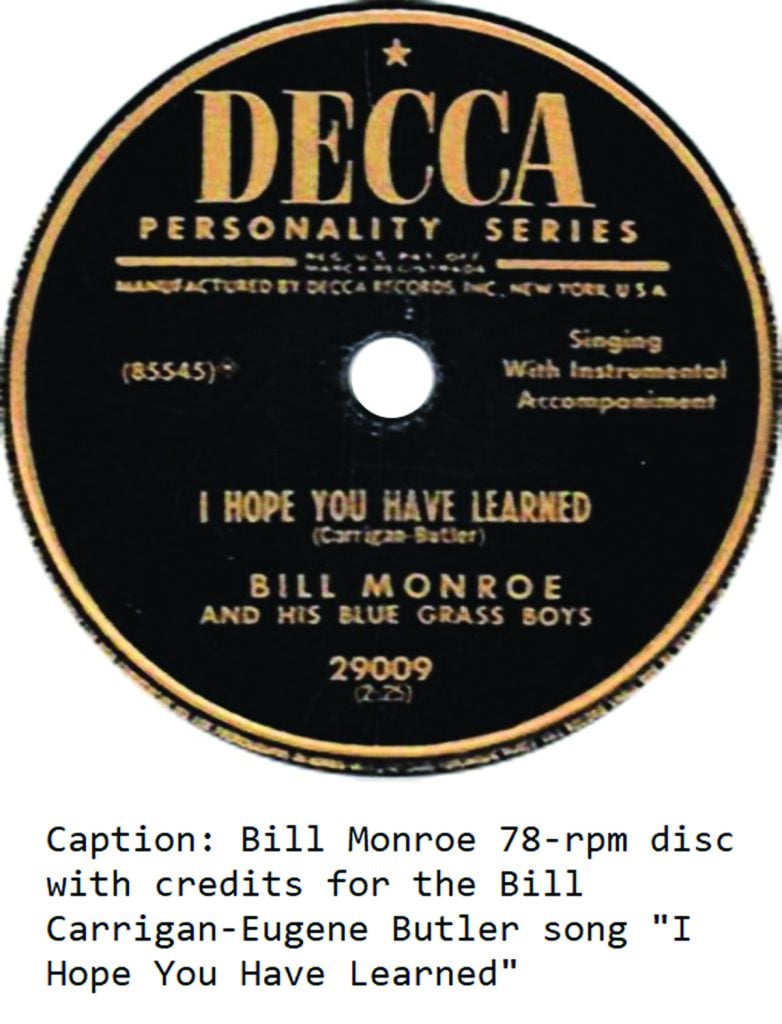
“I Hope You Have Learned” was a 1954 release for Bill Monroe, who recorded it as a duet that featured him and singer Jimmy Martin (recorded November 28, 1953 and released on Decca 29009 on March 8, 1954). The song was credited to Eugene Sanders Butler and William Jerome “Bill” Carrigan.
Butler was a native of Durant, Oklahoma, who was born on January 13, 1935. At the time of Monroe’s recording of the song, he was only eighteen years old. He went on to enjoy a fruitful career as a gospel music composer. Butler’s bio on the discogs.com website told that “his undergraduate degree was earned at Oklahoma University in 1957. His masters degree in Sacred Music is from Union Theological Seminary in New York in 1960 and his Doctor of Musical Arts in Composition was earned in 1974 from the University of Missouri in Kansas City. He has published over 1000 compositions with some 50 different publishers. As a composer, Dr. Butler has received various honors such as Kansas ‘Composer of the Year’ and the coveted ASCAP Standard Music Panel Award.”
Bill Carrigan was born on August 24, 1928, in Columbia, TN, a city about fifty miles south of Nashville. He gained some radio experience in the late 1940s before signing up for a three-year hitch in the Army, from the summer of 1949 to the summer of 1952. He spent the bulk of his time in Germany where he was in charge of hillbilly music on American Armed Forces Radio Network, which was headquartered in Frankfurt. Using the on-air name of Uncle Willie, Carrigan had a daily hillbilly music radio program that drew 150,000 pieces of fan mail annually. His Hillbilly Gast Haus was heard in twenty-two countries, including several behind the Iron Curtain. A special Saturday evening feature of the Hillbilly Gast Haus was the broadcast of transcribed portions of the Grand Ole Opry. Response was so great that Carrigan organized a European version of the Opry and staged it at Frankfurt’s 3,000 seat Palmgarden.
Carrigan used his Army radio experience to land jobs in the States. From 1953 to 1955 he worked as an announcer for WSM and WSM-TV in Nashville. It was likely his WSM connection that afforded him the opportunity to pitch “I Hope You Have Learned” to Bill Monroe. The same period saw other Opry/WSM performers record his songs including Red Foley, Rita Robbins, and Hank Locklin. In all, he had fifteen co-compositions registered with BMI. How Carrigan and Butler collaborated on the song is not known. A likely scenario is that Butler presented the song to Carrigan, who then contributed to and/or added his name to the piece in exchange for his connections to get the song recorded.
The middle 1950s found Carrigan bouncing around to several Tennessee radio stations, including Nashville’s WMAK; WAGC in Chattanooga; WHLP in Centerville; and WJGD in his hometown of Columbia. In the midst of his radio moves, he made an unsuccessful bid for Congress.
By 1959, Carrigan had relocated to Baton Rouge, Louisiana, where he worked on stations WIBR and WLUX. He had a 30-year run there which ended in the late 1980s. In retirement, he appeared in local commercials and did some freelance work as a columnist. He died in Baton Rouge on March 22, 2000, after a brief illness.
Queries
Q: I recently came across a series of interviews (from the late 1950s?) that were done with Earl Scruggs, Carter Stanley, and Jimmy Driftwood. All of the subjects being interviewed referred to their host as George (no last name). Any idea who George was? And when these interviews were made? Thanks. ZW, via email.
A: The short answer is George Lorrie, recorded at the first Newport Folk Festival on July 12, 1959.
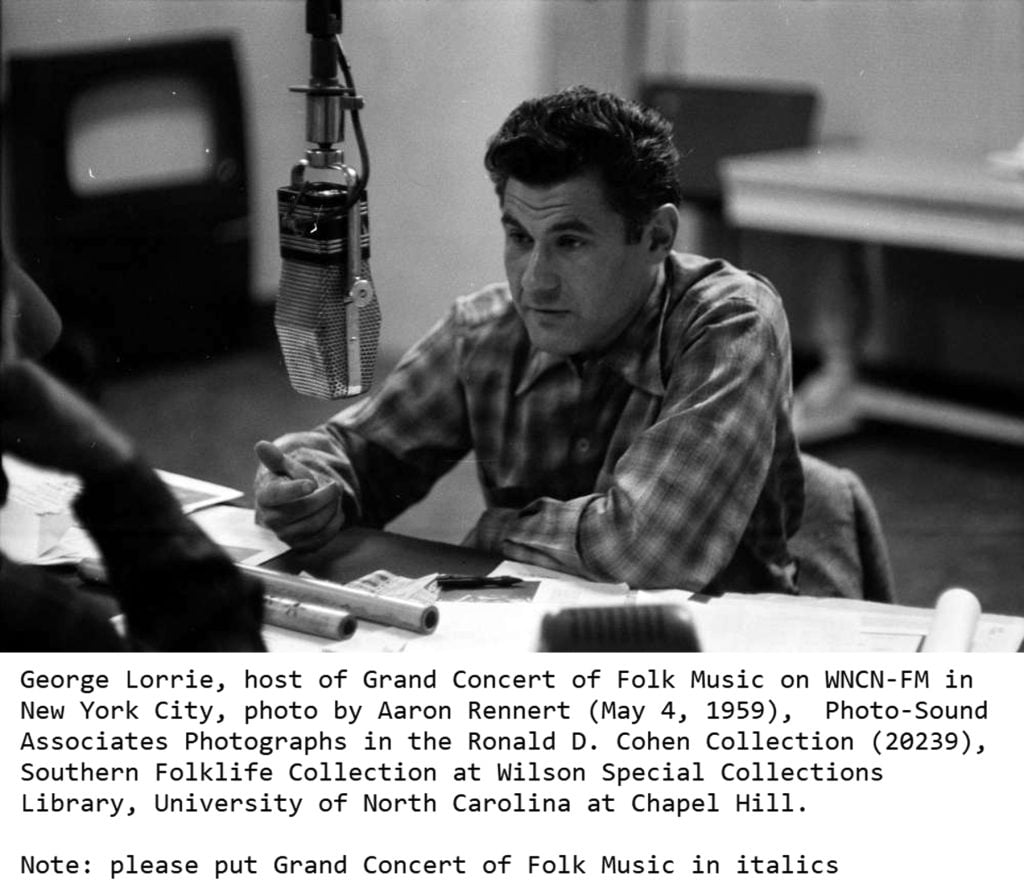
The long answer is that George Lorrie (December 12, 1923 – December 31, 2009) was a folk music performer and radio host who, at the time of the 1959 Newport Folk Festival, piloted a program called Grand Concert of Folk Music. It aired on Monday evenings from 8:00 until 10:00 over radio station WNCN-FM in New York City. The program could be heard roughly seventy-five miles in any direction from the city. Lorrie was set up at the Newport festival with something that he called “Operation Sidelines” where he conducted taped interviews with performers. As noted above, three of his interviewees included Earl Scruggs, Carter Stanley, and Jimmy Driftwood. The interviews were ostensibly played later over his Monday night broadcasts.
In life, George Lorrie was born George Levine. His father, Edward Levine, was born in New York to parents who were Russian Jews who immigrated to the United States, presumably in the late 1800s. His mother, Sally, was likewise born in New York. Although Edward was born in the United States, a census listed his first language as Jewish.
George attended St. John’s College in Annapolis, Maryland, in the early 1940s but his studies were apparently interrupted by World War II. His contribution to the war effort involved working in the shipyards in Baltimore. In a November 1960 Week-End Magazine article by Frank Askin called “Lorrie Taught History By Singing Folk Music,” he noted that “I worked alongside many people from the rural areas of the South, many of whom had never before been in a big city. Mostly they sang the current popular songs they heard on the radio, but if you really got to know them, they would overcome their bashfulness and break into the songs they really loved, the ones their parents had taught them as little children.”George began collecting the songs he heard and learned to play them on a guitar that was given to him by one of his co-workers.
By 1946, George had transferred to New York University where he earned a B. S. degree in education. By 1948, he was back in Baltimore where he taught school. His activities there weren’t limited strictly to teaching. He became a member of the Young Progressives of Maryland and entertained members with folk songs at club social events. One performance at a rally for a progressive political candidate billed George as the “people’s song artist.”
It was about this same time that the transformation was made from George Levine to George Lorrie. The reason for the adoption of a stage name is not known. One possible explanation is that he sought to keep his musical and political activities separate from his work as a teacher. Or, he may have felt that Levine was too ethnic sounding for a folk performer. In any event, he went public with his new name in a big way. With his guitar in tow, he approached the Baltimore ABC radio affiliate (WFBR) about hosting a program; his show was titled Lore With Lorrie. He soon switched to WCBM and continued with occasional live performances as a “guitarist and ballad singer.”
At some point in the early 1950s, George relocated to New York where he got a job teaching history to fifth graders. His teaching style was probably a little unorthodox at the time as he incorporated folk songs, played and sung by him, to illustrate key events in American history. He noted that “nothing makes the American Revolution come more alive than the song of the crackling ‘Riflemen of Bennington,’ which tells a Davy Crockett type story of the Vermont militiamen… So much can be learned about our country through its songs. America has always been a singing nation, and our folk songs tell our story.”
In 1957, George returned to the airwaves. His one-hour Folklore With Lorrie aired on Monday evenings over WBAI-FM. He soon switched to WNCN-FM where he inaugurated his Grand Concert of Folk Music program. An amazing array of in-studio photographs from the late spring/early summer of 1959 (available for viewing on the website for the Southern Folklife Collection at the Louis Round Wilson Special Collections Library on the campus of the University of North Carolina in Chapel Hill) show George with a variety of folk artists who were guests on his program.
It was at this stage in his career that George conducted his interviews with folk/bluegrass performers at the 1959 Newport Folk Festival. By his own admission he was not very well versed in bluegrass or, as Carter Stanley termed it, hillbilly music. George recounted that “I’m also guilty of not paying enough attention to the real American music that’s being made.” He wisely asked Mike Seeger to sit in on some of the interviews to assist with asking questions. Despite his lack of deep-dive knowledge about the music, George asked thoughtful questions and kept the dialogue moving.
In October 1960, George’s radio home changed once again, to Newark, New Jersey, station WNJR-AM. By this time, he had abandoned his job as a teacher and devoted his energies solely to music. Still, he didn’t lose his inquisitive nature. “I don’t know which field offers a more uncertain livelihood, teaching or folk music, but at least this way I get to talk to more people.” In addition to his radio work, he presented folk music concerts in the greater New York City area.
Aside from a January 1983 “Music and Reminiscences” event that was held at the Carnegie Recital Hall with Elias, Eugene, and Norman Seaman and “guest artists Martha Schlamme, George Lorrie, and others,” George drifted into obscurity. His residence at the time of his 2009 passing was located in Flushing, Queens, New York.
Over Jordan
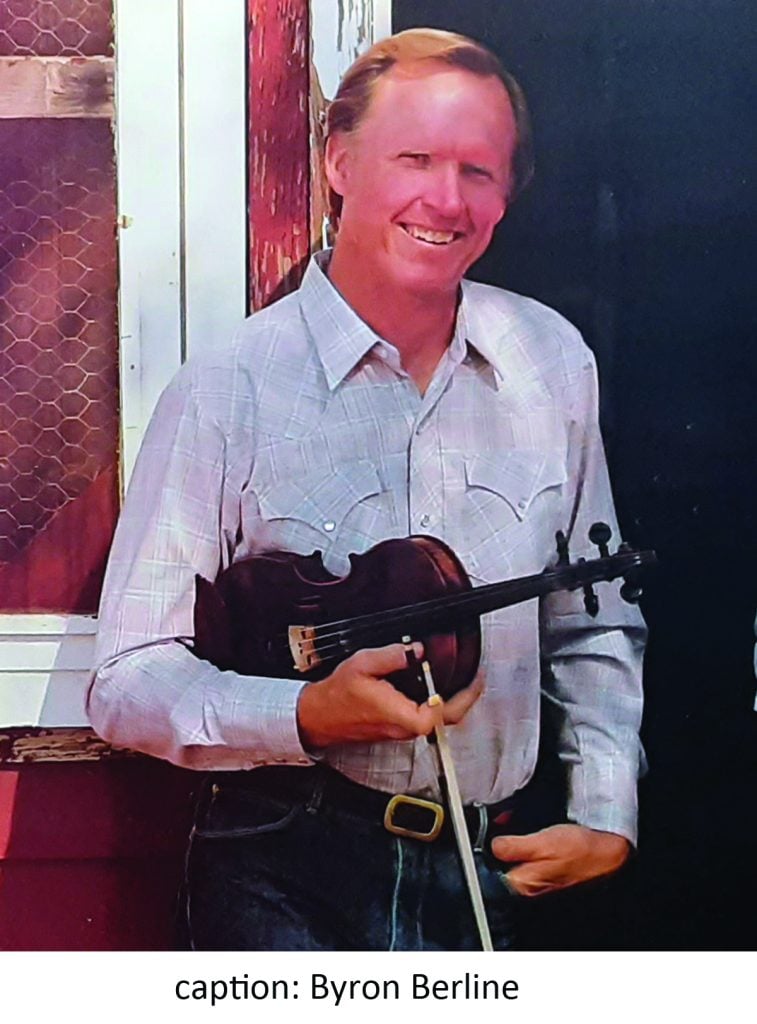
Byron Berline (July 6, 1944 – July 10, 2021) was a multi-instrumentalist who played music for over seventy years. He is fondly remembered by the bluegrass community not only for his musical talent, which he possessed in spades, but also for his giving nature and pleasant disposition. While he was known primarily for his fiddle work, he also played mandolin and guitar.
Byron was born in Caldwell, Kansas, but grew up in Oklahoma and started out on the fiddle at age five. Getting him started on the right track was his father, Lue Berline, who was a championship old-time fiddler. Fiddle albums by Tommy Jackson and Howdy Forrester influenced Byron’s early playing and when he later discovered bluegrass, Chubby Wise and Kenny Baker were very inspirational.
In his mid-teens, Bryon began attending—and winning—regional fiddle contests. (He went on to be a two-time—1965 and 1970—Grand Champion fiddler at the prestigious National Old Time Fiddle Contest in Weiser, Idaho.) He met the Dillards in 1964 and subsequently appeared on their Pickin’ and Fiddlin’ album on Elektra. This led to Byron’s appearance with the group at the 1965 Newport Folk Festival. Bill Monroe was also in attendance at the festival and offered the young fiddler a job with the Blue Grass Boys. He passed on the opportunity and endeavored to complete his college studies; he earned a B. A. in Physical Education from the University of Oklahoma. Following graduation, Byron embarked on what would become a lengthy career in music. He started out at the top and spent parts of 1966 and 1967 working for Bill Monroe; he recorded three tunes with Monroe: “Gold Rush,” “Virginia Darling,” and “Sally Goodin’.” Those tunes still rate as some of Monroe’s best instrumental work of the 1960s.
During a two-year stint in the Army (1967-1969) he was assigned to Special Services and was afforded numerous opportunities to play music. Shortly before being discharged, he received a request from Doug Dillard in California to help with the recording of an album. It was the start of a musically-active twenty-six-year stay out west. His associations there included Dillard & Clark, 1969-1970; Dillard Expedition, 1970-71; Country Gazette (which he co-founded and with which he recorded several influential albums including Traitor in our Midst and Don’t Give Up Your Day Job), 1971-75; Sundance, 1975-85; Berline, Crary & Hickman, 1978-90; L. A. Fiddle Band, 1978-93; and California, 1990-96. He also recorded a fiddle and banjo album with longtime friend John Hickman called Double Trouble.
Byron was also an in-demand session player and appeared on recordings by The Byrds, The Eagles, The Rolling Stones, Bob Dylan, John Denver, Elton John, Vince Gill, Emmylou Harris, Jethro Burns, John Hartford, Nitty Gritty Dirt Band, Don Reno, and Earl Scruggs. He also supplied instrumental music for numerous television programs and movies.
Byron returned to Oklahoma in 1995 and settled in the town of Guthrie. He was joined by John Hickman who shared a similar desire for a slower, less-hectic pace of life. In Guthrie, Byron organized the Byron Berline Band and also launched the Double Stop Music Shop; he was devastated when fire destroyed the shop in 2019. More than anything, it was the loss of vintage instruments that would never again be played or handed down from one generation to the next that distressed him most. He was able to reopen at a new location but expressed the opinion that he would never be able to fully erase the memory of the fire’s destruction. A more recent, personal loss came only a few months ago when John Hickman preceded him in passing (see July 2021 “Notes & Queries”).
Byron was an inductee to the Oklahoma Musicians Hall of Fame, was the driving force behind the Oklahoma International Bluegrass Festival, and was a 2012 recipient of the International Bluegrass Music Association’s Distinguished Achievement award. The Berline family asked that in lieu of flowers, donations to the Oklahoma International Bluegrass Festival Youth Scholarship Fund will be appreciated.