Notes & Queries – January
Editor’s Note: Our long-time Notes & Queries writer Walt Saunders, who is now 86 years old and has been involved with this magazine since 1967, was under the weather this month. We have asked noted bluegrass musician, scholar, entertainer, and historian Gary Reid to step in this month to write the Notes & Queries column. Thanks Gary!
NOTES
In reference to a question from the December “Notes & Queries” column about a duo that was billed as Charlie and Mary, the Bluegrass Sweethearts, we’ve been able to unearth some information about them. The husband/wife duo consisted of Charles Woodford “Charlie” Renfrow and Mary Bell Roberts Renfrow. Charlie was born in Butler, Kentucky, about thirty miles south of Cincinnati, on September 17, 1914. Mary was born on July 27, 1922, in Clay County in eastern Kentucky. By the time of the 1940 census, Charlie and Mary were married and living in Cincinnati; Charlie’s occupation was listed as “musician.”
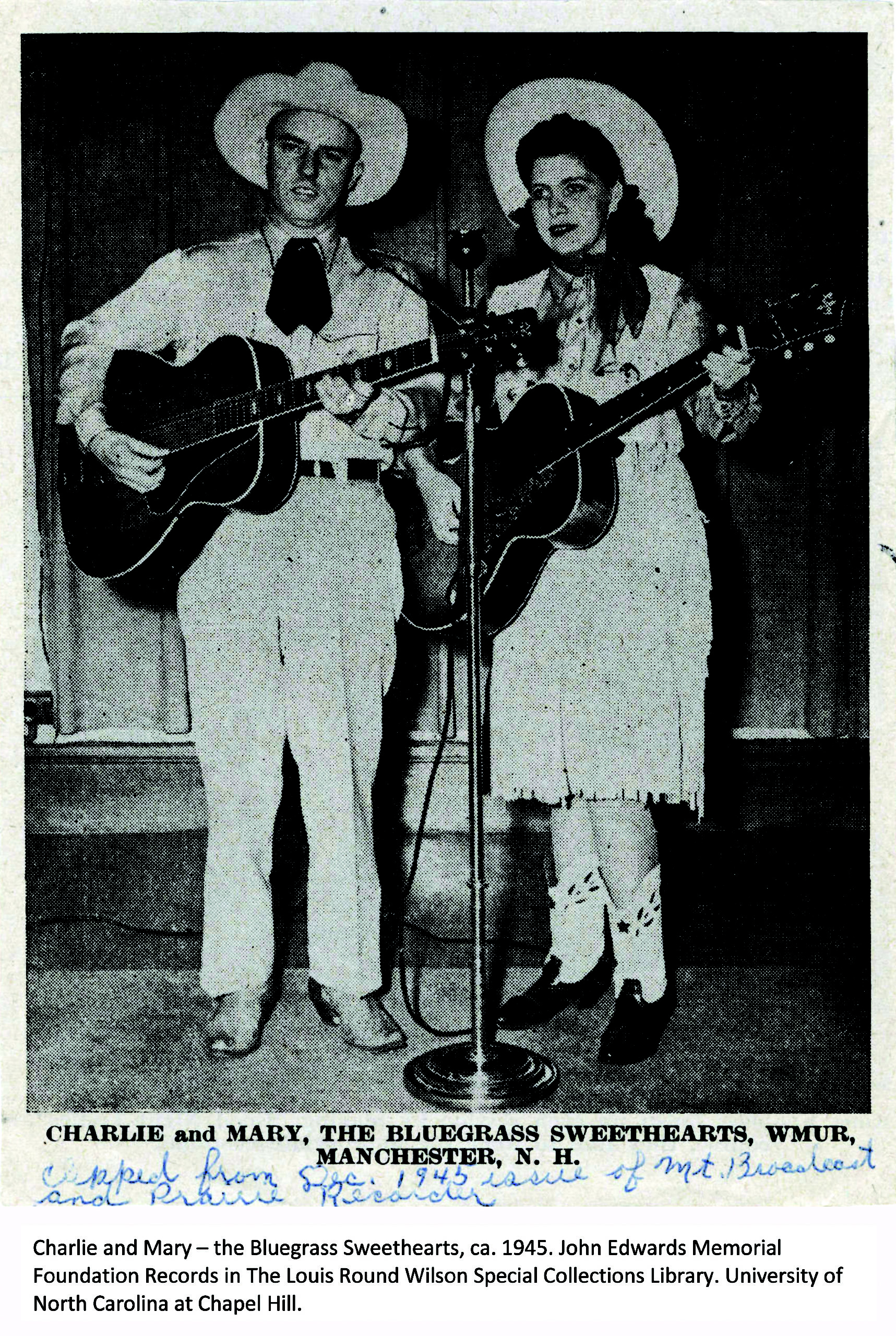
In 1943, Dixie Music Publishing issued a songbook for the group: Charlie and Mary, the Bluegrass Sweethearts – Famous Folio of Songs to Remember. By 1945, the couple had relocated to New England where they appeared on WMUR radio in Manchester, New Hampshire. A December 1945 photo showed the couple dressed in western attire and playing guitars. Advertisements for shows in the area billed them as having a “Cowboy Roundup and Amateur Show.” By 1950, they were back in Cincinnati and inked a deal with Rich-R-Tone Records, however it appears that nothing was ever released. A few years later, they recorded several gospel discs for the Cincinnati-based Kentucky label, with backing by Jim & Jesse McReynolds.
A February 1955 advertisement for a gospel revival in Corpus Christi, Texas, told of the “converted Radio, Television, and Stage Stars! They have sung to audiences up to 20,000 . . . Come hear them sing the Gospel Hit Song that is rocking the nation . . . ‘IDLE HANDS’ . . . their own composition, and many other favorites.”
By 1960, the couple wound up in Los Angeles where they continued their musical ministry. At some point, the couple divorced. Mary re-married in 1982 and made her way to Albuquerque, New Mexico, where she passed away on June 15, 2005. Her obituary stated that “Mary loved music.” Charlie remained in Los Angeles where he died on July 18, 1977.
Also in the December issue, a photo on page 48 of a jam session at the home of fiddler Tex Logan misidentified one of the participants. In the back row, third from left, a woman holding an autoharp was pegged as being South Carolina musician Betty Fisher. BU’s Murphy Henry, author of Pretty Good for a Girl – Women in Bluegrass and a former member of Fisher’s Dixie Bluegrass Band, concluded “that is not Betty.” Fred Bartenstein suggested that the mystery woman might be Annette Null, the wife of songwriter/autoharp enthusiast Cecil Null, who was in attendance at the party. As Cecil and Annette often performed together in public, with Annette on autoharp, her identification as the mystery woman seems obvious.
QUERIES
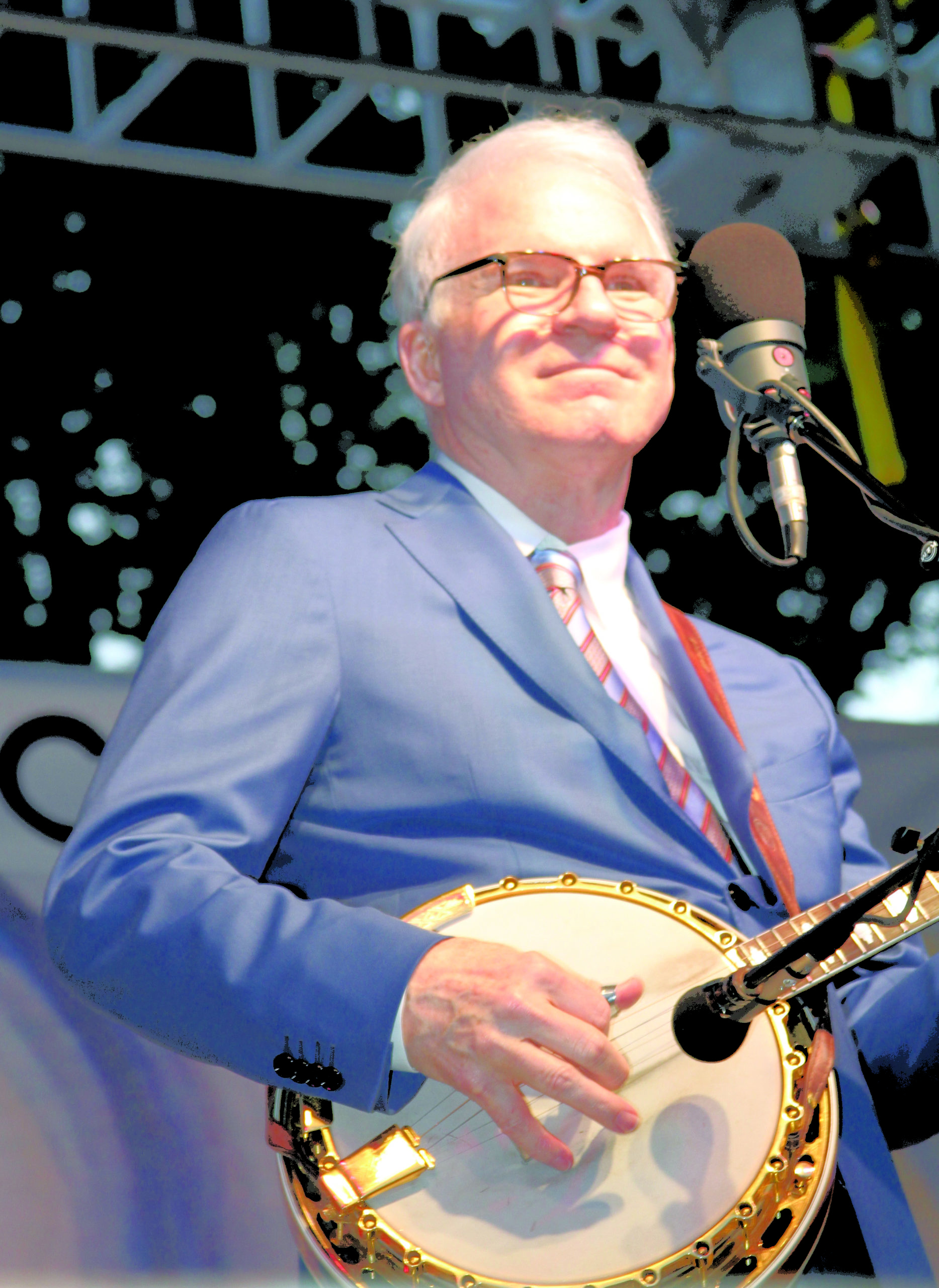
Q: What kind of banjo does movie actor and comedian Steve Martin play? BJ, Cal.
A: A query we sent out to a known banjo expert notified us that Steve Martin’s banjos include:
• a late 1920s Gibson Florentine with a 5-string neck,
• a Deering Clawgrass model co-designed by Mark Johnson.
• a Gibson RB7 that once belonged to John Hartford.
The information about the Hartford RB7 didn’t seem right to us, so we sent this answer to Steve Martin, through Pete Wernick, (thanks Pete!) and here is what Steve Martin said:
“The ‘Hartford’ is an RB 18, etched inside the pot by John Hartford and Roger Sprung. With their home addresses! The Florentine is a 1926 arch top with an added five string neck. The Deering Clawgrass is accurate. I currently play a Nechville on stage for three-finger. Road warrior. Invulnerable. I play a Stelling around the house. I have two, one with a wooden tone ring.”
Q: On the cover of the old Flatt and Scruggs album Country Music, can you please identify the person standing all the way to right in the back row? The bass player is Hylo Brown, right?” SA, Japan
A: The album you referenced was released in February 1958 and was comprised of songs and tunes that Lester Flatt and Earl Scruggs recorded for Mercury Records between 1948 and 1950. Curiously, aside from Flatt and Scruggs, the only person on the cover who actually appeared on those recordings was mandolin player Curly Seckler (front row, bottom left). Apparently, the record company did not have any photos of the band(s) that appeared on various cuts of the album, so a decision was made to use a contemporary photo of the band as it appeared near the time of the album’s release. In the front row, left to right, are Curly Seckler, fiddler Paul Warren, and dobro player Josh Graves. In the back row, left to right, are bass player Frank “Hylo” Brown, Lester Flatt, Earl Scruggs, and – the person you asked about – Charles Elza.
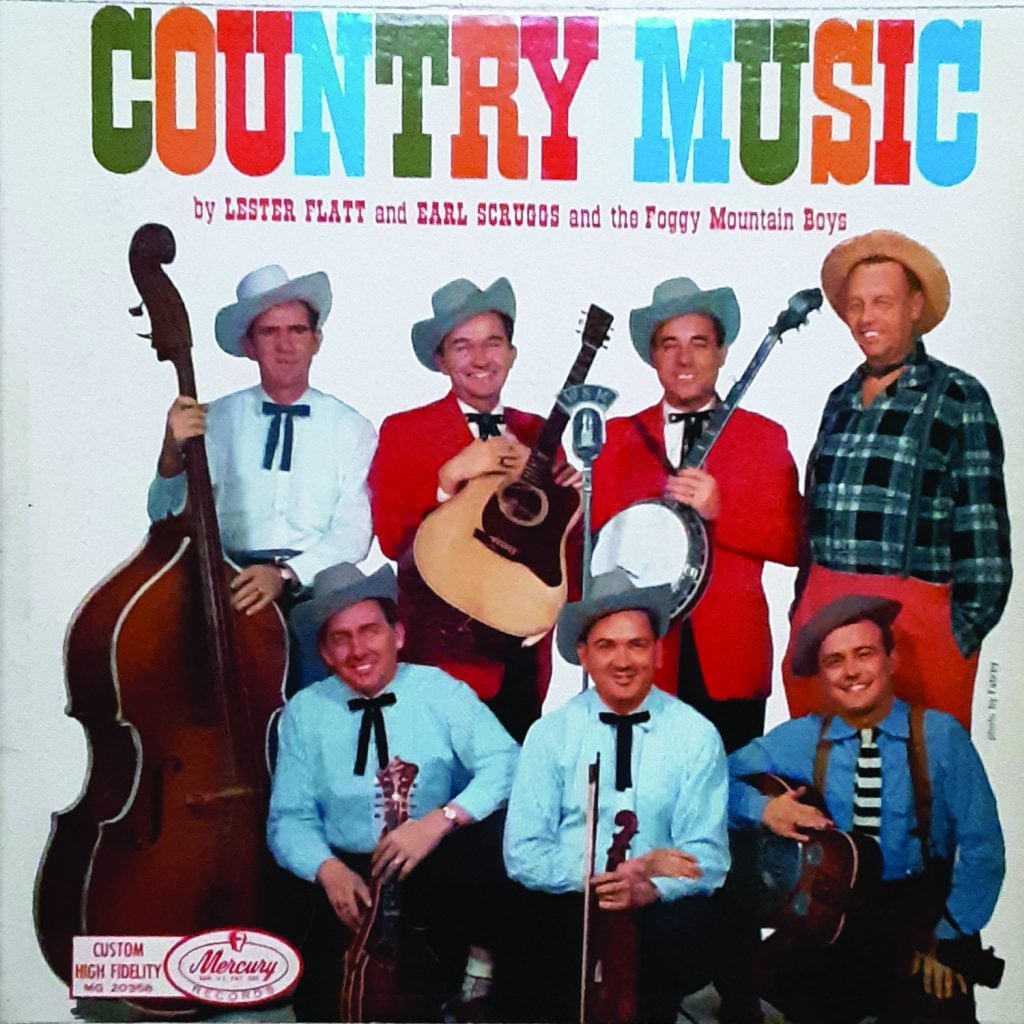
Elza was an old-time song and dance man who went by several stage names including Kentucky Slim and Little Darlin’. He did comedy with a number of country and bluegrass acts during the 1940s, ‘50s, and into the early 1960s. Among the recognizable groups he appeared with were Roy Acuff, Carl Story, Esco Hankins, Hylo Brown, Flatt and Scruggs, and the Stanley Brothers. He also logged time on several radio programs and barn dances including WNOX’s Mid-Day Merry-Go-Round in Knoxville, Tennessee; the WSB Barn Dance in Atlanta; and the Renfro Valley Barn Dance in Kentucky.
Although he retired from performing in 1963, Elza made select appearances over the years, including the 1982 World’s Fair in Knoxville and the Annual Tennessee Homecoming in Norris, Tennessee. He died on February 23, 1996, in Knoxville.
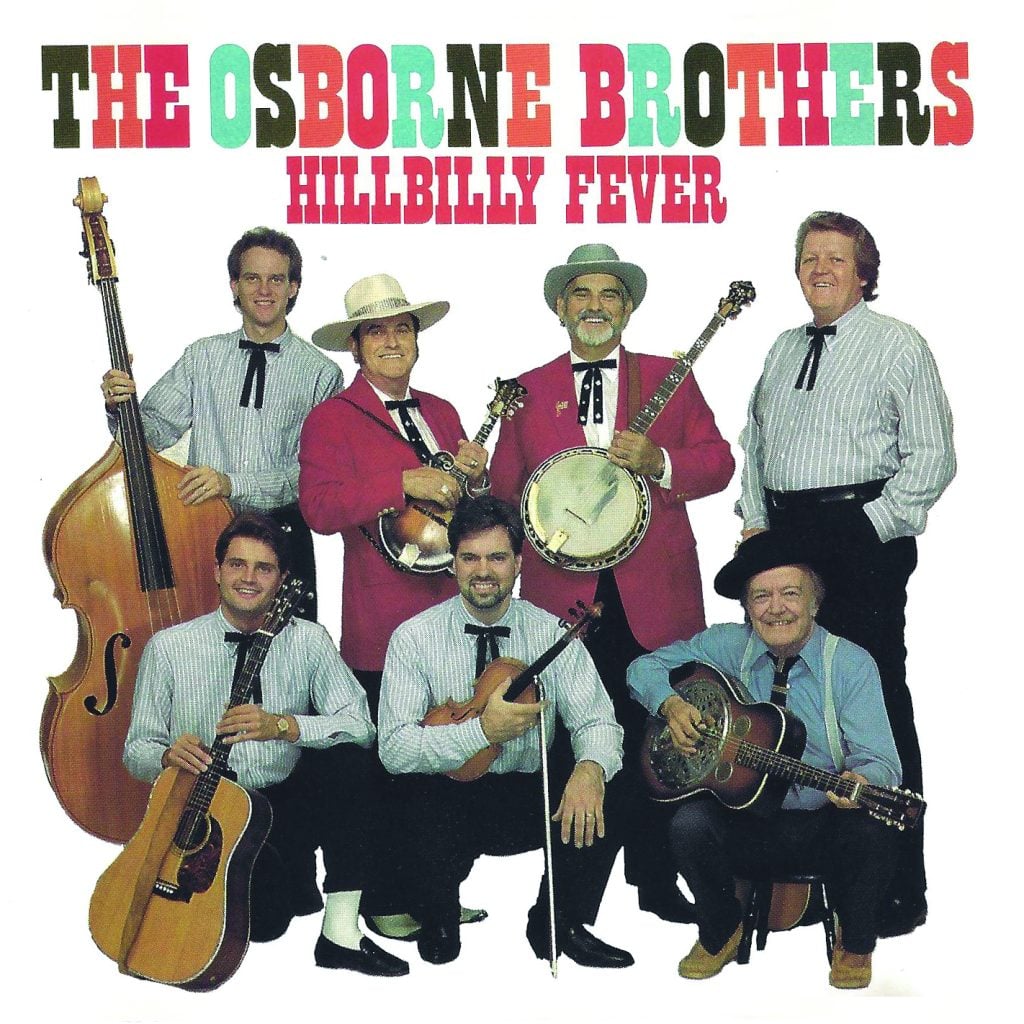
The Country Music album was influential in more ways than one. It was one of the first long-play albums ever issued to feature bluegrass music. Thirty years after its release, the album’s iconic front cover photo and layout inspired a light-hearted spoof by the Osborne Brothers for the cover of their 1991 album Hillbilly Fever.
Q: There’s a custom release 78RPM record on The Great Guiding Light label credited to “The Pennington Bros. and Their String Band.” It is Blue Grass influenced material with banjo, fiddle and electric guitar, and great raw duet singing. The songs are “The Old Cross Road” and “Travelin’ Shoes” (the latter likely an original). No address is given and no pressing plant info are in the deadwax. Do you know more? MR, Italy
A: The Pennington Brothers was a group from the Dayton, Ohio, area that was active in the late 1940s and into the 1950s. The duo consisted of Jackson County, Kentucky, natives Charley and Frank Pennington. Frank was born on December 24, 1918, and Charley followed some three years later on February 17, 1922. They both received limited grammar school educations.
Charley worked at the Jackson Coal Company before enlisting in the Army in August of 1940. He received basic training in Battle Creek, Michigan, and also in North Carolina. His first two and a half years of service were spent in Iceland but by April of 1944 he was on active duty in Ireland. He was wounded in France in July 1944 and was sent to a hospital in England to recover. When he was well enough to return to active duty, he was sent back to the front lines until the war’s end. He was discharged in August 1945.
Meanwhile, Frank had moved to Montgomery County, Ohio, presumably in the area of Dayton. He enlisted in the Army at Huntington, West Virginia, on September 29, 1944. Two weeks later, he was transferred to the signal training unit at Camp Atterbury in Indiana. However, an undisclosed ailment necessitated his discharge after only four months of service.
In the early part of 1947, Frank Pennington organized a prayer group that eventually morphed into what is known today as the Dryden Road Pentecostal Church. Charley Pennington served as a pastor at the church for many years. As part of their musical outreach, the Pennington Brothers provided music for area church events such as a 1949 tent revival in nearby Hamilton, Ohio, and a 1951 opening in Dayton of a Church of God assembly.
In the early part of 1949, Charley and Frank, along with four musicians, made regular appearances on a radio station in Springfield, Ohio. The popularity of the program swelled church attendance. In 1953, Charley and Frank secured another spot on WPFB in Middletown, Ohio, and at some point, also appeared on Dayton’s WONE. Accompanying musicians, at times, included banjo picker Johnny Vickers, Chester Robinson, Frank Pennington on mandolin, Charley Pennington, Eddie McCarroll on acoustic guitar, George Stearns on electric guitar, and Estil Gullette on fiddle.
It is likely that it was in this timeframe that the Pennington Brothers recorded what is believed to be their lone record release, a 78-rpm disc on the Great Guiding Light Label. The disc appears to be a custom pressing and consisted of “The Old Cross Road,” a song made popular by Bill Monroe in the late 1940s, and “Travelin’ Shoes,” an apparent original band number.
In 1970, after nearly twenty-five years in Dayton, Frank Pennington felt called to move to Florida and organize a new church. In 1971, after pastoring to the Dryden church for over twenty years, Charley, too, moved to Florida to preach there. The brothers reunited and established the Lake Worth Pentecostal Church. One newspaper account told that “the two brothers preach and sing, and are heard weekly on WSWN (Belle Glade) Sunday afternoons from 2:30-3:00 p.m.” An advertisement for their church bade worshippers to “hear the Pennington Brothers sing and preach.”
Little is known of brothers’ activities after the start of their work in Florida. Jeff Roberts of the Dryden Road church held them both in high regard, calling them “great men.” Frank was living in Port Saint Lucie, Florida, when he passed away at age 92 on April 28, 2011. Charley was living in Franklin, Ohio, when he passed away at age 93 on January 5, 2016.
Q: I would like to know more about the fiddler Jack Youngblood. I understand that he made at least two 78’s/45’s on Columbia Records in 1953 and ‘54, and also an EP called Hoedowns and Waltzes – all with Bluegrass backing?! UH, Sweden
A: Arnice E. “Jack” Youngblood was an Alabama-born fiddle player who logged time with several country legends such as Lefty Frizzell, Bill Monroe, and Ray Price. Despite his high-profile work in the 1950s, he released only a handful of recordings under his own name.
Youngblood was born on February 15, 1922, in Oneonta, Alabama, and spent a number of his formative years in Trafford, Alabama. Although his father was a fiddle player, Jack started out on the guitar. Around 1934, at age twelve, he took up an interest in the fiddle.
Jack got his first taste of radio work around 1937, at age fifteen, when he appeared with Tex Dunn and the Virginia Hillbillies on WBRC in Birmingham, Alabama, about twenty-five miles due south of Trafford. He also logged time with a performer by the name of Happy Tex Wilson. Jack’s first tune to play on the radio was “Chicken Reel.” It was while in Birmingham that Jack had the opportunity to play several dates with the Delmore Brothers. Farther from home, in 1939, Jack appeared on WSB in Atlanta with a group called Red and Raymond.
The Youngblood family relocated to Talowah, Mississippi, in 1940. It was there, at age nineteen, that Jack married Vondelle Davis on May 25, 1941. He served about one year as a private in the Marines during World War II.
Jack’s war-time service didn’t diminish his skills with the fiddle. In 1947, he won a “Southern championship among hoe-down fiddle players.” But apparently it wasn’t until 1951 that he was able to earn his livelihood with the fiddle. In the fall of that year, he was employed by a Louisiana entertainer by the name of Jelly Elliott; he claimed to have acquired the nickname “because I got in so many jams.” Elliott had recently gained fame by recording a series of fifteen-minute syndicated programs that were sponsored by “U. S. and state forest services throughout the country.” The shows were a “combination of hillbilly music and homespun patter by Jelly on forest fire prevention.” In November 1951, Elliott recorded a series of thirteen programs that were intended for broadcast on 1,500 stations. Life magazine even dispatched a reporter and photographer to cover the recording of the programs. Included in Elliott’s group, which he called The Knot-Heads, was fiddler Jack Youngblood.
It was probably around this same timeframe that Jack appeared on a disc by “Happy Pappy” Powell Shaw, a Mississippi-based country crooner. The two sides were released on the Gabriel label of Gulfport and featured two gospel songs called “What’s My Verdict” and “Thankful.” Jack’s fiddle was accompanied by tasteful accordion and steel.
Starting in late summer or early fall of 1952, Jack began touring and recording with country star Lefty Frizzell. Over the course of the next year, Jack recorded twenty-six sides with Frizzell, including the popular “Run ‘Em Off.” Between sessions that were recorded on February 6 and February 7, 1953, Jack recorded at least two tunes under his own name: “Boil Them Cabbage Down” and “Wednesday Night Waltz.” Presumably it was members of Frizzell’s group that provided backing: Jimmy Rollins, Joe Knight, Paul Blunt, Eddie Duncan, Fred Cantu, and Harold Carmack.
Youngblood left Frizzell’s group and, in the early part of 1954, joined Bill Monroe’s Blue Grass Boys. The band at the time included banjoist Jim Smoak, guitarist Edd Mayfield, and comedian Lazy Jim Day. Smoak, who had worked with Monroe previously in 1952, recalled his 1954 stint with Monroe with fondness, stating that he “really enjoyed my time with Bill Monroe at that time . . . Jack Youngblood and Edd Mayfield.” Apparently, the boss man was happy, too. “Bill Monroe liked his fiddle playing . . . you’ve heard him talk about that long bow and all that kind of stuff . . . Jack Youngblood, he just had a really good swing to his fiddle playing.” Smoak continued that “Tater Tate was known for like double stop playing . . . well, Jack Youngblood was, too. He was an all-around fiddler. He just had a lot of fiddle tunes.”
Jack never had the opportunity to record with Monroe, but Jim Smoak recalled one incident where the fiddler’s work impacted Monroe. “We were in Hot Springs, Arkansas, and we just kinda had nothing to do and Bill Monroe played ‘Cheyenne’ for us back stage. [Jack was] the fiddle player that made the tune come alive. We all picked it up and started playing it.” It became an instant hit with Monroe’s fans.
It was while working with Monroe that Jack recorded his second, and last, session for Columbia. Two tunes are known to have been recorded: “Hitch Hiker’s Blues” and “Twinkle, Twinkle Little Star.” Jim Smoak and Edd Mayfield were featured on the session. “Hitch Hiker’s Blues” was actually Jack’s take-off of “Lee Highway Blues.” Jim Smoak said, “I remember that one . . . Jack got to that long part of the top where he just kind of stayed in D for a long time and I was playing a hot roll in the background.” While the tune found favor with record reviewers, at least one was baffled by the song’s title. “Why the title we don’t know . . . it is all instrumental, a foot-tapping tune heavy on fiddle . . . while you spin ‘Hitch Hiker’s Blues’ see if you can figure out that title.”
Youngblood left Monroe by the end of 1954 and headed south to Baton Rouge, Louisiana. There, he hooked up with Dean Evans, a radio personality who fronted a band called the Wood Sawers. The group also included bass player Lum York, and Jack persuaded Jim Smoak to join them. The group played a VFW hall in Baton Rouge three nights a week.
Aside from a few dates with country performer Ray Price, there is a wide gap in Youngblood’s career. A guest spot on an album by Mississippi bluegrasser Luke Thompson in 1971 punctuated the chasm but it wasn’t until the early 1980s that he fiddled regularly again. It was then he hooked up with another Baton Rouge artist by the name of Jim Beam and the James Gang. Beam operated a club in town called Jim Beam’s Country World and touted “continuous entertainment” that included bluegrass, Nashville acts, and Jim Beam and the James Gang.
The time with Beam resulted in several trips to the recording studio. There were two 45 rpm discs by Beam’s group called “Amtrackin’ “ b/w “Consider Me Drunk” and “Mexico” b/w “You are a Liar.” The group assisted with the recording of an album by Prairieville native Bruce Broussard called 31 Favorites, and also appeared on singles by Paul Broussard, Liz Mixon, and Randy Bridges. Solo recordings by Jack were also slated to be released.
Jack released a solo cassette tape in the middle 1990s called Jack Youngblood – Mississippi Fiddler.
Jack’s last public work was in the middle and late 1990s with a group called the Piney Woods Ramblers. They were frequent performers on the regional Piney Woods Opry.
Jack Youngblood passed away in Hattiesburg, Mississippi on April 24, 2007. He was survived by his wife of 65 years, Vondel, and their five children: Foster, Farron, Dianne, Sue, and Sandra.