Notes & Queries – December 2022
Notes
More Mockingbird
Walt Crider, the historian for the Seven Mountains Bluegrass Association, wrote: “As a follow up to the ‘Listen to the Mockingbird’ song story (October “Notes & Queries”), I was visiting the Gettysburg National Civil War Museum when I heard ‘Listen to the Mockingbird’ coming from one of the displays. It was about the Confederate soldiers marching in cadence to that song which was being sung by the squad leader I assume. Also, that song has also been a theme song for the Three Stooges for many years.”
Correction
Jimmie “Ratso” Silman wrote to inform us of an error in the recent (November “Notes & Queries”) remembrance for Richmond, Virginia, bluegrass band leader George Winn. His band, The Bluegrass Partners, was mistakenly listed as The Virginia Partners. Our apologies for the error.
Queries
Q: “I’m wondering if you have any information on the York County Boys (a Canadian bluegrass band) that recorded a best-selling album in the late ‘50s called Blue Grass Jamboree. I believe that Rex Yetman, the mandolin player, later worked in an East Coast band called Crooked Stovepipe with Neil Rosenberg. I know they were featured many times on the Tommy Hunter Show and backed up Mac Wisman when he came to Ontario. Thanks!”
— Robert Ivany, via email.
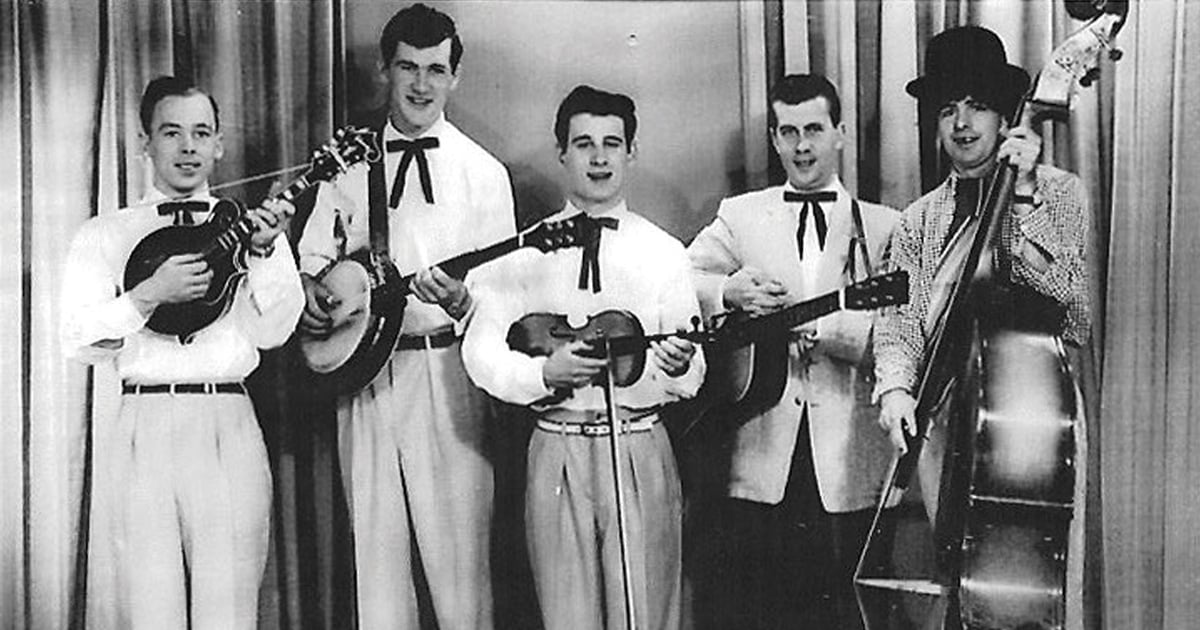
A: The York County Boys have been touted as the first bluegrass band in Canada. The group came together in 1953 when mandolin player Rex Yetman teamed up with guitarist Mike Cameron and banjo man “Big John” McManaman. Others who joined shortly afterwards were fiddler Brian Barron and bass player Alfred “Dusty” Leger. Most of the members were from rural regions of Ontario and the Atlantic coast area of Canada who had relocated to Toronto for work; it was there the band came into being.
During the middle 1950s, the group appeared on CBC-TV (Canadian Broadcasting Corporation) programs such as Pick The Stars and Country Hoedown. The television exposure led to tours of the Maritime provinces of eastern Canada. A highlight of one of their early performances was the opportunity to appear on a 1955 program at an arena in Brampton, Ontario, with Bill Monroe and the Blue Grass Boys.
In 1958, the group recorded what is generally considered to be the first album of Canadian bluegrass to be released. Appearing on the newly formed ARC label, Blue Grass Jamboree sported such favorites as “Gotta Travel On,” “Gone Home,” “Once More,” and “Golden Slippers.” Also included was an original instrumental called “York County Breakdown.” The album reportedly sold over 30,000 copies.
The York County Boys had the honor of performing for the first Mariposa Folk Festival, an event first held in 1961 in Orilla, Ontario, that featured all Canadian talent. At least one newspaper at the time tagged the group as “famous Canadian bluegrass pickers.” The group made a return visit to the Mariposa festival in 1965 where they “batted off a few bars and blew a fuse in the PA system.”
The group disbanded in the middle 1960s but gave several reunion performances in 1968, 1972, and 1990. During the 1970s and ‘80s, Rex Yetman performed with the Toronto Bluegrass Band and in 1999 joined Crooked Stovepipe and appeared on their 2006 compact disc Just In Case.
Over Jordan
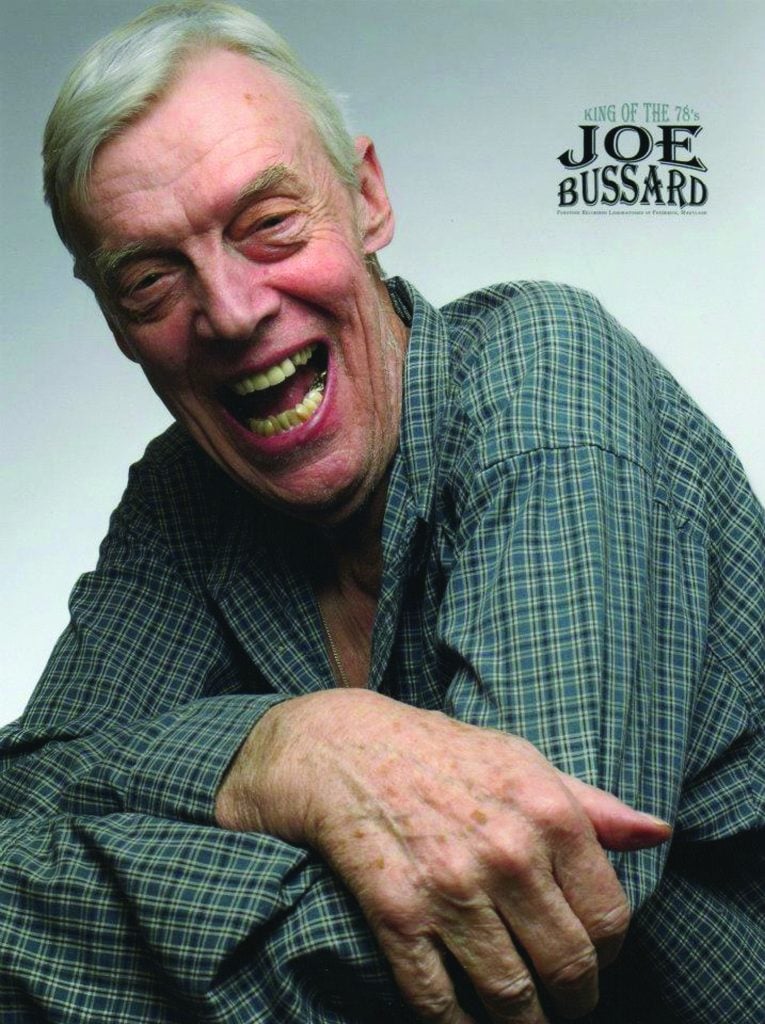
Joseph Edward “Joe” Bussard, Jr. (July 11, 1936 – September 26, 2022) was best-known as a record collector who amassed what many industry professionals have called the largest collection of blues, old-time, jazz, bluegrass, and early country music on 78 rpm discs. A charismatic and enthusiastic champion of the music, he delighted in sharing his trove with frequent visitors to his basement music library. Over the years, he scoured the country sides in search of old recordings, dabbled as a broadcaster with his own low-frequency (and slightly illegal) radio station, operated his own record label (Fonotone), and recorded programs in his basement that were broadcast on roots-friendly radio stations.
Bussard first embarked on his record collecting quest around the age of twelve, when he went door-to-door in his native Frederick, Maryland, community to find discs by Jimmie Rodgers, whom he deemed to be the “greatest singer that ever lived.” At age sixteen, and then able to drive, he combed the country sides of Maryland, Virginia, West Virginia, and North Carolina in search of out-of-print 78 rpm discs. He possessed an innate ability to sense which homes, many of them without electricity or running water, would prove fruitful.
Around 1951, at age fifteen, Bussard built a radio station in his parents’ home. Christened WCRT, the tiny broadcaster covered the vicinity of Frederick and programmed “nothing but hillbilly music.” His studio boasted three turntables and an antenna that was affixed to two poles in the yard. The station, which operated without a license, was finally shut down by the FCC after about eight years of service.
At various times early in his professional life, Bussard held several day jobs, including stints with an electric company, an A & P grocery store, his father’s farm/supply business, and the National Guard. But, all of these were secondary to his love of music. From 1958 until 1970, Joe operated Fonotone Records, a label on which he recorded local artists with exotic names such as the Mash Mountain Boys, the Bald Knob Chicken Snatchers, and his own Jolly Joe’s Jug Band. The label laid claim to having the earliest recordings by mandolin master John Duffey and guitar guru John Fahey. In 2005, the Dust-To-Digital label issued a five-CD set of Fonotone material that came with a sporty 160-page book and which was packaged in a cigar box. (Joe always had a lit cigar at his side!)
Starting in 1959, Bussard began recording half-hour radio programs of old-time and bluegrass music in his basement. The program appeared, via pre-recorded tape, on stations such as WELD in Fisher, West Virginia; WSIG in Mount Jackson, Virginia; WTHU in Thurmont, Maryland; and WPAQ in Mount Airy, North Carolina.
Joe Bussard was the subject of numerous newspaper articles and at least one DVD documentary called Desperate Man Blues. The video captured Joe’s enthusiasm – that included smiles, laughs, and gyrations to the music – as he played favorite recordings for various visitors. In his final days and weeks, hospice volunteers set up a hospital bed in his basement so that he could be with his beloved record collection – 25,000+ 78 rpm discs – as he passed from this life.
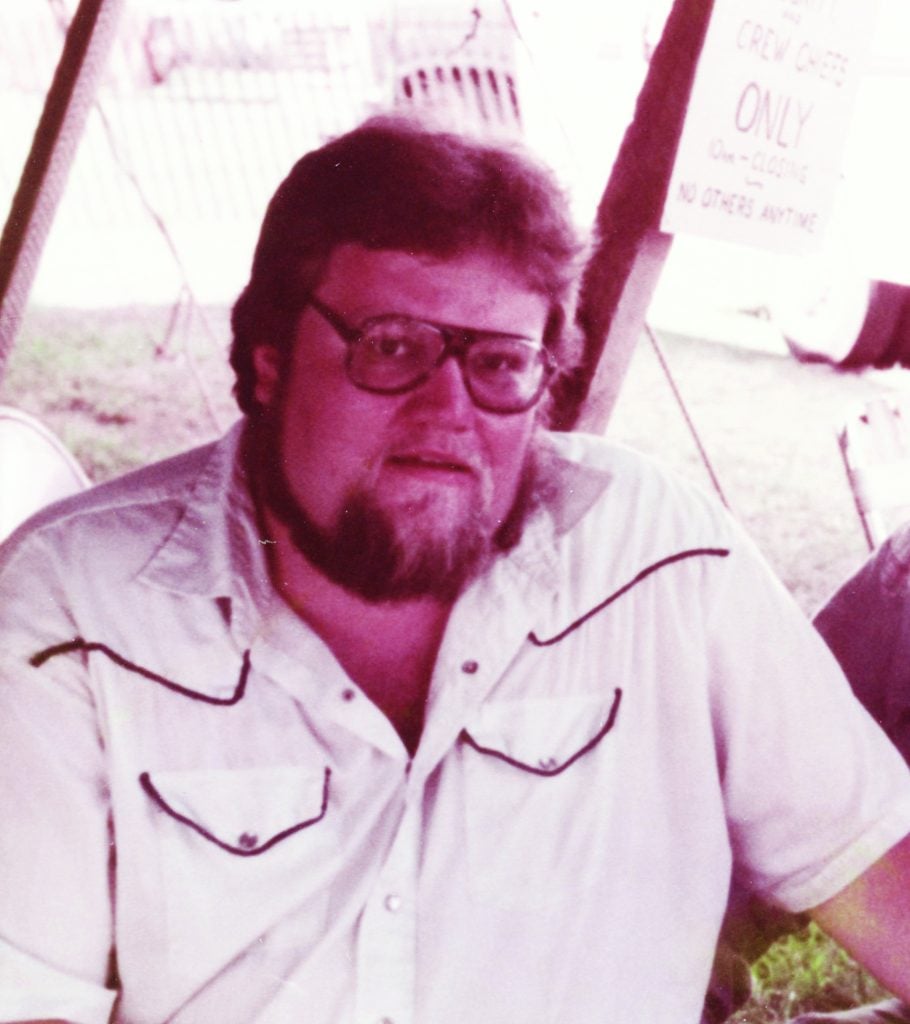
Thomas Michael “Tommy” Cordell (March 2, 1957 – September 30, 2022) was a gifted fiddler from West Virginia who spent much of his adult life in the state of Florida. Over the years, Tommy logged time with a number of high-profile groups including Dave Evans and River Bend, Larry Sparks, and the Boys From Indiana; he also served as the leader of Florida-based Big Timber Bluegrass.
Speaking to Orlando Sentinel reporter Sam Hodges in 1990, John Hartford related that “I first heard Tommy when he was with Dave Evans’ band. He’s an excellent fiddler.” Byron Berline added that “He gets that great tone. I’ve been very impressed with his playing.” And icon Jesse McReynolds rated Cordell as “one of the top five fiddlers in the bluegrass style.”
Tommy got his start in music at age five when his father, Austin Cordell, started him out on the guitar. It remained his primary instrument for much of the next decade. In his early years, he also took up the fiddle and was mentored by legendary West Virginia fiddler Clark Kessinger. Tommy also mastered the mandolin and bass fiddle.
Recalling his first visit to a bluegrass festival, in 1975, Cordell told Sam Hodges about seeing Bill Monroe and, more importantly, fiddle player Kenny Baker for the first time. “Kenny Baker saw me standing out in the rain with my fiddle . . . He said, ‘Come over here.’ We’ve been friends ever since and he’s taught me a lot, including not to stand in the rain with my fiddle.”
Cordell’s professional career got underway in 1980 when he performed at the Milton Opry House near Hurricane, West Virginia. The early 1980s found him performing with a number of groups. He spent three years, off-and-on with Dave Evans, with whom he recorded four albums: Call Me Long Gone, Goin’ Round This World, A Few More Seasons, and Poor Rambler. Other stints during the same period included Larry Sparks (with whom he fiddled and sang tenor), Don Sowards and the Laurel Mountain Boys, and a group headed by Lowell Varney and Landon Messer. Tommy also appeared on a 1984 release by the Boys From Indiana called Showtime.
In the very early days of 1984, Tommy relocated to Florida where he joined Chubby Anthony’s former group, Big Timber Bluegrass. By 1987, he assumed leadership of the band and released a solo album. In recognition of his move to the Sunshine State, he titled the album Florida Blues. When critiquing the disc, Bluegrass Unlimited contributor Richard C. Buckingham began his review by proclaiming that “Tommy Cordell is a powerful fiddler.” This was also evidenced in 1992, 1993, and 1994 when he was named Florida State Fiddle Champion.
Tommy’s connection to Florida was further solidified when he was asked to provide guitar backing for a recording that featured Florida swing fiddler Chubby Wise and North Carolina banjoist Raymond Fairchild. The project was called Cherokee Tunes and Seminole Swing.
Throughout the early 2000s, Tommy fronted a band called the Sons of Bluegrass and also performed as part of the house band at the Orange Blossom Opry in Weirsdale, Florida.
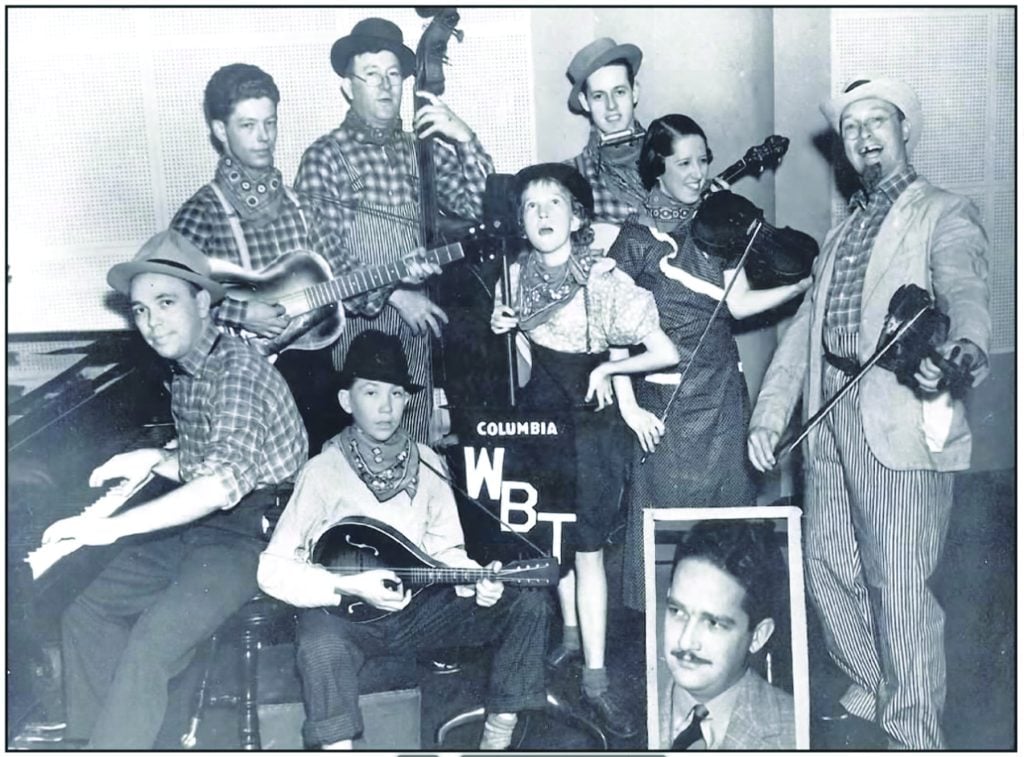
Billie Burton Daniel (March 8, 1924 – October 1, 2022) was a member of the Briarhoppers, who were performers on Charlotte, North Carolina, station WBT, starting in the middle 1930s. The June 1940 edition of the Radio and Television Mirror magazine wrote that “Every afternoon except Sunday WBT airs an hour-long program of hillbilly songs and chatter with, as master of ceremonies, an aged rustic named ‘Pappy,’ head of the ‘Briarhopper Family’.”
Billie Burton began her career in show business as a child singing on the Popeye Club Amateur Hour. From there, at age twelve in 1936, she was chosen for the part of Billie Briarhopper, Pappy’s daughter. In a 1972 Letter to the Editor of the Charlotte News, Billie wrote (in third person) about the early days of the Briarhoppers. “Billie was the youngest member of the ‘Briarhopper’ family and for years the only girl. She was a little bit shy, especially around strangers, but she loved to sing, and when Mr. Crutchfield [the show’s announcer] called her up to sing, she did her very best.” She added that her “voice was low, almost sultry, and soft. ‘Lonesome Road’ and ‘Georgia on My Mind’ were her best songs.”
In addition to the daily radio show, the group went out for personal appearances nearly every night. Combining radio and stage with school left no time for extracurricular activities. Looking back on it in later years, she said, “Still, I wouldn’t have changed one minute of those days.”
Billie’s association with the program ended in 1940 when her family moved to Wilmington, North Carolina, to “join the ranks of shipbuilders.” She had a chance reunion with the show in 1943 when it was booked at Wilmington’s Thalian Hall.
Billie Burton Daniel went on to enjoy a successful career as a blues singer; she counted popular entertainers such as Billie Holiday and Bing Crosby as fans of her work.
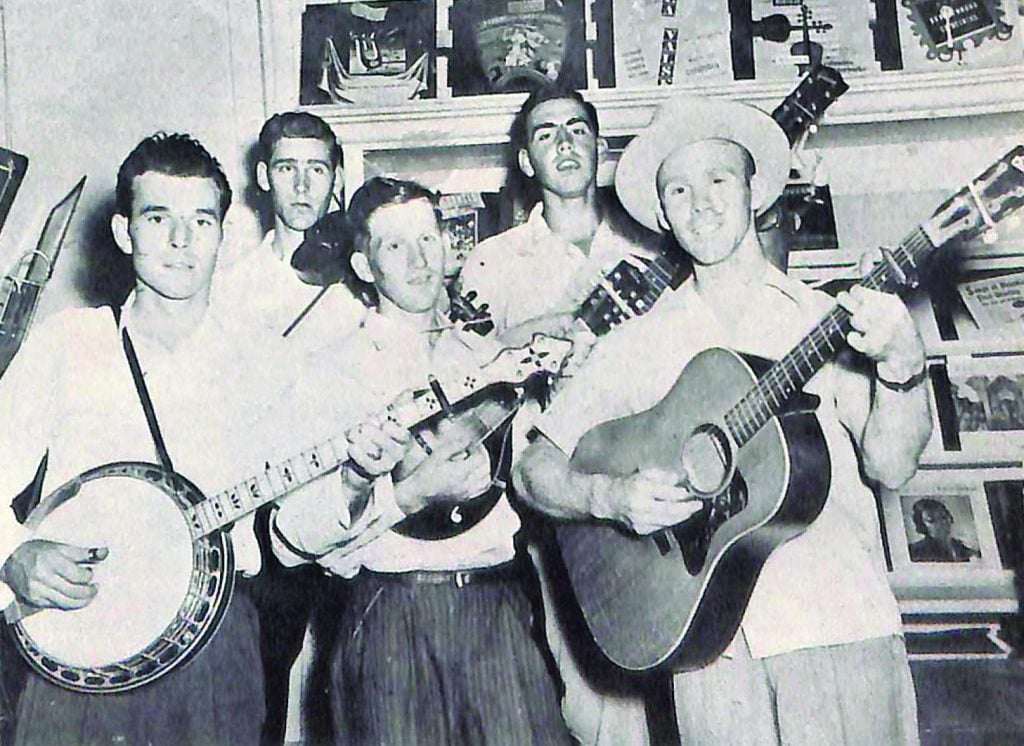
Arthur Ward Eller (May 24, 1930 – September 20, 2022) made his mark in bluegrass as a founding member of the North Carolina band known as the Church Brothers & the Blue Ridge Ramblers. With that group, Eller recorded several now-legendary sides for the Rich-R-Tone and Blue Ridge labels. His work with the Church Brothers earned him a spot in a comprehensive Pioneers List of pre-1955 bluegrass performers as well as induction to the Blue Ridge Music Hall of Fame.
Ward started playing guitar around age 14 and soon afterwards joined with his cousin Ralph Church to form a small group. When Church’s older brothers Edwin and Bill returned from service in World War II, they joined the pair and launched a group named the Wilkes County Entertainers. The new outfit was heard on Saturday mornings on WILX in North Wilkesboro, North Carolina.
In 1948, the group landed at WKBC, also in North Wilkesboro. The station hosted a daily noontime jamboree program. An announcer at the station suggested that the group change its name to the Church Brothers & the Blue Ridge Ramblers. Exposure from the program elicited requests for show dates, mostly from area schoolhouses.
An association with area songwriter Drusilla Adams led to the group being signed to Rich-R-Tone Records of Johnson City, Tennessee. At least two sessions were recorded in Johnson City and Kingsport, Tennessee. Eller played guitar and sang on both sessions. In 1951, Noah Adams, Drusilla’s father, launched his own label, Blue Ridge Records. He purchased the group’s contract with Rich-R-Tone and soon had them recording for him. A 1951 session that was held at the studios of WKBC yielded six songs, one of which was a co-written by Ward and Drusilla Adams called “You’re Still the Rose of My Heart.” A number of people made the comparison of Eller’s vocal style to that of Lester Flatt.
The Korean War ended Eller’s involvement with the Church Brothers. He served in the military from 1951 to 1953. Upon his return to the States, he devoted his time to earning two teaching degrees and then spent thirty-three years as a teacher, coach, and principal.
Eller’s career in education notwithstanding, he was by no means musically inactive. Starting in 1956, he held forth with various musicians at the local VFW post to provide music for Saturday evening square dances. Over the years, he alternated between country (where he sported a red Fender Stratocaster) and bluegrass music. Ward’s musical stay at the VFW, where he was active as a post commander, district commander, and honor guard, lasted for over sixty years.
In 2008, Eller and other members of the Church Brothers band were interviewed on video as part of an oral history project by the International Bluegrass Music Museum. In 2014, he received the Dr. T. R. Bryan Wilkes Heritage Music Award, which signaled his induction into the Blue Ridge Music Hall of Fame. A number of items from Ward’s musical career are on display at the Wilkes Heritage Museum in Wilkesboro, North Carolina.
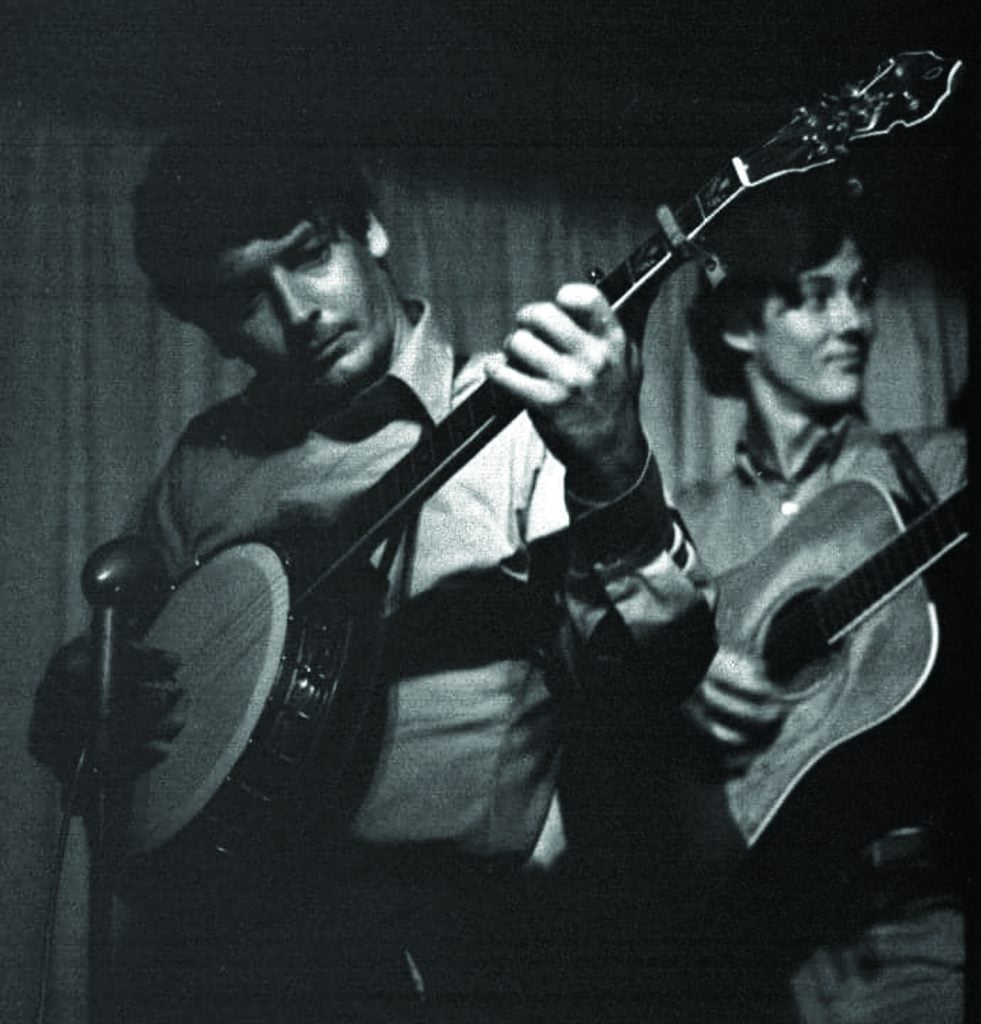
Vernon “Buddy” Spurlock (September 1, 1941 – September 21, 2022) arrived on the bluegrass scene in 1968 when he debuted with the newly formed Bluegrass Alliance. The album notes on the group’s initial record release, a 1969 self-titled piece on the American Heritage label, told that “Buddy comes from [Dwarf in] Perry County, Kentucky, and plays one of the fastest and cleanest banjo styles to be heard. As an admirer of Don Reno, Buddy has developed a style which contains much of the Reno flavor and which includes an intermingling of the older styles with the more progressive.”
Buddy was by no means a newbie when he signed on with the Bluegrass Alliance; he logged nine prior years of picking with regional groups in the Louisville area. Among his picking buddies was Doyle Lawson who noted that “before I moved from Louisville to Lexington he and I got together and picked banjos a few times. I was so impressed with the note separation he had. He was a Don Reno fan and played Don’s style as good as anyone I ever heard while I was trying to pick like J.D. Crowe. But I must tell you he was far better at Reno than I was at Crowe.”
Early members of the Alliance included banjoist Spurlock, mandolin player Mason Richards, fiddler and leader Lonnie Peerce, guitarist Dan Crary, and bass player Ebo Walker. Danny Jones was soon added on second guitar. Near the close of 1970, future legends Sam Bush and Tony Rice were added to the mix. By the spring of 1971, Buddy left the group and was replaced by Courtney Johnson, thus setting the stage for the evolution of the New Grass Revival.
In the three years that Buddy spent with the Alliance, he became known for his “sparkling banjo work, [that was] clean, crisp, and driving.” Throughout his lifetime, he was woefully under-recorded. Two albums of note that highlighted his talents were Dan Crary’s Guitar album and the Alliance’s self-titled first release. The group disc contained two Spurlock originals: “Joanie Hill” and “Naugahyde.” The latter tune, synonymous with the brand name for synthetic leather, was touted by Muleskinner News as “one of the best new Blue Grass instrumentals to come along in a good while.”
After leaving the Alliance, Buddy more or less dropped off the bluegrass radar, but he never lost interest in the banjo. Longtime friend and ace mandolin player Scott Napier recalled that Buddy was “very passionate about playing, and playing well . . . [he] had a burning desire to improve, even though he had no interest in being heard. It taught me that if you have the music in you, it has to come out, regardless.” Others, such as fiddle player Don Rogers, related that “I used to jam with him at festivals. He’d play about two tunes that were complex and spectacular then he’d put his banjo up and just hang out all weekend. I always loved when he’d come around.”