
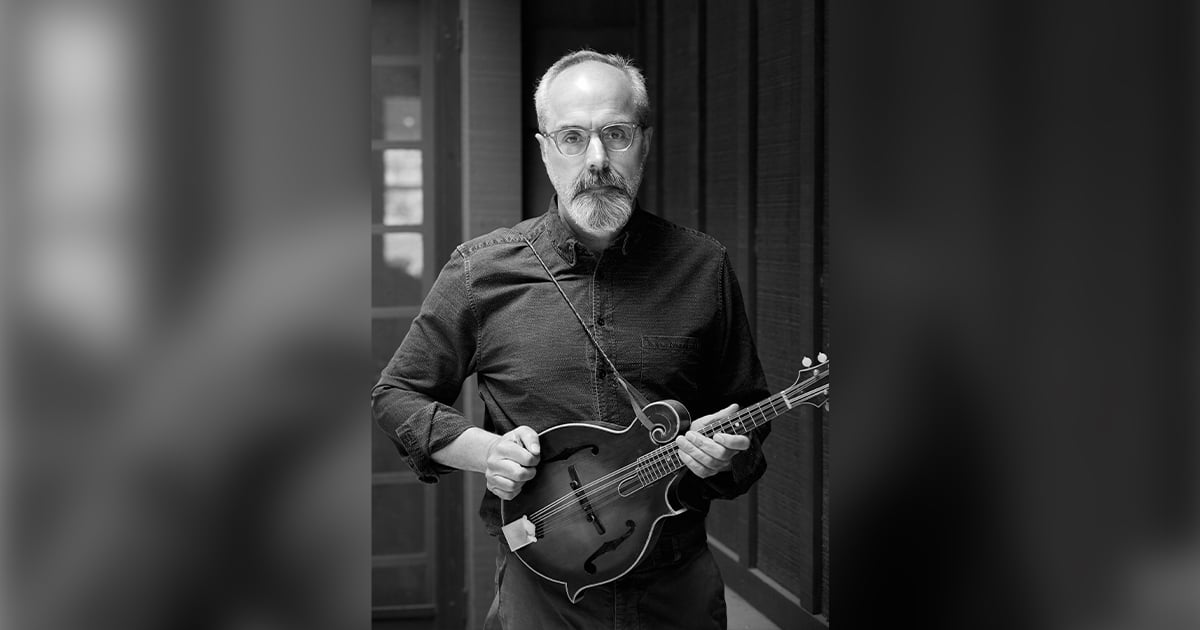
John Reischman Walks Along
Photo By Stephen Schauer
John Reischman lives up in the woods. No, John’s home isn’t a log cabin high in British Columbia’s densely wooded Coast Range. The woods that nurture him and sing new melodies in his inner ear are the stately firs, hemlocks and huge lodgepole pines lining the regal British Columbian hiking trails he walks frequently with his bernedoodle Rosco and wife Gwendolyn.
And even more than those long nature hikes where many of his classic melodic mandolin tunes emerge from the birdsong and the larch winds, John Reischman lives deep inside the grain of the Adirondack spruce and maple tonewoods Lloyd Loar chose for John’s legendary 1924 Gibson F-5 Master Model mandolin. Those ancient, respiratory wooden plates and parts, in John Reischman’s uniquely skilled hands, create unmistakably ancient, arboreal tones.
It’s no wonder so many of his original instrumentals bear names from the natural world and its wildlife. His song titles regularly speak of hidden pathways through the dark wood, like “The Coyote Trail” from his forthcoming CD New Time and Old Acoustic, inspired by the sight of coyotes along one of his favorite hiking spots with Rosco.
Through career-defining stints with the Good Ol’ Persons and the Tony Rice Unit, moving riskily from the bluegrass mandolin-rich San Francisco Bay Area scene to Vancouver in the 1980s, releasing three acclaimed solo CDs with a new one coming on Corvus Records, and founding his bandJohn Reischman and the Jaybirds 20 years ago, John Reischman today still walks the “melodic mandolin” path he helped blaze in the glory days of dawg music, along with a heaping dose of Pacific Northwest bluegrass
Unsurprisingly, John Michael Reischman comes from a family charmed by music. Surprisingly, he and noted blues fusion guitarist, and Miles Davis sideman, Robben Ford both hale from otherwise-unheralded Ukiah, California. Reischman’s mom played piano, and her brother—Uncle Dudley to John—toured as a sax player in the Big Band era. Reischman’s siblings also excelled at music, both as singers and players.
“My brother Steve is very naturally talented. He’s a great singer and rhythm guitar player. We played a lot together when I was developing and learning how to play, not just bluegrass but swing, because he had learned a bunch of swing standards. We really liked trying to recreate that Homer and Jethro sound,” John remembers fondly.
Reischman’s first mandolin experience was on the family television. He’s just not certain what it was.
“I guess it would have been The Dillards on The Andy Griffith Show, or maybe some Italian type of mandolin. All I know is early on I associated (mandolin) with bluegrass, which I was intrigued with. I’d only heard it on TV, Flatt and Scruggs on The Beverly Hillbillies, Foggy Mountain Breakdown in Bonnie and Clyde. Our local PBS station KQED would air folk festivals, and I remember seeing Bill Monroe on there. The one show I saw of his on KQED, I think he played “Orange Blossom Special,” and he didn’t take a solo and just chopped along. And I’m ignorantly thinking, ‘What’s the big deal?’ Later on, I learned better of his reputation.” Up close and personal, it turns out.
Years later, Bill Monroe, Frank Wakefield and David Grisman walk into a bar. This is not a joke. Reischman is playing onstage, only to look up and see the three mandolin heroes stroll in after Monroe’s last set at the nearby Great American Music Hall. They sit down and look at him as if to good-naturedly say, ‘Show us what you got, Mr. Reischman.’
“I was pretty nervous. We ended up jamming after our set,” the younger mandolinist recalls.
Living near the Bay Area gave young Reischman the opportunity to hear live bluegrass when he was old enough to attend concerts. High Country. The Phantoms of the Opry. Laurie Lewis. Kathy Kallick. Paul Shelasky. All these leading Northern California musicians helped sow the seed of melodic mandolin within him.
John started guitar at 12, still plays some today. During a beach campfire on the Mendocino coast with friends, they went over to visit with another campfire where Reischman found a mandolin lying in the sand. “It was in open G, so I could strum and it sounded kind of musical. And I thought to myself, ‘I’ve got to get one of these.’ So I borrowed one, and I tuned it to open E and I didn’t even use a pick, then I got a better mandolin and I figured out how to tune it properly. I knew how it was supposed to be tuned, but with my limited skills I couldn’t relate to it,” he explains. Eventually, the eight-stringed instrument, with its articulate wooden soundboards, became his musical home, and from high school to college, “I spent all my time with the mandolin.”
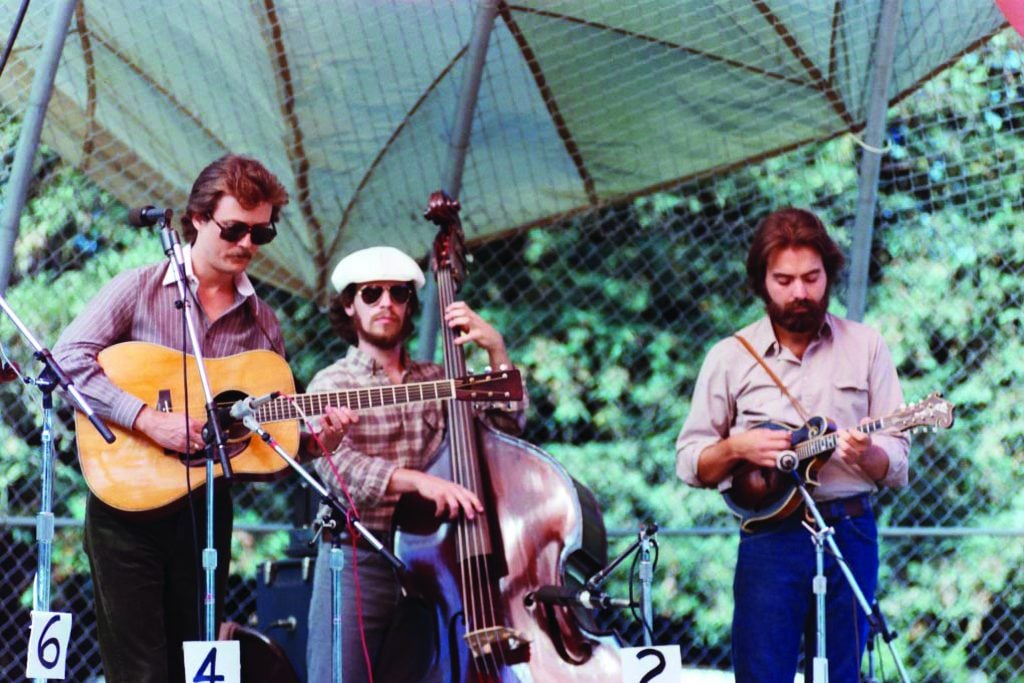
In 1978, John’s seldom-trod trail led to the Good Ol’ Persons, a seminal San Francisco Bay-area group playing traditional and contemporary bluegrass. With an emphasis on original material and a willingness to push bluegrass boundaries, the band gave Reischman a vehicle not only on which to hone his bluegrass mandolin chops, but to demonstrate his impressive compositional gifts. His obvious talent as a soloist and tunesmith soon caught the attention of Tony Rice, who invited John to tour and record with the Tony Rice Unit after a brief audition. For the next several years, Tony proved to be a mentor and friend, with John’s mandolin providing a pivotal sound on tunes like “On Green Dolphin Street,” “My Favorite Things” and John’s great original, “Birdland Breakdown.”
After leaving Tony’s ensemble, Reischman remained in the Bay Area, freelancing gigs and session work, and performing with the Good Ol’ Persons. But when that band stopped performing, John hit a fork in the trail. He chose the one less travelled and headed north to Canada, where the Kentucky bluegrass doesn’t grow, a move some might have thought risky.
“(Vancouver) was a nice place to land,” John recalls. “Years ago when I was in the Bay Area, there was a great mandolin scene. The ones you’ve heard of like David Grisman and Mike Marshall, but then Tiny Moore was not that far away in Sacramento, and a lot of regional players who were great, like Butch Waller and Tom Bekeny. So, there was no shortage of mandolin players. But when I moved to Vancouver, there weren’t really many. And I had toured up here many times so people recognized me. One of the first tunes I wrote was “Itzbin Reel.”It’s on the first Good Ol’ Persons record that I played on. When we toured we made it up to Vancouver, and when we went back the next year, they were all playing “Itzbin Reel,” which was kind of remarkable. So, I was established right away. I did a lot of recording sessions, and I had friends in the newspaper business who ensured I got coverage if I ever did a show or something of note. So, I don’t know, I’ve just been fortunate.”
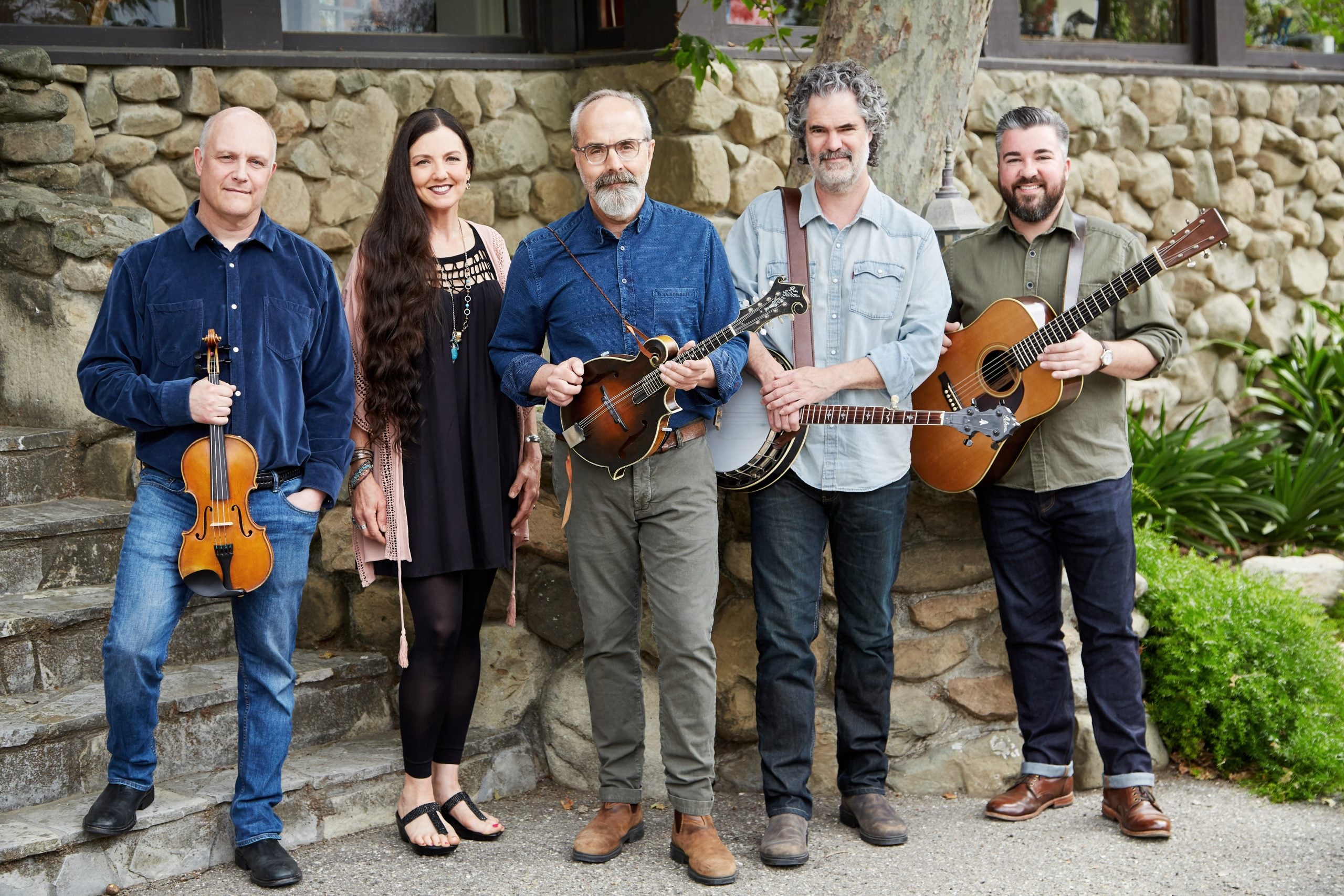
One hugely fortunate turn of his Bay Area-to-Vancouver thru-hike occurred when Reischman decided to form his own band for the first time. John recruited four of the finest bluegrass players in western Canada and the West Coast and called the band Jaybirds. Aside from his solo CDs and some session work and random pairings like his great Harmonic Tone Revealers CD with Sharon Gilchrist and Scott Nygaard, it’s been his main musical vehicle for two decades with no end in sight.
John Reischman and the Jaybirds have toured extensively throughout North America and abroad, bringing a uniquely Pacific Northwest sound to their brand of bluegrass and original acoustic instrumentals. They’ve released seven CDs as a band, earning major Canadian music award nominations and fans worldwide. Merging musical paths with John’s, the Jaybirds feature four exquisitely talented bluegrass musicians.
Vocalist and bass player Trisha Gagnon loves jam-making as much as jamming, perhaps more. Her openly emotive alto voice distinguishes Gagnon as one of the finest female vocalists in bluegrass, and she lays down a solid foundation for the Jaybirds with her strong stand-up bass playing. Another songwriter for the band, Trisha is also a world-class berry farmer and jam-maker. “She won the World Jampionships in Scotland,” her boss says, adding, “Yes, that’s really what they call it.”
Blazing a unique two-finger style on five-string banjo, Nick Hornbuckle’s brilliance gives the Jaybirds fresh sounds at a crucial skilled position. A strong bass vocal harmonist with two award-nominated solo records to his credit, Hornbuckle uses his unorthodox picking style to compose sublime, lyrical banjo instrumentals, adding to the band’s already impressive tunesmithing capabilities. He also digs for rare old-time musical gems.
No bluegrass band is complete without a fiddler, and writer/musician Greg Spatz gives the Jaybirds a diversity of fiddle styles from new acoustic bluegrass, Celtic, and old-time styles. When not jotting notes for his next novel, he’s played with iconic mandolinist Frank Wakefield, Rob Ickes, Laurie Lewis, and Eli West and Cahalen Morrison. Greg, who also plays and records with Mighty Squirrel, has a solo album called Fiddler’s Dream.
Newest member Patrick Sauber replaced longtime Jaybirds guitarist and vocalist Jim Nunally, the band’s only personnel change. Sauber also walks along, performing with Peter Rowan, Laurie Lewis, John Jorgenson, and Tim O’Brien, among other greats. A brilliant interpreter of Clarence White, he gives the Jaybirds a lead guitar voice matching the high standard of musicianship that has been the Jaybird’s hallmark. Recently, he has emerged as a second lead vocalist for the band. And if you look closely, he’s in the “Folk Scare”-era parody film A Mighty Wind with Christopher Guest.
Tony Rice’s Death and Influence
Some trails end, abruptly. Given John’s contributions as the Tony Rice Unit’s mandolinist on its landmark albums Backwaters and 1981’s Still Inside, and his close relationship with the guitar legend, the news of Rice’s sudden passing affected Reischman deeply.
“It was definitely a sad thing, and it hit me hard,” he shares. “I wasn’t too terribly surprised. I felt in a way he had already left us. I wound up dreaming about him a lot, thinking about him a lot. It’s very tragic.” Their relationship was deep, but brief, lasting only during Tony’s time living in the Bay Area. Once the guitar legend moved back east, Reischman lost touch with Rice except for brief encounters.
“He was always very encouraging to me early on, right from the audition (for the Unit). He always very positive toward my playing,” Reischman says. The former bandmates did cross paths at festivals like Merlefest, and John had even hoped to have Tony play guitar on several tracks on Walk Along John, which also would have reunited the duo with former Unit bassist Todd Phillips.
“I had hoped to record with Tony and Todd again. I feel like I developed much more as a musician in the time since we played, and I wanted to revisit that musical relationship,” Reischman recalls, adding with his trademark sly introspection, “I can’t play as fast as I used to, but I like what I play better now.” Although Tony was up for the reunion and the two exchanged texts, a session could never be arranged before Rice’s declining health forced him to stop playing and singing.
As a musical intimate of Rice’s, Reischman feels that one aspect of Tony’s genius was underappreciated in the many tributes filling guitar and bluegrass media following his sudden passing.
“I think a lot of (tributes) overlooked his compositional abilities. He just was prolific at that time he did “Swing 51” and “Neon Tetra” with Grisman. Tony was writing lots and lots of tunes, and they were just beautiful pieces. I was definitely influenced by his writing in some of my own compositions. Like the tune “Brooks” (track #5 on North of the Border) was definitely influenced by my time with Tony. I think Tony may be underrated as a composer because, if you look at it, most people pay attention to more of his bluegrass stuff and Manzanita, and rightfully so. Manzanita is one of my favorite records of all time. I’m very proud he said his favorite CDs were Manzanita and Backwaters, and I’m part of one. So, I’m pretty proud about that.”
Reischman took inspiration from Rice’s experimental, soaring new acoustic music and found the confidence to explore the melodic trails and pathways conjured within his imagination. One seductive path led south of the border, and John walked along.
His passion for mandolin-like instrumental music from Brazil, Puerto Rico and other Hispanic regions stems from a random Good Ol’ Persons fan handing John a cassette during a break in their show. He remembers, “it was a cassette of jibaro Puerto Rican music, and I started learning those tunes. Then I got a cassette of some Brazilian music, some choro, and I really liked that because it sounded like it was mandolin with rhythm. Of course, it was not a mandolin but a cavaquinho. And I got into more of the samba end of things from Brazilian music. The more classical-sounding choro pieces, I was not as interested in. I never delved into it heavily as some people have. But I have a number of tunes that I remember and play, and I get to play them with (fingerstyle guitarist) John Miller.”
Buoyed by his mentor’s confidence in his composing chops, Reischman also concentrated on building what eventually became a large catalogue of original tunes. Some, like “Salt Spring,” “Little Pine Siskin,” “Itzbin Reel,” and “Birdland Breakdown,” have emerged as jam session standards, especially west of the Mississippi where the grass along John’s walks grows a special shade of blue.
His inspiration as a composer relies in some ways on what the Japanese call shinrin-yoku, which translates to ‘forest bathing’—immersion into the green silence of wooded nature.
“Several of the numbers featured on Up in the Woods came to me not with a mandolin in hand, but while out for a walk,” he tells Bluegrass Unlimited. “I believe (tunes like “Greenwood,” “Nesser” and “The Nootka Blues” that came to him on hikes) are some of the strongest melodies I’ve written.”
Asked if he writes mostly at home with an instrument in hand or when he’s walking wooded tracks, Reischman says it’s a bit of both. “And both are represented (on New Time and Old Acoustic). “There’s a few that came to me while I was out walking and I sang the melody into the phone, and then I’d develop it from there. It might be just one part of a tune and I’ll play around with it from there, sit down with the mandolin and work on chord voices and ways to reharmonize it chordally. Some happen quickly, because I accept more of them when I’m a roll of writing. Sometimes I go years without having written anything new.”
Finding the tiniest of silver linings in the otherwise coal-clotted cloud of global pandemic, Reischman explains that having no live shows for 14 months gave him the time to concentrate on writing and polishing the tunes for New Time and Old Acoustic.
“I had written some, but I only had four tunes ready to go, and this free time gave me the chance to keep writing and writing and exploring new opportunities. And the other reason I’m glad I had this time is because at first, it seemed like I was just recreating the template that I used for Walk Along John,” he says. “But then, gradually, the tunes started changing a little bit. They still kind of relate to some of the tunes on Walk Along John, and maybe to a lesser extent Up In The Woods. But I always thought that on my next recording, I might want to take a more jazzy approach. Not quite like I did with the Tony Rice Unit, not swing. But I guess new acoustic is the best thing to call it. And it turns out I came up with a few tunes that kind of loosely fit that description, and I chose musicians I thought would be appropriate for them.”
Indeed, tunes from the new CD like The Old Road to Kingham and Cascadia do remind the listener of the composer’s jazz-influenced early work with Rice. They’re a switchback trail to Still Inside, dreamlike and elegiac. The instant classic Cascadia, flows like an eddy spinning off from Backwaters with great solos from Chris Eldridge and John.
Sharing The Knowledge
Not only has Reischman planted deep roots around the mandolin world, he’s grown to enjoy spreading the seeds of his experience and expertise. But it wasn’t always that way.
“The first workshop I ever taught was kind of a disaster,” he tells Bluegrass Unlimited. “I had no idea. I had not even done that many private lessons. I think the difference now is that I have a better idea of what people will be receptive to at different levels. What I was teaching then was all over the map. I knew how to play what I play, and I thought that’s what they’d want to learn. But I realized later, your typical student is not at a professional level. And just a little thing from, say, teaching basic double stops to someone’s who’s only playing fiddle tunes can be really eye-opening to them. So, I figured out a way to sort of dole out the information in a way people can be receptive to.”
Years of teaching the popular Melodic Mandolin Tunes course at pegheadnation.com also inform Reischman’s own vision of himself as a musical educator. When the pandemic hit, all Peghead Nation instructors started taping their lessons at home. Viewing the tapes he submitted after being edited and post-produced for his students gave Reischman a fresh perspective.
“I’ve been filming the Peghead Nations videos myself during the pandemic, and every time I view the raw footage, I think, ‘Oh this is terrible, that this is not good at all.’ And then they send me a proof of what they’re going to post, and it always surprises me. ‘Oh yeah, I guess I actually do know what I’m talking about.’ So, I mostly have learned to have faith in my ability to communicate,” he explains.
Showing that newfound communication confidence at one of the Marshal Mandolin Summit workshops sponsored by Northfield Mandolins, John and Sierra Hull were teaching a class on improvisation. Adding to Sierra Hull’s comments on hewing close to the melody when soloing, then building on prior knowledge of fiddle tunes to add fresh notes to the solo as it soars, John explains,“Even if you can’t play the melody note for note, you can follow the contour of the song as it rises and falls. That’s one thing to think about when you’re improvising, and trying to reference the melody. Maybe not every little detail and every little stairstep, but if you can get the main melody tones—a lot of times it’s chord tones—that’s something to shoot for. A lot of my improvising is double stops and chord tones.”
Although he suffers from no repetitive stress injuries or other health issues common to musicians, Reischman does recognize how aging has affected his playing.
“I do notice I can’t play quite as fast as I used to, but I can play fast enough. I realized that when we had Good Ol’ Persons reunion tours, and I tried to play along with the records and they were blazingly fast tunes. So, I definitely have a speed threshold, depending on the type of tune. But I still like my playing. I like the way I sound, I’m happy with tunes I’ve come up with. It’s been great to play with younger musicians, like I rerecorded the tune “Salt Spring,” which seems to be my ‘hit’.”
The stellar opening track from New Time and Old Acoustic features emerging bluegrass stars Molly Tuttle, Alex Hargreaves, Max Schwartz on bass and Allison DeGroot on banjo. “I think Max may not even have been born when that tune was written. It’s been fun to hear that tune become sort of a jamming standard now, and it’s gratifying to play with those younger guys,” the bearded, distinguished-looking trailhead of the Pacific Northwest’s bluegrass passageway says.
Like notes offered in melody or harmony, some trails merge with other trails. Some trails form loops of themselves. Some trails, like the one followed by John Reischman since he unearthed a mandolin from the sands of eternity, do both.
Ask John Reischman about the inevitable end of his career as a musician, and he doesn’t wax poetic or indulge in maudlin philosophy.
“Well, I’m not playing pizza parlors,” he replies with a sly smile, referring to the many Good Ol’ Persons gigs at a noted Bay Area pizzaria. “And I’m playing with people I really enjoy playing with, I like spending time with. So that’s gratifying. I just plan on keeping on playing.”
Walk along, John Michael Reischman.