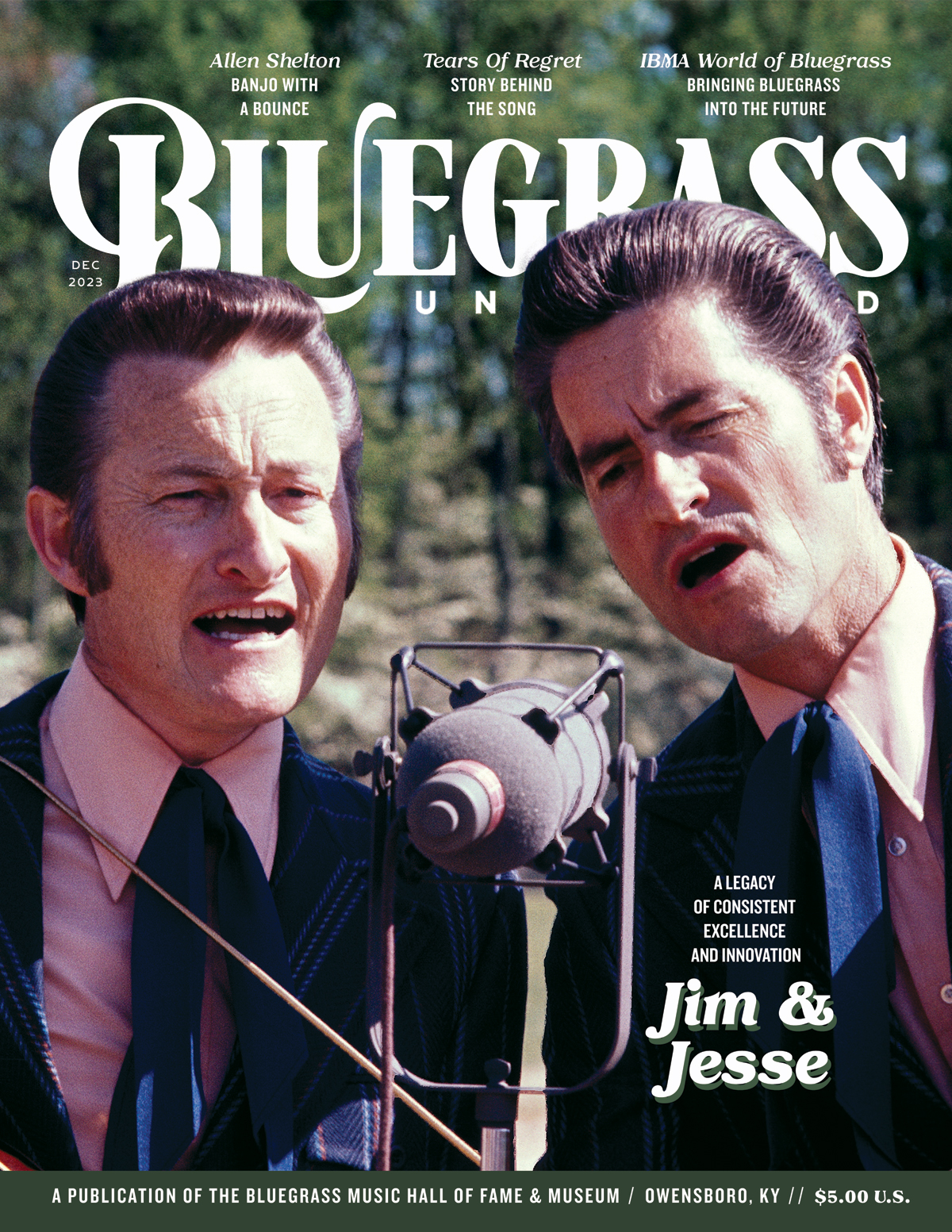
Jim & Jesse
A Legacy of Consistent Excellence and Innovation
With the passing of Jesse McReynolds and Bobby Osborne on June 23 and 27, 2023, at ages 91 and 93 respectively, most pioneers of the bluegrass sound have passed on and younger musicians are challenged to build on the musical foundation of artists like Bill Monroe, Flatt and Scruggs, the Stanley Brothers, Reno and Smiley, Jim and Jesse, Mac Wiseman, the Osborne Brothers, and Jimmy Martin.
Jim and Jesse McReynolds were born in 1927 and 1929 in the mountains of southwest Virginia in Carfax, near Coeburn, Virginia, into a musical family. Their fiddling grandfather, Charles McReynolds, recorded for Victor Talking Machine Company in Virginia at the historic Bristol Sessions the same year elder brother Jim was born. Initially featuring Jim on mandolin and Jesse on guitar, the brothers decided to swap instruments and work up their nerve to try singing to accompany their picking. Reserved by nature with a dry sense of humor, Jim and Jesse were as determined and hard-working as they were talented, and in 1947 they decided to pursue a music career.
Separated as musical partners only by military service and death, for 55 years Jim and Jesse played music, wrote songs, married sisters Arreta and Darlene (Jesse’s first marriage), and lived next door on adjoining properties near Gallatin, Tennessee.
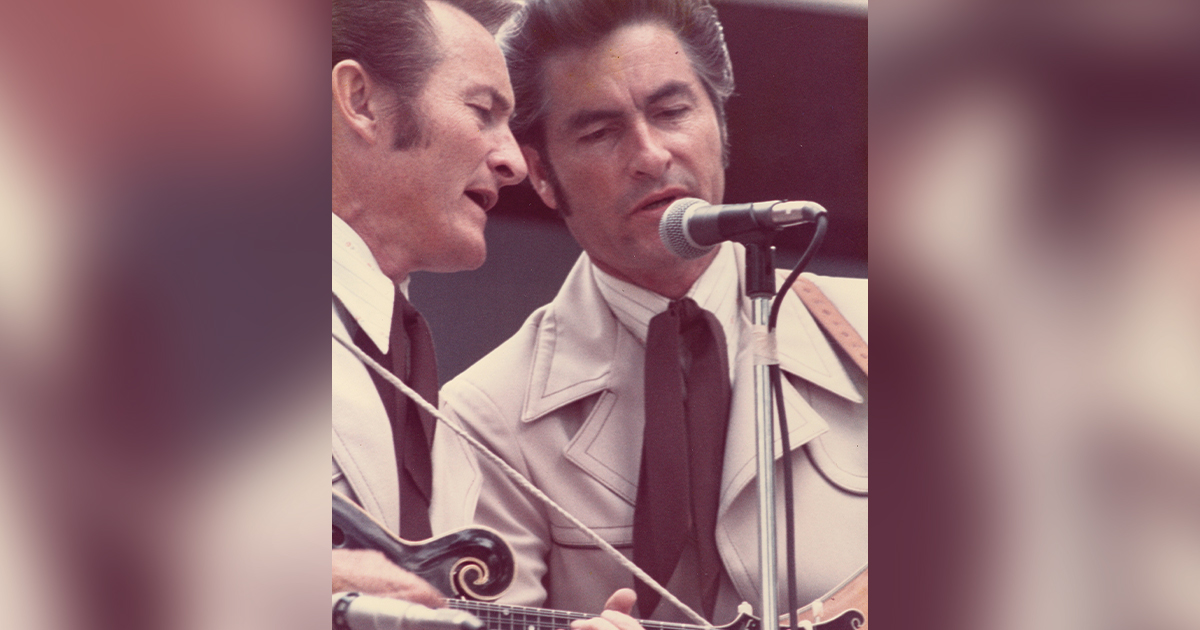
Their music was instantly recognizable and consistent, but also innovative. Whether they were performing an original song or playing a cover like John Prine’s “Paradise” or Johnny Horton’s “Ole Slew Foot,” and despite personnel changes over the years, there was a definite Jim and Jesse sound that fans could not get enough of. Jesse’s unique cross-picking style of playing the mandolin and his split-string technique put an original stamp on their songs, along with the brothers’ transcendently beautiful, heartfelt, high-sailing vocal harmony style that has never been duplicated. Jesse could play the mandolin tremolo-style like a pair of hummingbird wings, like a ragtime piano, a bluegrass banjo, or a rock ‘n’ roll or blues guitar, choosing repertoire and rhythms from around the world, as well as creating original music. Jim and Jesse kept their fans and themselves entertained over the decades with numerous innovations and experiments in composition, arrangement, repertoire, and instrumentation. Consistently excellent, yes. Boring, never.
“Jim and Jesse and the Virginia Boys achieved a rhythmic synchronization that could make a stage floor move with them, a pulsing forward movement like a freight train going by while you’re close to the track,” says IBMA Foundation president and bluegrass historian Fred Bartenstein. “Future bluegrass bands would do well to study and emulate that approach. In addition to a rich catalog of their own originals, they are largely responsible for bringing the Louvin Brothers and Johnnie and Jack repertoires into the bluegrass canon. Of course, Jesse’s cross-picking and split-string styles of mandolin playing were giant innovations that expanded the capabilities of that instrument. Much like Earl Scruggs’s virtuosity on the banjo, Jesse’s on the mandolin set a standard that is rarely if ever matched. But the example he set raises the bar for all that follow.”
Bluegrass Hall of Famer and author Neil Rosenberg agrees. “I think Jim and Jesse will be remembered for their perfect harmony duets and for their decades of maintaining a bluegrass band sound created by the most skilled musicians in the business. Jesse’s brilliant mandolin style, his prowess as an instrumental composer, and his appetite for repertoire that stretched from old-time to rock mark him as a man of creativity and vision.”
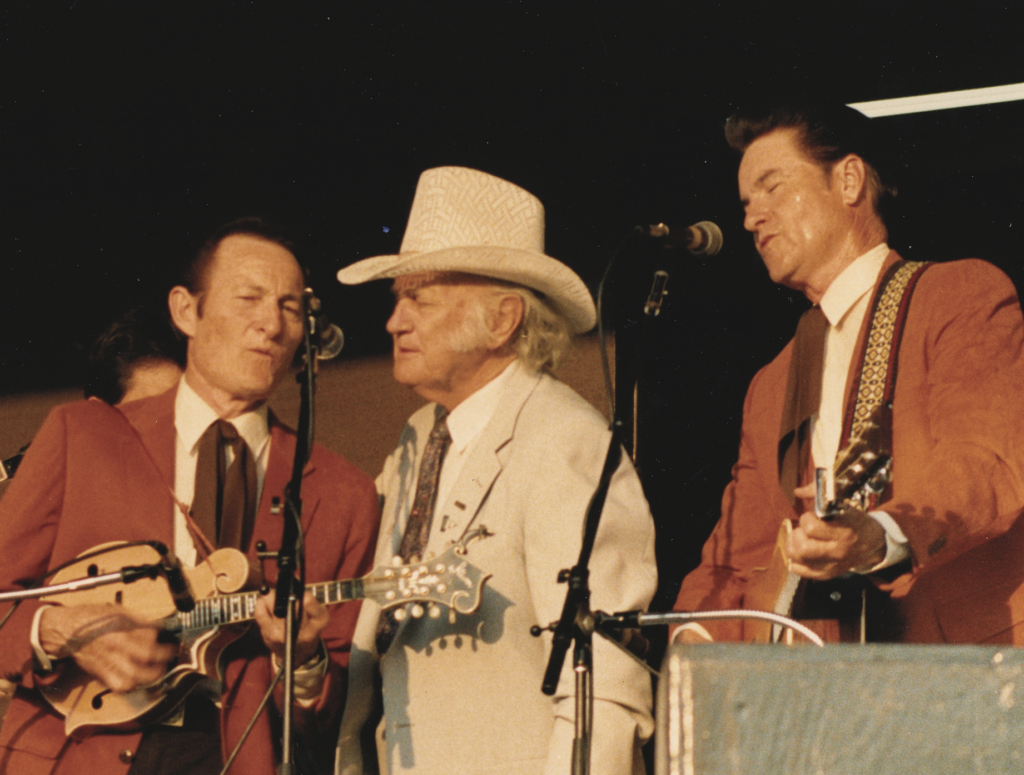
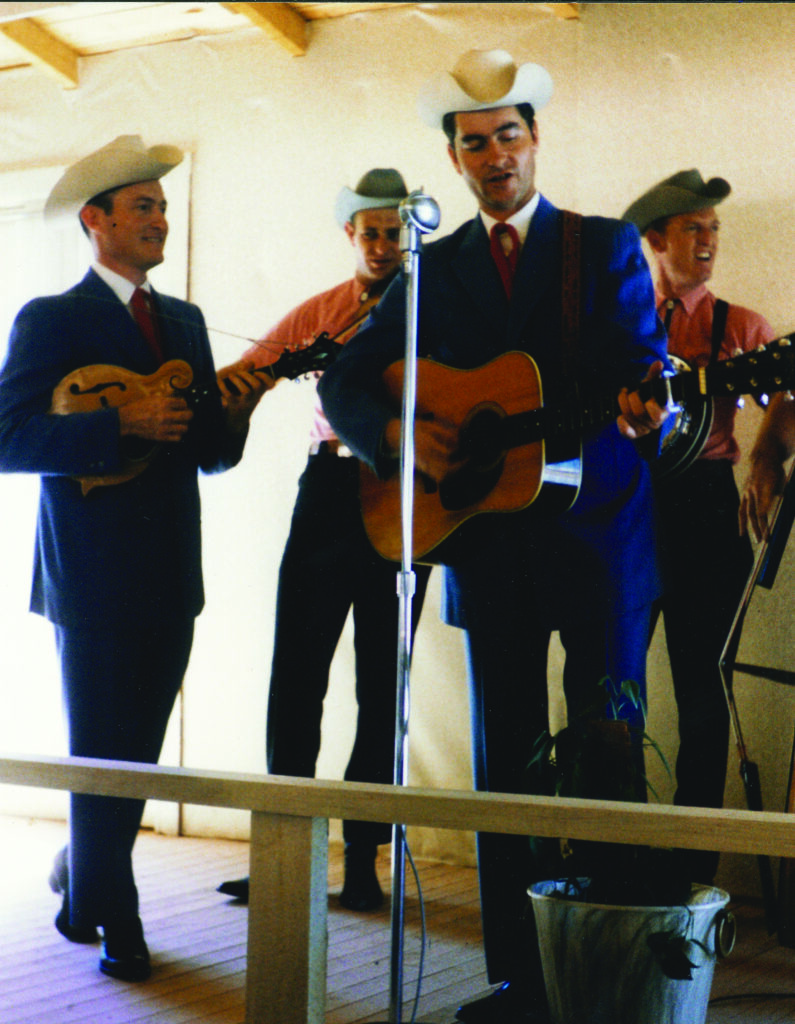
In 1947 Jim completed a two-year stint in the Army at the end of World War II, and Jesse graduated from high school. During the next 14 years they played on more than a dozen radio stations in at least 10 states. Their band included fiddle, mandolin, guitar, bass, and a banjo player when they found a good one. In 1949 Jesse devised a way to use a flat pick on his mandolin to imitate Hoke Jenkins’ backward banjo roll. Their smooth vocal harmony, perhaps influenced by early radio station gigs in Iowa and Kansas playing cowboy music, established a unique sound. Originally billed as “The McReynolds Brothers, Jesse and James, and the Cumberland Mountain Boys” from 1947-52, they performed on the radio and at local dances with their fiddling brother-in-law Oakley Greear.
In 1952 they signed with Capitol Records, and the band name changed to “Jim and Jesse and the Virginia Boys.” Over the years Jim and Jesse together and separately recorded more than 50 albums and numerous singles for the Columbia (and its subsidiary Epic), Starday, Opryland, CMH, Rounder, Pinecastle, OMS, Atteiram, and their own Old Dominion and J and J Music labels. In 1952 their first single for Capitol was “I’ll Wash Your Love from My Heart,” backed by “Are You Missing Me.”
More songs were recorded during Jesse’s two-week furlough between Army basic training and his departure for Korea. Jesse drove a jeep for the Army—including a brief job chauffeuring Marilyn Monroe on a 1954 tour to entertain soldiers! He also played in a five-piece band with Charlie Louvin while they were stationed at the same base.
Jim farmed in Virginia from 1953-54 until the band started up again. He and Jesse got their records placed in jukeboxes; they appeared on regional television throughout the Southeast; and they lined up sponsors like Ford Tractors, Pet Milk, Jim Walter Homes, and Martha White Mills. A sponsor of the Grand Ole Opry, Martha White asked the McReynolds brothers to be guest hosts, which led to them joining the Opry on March 2, 1964, and their move to Tennessee.
A few of their early hits included the Louvin Brothers original “Are You Missing Me” and the McReynolds’ own “I Will Be Waiting for You” and “Just Wondering Why” for Capitol. In 1958-59 Jim and Jesse produced “Hard-Hearted,” “Border Ride,” and “I’ll Love Nobody Like You” for Starday. On Columbia Records, Jim and Jesse recorded their first top-100 country chart hits: “Cotton Mill Man” (1964), “Better Times a-Coming” (1964), “Diesel on My Tail” (1967), “Ballad of Thunder Road” (1967), “Greenwich Village Folk Song Salesman” (1968), “Yonder Comes a Freight Train” (1968), and “The Golden Rocket” (1970). The brothers released one of the first bluegrass-rock crossovers in 1965 with their Chuck Berry tribute album, Berry Pickin’ in the Country. In 1969, the Doors’ Jim Morrison picked Jesse to play mandolin on The Soft Parade.
Jim and Jesse, the longest active professional brother duet in country music history at 55 years, performed in all 50 states except Alaska, on bluegrass cruises, and in Canada, Mexico, Japan, Europe, the British Isles, and Africa. They were inducted into the Country Music Hall of Fame’s Walkway of Stars, the Virginia Country Music Hall of Fame, the IBMA Hall of Fame, and Bill Monroe’s Bluegrass Hall of Fame. Separately they have been nominated for four Grammy Awards, numerous IBMA awards, and in 1997 they received the prestigious National Heritage Fellowship from the National Endowment for the Arts in Washington, D.C.
Jesse’s son and bass player, Keith McReynolds, contracted multiple sclerosis and died at the age of 44 in 2000. In 2002, both McReynolds brothers were diagnosed with different types of cancer. Jesse recovered but Jim passed away at age 75, on the last day of that year.
After Jim’s passing Jesse continued, first adding tenor singers Donnie Catron and then Charles Whitstein to the band. Next, he performed and recorded with his grandchildren, Luke McKnight (Gwen’s son), and Amanda and Luke McReynolds (Keith’s children), featuring a beautiful three-part vocal blend.
Jesse and his wife Joy opened the Pick Inn next door to their home in Gallatin and hosted music festivals, concerts, weddings, a local radio show, and other events. In 2010 Jesse collaborated with David Nelson of New Riders of the Purple Sage and Stu Allen of the Jerry Garcia Band to record Songs of the Grateful Dead. Recommended by Ronnie McCoury, Jesse even found himself playing an acting role on the CMT television series, Nashville, in the 2017 season premier opener.
Jesse’s most recent Pinecastle album was a fiddle tribute to his grandfather, featuring fiddlers Jim Buchanan, Michael Cleveland, Glen Duncan, Buddy Griffin, Corrina Rose Logston, and Eddie Stubbs, all playing the historic fiddle that belonged to Charlie McReynolds. “Soldier’s Joy,” a collaboration with Michael Cleveland, made Jesse the only bluegrass musician in history still getting IBMA award nominations into his 90s. Jesse was friends with Ketch Secor and sat in frequently with Old Crow Medicine Show, and he was a hit at the Grateful Dead’s Rex Foundation concert in 2010 at the legendary Fillmore Auditorium in San Francisco, California. Jesse worked for five years to produce and record the Grateful Dead tribute album in 2010. Recorded at Gaintrain Studios in Hendersonville, Tennessee and co-produced/engineered by former Virginia Boy Steve Thomas, Jesse said it was one of the most exciting things he had done in 20 years.
In 2018 he released Jesse McReynolds Introduces the Mandolobro, featuring an instrumental set of music on the enchanting hybrid instrument. He continued playing the Opry through March 2020, when the COVID 19 pandemic pared down the format at the historic radio show. Jesse was working on a new McReynolds pinkie-finger style of playing that involved split-string playing with triple strings instead of two, he talked about his plans to organize a mandolin orchestra concert to play Bill Monroe songs at the Ryman, and he started writing his autobiography.
In addition to the years with his brother, being an Opry member, and the National Heritage Fellowship, Jesse’s wife Joy said he was most proud of creating an original style on the mandolin. “Some people say his style came from this place or that place, but you can take it from me when he told me he sat down and created it early on, in a rooming house in Virginia. There might have been other people who heard it, but the cross-picking and split-stringing were totally his creation,” she said.
“He was proud of the Best Instrumental Recording IBMA Award nomination for Breaking the Rules, an OMS project he did with Travis Wetzel in 2005, but as a solo artist I think he was most proud of the Grateful Dead project. He took it very seriously, it remains his most asked for album to this day, and it truly is a masterpiece,” she added.
“Jesse was very complicated,” Joy said, “but one thing about his personality was his amazing ability to get along with everybody. He didn’t have an enemy. Everybody that met him fell in love with him. I’ve never seen anything like it before, and I’ll never see it again. He was very big on avoiding conflict. I know he swallowed a lot of feelings when he was on the road for 55 years, but he and Jim made it—and that’s something to be proud of. But of all things, I think he’d most like to be remembered for his great faith in God.”
Jesse McReynolds was known for his drive to create and his work ethic – a powerful combination. “I would hear him playing in his music room from time to time, but he was very shy,” Joy said. “He did his best practicing when I was out of the house mowing the yard or doing something else. He needed privacy to create. I tried to keep his life as happy and stress-free as possible because I knew he could do his best creating that way. He needed to play music as much as he needed to breathe; that’s how important it was to him.
“Someone commented recently, saying, ‘It’s a shame I never met Jesse,’” Joy said. “I told him, ‘You’ve met him if you heard and like his music, because he was just like that…. He was open and honest and kind, and he could get a little bit fiery and temperamental, but he came right back to his usual sweet self. He was truly an amazing person.
“Our family still owns the McReynolds homeplace in Virginia, and we are working to fix it up to preserve it for future generations to see how Jim and Jesse grew up. We want to keep their memory alive. The last few years, Jesse was writing a book about his life. We are taking that manuscript, and with the help of Dennis McNally we will be coming out with Jesse’s book. To be Jesse’s wife and love for 27 years, I was so blessed. I will never forget.”
The accomplishments and decades of creativity from Jim and Jesse McReynolds, together and separately, are mind-boggling. Perhaps their legacy is best described by former Virginia Boy members and the musicians they influenced. Please see a few of their comments in an article elsewhere in this publication.
Thanks to resource Fred Bartenstein, co-author of The Bluegrass Hall of Fame, jimandjesse.com, the McReynolds family, and all the band members and musicians who took the time to send their comments. -Nancy Cardwell, proud Virginia Boy (2017)