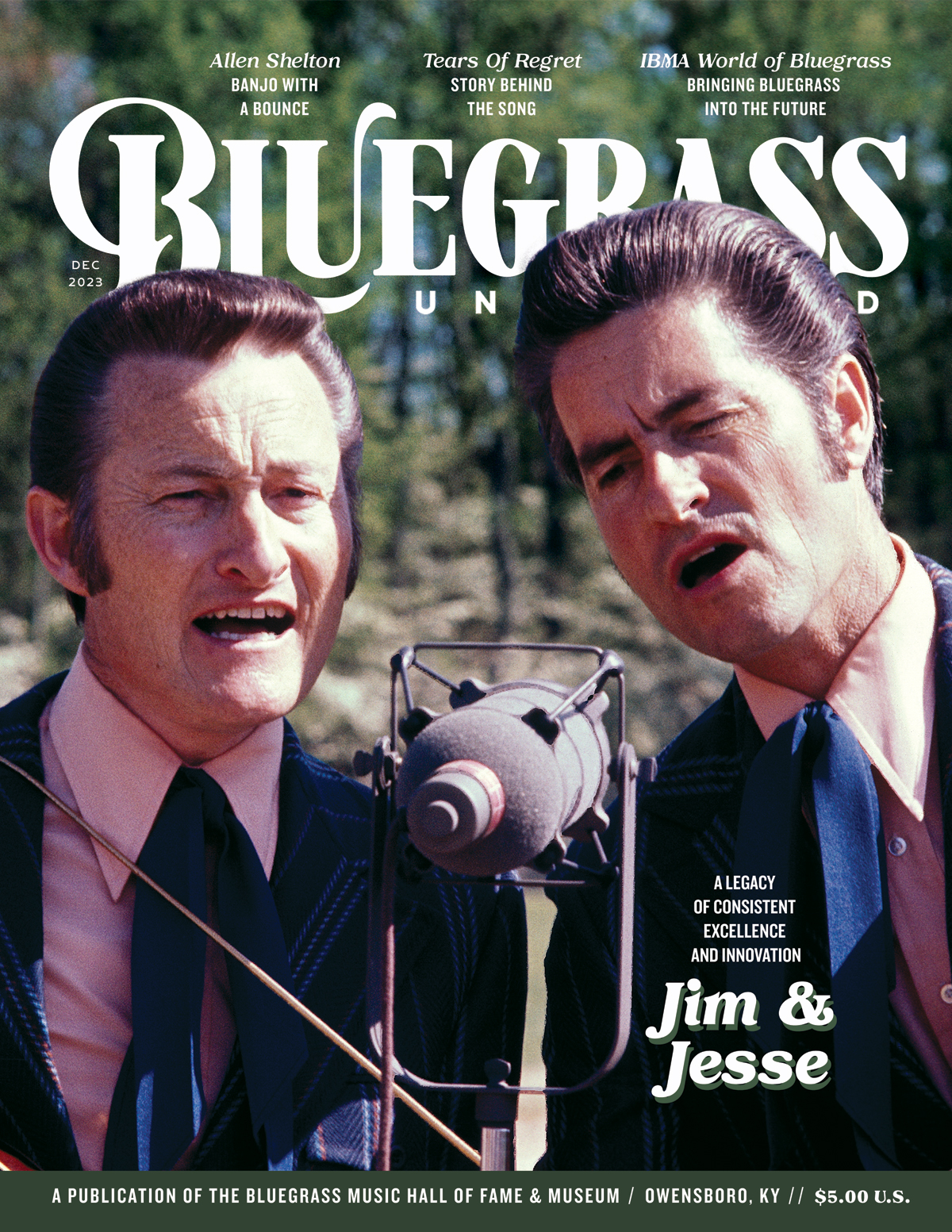
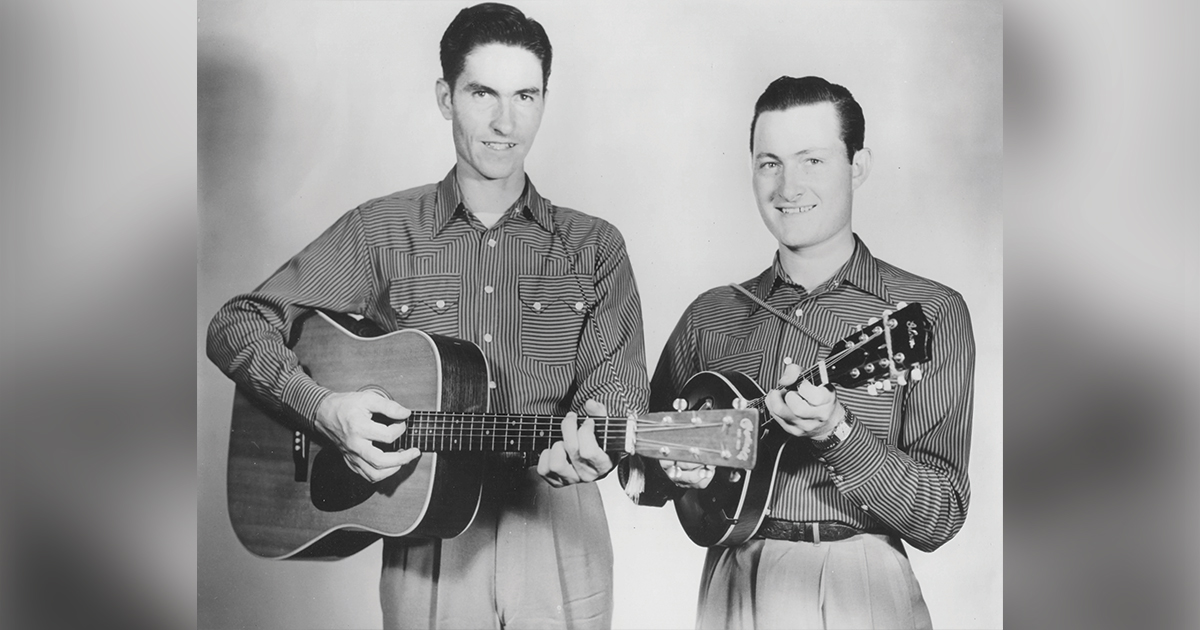
Jim and Jesse: Falling Leaves and Accolades
In the well-known song by Grandpa Jones, “Falling Leaves,” we’re told: “To your grave, there’s no use taking any gold. You cannot use it when it’s time for hands to fold. When you leave this earth for a better home someday, the only thing you’ll take is what you gave away.”
Jim and Jesse certainly gave away a lot to those who follow in their footsteps. From “A” to “Z” (Aldridge to Zenkel), here are a few comments from former band members, mandolin players, singers, and colleagues who were inspired by their music, their business savvy, and their friendship.
Darin Aldridge (mandolin):
“I have loved the music of Jim and Jesse since I first heard it in the early 1980s. Jim’s voice always reminded me of my grandpa singing, and it was something special when Jesse added his voice to blend. Jesse‘s mandolin playing was so distinctive, and the way he could play the melody throughout the song set him apart from everyone else. In the late 1990s I was a member of the Country Gentlemen and recall being on the circuit with Jim and Jesse often. I’m fortunate that I was able to see them a lot before Jim’s passing in 2003 and experience first-hand the inimitable Jim and Jesse sound. I don’t think there will ever be another duo as good as Jim and Jesse. From their brother duets and the material they chose to play, they left a huge impact on bluegrass music in their singularly unique way that no one else will ever capture.”
Fred Bartenstein (IBMA Foundation):
“I’ve always been struck by the effortless-sounding beauty of Jim’s tenor vocals, quite a contrast to the intensity of most bluegrass and country music tenors. I tried to emulate his approach and came pretty close on a version of ‘Sowing on the Mountain’ I sang with Bob Applebaum in my teens. Jim’s solo vocals also knock me out every time they come up on my iTunes. I have known Jim and Jesse’s recordings since my early teens. I bought a sealed LP of Bluegrass Classics (1963) in New York City and was initially disappointed that inside was a white-label disc jockey version of The Old Country Church (1964). But when I heard the first few cross-picked notes of “Swing Low Sweet Chariot,” I knew I had a serendipitous winner. After that, I saved my money to complete my collection of all their Epic albums and the two-record reissue of their earlier Capitol singles (1968). In the early 1980s, my toddler daughter Anna danced wildly to Jim and Jesse’s ‘Ole Slew Foot,’ a treasured family memory.
“I first saw Jim and Jesse live either at Carlton Haney’s Berryville festival or at Sunset Park in the late 1960s. I brought them on and offstage countless times as an emcee, and we developed a good friendship through the years. After Saluting the Louvin Brothers came out, they toured with a bluegrass/country fusion band that I loved, with Doug Jernigan on steel, Carol Johnson on high-baritone vocals, and Joe Greene on fiddle. Before the bluegrass festival scene matured into a stable economic platform for bluegrass, acts like Jim and Jesse, the Osborne Brothers, Reno and Smiley, and Jim Eanes presented themselves to radio, jukeboxes, and live venues as country music, and darned good music it was!”
Alan Bibey (mandolin):
“Jesse’s style definitely influenced me. First, I wanted to learn how he did that cross-picking and split string stuff. I’m still working on that! Unreal! Most of all, even as a young kid it hit me that it could be great to be different and do your own thing. I met them first when I was eight or nine in Statesville, North Carolina. Jesse had just come out with a new mandolin album, and I was dying to get it. I loved their music, and Jim and Jesse were always so kind and encouraging. I won’t forget that.”
Jim Britton (Virginia Boy 1997-99):
When he joined the band on New Year’s Eve in 1997, Jim said it was “a dream come true, and an absolute honor to work for these men. They were part of the first bluegrass concert I ever attended years ago, and I had no idea I would have the privilege of working for them. Jim and Jesse were very professional and courteous, very down-to-earth and kind to me. My favorite part was always on stage at any venue and especially the Opry. The music just flowed through them. There was never any real tension that I can remember on the road traveling. Jim and I did 95% of the driving, and everyone got along fine.”
Jesse Brock (mandolin):
“I have definitely been influenced by Jesse McReynolds’s style and how it fits with vocalists. He used his instrument like a piano, finding the ranges that blend with what is going on around him. I use this technique today. I grew up listening to Jim and Jesse duets, as well as the Louvin Brothers, the Wilburn Brothers, and the Lilly Brothers. There is freedom to do cross-overs as a duo. Growing up with two singing sisters, I learned how to weave around such crossings and enter into a third-part realm.
“Jim and Jesse’s iconic blend was different than the Louvins in the way that Jim could roll his tenor voice around brother Jesse as he delivered a straight lead. It was a tapestry of sound incomparable in its time or even now. They, like many other colleagues, added drums on later records to bring a younger crowd in and is as close to real country music as you are going to get. The unmistakable sounds of Jesse’s pick flowing back and forth, choosing patterns like Earl Scruggs would on the banjo with the advantage of three picks, was poetry in motion. At times, that mandolin in his hands would sound like what I would imagine an angel’s harp sounding.”
Sam Bush (mandolin):
“Growing up outside of Bowling Green, Kentucky, we were within close enough proximity to Nashville television that I got to see Jim and Jesse a lot on Nashville shows like Ralph Emery’s show before I went to school, and sometimes they would be on the Bobby Lord afternoon show. At 5:45 each morning on WSM was the 15-minute Martha White Show. Flatt and Scruggs did it for many years, and then Jim and Jesse took it over. My father really loved Jim and Jesse too, and he would carry a transistor radio around the house. He’d stick that radio in my ear, and many a time that’s how I’d wake up!
“They came to the Bowling Green High School auditorium when I was around 14. Dad and I were walking up about a half hour before the show and here comes their bus, the door opened, and Jim was driving. Jesse said, ‘Hey, do you all know how to get to the back of the auditorium?’ So, my dad said, ‘Sure!’ and we got to hop on their bus and ride a few blocks. Jim must have taken one of those turns pretty sharp, because all of a sudden, we heard a big THUD from the back of the bus, and apparently Jim Brock, the fiddle player, had fallen out of bed, which cracked up Jim and Jesse. That night was a stellar show, and they were doing material from the current album that had ‘Sleepy-Eyed John,’ ‘Ole Slew Foot,’ and ‘Better Times a-Comin,’ and also ‘Cotton Mill Man.’ It was just classic. And they always called ‘Dueling Banjos’ ‘Mockin’ Banjo.’ When I got my got my first mandolin when I was 11, a Gibson A-50, one of the first things I tried to play was Jesse’s melody on ‘Mockin’ Banjo.’
“I loved when they did Berry Pickin’ in the Country; I saw them do those songs on television with Allen Shelton and Jim Brock. They were always at the cutting edge of progressiveness, while you could plainly hear their Louvin Brothers and bluegrass roots in their beautiful harmonies. I didn’t realize what a monumental thing it was for them at the time to record an album of songs by an African American artist. The Jim and Jesse version of ‘Brown Eyed Handsome Man’ turned me onto Chuck Berry songs.
“I always admired them and probably took their cue, along with the Osborne Brothers and the Dillards, on how to augment and give more than just your stage sound on records. Jim and Jesse were using pedal steel and other instruments on their recordings, and it sounded great to me! It was the next logical step to add certain instruments to your sound, but that’s because I had them to look up to and listen to.
“Future bluegrassers will have Jim and Jesse to look up to when it comes to duet singing – the way you interweave the harmonies. You don’t hear that as much as you once did. And their stage demeanor…when Jim and Jesse played, it looked so easy, when in fact it was not easy, but it was natural for them. People talk a lot about Jim’s singing, when in fact, Jesse was one of the best singers that ever sang. He didn’t have a high, lonesome voice, but he was so smooth. It was Jesse’s lead singing that really made the sound for me. When I was a kid, I could split strings a little bit. So, in addition to the cross-picking, the way Jesse would split the strings to make a three-part harmony that you can’t get any other way seemed effortless, but I’m sure he worked hard to get that figured out. Also, Jesse may be the only bluegrass style mandolin player who did not devote a portion of his life trying to play like Bill Monroe, like the rest of us have—and rightfully so. I bet that Jesse knew a lot of Bill Monroe stuff but didn’t feel compelled to put it into his music. He was one of a kind.”
Larry Carney (Virginia Boy 2009-21):
“I met Jesse through a mutual friend, Harv Mason, a disc jockey at a local radio station. I had listened to Jim and Jesse since I was a child and was very aware of their prominence. I had such a good time playing with Jesse and the Virginia Boys at the Grand Ole Opry and other shows. I always enjoyed playing the older songs, but I loved the way Jesse would try to keep the music fresh. He was always throwing licks and ideas at me, that I would try to decipher. I remember one tune in particular that Jesse was writing around Halloween that he called ‘Witchgrass’—a lot of changes and far from traditional. I would say that ‘Witchgrass’ was my indoctrination! As a musician, I learned patience from Jesse. I had always been an anxious player, and he helped me to slow down and to think. He could teach and get a point across without saying a word. After a couple of years of playing together I could read him, and he could read me. His positive influence, wisdom and knowledge has stayed with me. I am so thankful to have known Jesse, and I would be remiss not to mention the kindness and humbleness of such an extraordinary man. I am even more thankful that he is now in the presence of his Lord and Savior, Jesus Christ.”
Mike Drudge (Virginia Boy, 1989 – 1993):
“I started on acoustic guitar and singing the third part as Keith McReynolds was transitioning out of the band. Keith was having some health challenges at that time, although the full extent of his illness was still unknown. He was extremely gracious and helpful with me, offering many tips as this was my first real professional gig in a band.
“It was a dream come true. At some point when I was in high school I asked myself, ‘How can I ever land a job as a Virginia Boy?’ I considered it a long shot at best, but I didn’t play the banjo or fiddle, and I didn’t think they would add a second guitar in the group, even though they had Don McHan back in the day. I thought Keith might tire of being in the band one day and the bass position would open up, so I bought an electric bass and set out to learn everything Jim and Jesse recorded.
“In the summer of 1988 I offered to go to the West Coast with them and help sell merch. They agreed, and at some point during that trip I made the mistake of telling Jim, ‘You know, I know everything you all have ever recorded.’ That would come back to haunt me when, after working in the band for a couple years, a fan yelled out a request for an obscure deep catalog song, ‘If You’ve Seen One, You’ve Seen Them.’ Jim Buchanan was in the band at that time, and of course he knew it. I didn’t remember it at all. Jim turned about and with his signature, under-the-breath chuckle said to me, ‘I thought you said you knew everything we ever recorded!’
“Jim was intrigued by the idea of me helping with booking since he had done it for so many years, and I had already started an agency called MD Entertainment. Soon after I started in the band, Jim turned virtually all the booking over to me. I learned a great deal during that time by watching him. He would always make it a point to seek out the promoter, ask him how sales were and how the festival was going, express genuine gratitude for booking the band, and so on. I always considered Jim and Jesse to be a ‘class act,’ which played a huge part in naming my agency, years later, Class Act Entertainment.
“Jim and Jesse will always be remembered for their class and innovation. When I hear their music today, it stacks up against anything that was happening not only in their era, but today. They were stylists—you knew it was Jim and Jesse immediately. When I think about my time as a Virginia Boy, of course I think about the exciting places we played, but I most often think about all the conversations I had with both Jim and Jesse, riding down the road late at night. Getting to work for your musical heroes is not something I have ever taken for granted. I wouldn’t trade it for anything.”
Eric Gibson (The Gibson Brothers):
“Leigh and I were definitely influenced by Jim and Jesse. The first harmony we ever hit together was on the chorus of ‘Are You Missing Me.’ They had those sweet harmonies and so many great songs, and they always had strong bands. Those are the kind of things that you want to emulate. I think besides the incredible catalog they leave behind, songs that will be covered by bluegrass artists and sung in jam sessions for decades to come, Jim and Jesse’s class will be remembered. They treated the music and their audiences with respect. They also weren’t afraid to experiment. Real artists have to keep things exciting for themselves, changing things up sometimes, or they get stale. I feel like Jim and Jesse were always trying to keep the music fresh. Jesse was always pushing, especially instrumentally. I will remember Jesse’s rich baritone and the ease with which Jim hit the tenor. Jesse was such a stellar mandolin player. People are still trying to figure out that cross-picking and split string stuff. I marvel at stylists whose playing you can tell immediately. There have been thousands of mandolin players. How many can you pick out immediately? Jesse is definitely one.”
Daniel Grindstaff (Virginia Boy 2001-2014):
“I had been a fan of their music since I first picked up a banjo. To say I was on cloud nine as a senior in high school on that first trip to Columbia, Mississippi, would be an understatement. I was a Virginia Boy the last year Jim was with us and continued with Jesse full time for around three years. I continued to fill in anytime Jesse would call and I was available. The final show I played was at the Bristol Rhythm and Roots Reunion in September 2017. I loved playing with them; they were stylists and consummate professionals. I often look back and think, those guys could have easily recruited a far more experienced player than this kid from East Tennessee that hadn’t played at their level. However, they both encouraged me, and I suppose they saw potential. I really don’t know if Jim or Jesse understood how life-changing that opportunity was for not only myself but so many before and after me. It set in motion a career playing the music I love, learning from some of the very best and most legendary to ever do it. I’ll always be thankful for that.
“I really don’t have words that give justice to what I learned from those years. Initially, the way they carried themselves. Their humility, honesty, and professionalism were at the forefront. The men seen on stage were the same people off stage. They both knew how to work and didn’t shy away from any task. Some of my fond memories with Jim were the times I went to their homeplace in Virginia and helped around the family farm. Jesse would work solid, consistent, and very precisely, much like the way he sang. Jesse was always learning, always trying something new, always working on his next idea. He would continually encourage me. I remember him saying, ‘Do you sing any?’ and when I told him I hadn’t tried, he said, ‘I’m sure you can do it. Listen to me a few times, and you give it a try.’ I’ll never forget that. He was a musical genius. Jesse McReynolds will always be one of the most creative people I have ever known, and more importantly, he and his brother Jim will remain with me as some of the most humble, genuine, and kind.”
Buddy Griffin (Virginia Boy 1998-2002, 2015-19)
“It was always fun playing with them together or separately. The first time I shot-gunned Jim driving the bus, I don’t think he had ever said four words to me. I thought, ‘What am I going to talk to Jim about?’ He said, ‘Buddy, if you’ll make some coffee, I’ll drink a cup of it.’ I made the coffee, sat down, and after about an hour I was looking at my watch. He talked me half to death! Jim was well-read. Jim and Jesse never told me what to play. Every once in a while, if I was having trouble picking up a melody line, Jesse would play it on the mandolin over and over. I don’t think I’ve ever had any better bosses than Jim and Jesse McReynolds. I enjoyed playing both fiddle and banjo with them, and what I remember most is probably Jesse’s exuberance onstage. And I was always impressed with Jim’s guitar playing. He was always there.
“Jim and Jesse maintained that good country music approach, and that’s what I appreciated about them more than anything. How can you argue with something like ‘Drifting and Dreaming’? They were icons and they were heroes and colleagues and friends. They were just wonderful.”
Chris Henry (mandolin):
“For me, Jesse’s brilliant mandolin genius opened up a creative world of possibilities that are not limited to conventional technique. Unique ways of blending notes that ring together in a beautiful and magical way have a wonderful precedent with his cascading flow. His graceful and fearless way of finding new ways to channel the true bluegrass energy, connected to the strong magnetic melodic energy of the earth, shine far from the shadow of Monroe’s deep footprint. I love not intuitively knowing how he was able to do everything he was doing, especially with the cross-picking and split string work he championed in such tasteful ways.
“Jesse’s strong and rich lead voice has always appealed to me, with his tasteful and subtle inflections. He would deliver the emotion of the song without gilding the lily. The perfect brother blend is a touchstone of the classic first-generation sound that is a wonderful aesthetic ideal to aim for or to reference with their classic material and other songs that benefit from singing it true and simply for the listener.
“I think Jim and Jesse will be remembered as epically smooth and honest entertainers who mastered their craft and made it look easy. From their clothes to their hair to the music, everything was in complementary balance, and they innovated brilliantly and expanded the tradition with the now classic repertoire that stands the test of time. They had an ear for pushing the musical envelope without disenfranchising the audience.
“Jesse was brilliant in knowing that if he reached out to the Grateful Dead audience it would connect, and he built a wonderful bridge to that world in his later years. That’s a significant achievement and feather in his hat. He was a very sweet fellow to visit with and a great teacher who shared important tangential lines of musical and cultural energy that showed how far one can branch out and still be firmly rooted in the tradition and grounded to the earth while reaching for the stars. And if there was only his version of ‘El Cumbanchero’ to talk about, he would still be a legend!”
Sierra Hull (mandolin):
“Jesse changed the mandolin world forever with his brilliant, banjo-like cross-picking. I’ll never forget talking to him about how he still practiced daily even in his 80s and loved every minute spent with the instrument in his hands. Even as he grew older and his hands less able, he found ways to change his technique so he could still make the music he loved. That positive attitude just radiated from him. I never got to meet Jim, but I was always such a fan of the brother duet sound that he and Jesse had together. There’s nothing like that kind of harmony!”
Carl Jackson (Virginia Boy 1968-73):
“I joined the band when I was still 14 years old, not turning 15 until September of that year. Jim and Jesse were already bluegrass legends to me and suddenly there I was, literally a Virginia ‘Boy,’ filling the shoes of banjo idols like Allen Shelton and Bobby Thompson. It was magical to say the least, a blessing from God that I am eternally grateful for. Jesse was a genius. His cross-pickin’ took the mandolin to a whole new level, and his split string technique carried it even beyond, two distinctive styles that few even attempt to this day. Jim was the steady hand of Jim and Jesse business and made tenor singing look as easy as fallin’ off a log. But even more than their musical influence was their continuation of what my parents had taught me, always showing an example of how to treat folks with kindness and respect. They made me part of their family, and I will always cherish that.”
Vic Jordan (Virginia Boy late ‘80s, 1992-94):
The late Vic Jordan said Jim and Jesse were the only bluegrass band he’d ever heard where the mandolin was as loud as the banjo—a good thing! Jim and Jesse complemented each other and had their distinct roles in the band. Vic said Jesse played the mandolin and fixed the bus when it broke down. Jim drove the bus, booked the shows, and he “stirred the guitar.”
Corrina Logston (Virginia Boy 2016-20):
“My first Opry date with Jesse was February 20, 2016. My husband, Jeremy Stephens, started working for Jesse just a few weeks after me in 2016 whenever he was available and then more regularly in 2017 after he left the Chuck Wagon Gang. We stayed on call for Jesse until the end and always stayed ready and hopeful for that Opry call.
“Jim and Jesse, more than any other artist or band, were responsible for my love of bluegrass music. Their In the Tradition record was the first album I was conscious of listening to as a three-year-old child. When I saw Jesse McReynolds live at Bean Blossom for the very first time as a 14-year-old, I decided right then and there I wanted to get good enough on the fiddle to be able to play for him. When Jesse asked me about working with him as a member of the Virginia Boys, it was nothing short of a dream come true. He was a living legend, full of history, insight, and musical magnitude. He was one of the greatest vocalists of bluegrass and country music and a genius on the mandolin, as well as a gifted multi-instrumentalist who could play many other instruments such as fiddle and guitar. He was always thinking, always creating, and always elevating his craft. Working with Jesse inspired my singing and elevated my musicianship and in so many ways, it would be impossible to enumerate. Jesse took genuine interest in many different types of music, and he inspired me to be creative beyond the constructs of traditional music, encouraging me in my own original music even beyond working on the timeless Jim and Jesse catalogue or Jesse’s own creative pursuits. My story is unique to me but is not unique to Jesse. His encouragement to countless other artists, musicians, fans, and friends is nothing short of monumental. I consider myself deeply blessed to have been able to experience working with him and to have known him as a mentor, artist, and friend.”
Ronnie McCoury (mandolin):
“I can’t remember a time in my life that Jim and Jesse’s music wasn’t a part of it. Growing up in the bluegrass world, going to festivals as a child, I saw them more times than I can count. They always had a great band backing them up led by their beautiful, smooth harmony singing and Jesse’s inimitable mandolin playing. They were always played on WAMU radio from Washington, D.C.; on the local TV station Channel 8 from Lancaster, Pennsylvania; and they played a fireman’s carnival in Manchester, Maryland, for 45 consecutive years! Our family always attended when we could. One of the hardest working bands in the history of our music, they were real stars to me!
“When I started playing in Dad’s band in ’81, Jesse was so incredibly open and always playing/showing me what he had been working on. I cherish the moments in his bus or backstage at some festival or the Grand Ole Opry watching this genius share his playing with such enthusiasm. He was always so complimentary to me, and all I could say was, ‘What’s it like to be a true original and innovator on the mandolin?’ He’d always just smile and laugh.
“I had the great pleasure of co-producing Bluegrass Mandolin Extravaganza with David Grisman in 1999, which included mandolin players who I thought had been influential to our music. I think everyone will agree that bluegrass mandolin came from Bill Monroe, Jesse McReynolds, and Bobby Osborne. Jesse and Bobby were my first calls. They both never hesitated to be a part of what we were doing. All on the project were so in reverence of Jesse because they knew what he came up with on the mandolin was something no one had ever done on the instrument before. The respect was immense, and to watch my heroes give him the respect he deserved was heartwarming. They even chose his ‘Dixie Hoedown’ to be a mandolin picker jam on the project. Jesse has written so many incredible tunes and songs; there are few who have given the music so much material.
“Jim and Jesse’s legacy to me, is they were one of the most innovative brother acts in bluegrass history. From charting songs on bluegrass and country charts to covering Chuck Berry, to Jesse’s Songs of the Grateful Dead. His enthusiasm and openness through his career is what I’ll carry with me as I continue to play and sing in mine.”
Luke McKnight (Virginia Boy, 1995-2010):
“I worked in the band with Jim and Jesse from age 14 to 30. I wanted to be in the band since I was a little boy. Once I became a teenager, they hired me as a full-time member. It was the time of my life. What teenager wouldn’t want to be in a band working on the road? Being with family was just an added bonus. I did my home schooling on the bus and learned how to drive by the time I was 17. Jim and Jesse taught me so much growing up—how to walk and how to talk and be the most professional I could be off stage and on. They were truly first-class gentlemen. I was a bit wild as a teenager, but they never gave up on me. They were always there to teach me about the music business and how to be the best I could be. I thank the Lord for their patience. Jim and Jesse loved the music business and entertaining folks. I’m proud to have been able to work with them for so many years.”
Megan McKnight:
“Honorary doctorates are among the highest accolades that an institution can bestow upon individuals. As a bluegrass musician and an educator, it became a goal of mine to properly honor those who have done outstanding things for society and the greater good. The first generation of bluegrass masters have left such a legacy for us to study, and it was an honor to be given the opportunity to hand-deliver invitations from West Virginia’s Glenville State College in late 2018 to Jim and Jesse, Sonny and Bobby Osborne, and Mac Wiseman, along with their families. All but Jim were still with us at that time, willing, excited, humbled, and grateful. Teaching bluegrass during a time that we were living among our heroes and mentors as contemporaries was indescribable. Now it’s become our duty to preserve and share as much as we can with the world.”
Raymond McLain (Virginia Boy, 1990-2000):
“The McLain Family Band had met Jim and Jesse at Monroe’s second Bean Blossom festival in 1967, but we had already been so inspired by their records. They had a weekly television show on WKYT in Lexington, KY. We played the Shindig in the Barn in Lancaster, Pennsylvania, once with Jim and Jesse, and it snowed like crazy, so we had some time to visit. I was trying to learn to play the fiddle, and Jesse gave me some good advice. The respect they had for other people and other musicians showed, and I continued to notice it when I traveled with them for 10 years. That’s one of the reasons for the longevity of their success. You have to be able to play and sing well to succeed in a professional band, but I think their career had a lot to do with respect for one another, for the band members, for the fans, and for the promoters they worked for. It carried through in everything they did. They dressed for the crowd because they had respect for them.
“They expected band members to act in the same way—to show up prepared, on time, ready to do a good job, knowing our parts, and knowing what our role in the band was. I did not think that I was just their banjo player or fiddler; my job was to help them do their job. Whether selling concessions, ordering merch, carrying things to the bus and back, being a relief driver for the bus, running errands, whatever the job entailed was my job. It was a responsibility from the time I started until the time I left. Sometimes it would mean driving out to Missouri with Jim to pick something up or helping Jesse stock concessions.
“Their sound was very well defined—like Bill Monroe, or the Beatles, or Bob Wills. There is a Jim and Jesse sound and you can recognize it. I was very fortunate to play the banjo and the fiddle in that band because the roles of those instruments were well-defined. If I played something that didn’t fit into their sound, I knew it before Jim looked at me out of the corner of his eye. Their music had groove, and when all the parts of the band were playing in such a way that they’re making everyone else in the band sound good, it was like the band was one instrument—like a set of drums. It was easy to fall in with that. When it was clicking, man, it felt so good. Jim and Jesse went for groove. If it felt right, there was nothing better.
“In the early days Jim and Jesse were more like the New Grass Revival, doing things no one had done before—plugging in the mandolin, incorporating electric instruments, using a steel guitar, playing with a country band on television and with the Opry house band steel player, drummer, and lead guitarist. They were very creative. They were always humble. They absolutely walked the talk. Whatever they said was true and honest and real, always. I don’t remember hearing any of the McReynolds tell a lie or say anything that wasn’t true. The closest would be to not say something that they could’ve said. They were kind people by nature. I tried to channel the creativity and play off them. I got to where I could feel what they were going to play. Jesse practiced on the bus all the time, and I tried to do that with him too, sometimes. That was good for me. Both Jim and Jesse were very encouraging to young people. At one point they realized that Mark O’Connor needed a job and a place to be, and they took him on the road with them and let him sell his records. They helped all of us. That was true of a lot of artists of their generation.”
Dennis McNally:
“I wrote A Long, Strange Trip about the Grateful Dead. In order to research the book, I found out that in 1964 Jerry Garcia, an aspiring bluegrass banjo player, took this trip from San Francisco through the South and went to Bean Blossom. One of the things he specifically said was how much he loved Jim and Jesse. Somewhere in the South he tuned in their show on the radio or television, and he was so excited to hear bluegrass as a normal, daily part of the environment. In San Francisco it was a bit more work to find it, although he did grow up listening to the Opry and his grandmother liked it.
“Jesse’s wife, Joy, is a Dead Head. They’d be driving around, and she would put them on the car cassette player…. Jesse, like most musicians, had big ears—meaning if it’s quality, he would listen to almost anything. Over the course of time, he got more impressed with the Hunter/Garcia songbook. Eventually he hooked up with a couple of Jerry’s old bluegrass buddies, Sandy Rothman and David Nelson, and he recorded this [Grateful Dead tribute] album. I got a call from them saying, ‘Will you publicize this album?’ So they did, and I did.
“The Grateful Dead has this Rex Foundation. They do shows to raise funds, and they brought Jesse out to play. That was the first time I ever met the man. If you play music for 50 years and you care about it, it does good things for you. He was an example of that. Eventually one day he said he was working on his memoirs and invited me to help edit them. Then his health declined pretty much right around then. We’re in the process of putting together his memories into some kind of memoir.
“The Deadheads at the Rex Foundation show were in love with Jesse. The original version of ‘Ripple’ on American Beauty includes a mandolin part by David Grisman. Dead Heads are very eclectic about music, including bluegrass and jam grass. When he played for them, the obvious respect he had for the songs and the beauty of his playing spoke to them. They especially loved the gospel song, ‘Black Muddy River.’ Jerry loved gospel music, too. So, it was a completely comfortable meeting of music and talent. Jesse had a very fertile musical mind. In one of our interesting musical adventures, the Grateful Dead sponsors a group of Tibetan Monks, and I’ve ended up working with them at times. I was called up to the abbey to say something about working on their behalf, and the older monk had this big smile and he put a kata (white scarf) on me, which they hand out as an honor to guests. Around the older monks, I always felt like I was six years old with a big smear of peanut butter and jelly on my cheek. I had basically the same feeling when I met Jesse. Not in a pompous sense, but here was this very wise person holding onto his mandolin and navigating the world for a long time. There was a sweetness and a generosity in him that was lovely. It was a wonderful experience.”
Garrett McReynolds (Virginia Boy 2006-20):
“I am very blessed and grateful for the opportunity to play professional music with my grandfather, especially at the Grand Ole Opry. I don’t think any other musical opportunity could top that. It was truly a privilege to stand beside a master artist and watch him do what he loved. I basically had the best seat in the house, watching him perform. I guess the best part was watching the crowd as he played his cross-picking and split string styles in these beautiful masterpieces, and then he would rip through a tune like ‘El Cumbanchero’ at blazing speeds, leaving the crowd roaring. It was also great being able to perform with Jesse alongside my cousin Luke McKnight, my sister Amanda McReynolds, and my uncle Darin Lyons, who learned to play bass from my dad Keith McReynolds.
“Unfortunately, I never got to perform with Jim. Though it was a great honor to step in and sing his part, I could never replace the clear, smooth vocals of Jim McReynolds. He made it sound so effortless when he would hit those high harmonies. Listening to him sing and learning his vocal parts from the recordings helped further develop my ear and helped test and stretch my vocal range. Thank you, Jim, for that.
“I also learned to listen for chord changes on the fly. Jesse was always listening to different things, so he was constantly pulling songs that were not necessarily common to bluegrass, or he would pull old bluegrass songs, not to mention the intricate songs he would write himself that would keep us all on our toes. I guess the biggest takeaway from that is to always be ready and sometimes it’s OK to just wing it and see what happens.
“Jim and Jesse were a professional class act. They were always dressed well on stage, even if it was 100 degrees outside with the sun shining right on your face. They always had musicians to ensure the music sounded great. They were always appreciative of their fans and always made sure the band joined them at the record table after the shows to meet and greet people. I have heard countless stories from fans where Jim and Jesse would sit and have a meal with them or just sit and talk at a bluegrass festival between shows.
“I do have a few childhood memories of being at the Opry or at a bluegrass festival, but honestly, due to my dad’s battle with MS, I did not get to see him perform for very long and therefore was not around the music much growing up. I do wish I could have sung with him and got to know that side of him more. It is encouraging to meet people that knew him, and they all say he was a great man and fun to be around. I enjoy watching the Jim and Jesse TV shows that featured Dad on bass and vocals. If you watch closely, you can see him making faces in the background to go along with the lyrics being sung. I am proud of being a small part of the McReynolds musical history. I am also honored to be called a Virginia Boy, as so many great musicians have also carried that honor. It has truly been an amazing experience that I will cherish for the rest of my life.’
Janeen (McReynolds) Reynolds:
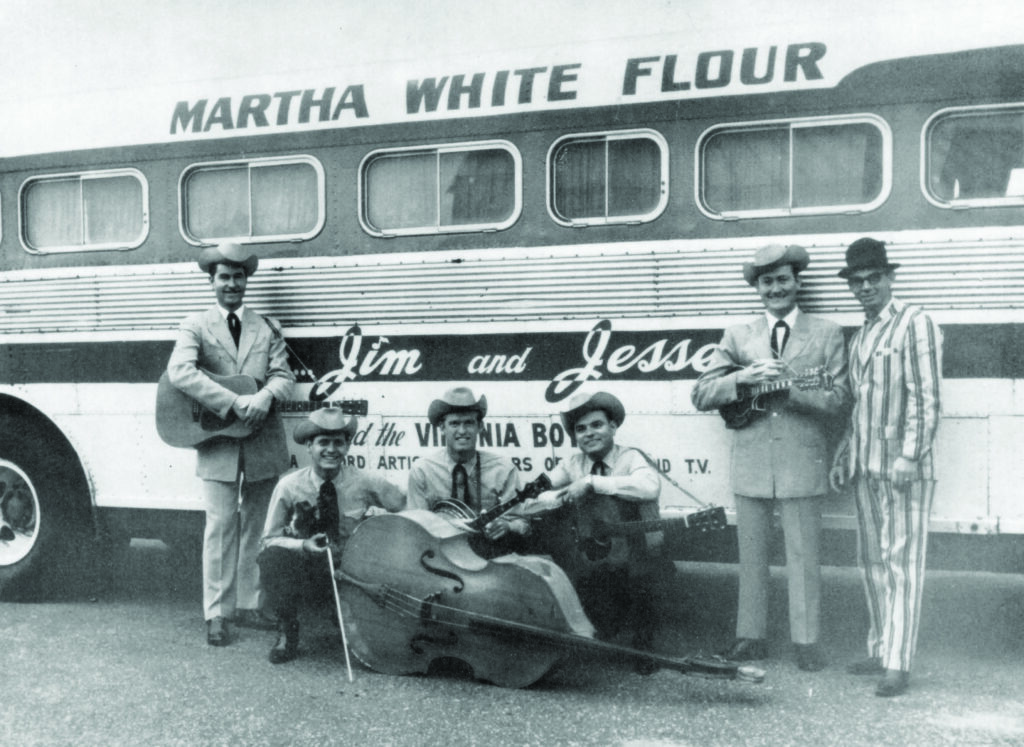
“Dad (Jim McReynolds) taught me how to play guitar, and he taught me songs we could sing together when I was little, but I was more interested in the business side of music. I enjoyed that. I started going on the bus during the summer when I was 14, and then when I was 18 I was working full-time for them, doing a lot of the contracts and paperwork. Dad wanted to be outside and fence and bush hog when he was home. Soon I was booking the flights and the hotels, selling stuff and packing it up during the week, cleaning the bus, and calling the promoters. I traveled with them until I was 31, when Dad passed, and I wouldn’t trade the memories and the experience for anything. I did appreciate it when it was happening. I remember riding shotgun with Dad on the bus, thinking, ‘This isn’t going to last forever.’ It was the experience of a lifetime. I was the mediator, sometimes, between Jim and Jesse. If they were mad, they would just walk away. That was the McReynolds way. I would go from one to the other if they disagreed about something, and eventually things would work themselves out.”
Janeen was a “Daddy’s girl,” and she loved following Jim around the farm. She learned to bush hog, change the oil on the bus and the oil filter, drive a tractor, and split wood. They would also go to the homeplace in Virginia every month to take care of the place. Janeen’s mother, Arreta, did the bookkeeping and made out paychecks. She preferred to stay home rather than travel on a bus, and she taught the four-year-old Sunday School class at the same church for 30 years. Janeen is married and has a son, and she has worked in animal rescue for 11 years. She and her husband have owned a children’s clothing consignment shop for 15 years.
Tim O’Brien (mandolin):
“Jim and Jesse carved their own niche in bluegrass music. Starting with a brother duet, mandolin, and guitar template, they contributed several classic original songs. Jim handled the business side and fronted the band, leaving Jesse’s creative fire to burn brightly. Jesse’s strikingly original mandolin style was one salient feature, but so were projects like their bluegrass Chuck Berry covers on Berry Pickin’.
“Often praised but rarely copied, Jesse‘s cross-picking inspired young mandolin pickers to develop their own sound and style. I was once lucky to witness Josh Graves and Jesse, along with Gary Scruggs on bass, in an informal jam during Earl and Louise Scruggs’ 50th wedding anniversary party. Both Josh and Jesse had basically invented their own way into the music, and the two fellow travelers dove deep into their own worlds, rarely looking up as they mined new notes and sounds on a tiny stage.
“Jesse was a fine lead singer and the perfect foil to Jim’s sweet tenor. Though they hailed from the same part of southwest Virginia as the Stanley Brothers, they developed a completely different sound—less mountain blues, more modern and streamlined, but still soulful. Most importantly, it was a sound that was all their own. Jesse was always a friendly face with words of encouragement for a young picker like me. He was quiet and unassuming, but he commanded so much respect everywhere he went.”
Akira Otsuka (mandolin):
“I came across Jim and Jesse’s recordings when I was learning to play mandolin in Japan. Then I found out that Jesse’s cross-picking was a required technique for all bluegrass mandolin players, so I had to learn it. Jim and Jesse released two very unique albums on the Epic label, and one was Berry Pickin’ in The Country (1965) of all Chuck Berry songs with bluegrass instrumentation plus a snare drum. The other one was Diesel on My Tail (1967), and they were all truck driving songs. This one featured pedal steel, piano, and snare drum, and almost no mandolin. However, I like this album because their vocals are strong and up front, and Bobby Thompson played a Dobro-banjo with a chromatic style (which became very popular in the ‘70s) throughout the album. I love it!
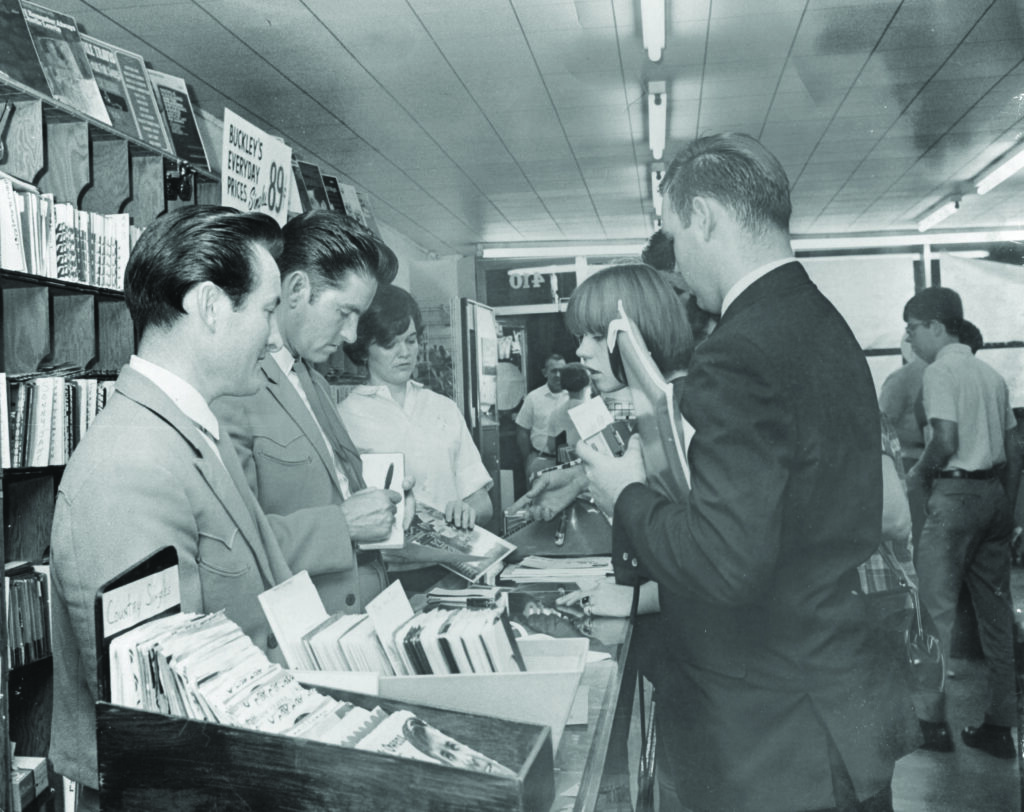
“Another unique Epic album is The All-Time Great Country Instrumentals, released in 1968. As the title suggests, it’s mostly country instrumentals featuring Jesse’s four-string electric mandolin, drums, pedal steel, piano, electric guitar, and bass. The mandolin playing was very interesting, so I slowed down my turntable and tried, but I just couldn’t copy anything. It didn’t make any sense and I gave up. Around 1975 my old band mate, Jim, told me Jesse was using an Echoplex for this album and explained to me how it worked, but it took me several more years to understand. Jesse did this way before Albert Lee or Ricky Skaggs, and it just blows my mind that a traditional bluegrass mandolin player figured out this Echoplex trick in the ‘60s. He was a genius.”
John Reischman (mandolin):
“Jim and Jesse have always been one of my favorites of the early bluegrass performers. They had the smoothest and most beautiful vocal blend, and I especially love Jim’s tenor singing. I think it’s interesting how they didn’t always sing in parallel thirds but took advantage of there just being two voices and the freedom that gives for singing duets. My brother Steve and I worked up several of their songs back when we were starting out. My favorite recordings of theirs are the ‘60s releases: Bluegrass Special, and Bluegrass Classics, both featuring fiddler Jim Buchanan and banjo player Allen Shelton. This was one of the best lineups in bluegrass history, in my opinion.
“The icing on the cake for me was Jesse’s mandolin playing. He is obviously one of the most innovative early bluegrass mandolin players with his cross-picking, but also techniques like splitting strings, and super clean single-note playing. Jesse also wrote great instrumentals which have become standards such as ‘Dixie Hoedown,’ ‘Stoney Creek,’ and ‘Border Ride.’ I never pursued cross-picking beyond learning the basic roll, but I love listening to Jesse using it. He was a genius.”
“Opry Dan” Rogers (Grand Ole Opry manager)
“An accurate description of the Grand Ole Opry that was shared with me years ago, is ‘It never changes. It always changes.’ I love that description, because it encapsulates two qualities that are so important to the Opry’s success: it needs to remain true to its roots and traditions, yet it needs to stretch, grow, and remain relevant to new generations of artists and fans. I think the same can be said for Jesse McReynolds. He never changed. He always changed. It was an honor to work with some of the greatest musicians in our business to celebrate Jesse’s 90th birthday on the Opry stage in 2019. How quickly those artists agreed to surprise Jesse on stage with mandolins in hand to play for him said so much about Jesse’s influence.”
Neil Rosenberg (author/historian/banjo):
“I first heard Jim & Jesse’s recordings in 1959, saw them for the first time in 1962, and got to know them in 1963 when they played the Brown County Jamboree in Bean Blossom while I was managing it. In 1966 Scott Hambly and I interviewed them at the Chicago Folk Festival. They were always friendly and helpful. I think they will be remembered for their perfect harmony duets and for their decades of maintaining a bluegrass band sound created by the most skilled musicians in the business. Jesse’s brilliant mandolin style, his prowess as an instrumental composer, and his appetite for repertoire that stretched from old-time to rock mark him as a man of creativity and vision.”
Mike Scott (Virginia Boy, 1983-86)
“When I started playing banjo at age 10 and I was listening to Jim and Jesse records, I felt the brother harmonies. I was influenced by everybody, but I don’t remember a time when I didn’t want to be able to play for them. They were gentlemen and professionals. When they walked onstage, you knew who they were. Coming into the band at age 19, their arrangements were something you learned early on. The banjo chopped rhythm when Jesse played lead, and the banjo was rolling in the background when the fiddle played with Jesse chopping mandolin. Also, we looked like a band when we walked onstage. I learned that from both Carl Story and Jim and Jesse.
“I rode shotgun with Jim driving the bus a lot. He was my politics and current events buddy. We would sit for hours and tell stories and talk. He had his ball cap on, and his hand would be slapping his knee, laughing. We worked 240-260 playing dates a year. They were work horses! We played in every state and several countries. Jesse would do general maintenance on the bus and took care of the band, hiring and firing. I spent some of the best years of my life with them.
“Allen Shelton came back as the bus driver, but how can you have Allen Shelton on the bus and not put him back in the band? I remember once we were driving from Roanoke to Bristol, and Allen and I got up. I played harmony with Allen on all the banjo songs he could think of. Jim McReynolds had a talent for knowing if someone was driving even five miles an hour over the speed limit. That door in the back of the bus would open, and the driver would automatically take his foot off the gas. Allen and I were playing the twin banjos faster and faster, and Jesse was driving, doing about 90. Jim popped out of the back of the bus and said, ‘Eh, Jesse, you’re in a little bit of a hurry to get there, aren’t you? You boys might as well put those banjos up. He’ll be driving 100.’
“Jesse would hear something in an Italian restaurant, or he would hear mandolins on the intercom on a Greek song, and the next thing you know he’s out on the bus, and he’s got his mandolin out and trying it out. I would like to know how many songs Jesse has on cassettes, of tunes that he started and never recorded.
“Carl Jackson and I were talking, and we agreed that neither one of us would be where we are today if it hadn’t been for Jim and Jesse having us in the band and giving us the opportunity. I live nearby, and during the last year and a half of his life I’d give Jesse rides to appointments around town sometimes, and we went to a Bible study at the Southside Baptist Church on Saturday mornings with 30 or 40 men. We both got a lot out of it.”
Jeremy Stephens (Virginia Boy 2016-20):
“Working for Jesse and getting to know him in the time Corrina and I were Virginia Boys was a joy and a life blessing that I will always cherish. Jesse was one of the most genuine and honest people that I’ve ever been around. Watching him interact with people he was close to and then with fans, I saw no difference. He was the same all the time; he had no pretense. Jesse was also always willing to show me how he played things on the mandolin and guitar anytime I asked, and I asked often! Knowing Jesse caused me to become a better musician and a better person, and I will forever be grateful to him
for those years.”
Steve Thomas (Virginia Boy 1983, early 2000s):
“There was always so much creative energy and joy in working with Jesse onstage and in the recording studio. We did the Grateful Dead album in my studio, and several other things. Jesse was always writing. I’m just now mixing some stuff with Jesse and David and Sam Grisman with Del McCoury that was recorded four years ago. I loved playing in the band. During the years when they had a banjo and a five-string Dobro and no fiddle, if I was at the same festival playing with The Whites, they would get me to sit in on fiddle.”
Radim Zenkel (mandolin):
“I certainly was influenced. I found out about Jesse’s signature technique early on in my bluegrass mandolin journey. I instantly liked it, especially the unevenness of the picking style (down-up-up, down-up-up, down-up), and I learned Jesse’s arrangements of ‘My Grandfather’s Clock’ and ‘Home Sweet Home’. Later I learned the more advanced versions, such as two string cross-picking that carries over to another pair of strings, covering all the mandolin strings with a harp-like effect. I also like the rhythm of the basic roll, which is nicely syncopated (groups of three notes against the 4/4 time signature, similar to five-string banjo rolls.) I have used some versions on many of my CDs (Mandolin Parade, Galactic Mandolin, Czech It Out, Strings & Wings). I met Jesse at the IBMA World of Bluegrass in Owensboro, Kentucky, in 1995. I remember him as a very friendly, sweet person. We spoke and jammed on a few tunes in a mandolin duo. We also did a mandolin workshop, together with Ronnie McCoury, Chris Thile, Butch Baldassari, and perhaps one more player. At that workshop, every player suggested a tune for all to play together. Jesse’s pick (to everyone’s surprise) was the Greek song ‘Never on Sunday.’ Nevertheless, everybody liked the challenge and did a great job on it. Thank you, Jesse, for your beautiful music and lifelong inspiration!”