Jerry Douglas Speaks
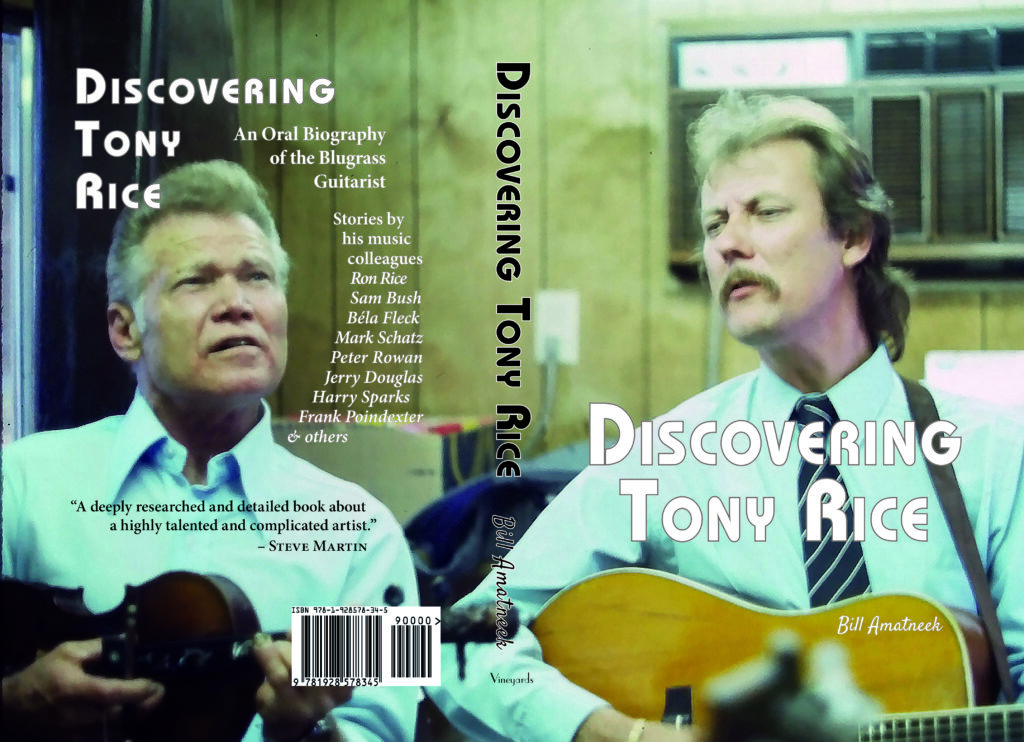
Jerry Douglas was one of the most insightful people whom I interviewed for Discovering Tony Rice, Tony’s oral biography. He was perceptive about Tony because he is insightful about himself. We see that what Jerry has to say about his old friend also says much about himself.
I spoke with Jerry on July 12, 2022 via phone. The following is excerpted from “Jerry Douglas Speaks,” Jerry’s chapter in Discovering Tony Rice.
Jerry, tell me about the Tony Rice you knew.
Or the guy we didn’t know. The guy we thought we knew. Tony was a difficult personality all his life right up to the very end.
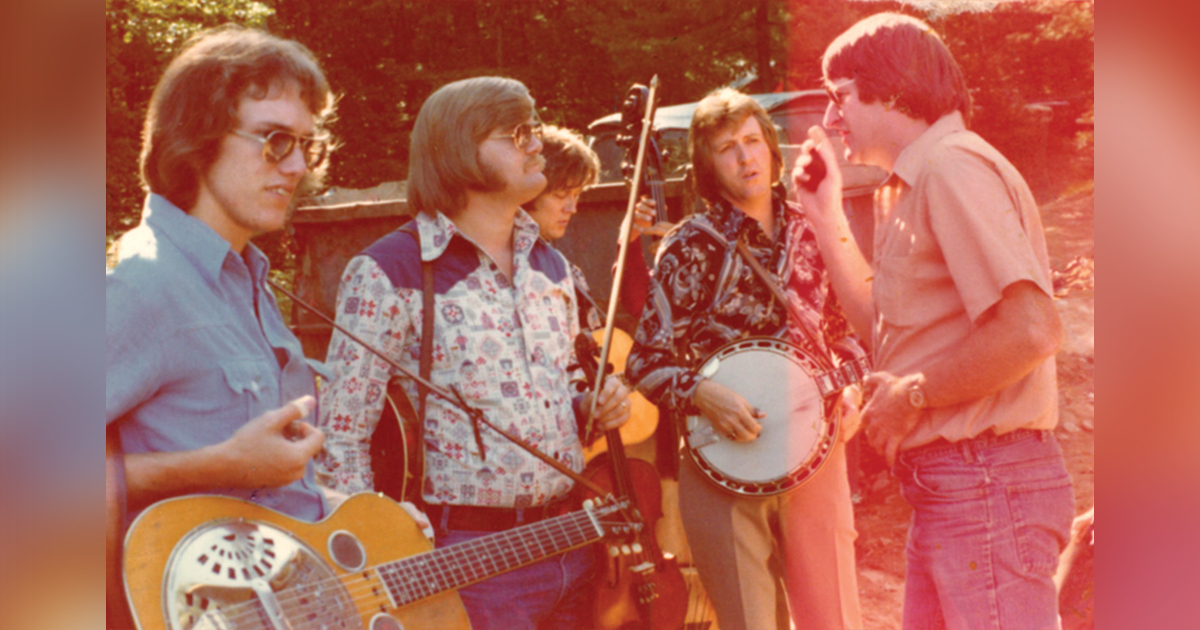
I came onto the scene in 1974. That’s when all of us met for the first time, Ricky Skaggs, Tony and me. I moved into the same apartment complex that Tony and Ricky lived in. I had just gotten married and took a one-bedroom at Larkin Terrace Apartments. We later joked on Boone Creek’s records about naming things like the “Larkin Terrace String Section,” the “Larkin Terrace Singers”… all kinds of stuff.
Tony was really a funny guy. He was always cracking jokes and laughing. He had a great laugh. He was really great to be around.
I remember one time, Tony and I played Berryville, Virginia at the bluegrass festival there [July 15, 1974]. Later on that first night, Tony and I took that fancy van and went driving thru the fields looking for pot. We wanted to smoke a joint. We weren’t carrying anything ourselves. We just went out in the fields, and we had fog lights on this van. And I said, “Tony, hit the fog lights.”
He hit the lights and we bounced up over this field. So, we’re driving through there, and I see people diving to save their sight from these fog lights we had going on, they were so bright and it was putting people’s eyes out everywhere. People were diving under mattresses into the tents to get away from us while Tony and I were laughing like crazy people.
We didn’t get any marijuana; we just went back to the hotel and laughed all the way there. That was one of the funniest nights I ever spent with Tony Rice. Just me and him out there, both just acting like a couple of teenagers being fools, and it was so much fun. I got so much out of it, I’ll never forget it. It was Tony being Tony. It was the closest I got to me and Tony just being us.
We were always close, and always loved seeing each other; it was always a big hug. But you got that from Tony no matter what. Tony was a hugger. Tony would see you and he’d come with his arms stretched out as far as they would go. He was just a lover guy. He loved his friends; he loved being with them.
I went to Japan with J.D. Crowe and The New South in 1975. So, I was only in the New South from June until we came back from Japan in September. Tony at that point had decided he was moving to San Francisco to play with David Grisman. I’ve heard several people float different theories as to why he did that.
I understood that as a musical move, and aren’t we all glad he did it. I think it was a hard thing for him to do, to move from Lexington and from J.D., whom he did love. He and Crowe were really good friends, and they were the leaders of that band. Ricky got there and … he was very ambitious. He had many things he tried to insert into it. But from what I could see when I got there, it was J.D. and Tony steering the boat.
The other reason [Tony quit J.D.] was something that I witnessed. The first festival show I did with them was “The Festival of the Bluegrass,” in Lexington. So, we’re getting ready to play, and all of a sudden there’s a commotion and I … What’s going on?
We had a camper for a dressing room trailer and this guy comes up and says that Tony had impregnated his sister, and he was going to shoot Tony that day on stage.
And we were all like, “Oh, great.”
The only thing Bobby Slone said was, “Don’t stand next to Tony during the show.”
There’s this theory that has floated around that Tony got the hell out of Lexington because of that and went west. I don’t know how true that is. I know what happened that day. The guy threatened Tony. It visibly affected him. The guy threatened his life and then left.
Tony left at the end of the summer. He was getting out of Lexington if this guy was looking for him. Tony had a problem with fidelity … [he laughs] … with infidelity.
Pressure, Anxiety, & Mental Problems
Tony liked being married. He liked having someone. He had Kate Freeman and then he had Leela [his first and second wife, respectively]. We all loved Leela. I couldn’t figure out what happened with Leela, but I have an idea. Tony was starting to have some problems, some mental problems, just stuff we all have. He was the best guitar player in this genre of music. He felt that pressure even though it’s not something that should drive us nuts, and make us do funny things.
He was just gifted. He had a gift. And he used it playing and singing. From the time he was a tiny kid, he wanted to be that, and now he was that, and he was the best. And people were following him around and telling him how great he was all the time. That can get to you.
And I think with Leela, his mental incapacity to deal with it was starting to present. He was starting to be depressed, have love anxiety …. But I imagine that was with him most of his life.
I suffer from it too, and I don’t know of a great musician who doesn’t suffer from anxiety to some degree once you get to a certain plateau. If you don’t deliver what’s expected of you, it’s a “What’s wrong with him?” situation. Tony was starting to suffer from that and from making records and trying to make each record mean something. There was a lot of self-imposed pressure. We all do that.
I think that Leela must have just got tired of it, couldn’t deal with it, and couldn’t solve it. He wasn’t really seeing anybody to help him with it. He was dumping it all on her. I don’t know of any things that happened to them, any infidelities or anything like that, but that was in Tony. We all thought that Leela was the best thing that ever happened to Tony. At that point Tony showed us all that he sometimes had problems with just being able to deal with day to day. I understand that now. I didn’t totally understand it then, but I knew that the guy was in pain of some kind.
The Elvis Syndrome
I never blamed him when he would come into the studio, and he just couldn’t do it. We’d all be there and we’d all spend a whole day waiting for him to get there. It was like the Elvis syndrome of having a studio full of people ready to play, but not knowing what they were going to play. Then you show up and you can’t emotionally get through it.
We’d try something, and Tony would go, “Man, I can’t do it.”
I remember one time being in the studio with J.D. Crowe, Vassar Clements, and Sam Bush … and we didn’t do anything. We spent all day waiting. Then Tony got there and we couldn’t do anything. And there was more than one day like that.
I’ve seen other artists do that too. It’s usually coming from an emotional drain, and too much going on where you can’t do your job. Unfortunately, we were all sitting there and the money wheel was spinning, but we were not getting anything done. That was really a dark period. That was the darkest of the recording times that I remember. It was bad.
Leela was so helpful in just helping him guide his life, his musical life and his personal life, trying to keep his feet on the ground. It’s not an easy thing to do. In Tony’s case, he had all this hero worship going on all around him, but at home he was just this normal guy, who he really wanted to be.
He took up photography. Anything he took up, it was like obsessive compulsive disorder. [Unwanted thoughts (obsessions) that lead you to do repetitive behaviors (compulsions), causing distress.] He’d get into it. He’d read everything he could read about it. Finally, it became watch repair later on in life. That was what he did; he didn’t do anything but that. He wasn’t even interested in playing the guitar anymore.
It hurt. It hurt to play the guitar. I think there was a lot of pain in his arthritic joints and his thumb, and his wrists. I imagine there were some carpal problems and trigger fingers, … I don’t know what. He had problems with his ulnar from overuse. A lot of it happens because things just wear out. And we have to get them repaired. There are ways to repair them.
Paul Simon Talks to Jerry About Tony
I opened for Paul Simon one summer. And I was really worried about Tony at this point. This was 2006, I think. Paul and I got to be close and talked about things. I brought up Tony, and all these things that were wrong, with his voice, with his hands, with his dysphonia [a.k.a. hoarseness].
I was standing in a catering line, waiting in line with a plate in my hand, but I didn’t get to any food, because I had said something to Paul. He walked up to me and said, “Ya know, your friend, all those things can be repaired and he can go on.”
We stood there for 45 minutes talking about that, and finally somebody brought each of us a plate of food and we sat down. They saw we weren’t going anywhere, we weren’t going to do anything, so somebody got us food, and we sat down and talked about it.
He said, “This dysphonia, that can be repaired. Any of these things can be repaired, if you want to get them fixed.”
I thought, I don’t think Tony wants to get it fixed. I don’t think Tony wanted to be him anymore.
And I’m sure Paul was talking about, “These are the best doctors in the world. And they don’t botch things. If it didn’t work, they’d fix it.” He was so matter of fact when he was telling me that stuff. He was saying, “There’s no need for your friend to go down this way. This can be fixed. This can be repaired.”
But I don’t think Tony wanted it to be repaired.
And yeah, I understand that about operations; they’re not all a success. But if you wanted to go that way, and you had that much inspiration left in you, then you would do it to try to get it better. And if it didn’t work, you are right back where you were ….
I don’t think Tony was ever going to go that route, and that conversation I had [with Paul Simon], I never told Tony about it. I never said that to him.
Self-inflicted Damage
I think Tony’s injuries and singing too much and smoking and drinking and alcohol dried out his throat. Tony was singing too high for the register of his natural voice. He stretched it out, and he made all those things happen. He was responsible for the things that eventually made him stop playing.
That was all self-induced, not like on purpose, but he was drinking an awful lot for a long time before he finally stopped. He stopped and wised up. He could quote you the Big Blue Book from A.A. [Alcoholics Anonymous] from cover to cover. But whether he was living it or not, I don’t know.
He had a problem with pills, not with uppers, not speed or anything like that. Just pain. I think that even in his best days he was taking things to get him through the pain of playing, and that exacerbated the problem. He got addicted to some things that didn’t help him later on. He was not fixing anything; he was making it worse.
It was a sad thing playing out in front of us. When Tony would get in trouble, we’d try to get him out of it, help him out. We did benefit after benefit. But he would repeat it again.
Until he got in A.A., he was wrecking cars and waking up in waist-deep water because he’d run off the road into a river. Things like that. He finally stopped that. He quit drinking and that seemed to really calm things down a lot, but there was still this dysphonia, that he couldn’t sing. When you’re a great singer and all of a sudden, your voice is taken away from you, you’re going to go deeper into your depression, your anxiety is going to increase.
It’s something God gave you and then you took it away. God did not take it away. Tony did the damage himself, all by himself.
We all tried to help, we tried to help him mentally, just by telling him, “Look dude, this is going to be all right. You’re you, we’re us; we’re here to help you. We’ll stand behind you, we’ll do whatever it takes to get you through this show,” and then he would immediately retreat somewhere.
The Last Time
The last time I played with Tony was when he spoke to the IBMA at his induction into the Hall of Fame, in September, 2013. He got in touch with his higher power [Tony said, “My heavenly Father”] and this voice came out that I’d been hearing all along from him. He could speak like that at any point as long as he didn’t get above a certain decibel; he could sound like Tony Rice 1975. But he couldn’t sing that way and he couldn’t speak beyond a certain level, or we would go into that guttural [zone] and his voice would close down.
But that night that he stood out there telling those people that someday he thought he could sing and always would, kind of thing. I went Whoa Tony. You’re making these people believe in the second coming or something, and this isn’t right.
We were standing backstage, because we were ready and lined up to kick off “Old Train.” I said to Ricky, when I heard [Tony] out there talking and what he was saying, and I said, “Ricky, knowing what we know, what do we do about this?”
And Ricky said, “Nothing, nothing.”
And so that was it: Nothing.
Wyatt was talking to me, he was saying, “He’s going to come up here and he’s going to kick the song off.”
I said, “No he’s not, Wyatt; you’re going to kick the song off. You sound the most like him that anybody ever will. And because we don’t know if he can play or not, you’re going to kick the song off, because you’re going to kick it off and sound like Tony Rice 1980 or whenever we did this.”
So, Wyatt kicked the song off, and Tony put that guitar on, and he hit that open mic, and as soon as I heard his guitar, I went, “Oh, man. He sounds great. That’s Tony. Nobody else makes that sound but Tony.”
Tony didn’t try to take it over. He let Wyatt kick it off. We just stood there in disbelief that Tony was even doing this after not playing for however long.