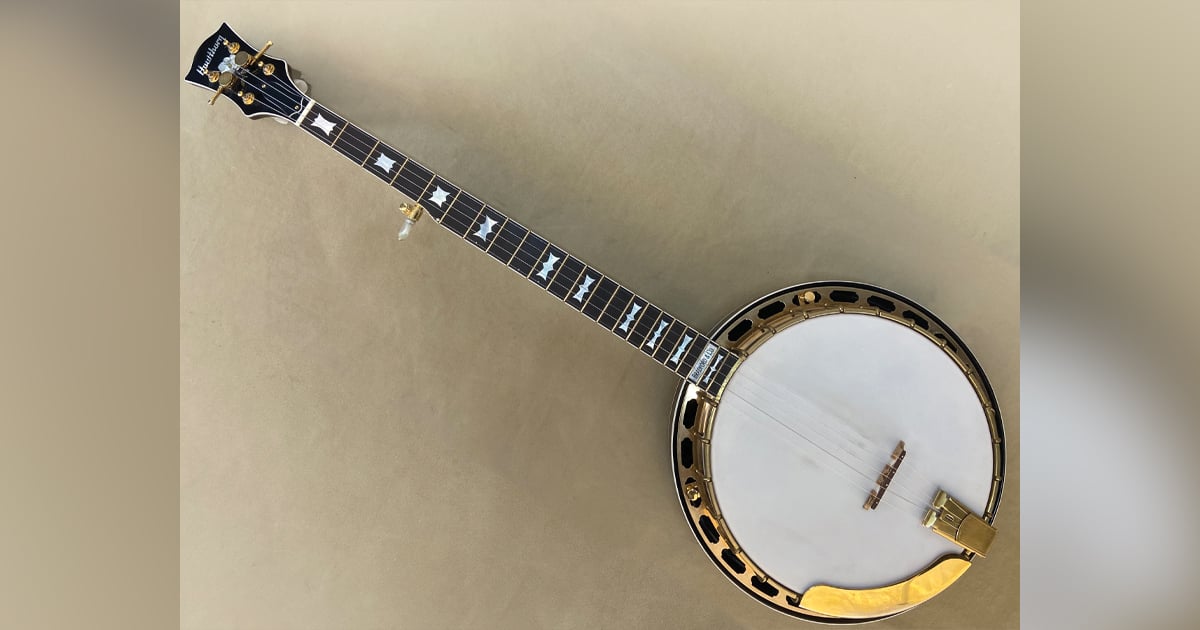
Hawthorn Banjos
It just makes sense that the finest musical instruments would be comprised of premier quality parts assembled and crafted by experienced luthiers, and that’s the foundation of Bradford and Company’s Hawthorn™ brand of instruments. If retired lawyer Glenn Bradford can’t find a particular part that meets his quality standards he will make it himself or find someone who can.
In June 2015 Glenn and fellow friend and luthier Mark Franzke opened the Bradford and Franzke Fret Shop in Kansas City, Missouri. After acquiring initial inventory of banjos, mandolins and guitars, they decided to build their own: the Hawthorn brand (named after the Missouri state flower) was born and included high end instruments and parts.
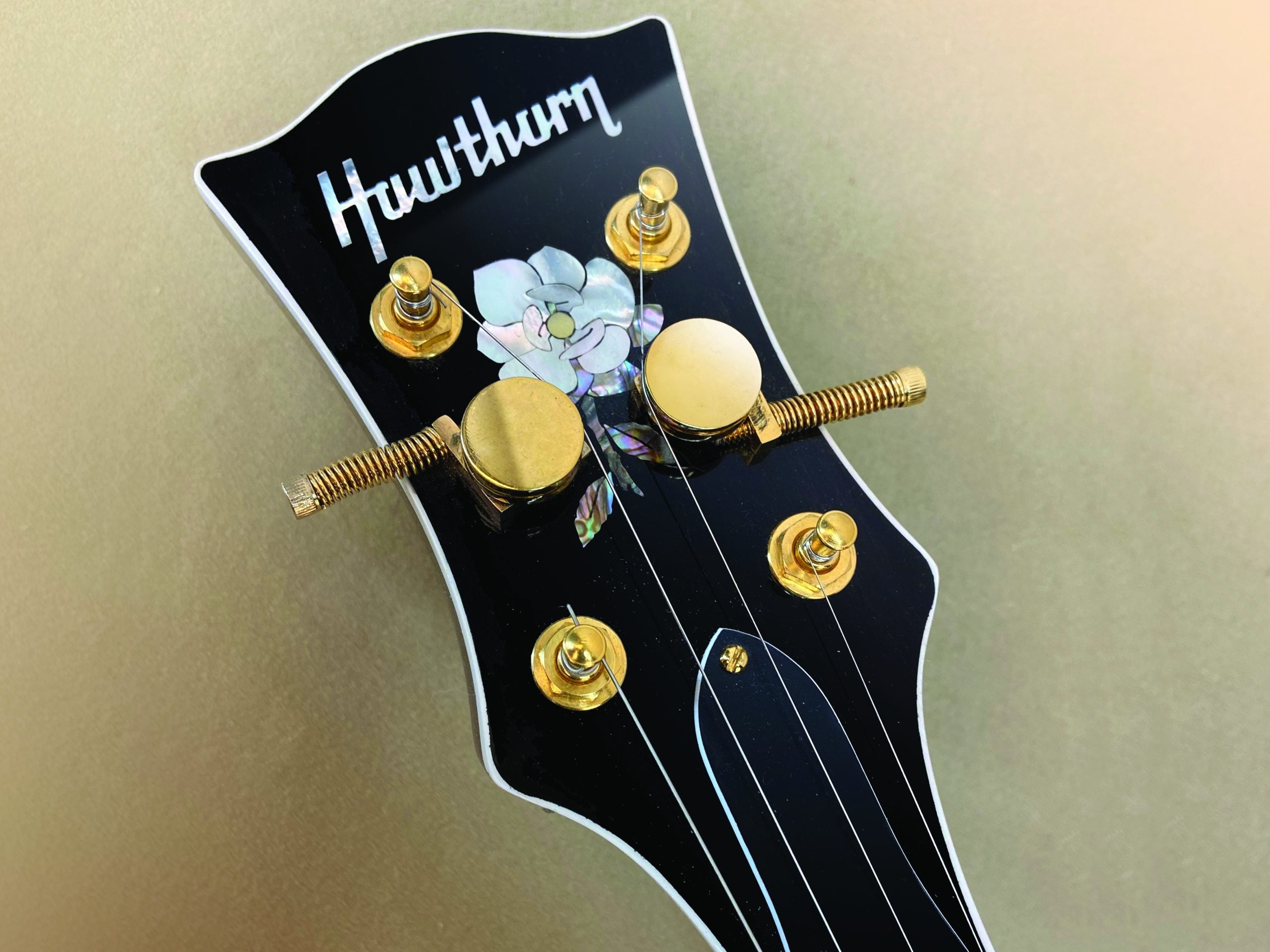
Eventually several experienced luthiers were added to streamline the process. Randall Wyatt of Searcy, Arkansas CNC’s the pearl inlay, Ron Coleman of Nashville, Georgia constructs all the banjo necks, and Missouri former Bluegrass Boy Lonnie Hoppers designed the ‘Hopper’s Tradition’ five-string banjo. Glenn works with Steve White of Kansas Brass to make the Hawthorn brand patented Ozark Thunder™ tone rings and Copperhead™ brass parts.
Hawthorn instruments are built to order, and the main focus these days has been on banjos. Regarding the style of the Hawthorn banjos, Glenn told me, “We don’t make exact copies of Gibsons, but folks seem to be more comfortable with a general Gibson look and feel. We’ll take that concept and do something Gibson never did, like use a block rim or make a Bowtie walnut instrument.”
Parts can many times be substituted and mixed and matched, but here are the models and their basic appointments:
Hawthorn Model 9467 Five String Resonator Banjo:
This banjo is named after the batch number of Gibson banjos built between 1930 and 1934, a batch that included J.D. Crowe’s ‘Banger’ banjo. It is fit with Hawthorn’s proprietary Ozark Thunder No-Hole, three pound ten ounce pre-war formula flat-head tone ring. (Players like Jim Mills and others have championed No-Hole tone rings over standard twenty-hole flathead rings in Gibson instruments as generally having more cutting and penetrating ability.) It comes stock with a three-ply ‘Fatboy’ maple rim, pre-war style mahogany resonator inlaid with concentric circles, and mahogany neck. Other appointments include antiqued binding, Style 3 peghead inlay, Flying Eagle fingerboard inlay, Prucha Presto tailpiece, Huber bridge with Crowe spacing, and Keith regular or ‘D’ tuners.
Hawthorn Hoppers Tradition Five-String Resonator Banjo:
Based on Gibson’s classic RB-75, this model is designed by Missouri legend and Bluegrass Boy Lonnie Hoppers. It comes with the Tennessee 20 tone ring (Ozark Thunder ring optional). It has a traditional ‘double-cut’ peghead (based on the shape of a violin) on a mahogany neck, Jimmy Cox resonator with twin inlaid concentric circles, three-ply hard rock maple rim and dual action truss rod. It features a ‘Reno’ pattern Flying Eagle inlay, dark red sunburst finish, Randall Wyatt bridge, nickel plated hardware, and Hoppers’ cam style D-tuners ( a maple cross-piece is inlaid into the peghead for a more stable install for the cam tuners).
Hawthorn Maple Rose Five-String Resonator Banjo:
This is Hawthorn’s top of the line banjo. It includes custom Hearts-and-Flowers inlay, Cox maple resonator, Tennessee 20 tone ring standard, natural blonde finish, double-cut peghead, and rosewood fingerboard. Optional ‘Maple Rose’ carving is offered on the back of the peghead and heel of the neck. It is gold plated and comes with a Randall Wyatt bridge.
Hawthorn Hollywood Hills Five-String Resonator Banjo
Inspired by Los Angeles picker Reuben Valles’ 1929 Gibson, this Style 4 walnut banjo comes standard with the Ozark Thunder tone ring, a Simms ‘Fatboy’ maple rim, double-cut peghead, burl walnut resonator and black walnut neck. The rosewood fingerboard is inlaid with the classic ‘Reno’ Pattern Flying Eagle. It comes chrome-plated with a Wyatt bridge and optional Keith D-tuners. Banjo set-up guru Charlie Cushman has set up every Hollywood Hills model banjo to date.
Hawthorn Top-Tension Banjos (RB-7, RB-12, and RB-7-Light):
These Five-Strings are the most popular in the Hawthorn line, with the RB-7 being by far the best seller. The 1937 Gibson catalog described the original top-tensions upon which the Hawthorn model is based as “the alarm clock that is going to wake up new possibilities in banjo playing.” It is a very innovative design. As the name would indicate, the head can be tightened from the top as opposed to the back. Adjusting from the back requires removing the resonator on resonator style banjos. Top-tension is much easier to adjust on-the-fly, so any of you hide head purists might want to take a serious look (hide heads fluctuate with humidity and can be challenging to deal with on rainy days but is un-equaled in tone in my opinion when dialed in). A Stern Tanning hide head from John Balch is offered as an option.
All three top-tension models have a twelve inch radius fingerboard, as did the original 1937-1941 Gibson models. If you’ve never played a radiused fingerboard, it can take some getting used to, but it can really make chords and complex left-hand fingerings much easier to deal with. The idea is that the human finger is naturally curved, not flat, so a radiused fingerboard should be a little more ergonomic. The Tony Pass Thinskirt™ birch block rim is offered at an up-charge, and all models include another unique aspect of top-tension banjos: the carved solid wood resonator with a blended hump on the outside and interior flat surface. When you throw in a fairly hefty brass flange, it makes for a pretty heavy instrument (see RB-7-Light below for a lighter alternative).
The RB-7 Top-Tension comes with a red maple neck, carved maple resonator (made by Clancy Mullins in east Tennessee), and rosewood fingerboard with option of classic Bowtie or Big Block inlay. The option of polished brass hardware is a nice touch.
The RB-12 is the walnut version of the Top-Tension model, with select Virginia black walnut neck, Mullins carved walnut resonator, and comes standard with a Kulesh Big 10 tone ring on a Randall Wyatt birch block rim. The RB-7-Light is offered with the same options as the standard RB-7 but is much lighter in weight. The lightness is achieved by substituting the Dannick NASA Aluminum tone ring (or the even lighter carbon fiber tone ring), aluminum top tension hoop, and reinforced aluminum flange. Unfortunately, the Dannick NASA aluminum tone ring is no longer available.
Hawthorn Bowtie Five-String Resonator Banjo:
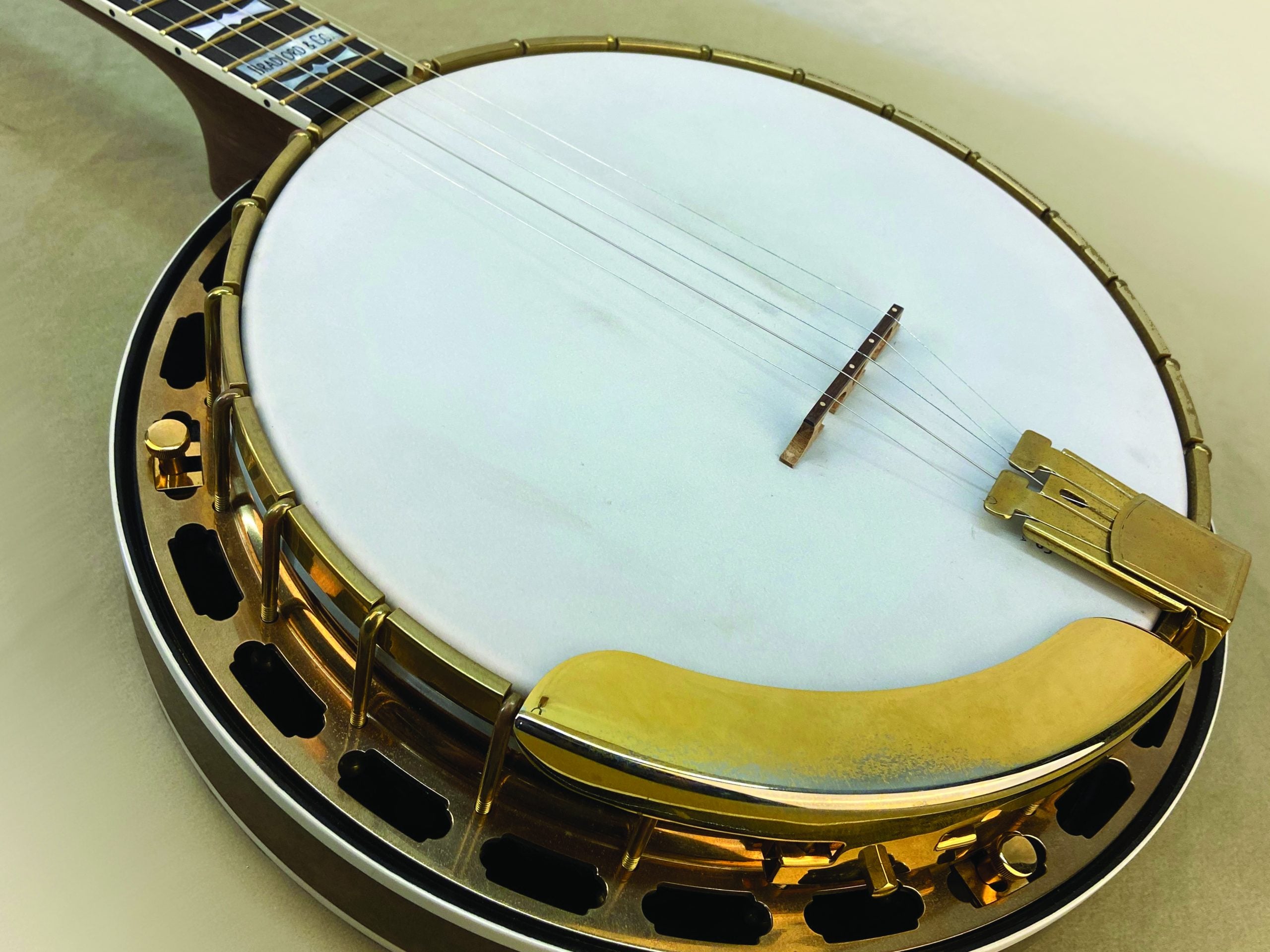
Offered in walnut, maple, and mahogany (standard), the Bowtie line is a nod to the Gibson models built in the 1950’s and 1960’s. It features the iconic bowtie inlays in the fingerboard and modified ‘flyswatter’ peghead shape. The Bowtie can be made to order with almost any combination of quality parts.
The Bowtie model is the banjo that I have personally played, and the particular instrument I played had a Huber HR-30 tone ring on a Huber engineered three-ply rim. In my opinion the real test of a well-rounded banjo is how it performs from around frets six to twelve, and this one had plenty of clarity and power. Even well-made banjos with great bass and ultra-high-end can be dead and lifeless in that area, and the Bowtie was even across the board and across the spectrum. If you don’t want the weight of a top-tension but you want the traditional bluegrass sound and more, this is a well-rounded model with lots of options. I was also able to try out for the first time the Hopper cam tuners (based on the original Scruggs cam type), and I really like them. They are well made, they seem to get you to the note a little more quickly and efficiently than Keith tuners, and it is definitely nice not having to deal with set screws on the standard tuners. It does get a little tight with six tuners on the peghead, but in my opinion it’s worth it, and the re-issued Kluson standard tuners are a great option.
Professional players who endorse Hawthorn banjos include Wes Corbett and Phil Easterbrook, and you can be sure to see Hawthorn instruments showing up more and more among great players as the banjo world discovers the attention to detail, the options, variety, and the never-ending quest for the best that Glenn brings to the table.
Glenn: “As a lawyer, I was always envious of trades that produced a physical product. Law deals in the abstract, but an architect can drive by the building he designed. It’s nice to have my name on a physical product that will hopefully still be around a hundred and fifty years from now.”
Glenn adds, “We mostly build to order at this point but we do build our Hawthorn RB-7 style, our RB-18 style, and our maple and walnut Bowtie models as production models between custom orders as we have room in our production schedule.