Gold Heart Locket
Jeff Black credits a small-but-mighty banjo with providing inspiration for his song, “Gold Heart Locket,” recorded by Black (B-Sides and Confessions/2003) and later by Sam Bush (Circles Around Me/2009). “I’ll always think that song was in that little banjo,” said Black, during a songwriter’s round at The Bluebird Cafe, Nashville.
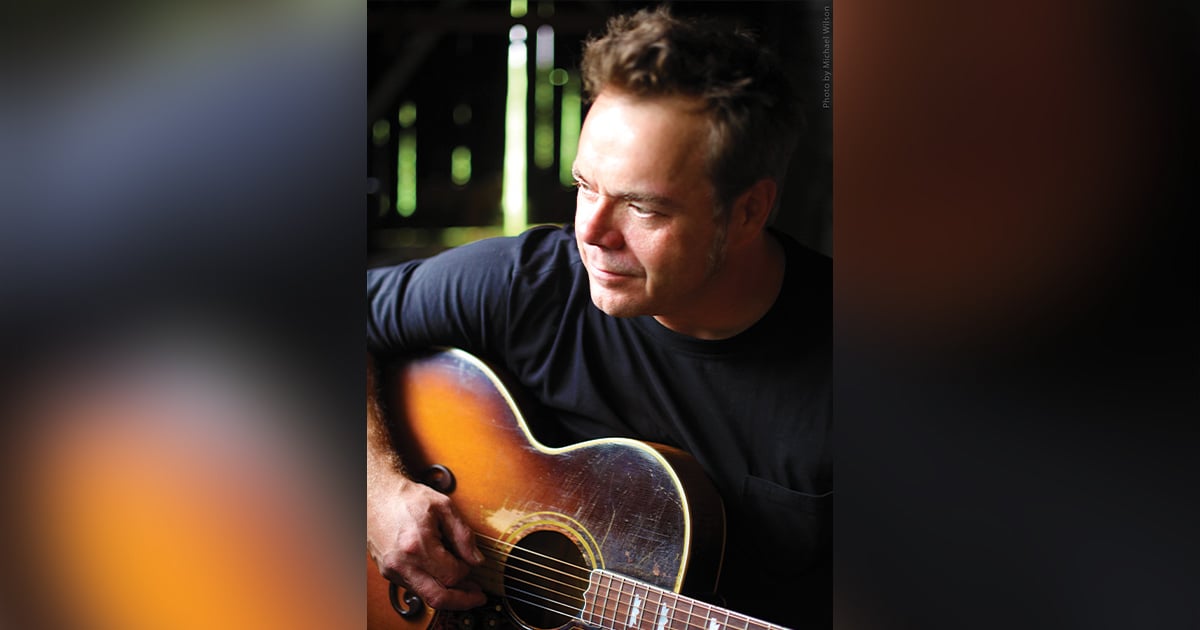
In an exclusive interview for Bluegrass Unlimited, Black spoke to me about his “poor-boy-in-trouble” song that can take listeners in many directions depending on their mood and life experiences. To begin, he explained more about the influences of banjo—and musical instruments in general—on his life and his songwriting. “My dad played a little plectrum banjo when I was a kid, and my Uncle Lyle played guitar,” he reminisced. “They played barn dances and living rooms, in the 1930s in north Missouri. Growing up, I heard about all this music, but nobody around the house played. Then my brother got a guitar, and I liked being like my brother…so, I had several cheap guitars early on, and I started playing and writing songs.”
Fast forward a few years…Black took to the music and writing and grew up to become a working musician and performer. He made his move to Nashville in 1989, and not long after, received a gift that would lead to this song. He explained, “Bruce Spaulding was a friend of a friend. He collected guitars and different instruments, and one day, he gave me a little tenor banjo.
“It’s funny…I’d never played the banjo…so, I tuned it up like a guitar (D, G, B, E) and I started noodling around on it and played that song immediately. I wrote that song as fast as you could write it. That happens with me and instruments, and that’s why I seek them out, I guess.”
The tenor banjo has “gone to pasture,” according to Black, who placed it prominently on his kitchen wall. “It doesn’t stay in tune much, but it looks good up there,” he said. “I’m not a banjo player, but I [now] own four of them. I like to play. It brings me great joy.”
Humble Genius
Black’s modesty permeates his conversation, so you might not pick up on his prowess as a writer and musician; however, his noodling-out-tunes-in-a-heartbeat makes more sense when you hear what others have to say about him. Take this from Steven Stone (Vintage Guitar), who wrote simply, “Jeff Black is a musical genius.”
Indeed, Black’s songs have earned Grammy recognition, chart success, and numerous BMI awards and have been cut by Bush, Alison Krauss & Union Station, Waylon Jennings, BlackHawk (who had a #1 country hit with Black’s “That’s Just About Right”), Jerry Douglas, and a host of other artists. A masterful performing artist in his own right, he has earned a reputation for delivering his songs with passion, soul, and the tradition of great song storytellers. “Jeff Black has the troubadour quality of a Steve Goodman, the poetic dignity of a Bruce Springsteen, and the outer-fringe edge of Townes Van Zandt. We kid you not,” wrote Steve Morse of The Boston Globe.
No Depression said, “His words and voice hold down center stage with a craft so deeply in the artistic pocket that it obscures anything outside.”
The Story in the Song
We’ve covered the banjo-inspired melody of “Gold Heart Locket,” but what of the detailed story in the song? Where did that come from?
“Gold Heart Locket” begins with the singer clearly trying to get somewhere (All night long I’ve been riding riding / I should have been there by now … ) and ends with uncertainty, despite the draw of love as the destination (I’m going to cross that river tonight / No matter what it takes / Although I might die trying / My true love will remain / In a gold heart locket on a silver chain).
Considering the origin of the story, Black reflected, “Your mind wanders…picks up things. I think it derived a bit from my dad telling me the story about my mom and dad’s first date. As it turns out, my dad was quite fond of my mother. And up in northern Missouri in the late 30s, early 40s, there were just dirt roads—not a lot of gravel. He had an old Model T or a Model A with narrow wheels. They went out, it rained, and they got stuck in the mud and didn’t get home until pretty late. I don’t think my grandad was happy about it at the time, but he and my dad later became great friends.”
Other parts of the song likely sprang from other memories. “There is a gold locket that exists that was my grandmother’s,” he recalled. “The idea of getting across the river probably comes from fishing the Thompson River, and the struggle with getting across there can take you lots of places. You know, time is nothing you can do anything about; money—to me, that’s easy to come by when you do what you got to do to get it; but love…love is the hardest. It’s nearly impossible, but if you set your mind to it, it’ll come to you.”
A self-professed romantic, Black touched on the narrator of the song. “People ask me, ‘Did that guy survive?’ And I think, ‘Don’t we all?’ I think if you want him to, he will, but I’m not really sure, and I don’t think it’s for me to decide,” he said, and described the song as more of an open-ended analogy and a witnessing of tough times. “I’m not crazy about dissecting songs, but I thought the idea of a ‘poor boy in trouble’ song kind of fit with so many things in our lives. We just do things [that need doing] and we don’t even think about it. For instance, this GOLD heart locket on a SILVER chain…that doesn’t match up, but it does, too. You know, if you need a chain, and it’s the only one you got, that’s what you do. It just seems like it’s that constant struggle—we all go through it. You don’t need a river or a banjo to relate to it.”
In a more positive vibe, Black added, “After a storm or struggle, suddenly you turn around and you’re still here. I think repeating that first verse is like taking a deep breath.”
Survival, renewal, continuing despite the struggle—these things are a theme in this song. Take that catchy, bouncy, banjo-derived positive melody, with its repetition at the end of certain lines (all night long I’ve been riding, riding…open it up and she’s lovely lovely…etc.). It pulls in listeners and has them singing along right away. When asked about it, Black reflected, “I don’t know. I picked up that banjo, and the simplest little melodies…those are circling around us no matter where we go. Sometimes we call it ‘old-time’ or ‘old-timey.’ That’s not really correct. It’s just music…I’m not even sure if it’s regional cause you can go anywhere and hear it. Once you hear those melodies, they’re not going to leave your mind, and I love that.”
Bush’s Friendship and Recordings
Black wrote “Gold Heart Locket” in the early 1990s and soon made a demo of it. “I would play it a lot,” he said. “I was always a live performer, and you’ve got to try out your songs. I met Sam Bush in 1991 when he came and played on some demos. That day, he played ‘Same Old River,’ and that’s when he also heard and said he was going to record ‘Gold Heart Locket.’”
According to Black, Bush was among several new friends in Nashville who “took him under their wing” when he didn’t know anybody yet. “There were a bunch of those guys—Sam, Jerry Douglas, and others were very kind to me and they liked my weird little songs.”
Bush also recorded Black’s “Same Ol’ River,” “King Of The World,” and others. The two have since cowritten songs, too, like “Circles Around Me” and “Transcendental Meditation Blues.”
The little banjo may have outlived its playing days, but Black is still noodling out new songs (on several instruments) for film, television, other artists, and himself. Learn more about the man, his songs, and his busy performance schedule at
jeffblack.com.