
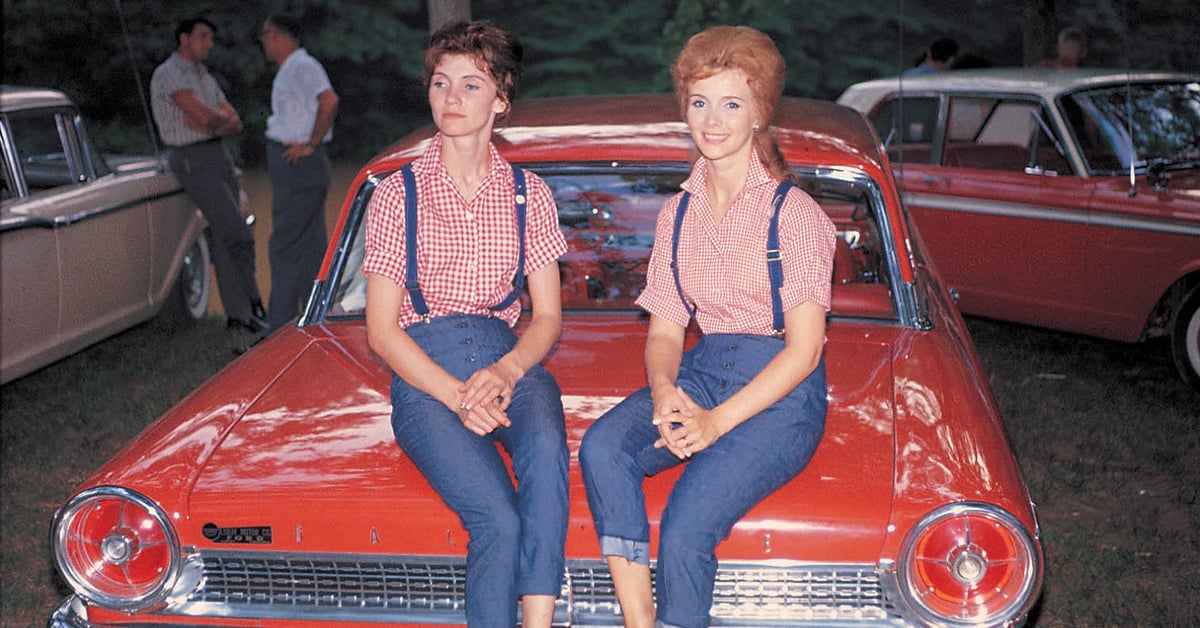
Donna and Roni Stoneman and The Legendary Stoneman Family
Before the Carter Family or Jimmie Rodgers ever stood in front of a microphone to record for Ralph Peer, another “hillbilly” artist had already solidly established himself. Starting in 1924, Ernest Stoneman, the “Unsung Father of Country Music” had recorded a multitude of songs and had a hit record with his self-penned “Sinking of the Titanic.” Then, Stoneman helped convince Peer to come to Bristol, Tennessee in July and August of 1927 to conduct the now legendary Bristol sessions, which led to the discovery of the Carter Family and Jimmie Rodgers. Between 1924 and 1929 Stoneman would record 200 songs.
Ernest Stoneman (1893-1968) would not be the only pioneering musician in his large family. Years before mandolin queens Sierra Hull, Rhonda Vincent, or Sharon Gilchrist were born, Earnest Stoneman’s daughter, Donna Stoneman, was playing fast and furious mandolin solos on stage with her family’s band The Bluegrass Champs. Donna’s sister Veronica (or Roni) was displaying equally adept talents on the five-string banjo. Donna is known as the “first lady of the mandolin” and Roni was the first female to pick bluegrass on the 5-string banjo on a recording. Donna (b. 1934) and Roni (b. 1938) are still going strong today and have just released a new album titled The Legend Continues on the Patuxent Music label.
There is no doubt that the Stoneman family is legendary. They have been recording, performing, and entertaining for nearly a century. For many of those years the family maintained multiple bands—not hard to do when Earnest “Pop” Stoneman, his wife, Hattie Frost Stoneman, and most of their thirteen children played music (Hattie had given birth to 23 children, but only 13 survived into adulthood). When Earnest originally recorded in 1924, he did so by himself, accompanying his vocal with harmonica and autoharp. By 1926, his wife, brother-in-law, sister-in-law, and a pair of cousins were joining him. By 1934, eldest son Eddie (1920-2001) was also part of the band.
Future Stoneman children (all born between 1920 and 1940) joined the band as they reached musical maturity. Roni recalls, “Instead of giving us toys, Daddy made us musical instruments.” When the oldest boys were ready to go out on their own, they formed a band called the Stoneman Brothers. Pop would then bring in the next generation of children to join him, for a time calling themselves Pop Stoneman and the Little Pebbles. Patsy Stoneman (1925-2015) would often front her own band, bringing in other local musicians such as Bill Emerson and Bill and Wayne Yates to back her up.
Perhaps the most well-known of the early Stoneman groups was the Bluegrass Champs. In 1947, the band won a music contest held at DAR Constitution Hall in Washington, D. C. In 1956, the Bluegrass Champs were the winners of the contest on Arthur Godfrey’s Talent Scouts television program (the Star Search or America’s Got Talent of the day). They also won many local contests as a band and as individual instrumentalists.

The award on Authur Godfrey’s show earned the Stonemans 27 weeks on a popular TV show hosted by promoter Connie B. Gay. The band became well known in the Washington, D.C. area, performing up to six nights a week at the Famous Bar and Grill and, in 1958, had a regular television program on Washington’s WTTG Channel 5. This half-hour show preceded another WTTG show called The Don Owens T.V. Jamboree. Owens was a popular country music disc jockey on WARL. Eventually the two shows merged, with the Stonemans remaining as the main live performers. They remained on the show through 1960.
Earnest and Hattie Stoneman were originally from the mountain community of Iron Ridge, near Galax, Virginia. Earnest had moved the family to the Washington, D. C. area in 1932 and bought land in nearby Carmody Hills, Maryland in 1941. After spending some time during the 1960s in Texas and California, the Stonemans moved to Nashville in 1965 where they signed a contract with MGM Records and started a syndicated TV show Those Stonemans. They received CMA’s “Vocal Group of the Year” award in 1967.
The various Stoneman musical groups were very high-energy and highly entertaining. Roni recalls, “Daddy always told us, ‘Play for the audience, not yourself.’” Her brother Scotty told her, “You can’t make a living just playing the banjo. You have to be a showman.” In addition to being a talented banjo player and singer, Roni was also the comedian of the group. Their approach to entertainment worked because audiences absolutely loved the Stonemans live shows.
If you have not heard much about the Stonemans, you may now be wondering why. They had a big record deal. They had a TV show. They won awards. Why were they not better known nationwide? My guess is that part of the problem was that the Stonemans displayed a lot of diversity in an industry that likes to pigeon-hole artists and bands. The Stonemans were not country, they were not bluegrass, they were not old-time, they were not rockabilly, they were not blues, they were not swing, they were not pop. Rather, they were all of those things!
Music industry executives did not know what to do with a band that played such a wide variety of music, much less a band that would not think twice about including a pedal steel guitar and an autoharp on the same song. Looking at the song list on a CD of Bluegrass Champs live recordings from 1958 and 1959 (Bluegrass Champs Live from the Don Owens Show Yep Roc Records, 2018), the songs range widely. From “Little Cabin Home on the Hill” and “Dark Hollow”, to “Rock-A-Bye Boogie”, and “Steel Guitar Chimes”, to the 1958 rock and roll instrumental “Tequila.” Live audiences couldn’t get enough of Stonemans. They thrived in that environment. But record labels were unsure how to categorize or sell them.
Probably the most well known of Ernest and Hattie’s children was fiddle player Scotty Stoneman (1932-1973). He was a highly-driven five-time national fiddle champion who also spent time playing with bands outside of his family, including the Kentucky Colonels, Buzz Busby, and Red Allen. His siblings credit Scotty with helping them improve their skills on their respective instruments. Roni said, “Scott encouraged everyone. He was the instigator and we learned from each other. He told me that the most important part of playing the banjo was the rolls and he taught me how to make my rolls smooth.”
Regarding Scott’s love of music, Roni said, “Scott would hear something and get obsessed with it. He would get up first thing in the morning and pick up his instrument.” She also recalls Scotty’s drive to be the best fiddler in the country. She said, “Scott told Daddy that he was going to enter a fiddle contest. Daddy asked him why and Scott said that he wanted to be the best. Daddy told him, ‘No matter how good you think you are, somebody, somewhere, is better. They just haven’t come down out of the mountains yet.’”
Scotty Stoneman’s fiddle playing influenced many of the musicians who heard him play. In Blair Jackson’s book, Garcia: An American Life, Jerry Garcia is quoted as saying, “I get my improvisational approach from Scotty Stoneman, the fiddle player. [He’s] the guy who first set me on fire—where I just stood there and I don’t remember breathing. He was just an incredible fiddler.” Garcia referred to Scotty as “the bluegrass Charlie Parker” while Peter Rowan called him “the Jimi Hendrix of the violin.” Richard Greene’s biography on his website states, “Richard Greene, one of the most innovative and influential fiddle players of all time, grew up in Los Angeles and studied classical music until his encounter with the pyrotechnic fiddling of Scotty Stoneman; from then on Richard was a fiddler.”
Unfortunately, Scotty battled alcoholism and died in 1973 at the age of forty-one. Roni said, “Scott had an addictive personality. He played in a lot of nightclubs and everyone wanted to buy the talented boy a drink…pushing him. It eventually got him. It got Keith Whitley and Carter Stanley the same way. My Daddy had told me, ‘Roni, don’t start drinking. Don’t get caught up in it. Those who will buy you a drink in the club won’t buy you a sandwich when you are down.’” Scotty had quit playing music in the early 1970s in an effort to quit drinking. However, after a period of staying sober, he died in March of 1973 of an alcohol related illness.
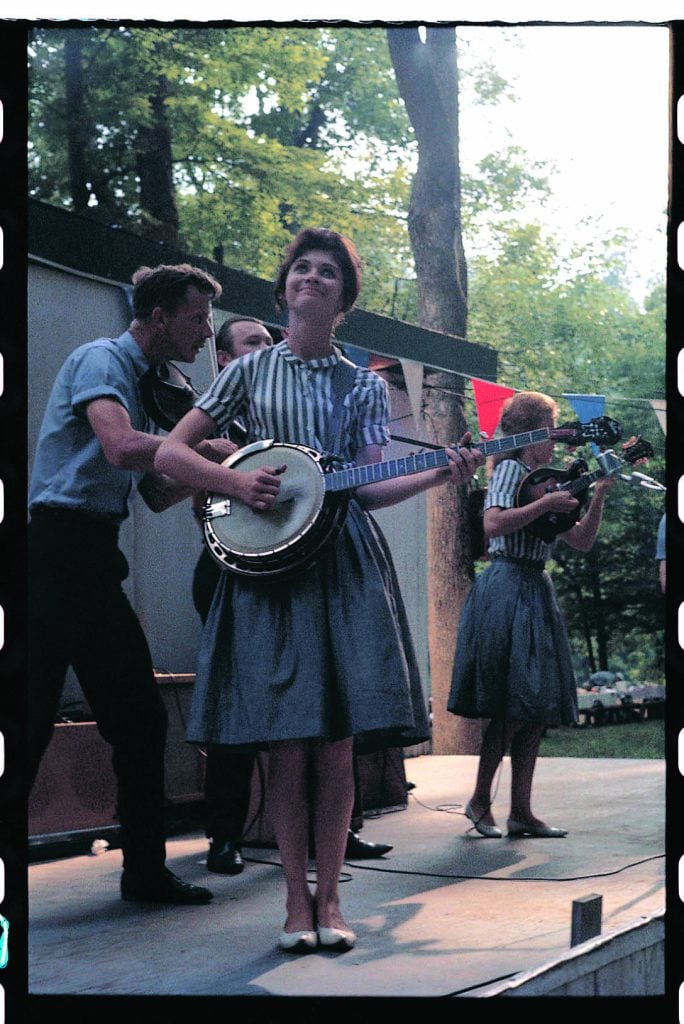
Born in 1938, Roni started playing the banjo when she was eight or nine years old. Recalling why she chose the banjo she said, “I was helping my momma’s father, Bill Frost, down in Galax. We were sitting on the porch and he said, ‘When I was a young, I went to town and there was a wagon train pulling in. There was a girl on one of those wagons playing the finest banjo music I ever heard. I followed her wagon round and round. The dust was flying and her legs were swinging. I fell in love with her.’” At that moment Roni decided that she was going to learn how to play the banjo so that she could make her Grandpa proud.
Remembering her early days learning how to play the banjo Roni said, “I walked up and down the street practicing my rolls and saying ‘one-two-three, one-two-three’ as I picked the strings. The boys in the neighborhood used to say, ‘Here comes that retarded, knock-kneed girl playing one-two-three, one-two-three on that banjo.’” She also recalls sitting on a stump in the woods for hours and working hard to get the Scruggs three-finger roll fast and smooth.
Roni credits her brother Scott for overcoming any prejudice against women playing bluegrass music. In a Washingtonian magazine article, she is quoted as saying, “He [Scott] told us that just because we were girls, that didn’t mean we didn’t have ten good fingers and two strong arms and a good brain and the talent of a Stoneman. I learned how to mash the strings and practiced till my fingers were sore. I’d get so worn out, I’d run out to the woods and get on my knees and just cry and cry.”1 Her hard work paid off.
Roni knew how well her brothers and sister played and if she wanted to play with them, she would have to spend many hours practicing. She said, “You had to be good to play with the Bluegrass Champs.” She joined the group in the late 1950s, taking the banjo spot that had previously been held by Porter Church (who Roni says was “a cousin by marriage.”). Other non-Stoneman musicians who performed with the Stoneman groups over the years included John Duffy, Charlie Waller, Bill Emerson, Buck White, and Roland White.
Recalling her days with the Bluegrass Champs, Roni said, “We were a team. We would listen to what the other was doing and we would cover for each other.” Roni added that the result of knowing that the other band members had your back was that, “We could relax and enjoy the music and the people.” In addition to Scotty and Donna, Roni’s brothers Jimmy (bass) and Van (guitar) were also in the band, and Pop would sing and play autoharp. After Pop passed in 1968, older sister Patsy would sometimes join the group.
Outside of playing music with her family, Roni is best known as a member of the cast of the popular 1970s television show Hee Haw. While she did, on occasion, pick the banjo and sing on the show, her comedic talents were more prominent on Hee Haw. She was involved in the sketch comedy scenes as the character Ida Lee Nagger. Roni had been friends with the show’s co-host, Roy Clark, since they were teenagers growing up in the Washington, D. C. area. She said, “He was like one of my brothers.”
In 1971, Bluegrass Unlimited Magazine conducted a poll asking its readers to list their favorite bluegrass pickers and singers. The top ten individuals in each category were all men…save one—Donna Stoneman in the mandolin category. Donna became interested in playing music when she noticed that the other kids in the family who were playing music got more attention. At first, she showed interest in the banjo, but soon turned to the mandolin because it was much lighter and didn’t restrict her movements. Anyone who has seen Donna perform onstage can understand why that would be important to her. She loves to dance while she is picking. She never stops moving.
Unlike her brother Scotty, Donna rarely recorded or performed outside of her family groups. However, in 1962, she played mandolin on seven cuts of the Rose Maddox Capitol Records release Rose Maddox Sings Bluegrass. The person who played mandolin on the other five cuts was Bill Monroe (who encouraged Maddox to record the album). Other musicians included on that project were Don Reno, Red Smiley, John Palmer, and Steve Chapman.
During the past two years, two new CDs have been released that give you a chance to check out the Stonemans, both old and new. Released in 2018 Bluegrass Champs Live From the Don Owens Show allows you to hear what a live Stonemans show sounded like. Recorded by Leon Kegarise in 1958 and 1959 this CD demonstrates why the Stonemans were not only a great live band, but also features their musical diversity.
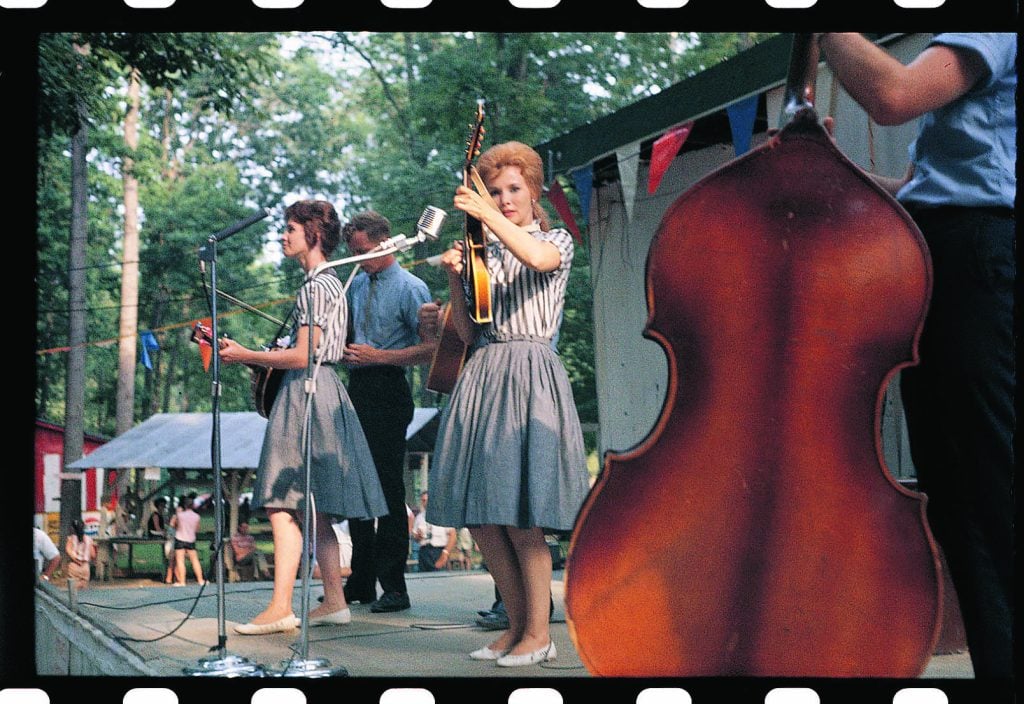
Donna and Roni’s recently released CD The Legend Continues clearly demonstrates that these two octogenarians have not lost one bit of their instrumental or vocal prowess. Their rapid renditions of “Rock-A-Bye Boogie” (an old Bluegrass Champs favorite), Monroe’s “Bluegrass Breakdown”, and their up tempo 4/4-time version of “Amazing Grace” demonstrate that these women can still play fast and clean. Their covering of Johnny Cash’s “Jackson”, Kris Kristofferson’s “Sunday Morning Coming Down”, Nat Stuckey’s “Sweet Thing”, and one of their father’s old numbers “May I Sleep In Your Barn Tonight Mister” tell the listener that the girls can still knock it out of the park with their vocals. With Donna’s original instrumental tune “Classical Vibrations,” she demonstrates her versatility on the instrument and lets us know why she can still be considered the reigning queen of the mandolin.
There is a lot more that can be said about a family who has spent nearly a century making music. In addition to the many articles that can be found online, two books have been published that focus on the Stonemans. The first, The Stonemans: An Appalachian Family and the Music That Shaped Their Lives, written by Ivan M. Tribe, was published in 1993 by the University of Illinois Press. The second book, Pressing On: The Roni Stoneman Story, also published by the University of Illinois Press, came out in 2007 and was written by Ellen Wright and Roni Stoneman. These books provide a combined 600 pages about this unique and pioneering musical family. Additionally, Murphy Henry Hicks includes a chapter about Patsy, Donna, and Roni Stoneman in her book Pretty Good For A Girl: Women in Bluegrass, again published by University of Illinois Press, 2013.
In 2008, Ernest “Pop” Stoneman was inducted into the Country Music Hall of Fame. In 2003, the International Bluegrass Music Association (IBMA) gave the Stonemans the association’s “Distinguished Achievement Award.” This award recognizes “forerunners and ambassadors for bluegrass music.” Perhaps one day the Stonemans will be part of the IBMA Bluegrass Hall of Fame with a plaque hanging in Owensboro honoring this family of musical pioneers. If I had a vote, I’d certainly cast it in their direction.