
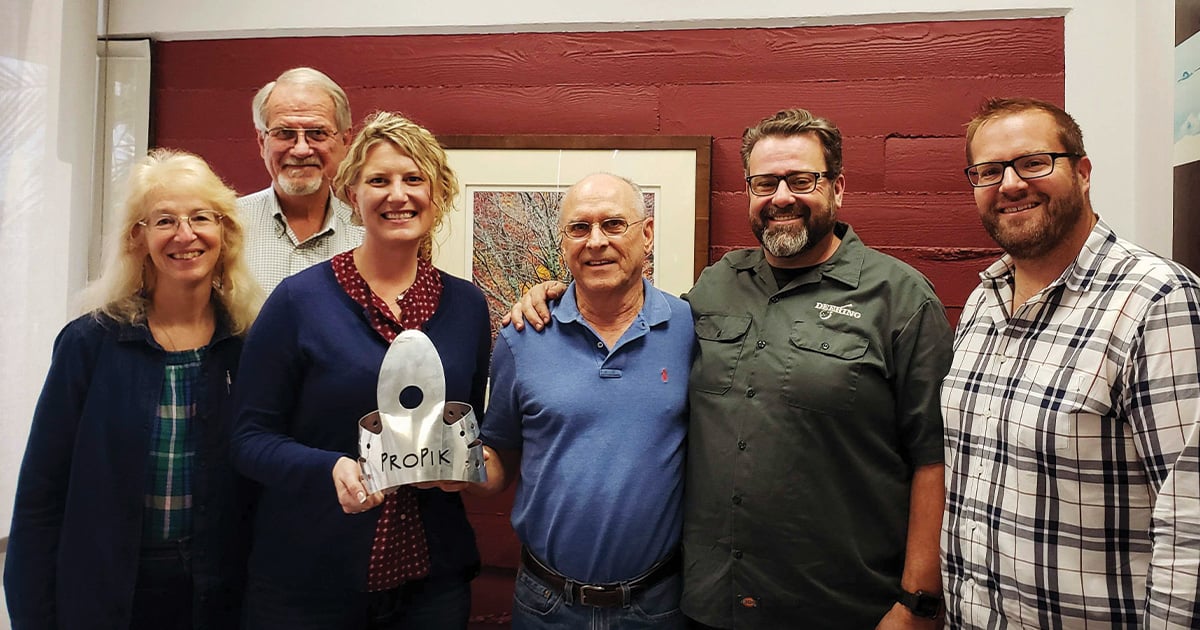
Deering Banjos and the ProPik Finger and Thumbpicks
The ProPik brand of finger and thumb picks that are used by banjo, Dobro, fingerstyle guitar, and autoharp players have been available for forty years. The story of how the company got their start is an interesting one. It begins in 1982 when a guitar-playing design engineer named Jim Mapson, who lived in Orange County, California, decided to take banjo lessons from local musician Dave Guptill. At that time, players could not get the National finger picks that were popular and Guptill shared this dismay with Mapson, and Mapson was not able to find a fingerpick that he was comfortable with. Being an engineer, Mapson decided to go to the drawing board and design one.
In 1981, Mapson had started Mapson Engineering, a company that made products supporting the aerospace and defense industries. Mapson Engineering provided high resolution, large-format precision graphic solutions for specialty electronic applications. Their state-of-the-art imaging technology allowed greater precision at extremely large scales, on a wide variety of metal substances. Mapson designed the parts and a metal etching process was used to manufacture Mapson’s designs.
Mapson personally designed ProPiks and used his contacts in the metal etching world to etch the designs out of the metal. Mapson and his team would then extract the picks from the metal sheets, de-burr, shape, buff and polish them. His banjo teacher Dave Guptill became the sole distributor for the picks. After forty years of designing a variety of pick shapes and sizes (new designs being based on customer input) ProPik eventually offered an impressive 83 different pick designs (this number includes small, medium, and large picks and a single band or double band [comfort band] option on some designs—plus the option of nickel, stainless steel, or brass pick material).
Every year at the National Association of Music Merchants (NAMM) show in Anaheim, California, Dave Guptill would set up a booth to display the picks and solicit wholesale accounts. Across the aisle from the ProPik booth, the Deering Banjo Company had their booth set up and nearly 14 years ago they decided to start selling ProPiks along with the other banjo accessories that they offered in their catalog. Janet Deering recalls, “We started selling ProPiks probably about 2009. We thought Dave Guptill was the owner and maker of ProPiks. We didn’t know anything about Jim Mapson.
“In late 2019 one of our top dealers, Banjo Studio, had written a blog post stating that ProPik was out of business because David Guptill was no longer answering messages and they couldn’t get any more picks. Much of the industry was in a stir about this. On January 7th 2020, Jim Mapson contacted Banjo Studio and let them know they were very much in business and to buy directly from him from now on. So they did, but they also had some correspondence and a phone call with Mapson along the way. He had shared he wanted to sell the business. They thought about it for a moment, that maybe Banjo Studio would want to make picks. They ended up deciding no. But, they did tell him that they had a line in with Deering, and that Deering might be very interested. Banjo Studio gave Mapson the contact information and passed the news about this call on to Jamie Latty, COO Deering Banjo Company.”
Then came the call that led to Deering learning more about the business and eventually acquiring ProPik. During the January 2020 NAMM Show newly named Deering CEO Jamie Deering (Janet and Greg Deering’s daughter) and Deering COO, Jamie Latty went to visit Jim Mapson to talk about the idea of Deering taking on ProPik. In this first visit they all hit it off and discovered that there were a lot of similarities between their two businesses. They were both family businesses and Jim and Diane Mapson were about the same age as Janet and Greg Deering. They also did a lot of hand-work at ProPik, and developed new designs based on customer input, just like Deering. Jim and Diane were planning their retirement and had no kids and thus nobody to pass the business on to, so they were looking for the right buyer. Dave Guptill did not want to take that on. Deering knew the importance of ProPik continuing for the music community all over the world. It is a well-known brand and product that they did not want to see disappear or be made in a lesser quality by someone else.
Jamie Deering worked with Jim and Diane Mapson and they came to an agreement for Deering to purchase ProPik. This was finalized on February 24th 2020. That same week Janet Deering, master craftsman Chad Kopotic, Jamie Deering and Jamie Latty spent a couple of days with the team at Mapson learning first-hand the process to make them. Each step was gone through and filmed in detail in order to be able to always refer back to the original team. John Mapson (Jim’’s brother) was one of the main makers of ProPiks for all their years of production. He starred in the filming and offered a wealth of information about the process.
Janet said, “Once we finalized the purchase, that is when I got involved as Jamie had already taken over running the company in December 2019. We went up and met Mapson in February 2020, right before the pandemic lockdown. They showed us the whole process and told us that Dunlop had looked at it. Dunlop had turned them down after they saw the process. They said it was too much hand work, so they were not interested. When we went in to look at it, they were worried we would think that there was too much hand work. We said, ‘No, that is what we do at our factory. We do hand work. We are not afraid of hand work.’ We spent the rest of that day and the next day filming and being shown, step-by-step, the whole process of how they make the picks. We were able to get some hands-on time and try it out and took turns actually making the picks with them. It was so similar to our mindset—having an option for everybody.”
When Deering purchased the ProPik brand, they purchased the name, trademarks, designs, machinery, jigs, fixtures and all of the various physical and intellectual components. Janet said, “We had taken our truck up and loaded it up with all the tools and machinery about three weeks before the lockdown. When the lockdown hit, we were able to keep nine people on at Deering as a skeleton crew, and had to temporarily furlough the rest of the team with a date set in May when we hoped the state would allow us to bring them back (which ended up happening and the full crew was brought back on full time). Most of those 9 were working from home. But, we have a 25,000 square foot facility…so there is a lot of space between people if a couple of people are there. I stayed to fill web orders and learn ProPiks.”
Janet used the time afforded during the lockdown to hone her skills at ProPik production. She said, “I had all of the film that I had taken when we went to learn the process, so I was editing the film into training videos and then I started training myself and doing it.”
When Deering acquired ProPik, they were first focused on producing the same models, designs, and sizes that were already available. Then they got to work sending their ProPiks to some of their professional endorsers and asked for feedback. New fingerpick designs grew out of the feedback that they received. A new thumb pick style was also added that was based on a new type of plastic that Mapson was working with for the thumb pick blade, but had yet to put into production. This led to the production of the “Super-Tone” thumb pick. Janet explains, “The Super-Tone thumb picks were something that Mapson had intended to release because they have a new kind of heavier plastic. It is much more durable. He had the design already done and had the plastic cut, ready to try it, when the change-over took place. So, we carried that to completion and also redesigned the band to be the customer requested solid band. We had the pleasure to work with Jim Mapson on the six new pick’s etching designs before he also sold Mapson Engineering and began enjoyment of full retirement.”
One of the most interesting and exciting new fingerpick designs is the “Heritage.” Janet explained that this pick is based on feedback that they received from Jens Kruger. His comment was that the holes on the sides of the fingerpick bands were not large enough for him. He liked larger holes because they allowed for part of the flesh of his fingers to swell into the holes and help the picks stay on his fingers. Deering’s website tells the story like this—“The ProPik Heritage fingerpicks are based on a set of Earl Scruggs’ 1950’s National oval eight picks that were used during the recording of ‘Pike County Breakdown’, featuring Lester Flatt and the Foggy Mountain Boys, in October of 1950. Following that session, Earl gave the picks to Dobro legend Tut Taylor, who approached Scruggs about what picks he used.
“Many decades later, those same picks made their way to Deering artist and R&D advisor Jens Kruger, who had become very close with Taylor and they became the base for the new Heritage picks. These picks are the exact dimensions of Earl’s ‘Pike County Breakdown’ picks, and each blade is individually buffed and angled backward for a played-in feel, as well as less resistance against the strings.”
In addition to the Heritage, Deering also added two new finger pick models that utilize the larger holes with a couple of the original ProPik designs which they named Progressive #2 and #2-Angled. Both Progressive picks feature a single band with holes that are progressively larger following the width of the band. All told, Deering has already added six more models to the 83 that they acquired from Mapson. All of the new innovations have been designed based on player recommendations.
Janet Deering emphasizes, “ProPiks are not just for banjo players. Our models include picks for fingerstyle guitarists, resonator guitarists, autoharp players, and sizes for little tiny fingers. So, we cover the breadth of the music industry. I’m even selling picks overseas to people who play Indian instruments. Every kind of player can use ProPiks.”
In this short article we do not have enough space to detail all of the models of ProPiks now being made by Deering. If you are a musician who uses fingerpicks, or a thumb pick, when playing your instrument, I highly recommend that you take some time to browse through the ProPik website (pro-pik.com) and explore the options. If you were already a fan of ProPik, you will be happy to know that your favorite picks are still available. If you have not tried ProPiks, or did not previously prefer the ProPik designs that were available in the past, you may want to check out the new designs. I especially recommend taking a look at the new Super-Tone thumb pick and the Heritage fingerpicks. I found these to be my favorites on both the banjo and the resonator guitar.