
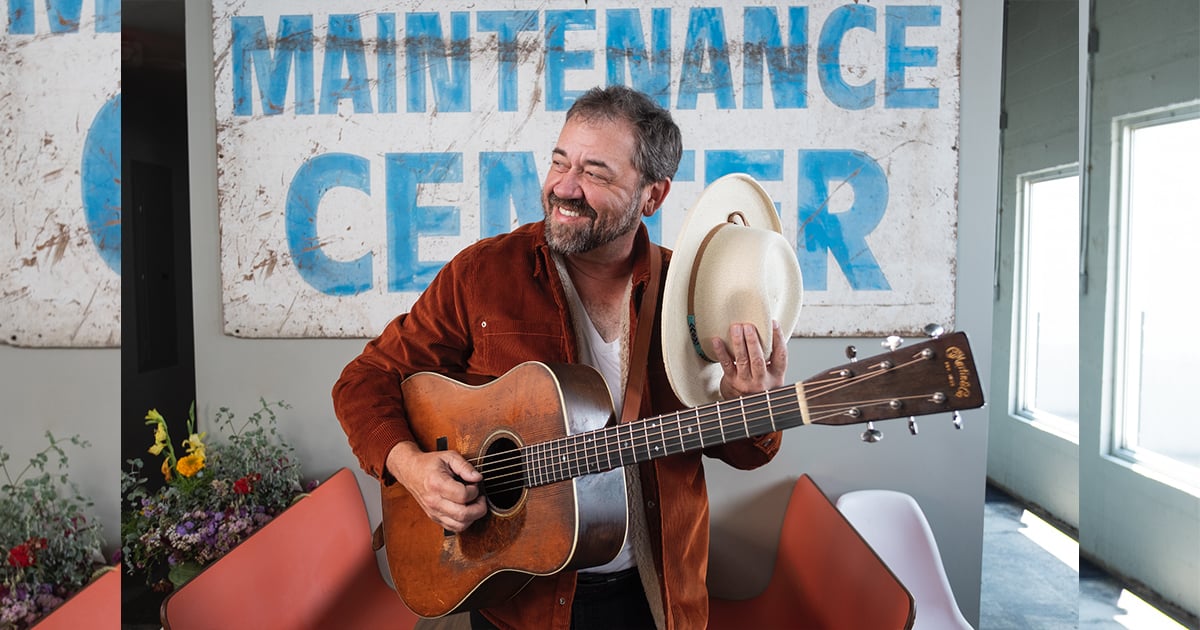
Dan Tyminski
Saved by Bluegrass
Photos by Scott Simontacchi
Forty minutes into conversation, Dan Tyminski drops an unthinkable truth. Without flinching, perhaps the most globally recognized voice in modern bluegrass explains the conflict that’s defined his journey. In spite of a tone so instantly head-turning it defined George Clooney’s character in O Brother, Where Art Thou, he confesses, “My voice has been the one thing I’ve never wished for. It’s the last part of the arsenal I ever wanted anything to do with.
“I grew up playing. I wanted to bury my head. I didn’t want anyone to hear my voice. I wanted to play my banjo or my mandolin, or whatever I had in my hand at the time. I wanted to support whoever I was playing with.”
The affable multi-instrumentalist known for his work with Alison Krauss+Union Station, and two stints in the Lonesome River Band, is obviously more complicated than he seems. In spite of fourteen Grammys and his deep love of the support role, he realizes it’s time to step out and stand on his own. Time to offer up an EP to honor Tony Rice that serves as a bridge from Rice’s peers and today’s influencers Sam Bush and Jerry Douglas, to rising (super)stars Billy Strings and Molly Tuttle. Time to create a solo project that cuts to his bones instead of songs that feel good, but may not reveal the man who survived what can generously be deemed a high impact childhood.
“I spent $300 on therapy to try to dig through this stuff,” he says, shaking his head. “I decided after three sessions, I didn’t wanna be fixed. I wanna write songs and play, because that’s where the answers are.”
A Musician Is Born
Tyminski’s parents loved music. Every weekend they’d be out at the country bars around their Vermont home, and they would attend fiddle contests, bluegrass festivals and square dances. The Northeast had an active music scene; the Tyminskis lived for seeing bands play live.
“It was back when you could take a five-year old into the bar,” Tyminski says. “One night, in a club called the You & I in upstate New York—I’ll never forget this—the band playing onstage was Smokey Greene, and we were watching them play. I asked my Mom if she would ask the band to let me sing. “My Mom said, ‘If you wanna sing, you ask him yourself.’ I wanted to sing ‘Please Daddy, Don’t Get Drunk This Christmas,’ by John Denver; that was my big six-year old hit. I was such a shy kid, this is where I think—no kidding—God put his hand on my back and pushed me forward ‘cause I wouldn’t talk to people, could barely look anyone in the eye.
“Whatever got into me? I walked down the hallway and tugged on the guy’s pants. He turned around and looked down, and said, ‘Well, hey there.’ I said, ‘Can I sing a song with you?’ He said, ‘Why sure…’ He could’ve ended my career right there, by saying, ‘Sorry! Bad timing…,’ or ‘Get away from me, kid…’ But instead, he said, ‘Why sure! What do you want to sing?’
“I remember, six years old, I stood there with my knees physically, literally, knocking together, shaking, trembling so hard. I don’t remember if I sang it well or wrecked it, but I got through—and when I finished the song, everybody in the bar was clapping. Some stood up. Because a little kid just sang, right? But I remember feeling like I’d never been picked up that high, something about everybody clapping.
“Then someone came up and gave me five dollars. This was in 1973. Five dollars! And I remember one of my uncles, who I told the story after we were home, he said, ‘You’re never gonna have to work again! You’re a musician.’” Part of Dan always believed that familial prophecy. But it wasn’t that easy—“my mother had 16 brothers and sisters; my father was the oldest of ten. In families that size, you learn to fend for yourself and put up your dukes. My Dad was the provider growing up, making sure everyone was taken care of, but in families that large…”—Tyminski longed for a place to fit in.
Vermont can be a rough place. Marble quarries that served as swimming holes and caves to hide out in. Limited opportunities once you got out of school. For Tyminski, who could throw 88, 89, 90 miles an hour as a kid, baseball went up in smoke as a way out after an injury took him out of play.
Not prone to introspection, he kept doing the next thing, striving to be better at whatever he focused on. But destiny works its way into a life and pulls people through all kinds of things. “I knew music was it when I was six ‘cause I was told it,” he says. “But what I loved was aggression. I loved the aggression of bluegrass. Like baseball, where you could throw as hard as you wanted, you could hit as hard as you like, there’s something about (that force). I get the same thing, same love, same release in music.’
“And liking the aggression, I wanted to be better. I knew I could throw the faster. I knew I could sing louder. I knew I could sing higher. I knew it was there. I never doubted it. I just didn’t want it to be for myself, I wanted it to be for someone else.”
Torn Between Iconic Bands

With that voice, his ability to morph to the people he sang with and the fact he could move from guitar to banjo to mandolin as needed, Tyminski was the great utility player. Going to festivals, sitting in, he joined the Lonesome River Band. After “three years, we’d made $9,000 over all of it,” he says with a sigh. “I’ve never done it for the money, but I was on my way to living in Vermont, working for GE, because, well…life.”
When Ronnie Bowman arrived, he agreed to come down and sing a little with him. Sure enough, magic. He jokes people used to think they sounded like brothers, noting he’s never said “thang” in his life. “But, you know, that’s how Ronnie sings, and I want to match him exactly. That’s my job, and to sing with Ronnie Bowman, well, of course you’re going to pronounce the words the way he does.”
Bluegrass is a tight-knit world. Everyone knows everyone. Sometimes dream opportunities emerge. One day the call came to join this year’s Hall of Fame inductee Alison Krauss and her storied Union Station. He loved LRB, but, “my favorite band, not even close, was always Alison Krauss and Union Station.”
And so, the invitation came. He took it. How does someone turn down being asked to join the Rolling Stones if they’re a rocker? The Beatles if its pop music? Or the Eagles? Vince Gill, noted in many genres, couldn’t help himself. With conflicted feelings, he did what he had to do—and in that, there was a nagging he couldn’t escape.
“I felt like I had let the Lonesome River Band down. I felt like I had, because we had just recorded Carrying the Tradition. We won ‘Album of the Year.’ Right? We were just hitting our stride. That’s when I left to go with Alison. When I listen to Alison’s voice, Barry on upright bass and Tim Stafford was playing guitar, with that baby seal flipper he’s got, that I don’t know what you call it…That band was—if you’re a player, and you’re young—that’s the band. There is one band, and one only, that you would hope to be in. I was in it…and then I quit.
“All songs, they have that little secret, you know? The Lonesome River Band’s ‘Gotta Do What You Gotta Do’ was how Ronnie Bowman got me to leave Alison Krauss and Union Station to go back to Lonesome River Band,” Tyminski says, then sings, “I just got a call from my good girl today / She said she must be going on her way.”
He stops and deciphers, “No, I called and told him I was leaving to go to AKUS.”
Then sings again, “Well, there’s better things on down the line / And I’ll not try to change her mind / Seems things are better off this way / But my heart it breaks in two / I can’t believe we’re really through / Though I want you to stay, you’re leaving anyway / But you gotta do what you gotta do.”
The singing stops. Without dropping a beat, he finishes the story, “Like, I literally left AKUS and went back to the Lonesome River Band…I literally went back because of that song.”
Funny thing about doubling back, even to a band as strong and musical as LRB, it’s rarely recaptures what was. After a year and a half, Tyminiski had his daughter. Like friends will do, Adam Steffey called when he heard the news.
“I remember Adam Steffey said, ‘Hey, just wanted to congratulate you, man. How you doing?’ I said, ‘Well, I’m missing you guys,’ and he said, ‘Oh, don’t say that.’
“When he said, ‘Don’t say that,’ I could hear Alison in the background saying, ‘Oh my God, let me talk to him. Let me talk to him. Give him to me.’ I can hear every word she was saying, “Let me talk to him. Let me talk to him.’
“She gets on the phone (with me) and goes, ‘Dan, would you be interested in coming back?’ I was stunned and answered, ‘Just say the word.’ She said, ‘You gotta be serious, because if this is real, we want you back.” I said, ‘I wanna come back.’ That was that.”
“Just like I didn’t love the Lonesome River Band more when I left and went back to them, AKUS was something I just couldn’t let go of.”
Passion + Perfection

It’s a storied career. Lonesome River Band, twice. Alison Krauss and Union Station. O, Brother, Where Art Thou. “Hey, Brother.” 2001 CMA Single of the Year. Fourteen Grammys. Four IBMA “Male Vocalist of the Year” honors. Millions of miles and smiles on the faces of music lovers around the globe over the last three decades. For a man born to compete, the accomplishments tell the story.
And yet, it’s more the story of music and other people. It’s not lost on the man who really just wanted to be a banjo player. With Alison Krauss and Union Station—a gig he’s had for more than a quarter century—he found a level and expectation of perfection that spoke to him. “She is the top of the mountain,” he explains. “Her vocals are so pure. Even when she was fourteen years old.”
He recognizes that her technical prowess is unparalleled, but there’s more to Krauss’ magic than merely how tight the band plays. “That’s what I loved about AKUS: I could hear the level of perfection she was striving for, and what she did turned me on! To be in a band where everybody’s game is clearly above mine, that’s my dream world.”
“But Alison is so connected with how she makes you feel in a song. What scares me is how she can do that on purpose. I just listened to a song she did when she was fourteen years old, and she impacted me every bit as hard as the last things she’s done. Those vocals were a little bit more reckless when she was fourteen, maybe ‘cause they didn’t’ have unlimited studio time.
“But I sat in my car, and heard, ‘I’ve that old feeling you’re leaving/I’m so tired of good-bye/ I can’t wait on your love forever/While you change your mind…’ I think I fell in love with her right then back when. Because of Alison, I’ve played so much soft tender music, and even though I have the ability to do that, it doesn’t mean that’s where I like to hang out.”
Tyminski pauses, weighing his thoughts. “I grew up absolutely an instrumentalist. I only wanted to hear how things fit together, and even when I sang early on, I don’t think I sang according to the message of the lyrics. I think I sang according to my ability to use my voice as an instrument: to find a certain tone, a pitch, a way to say my words with a cadence that sounds like it could be a rhythmic lick.
“At some point in my 30s, I started understanding the message in the songs was the biggest part. O Brother made me redefine how I listen to music. Up until O Brother, it was so important that everything fit mathematically and evenly into its space, and that everything was in perfect timing and the tuning was right. I was missing the whole fact that it has to touch your soul, and it doesn’t have to be squeaky clean to do that.
“I’m pretty critical of everything I’ve ever done, before I started to come around to the idea that the exact space between the notes is not what makes it good. That it’s in perfect tune is not what makes it good. I’m listening differently than before; I want it to touch a different part of me.”
Dialing in, he offers, “Before I got that first taste in O Brother, where I didn’t approve of my performance at all—and it ended up being a big fat hit, what I’m technically famous for. You know, everyone says, ‘We love how that sounds,’ and all I can think is, ‘I messed up tone and timing, clarity, enunciation, every little thing you want to be right.’ But I don’t know that any of it would make it any better.”
He laughs sheepishly. “My initial filter, growing up, everything that got me the most wasn’t about the soul of the music, wasn’t about how it made you feel. They were all mathematical equations, not living breathing things that could be fast or slow or sloppy. At the end of the day, I thought the Rounder 0044 JD Crowe and the New South record was the most perfect record, that everything fit together perfectly. I listen now, if you wanna pick it apart, it’s all over the map. But I can’t think of an album I’ve listened to more.”
Steeped In Tony Rice
When Tony Rice died, it took a day for the reality to sink in. Like so many progressive bluegrassers, Rice remains the North Star for Tyminski. After crying most of the second day, the developing songwriter decided to write something—pulling in Josh Williams. That song led to thinking, thinking led to wanting to expand the rings of honoring Rice with peers Sam Bush and Jerry Douglas who shared Rice’s world with those younger artists he influenced like Billy Strings and Molly Tuttle. That communion is how the music roots and grows, and it is what has kept bluegrass music as vital and dynamic as it has been for so many decades.
“When I heard Tony’s playing, that in my opinion was the highest level of perfection. That’s as far as I’ve heard it taken. I haven’t heard someone else pick a string and do that much with it,” Tyminski offers. “But it’s more than that. It touches me, makes me feel however he wants me to feel. I swear, if he wanted me to feel angry, Tony Rice could make me feel angry with just the tone. Melancholy or just sad, he can bring it out without a word. His tone, power, timing, everything—and I don’t see anything being played any better.”
Beyond honoring Tony Rice’s influence, Tyminski realized before he hits the half century mark, it’s time to stake his own claim. Not for success or awards, but to let people see the man behind all these iconic moments in American roots music. Touring with his own band—Maddie Denton on fiddle, Adam Steffey on mandolin, Grace Davis on bass and Jason Davis on banjo—the lessons of Southbound and pushing himself as a songwriter have dug deep.
Dan Tyminski Emerges
Uncomfortable stepping forward, though, he recognizes there’s a level of honesty that can only happen when he allows people to truly see the man, not the voice or technique. Joking there are enough “Cabin on the Hill” songs, he explains the record he’s in the studio working on will face graver things—not just his own turbulent growing up, but the plight of people facing challenges that feel insurmountable.
“It’s a little unnerving for someone who’s spent a lifetime trying not to let anybody see through the veil to actually not just drop the veil, but open the doors and windows and everything, and say, ‘Hey! This is how I see life.’
“For the first time, I think I’m giving people my version of me. They’ve had Avicii’s version of me. They’ve had Alison’s version of me. They’ve had the Lonesome River Band’s version of me. They’ve even had a version of me that looked like George Clooney. Now with the music that’s coming they’re going to have Dan’s version of Dan.”