Buddy Michaels
Hometown Hero Of N.C. Bluegrass Broadcasting
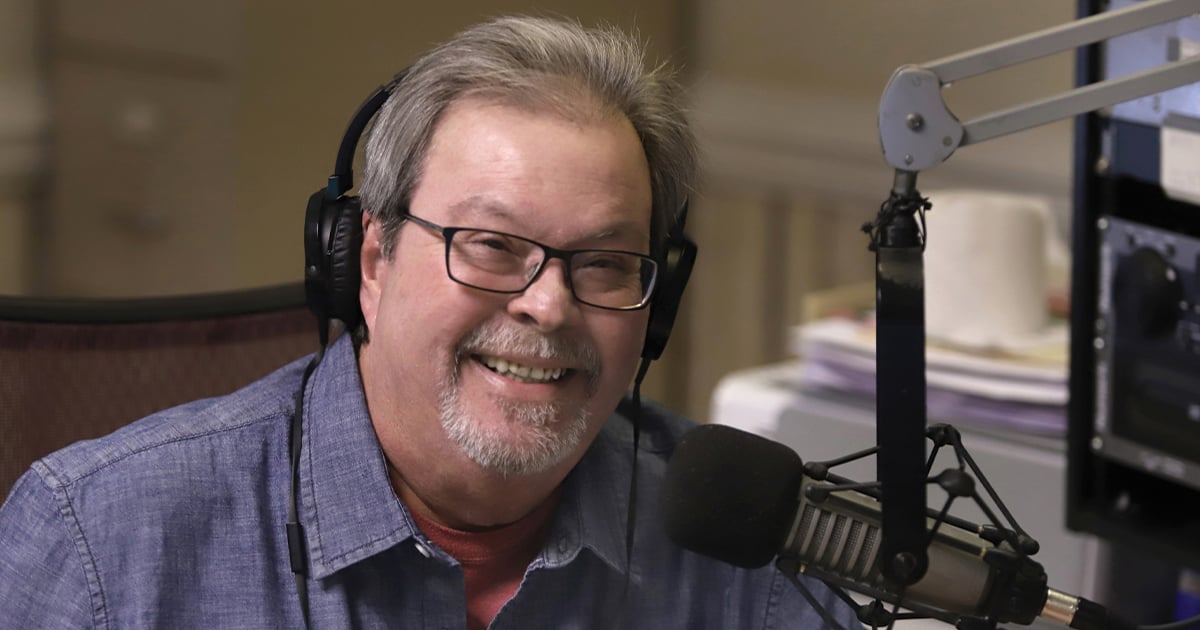
Photo by Lee Capps
Buddy Michaels loves to talk. Ask him a question then sit back and enjoy the ride, because he’s likely to detour through a story or two before arriving at the answer. His favorite subject: music and the people who make it. So what better path could he have taken than a career in radio broadcasting, a journey that has driven him for almost fifty years.
Buddy, whose given name is Gary Branchaud, was born in 1954 in Suffolk, Virginia. His mother came from a sharecropping family in Hertford County in northeastern North Carolina. When she was a teenager they moved to Suffolk, where she met Buddy’s father. He was a Navy veteran of World War II, who at the time was stationed in nearby Norfolk. “He was a Native American,” Buddy says. “Grew up on Red Lake Indian Reservation in western Minnesota, where it’s really, really cold. He was French-Canadian and Chippewa. He taught me to love the music that I love.”
Buddy’s grandfather played the fiddle in the Cape Breton style, and Buddy’s father learned to buck dance as a young boy. “They called it ‘jigging,’” Buddy says. “He would go with his daddy and his granddaddy to the bars, when he was six, seven years old. They’d play the fiddle and he would get up on tables and dance. And when I was a little boy he had these 78 records of French-Canadian fiddle bands. He would play those records and dance for us. That was some of the most incredible music I’ve ever heard! The music just got in me.”
Soon Buddy got a transistor radio for Christmas and discovered a whole new world of music. “I would listen at night, after I went to bed,” he recalls. “I would tune in WOWO in Fort Wayne, Indiana, WLS in Chicago, WKBW in Buffalo. I found the Grand Ole Opry on Saturday night. Something about that live audience just mesmerized me. I would hear Ernest Tubb, Roy Acuff, Lefty Frizzell. But then I heard [Bill] Monroe, and I thought, ‘He doesn’t sound like the rest of them.’
“Then I saw Flatt & Scruggs on The Beverly Hillbillies and I was really blown away. I really liked the banjo. I went to see [the movie] Bonnie and Clyde, and bought the soundtrack album. ‘Foggy Mountain Breakdown,’ if that doesn’t open up your sinuses, nothing will! Still, to this day, if I hear that song I have to stop. I’ve got to listen to it.”
Buddy was also listening to the local rock-n-roll station. “When I was twelve or thirteen, every Sunday after church I’d sit at the kitchen table and turn on the radio,” he says. “WGH in Norfolk would do a Top 30 countdown. I had a notebook, and each week I’d write down the Top 30. I’d look back on last week and try to predict [the new list]. And I was obsessed with the host. I thought, ‘This is the coolest job in the world!’”
As a teenager, Buddy was a self-proclaimed hippie, with waist-length hair. He had been a good student, but in high school he became bored and rebellious. After he graduated, his father got him a job at the highway department, where he sometimes worked as a night watchman. “So I would listen to the radio, and I would call up the late-night DJs. I got to know some of those guys and I caught the bug. I thought, ‘This is what I want to do.’ So I found Tidewater Broadcasting School in Norfolk, run by Paul Hennings.”
Buddy enrolled and turned out to be a star pupil. Hennings told him, “Kid, you’re gonna make it in this business. You’ve got the love for it, you’ve got the talent, and you love to talk to people.” Before the year was up, nineteen-year-old Buddy had a diploma and two job offers. He interviewed at WCBT-AM in Roanoke Rapids, North Carolina. The program director was impressed and told Buddy, “The job is yours, on one condition. The owner thinks you should cut your hair.”
The hair came off, and in 1973 Buddy began his broadcasting career. The station had a block format, including country, gospel, a noontime farm hour, pop, and rock. Buddy’s shift included a morning gospel program called “Sunshine for Shut-ins.” He recalls, “I played everything from George Beverly Shea to The Inspirations. But I got to play the Lewis Family, and that’s how I got even more into bluegrass. Another influence was a DJ in the Roanoke Rapids area, Cousin Slick [Roy Gray, Jr.]. He did a Saturday night [bluegrass] show on WCBT. I loved listening to him.”
After about a year and a half at WCBT, Buddy decided to go back to school. He enrolled in a two-year Bible college in Burlington, North Carolina, and landed a job working nights and weekends at WBAG in Burlington, a Top 40 station. In 1977, he moved on to WPET, a gospel station in Greensboro. “I really enjoyed that station,” he says, “because gospel’s got so much [variety]. You can have a banjo, you can have a steel guitar, and some of the best harmonies ever. I got to meet and interview some really neat people – The Inspirations, The Kingsmen, J. D. Sumner and the Stamps, Bill and Gloria Gaither, The Happy Goodmans. And I also did news and sports on WRQK, which was the FM upstairs, the number one rock-n-roll station in the area.”
In January 1979, Buddy took a major step up the ladder of radio success when he began working as the only live daytime DJ at WPCM, a brand new 100,000 watt FM country station in Burlington. Buddy worked both drive-time shifts, 6:00 to 9:00 am and 3:00 to 6:00 pm, and otherwise the format was mostly automated. Within about six months, he was promoted to Program Director and was allowed to hire additional air personalities.
Up until he came to WPCM, Buddy had been using the on-air name, Gary Michaels. He had chosen the last name “Michaels” partly because he knew people would have a hard time pronouncing or spelling his surname, Branchaud. The station manager at WPCM knew he had been known as Gary Michaels on rock stations and wanted him to use a first name that was more country-sounding. After rejecting “Bubba” and “Junior,” his manager said, “I’ve got it! ‘Buddy’ Michaels! Who’s offended by somebody named Buddy? Buddy’s just a good guy.”
The name stuck, and has served him well. WPCM became the first live 24-hour, 100,000-watt FM country station in North Carolina, and one of the most popular stations in the area. People heard the friendly voice of Buddy Michaels when they got up in the morning and on their way home from work in the evening. “We had a huge following!” Buddy asserts. “I would go out places and people treated me like I was a star! I gave autographs and made pictures with people and their babies. I had dogs and goats named after me. People would bring gifts to the station.”
One morning within weeks after the station’s debut, Buddy finished his air shift and walked to the lobby to find promoter John Maness waiting to talk with him. Maness and his partner, Mike Wilson, who played together in a band called the Bass Mountain Boys, had started a bluegrass festival the year before on John’s farm south of Burlington. They were planning to have another festival on Memorial Weekend in 1979 and wanted to advertise on WPCM. Maness also proposed that the station start a weekly bluegrass program, and offered to help get it started. Buddy responded, “Well, it’s funny you should mention that, because I LOVE bluegrass!”
After getting his manager’s approval, Buddy began hosting the Weekend Festival show from 3:00 to 6:00 on Saturday afternoons. It later was moved to Sunday mornings from 9:00 to Noon, which turned out to be an even better time slot. “It was the number two show on Sunday morning in Winston-Salem/Greensboro/High Point,” he asserts. “That’s a huge market. At one time there were thirty-six radio stations in that market. All the people that liked bluegrass made a pilgrimage to that Sunday morning program. People used to tell me they would put a radio in their pocket, run an earplug up through their sport coat [and listen in church]. And people would record it. A guy from Danville showed me he had hundreds of cassette tapes [of the show] in his van.”
John Maness also invited Buddy to work as an emcee for the Bass Mountain Festival. He had no previous experience, so Maness eased him in gradually. He was able to learn alongside such pros as Chuck Webster of WKTE in King, who presided over the annual Lester Flatt Mount Pilot Festival, and Bill Vernon of WVTF in Roanoke, who had been emceeing bluegrass festivals for many years.
Eventually Buddy became the most sought-after bluegrass emcee in the area. In addition to working forty years at Bass Mountain (later renamed Little John’s Mountain Music Festival), he has been a regular at MerleFest in Wilkesboro, the Doyle Lawson & Quicksilver Festival at Denton, Willow Oak Festival and Pickin’ by the Lake in Roxboro, the Got to Be NC Festival in Raleigh, various festivals at Wayside Park in Stuart, Virginia, and many more. He has also emceed indoor concerts at theaters, schools, and arts centers all around central North Carolina.
Buddy’s success as an emcee is attributable to his ability to combine professionalism with accessibility, humor, and a true appreciation of the music, the artists, and the audience. In addition, festival promoters trust Buddy to have his finger on the pulse of current trends and they seek his input when choosing which bands to book. His radio audience listens not only to hear their old favorites, but to be introduced to the new artists and songs that have Buddy’s stamp of approval. The artists know that Buddy studies and enjoys their music, and they think of him as a friend and supporter.
Those friendships serve him well in the frequent on-air interviews he conducts (many of which are archived at www.buddymichaels.com). Buddy is always happy to feature an artist who has a new release or a tour date to promote, but he goes a step farther. “I’ve been told by many different artists and listeners that they like to hear me do an interview because I don’t ask standard questions,” he says. “ I just talk to them. I cut up with them. I try to find out what they like. John Duffey taught me that. Let’s talk about muscle cars, the Atlanta Braves, and bowling, because the audience may want to know John Duffey as the bowler or the Braves fan. It relaxes the artists, and I get to know them better.”
The Seldom Scene’s Dudley Connell, who has been interviewed by Buddy dozens of times, agrees. “He makes you feel really comfortable,” Dudley says. “He calls me to promote an event or record release, but most of the time we talk about life. He makes it about the relationship that we have. I find that to be very refreshing.” The two have known each other since the early 1980s, when Dudley first played at Bass Mountain with the Johnson Mountain Boys. “Buddy was emceeing the festival and he wanted to know our influences and where we came from,” Dudley recalls. “I took a liking to him right away. He knows the artists, he knows their history. He’s very comfortable reading his audience and presenting the bands with enthusiasm without being over the top.”
Buddy spent twenty-six years at WPCM (which later changed it’s call letters to WKXU), but in July 2005 the station changed to a news/talk format and he found himself without a job. He decided to take a vacation and do a few home projects. Then, in November 2005, he received a call from the owner of WBAG (1150 AM/105.9 FM) in Burlington, who proposed that Buddy record a three-hour bluegrass Christmas show. It was so well-received that the station aired it again a week later. “It was very profitable and we had a ton of response,” Buddy confirms. “The station owner said, ‘Let’s do this again in January, just start doing a regular show.’ And I’m still on there now, every Saturday morning, 9:00 until noon. I’ve got great sponsors, [some of which] I’ve had for twenty, thirty-some years. It makes it easy for me that they believe in me and trust me.”
Just days after he started the program at WBAG, he received a call from the manager of WKRX (96.7 FM) in Roxboro, who wanted him to host a Monday night bluegrass show. His first show there aired on Monday, January 16, 2006 from 7:00 to 11:00 pm. (It now airs and streams online from 6:30 until 10:00 pm.) Just a few months later, Buddy was approached by WLHC (103.1 FM) in Sanford, and he began doing a Saturday morning program there. That show can be heard on air and online from 7:00 to 9:00 am, and is simulcast over WLHQ (103.1 FM) in Rocky Mount.
While his original program on WPCM was called “Weekend Festival,” Buddy’s wife Brenda suggested he group his new set of shows under the broader and friendlier sounding moniker, “Hometown Festival.” Initially, he was making the weekly drive from his home near Burlington to each of the stations to do the programs live, but about ten years ago he put in a home studio. This enables him to record each program at his convenience and email it to the appropriate station for broadcast.
Buddy has been a Bluegrass Unlimited reporter from the time the National Survey chart was created in 1990. “I think I was the first reporter from North Carolina,” he maintains. “That’s quite an honor. And it means something to the artists.” But he doesn’t let the charts dictate what he plays. “I play what I want to play. I know what I like and I feel like I know what people like. Sometimes as soon as a song comes into the Top 30 it’s an instant hit to me. And then sometimes I play stuff that never gets on the charts. The bottom line is, if it’s good it doesn’t matter if [the artist] is local or lesser-known. I try to listen to as much [new music] as possible. I absolutely love finding new artists!
“My slogan is ‘the latest and greatest in bluegrass,’ he continues. “I play brand new stuff, ‘recurrents,’ anything from the last five years, and I throw in the classic stuff a couple of times an hour.” He feels it is important to educate as well as to entertain. To that end, he presents a segment he calls “the bluegrass wayback machine,” in which he discusses that week’s birthdays or events in bluegrass history followed by a related “triple play” (three songs in a row).
Buddy retired from emceeing in 2021, after a series of major health issues including back surgery, a heart attack, blood clots, and other complications made it challenging for him to stand for long periods. But he still enjoys attending festivals, and he stays busy in his studio with three different weekly bluegrass programs. Last year he also began hosting a classic country show airing and streaming from 6:00 pm to Midnight on Saturday and Sunday nights on WPTF (650 AM/98.5 FM) in Raleigh. Of that he notes, “It’s an honor to be on a legendary, historic station that was North Carolina’s first commercial radio station and [was home to] Bill Monroe and other Grand Ole Opry stars.”
His recent brush with death seems to have made Buddy even more grateful for his bluegrass life and friendships. “I have made so many great relationships,” he reflects. “When I got sick, I got tons of correspondence. That makes you want to carry on! When I first started doing this over forty years ago, I never thought it would become such a big part of my life. It’s something I eat, sleep, and drink. I look forward to every day, listening to new music and discovering new stuff. I wake up hearing songs in my head. I want to chat with people on Facebook. This is some of the greatest music EVER! I’m just thankful God allowed me to discover this music, because I don’t know what I would have done if I hadn’t. Or rather, it found me, I didn’t find it.”