Bringing Bluegrass in the Future
IBMA World of Bluegrass 2023
Photos by Ricky Davis
“I hear banjos.”
Even Sir Walter Raleigh was wielding one. But music lovers sought no deliverance. The sound was coming from the streets of downtown Raleigh, North Carolina that were bursting with bluegrass during the last week of September for the IBMA conference and World of Bluegrass festival. Inside the Raleigh Convention Center, an elaborate, multi-story sculpture made of banjo parts strung together like dinosaur bones hung in suspended animation. The air was charged with excitement that turned into bewilderment as the announcement was made that the festival would be searching for a new home in 2025. But even if the bluegrass ball of the year’s coach was prognosticated to turn into a pumpkin at midnight, 2024, the music was too shiny and compelling to keep those with bluegrass in their blood from filling their dance cards. At least for the time being, IBMA was still in the south, so attendees just channeled their inner Scarlett O’Haras. They’d think about it tomorrow. And presented with the bluegrass buffet on the table throughout the festival, they’d never be hungry again.
Calling the World of Bluegrass a three ring circus leaves out a ring, or ten. But to the organizers’ credit, the event’s structure allowed attendees to customize their own experience to suit interests, mobility, and tolerance level for crowds and stimulation.
The major “rings” of the “circus” were the conference, awards show, main stage at the Red Hat amphitheater, street stages, the exhibit hall, and showcases at the Marriott and all over town via the Ramble. Even with an IBMA app to create a personal schedule, attendees had to learn to pace themselves…and accept that to be present for everything that was interesting would require cloning technology.
The Conference

The early part of the week was reserved for conference attendees—those in the business—to learn all about recording, promotion, and even stress reduction. Sessions were offered on artificial intelligence, live band coaching, songwriting, and women in bluegrass, among others. Promoting the importance of maintaining healthy habits while on the road performing, the conference agenda included sessions like “Tai Chi with Jim Lauderdale,” yoga on the road, and a session on how to relieve neck, hand, and shoulder tension.
Industry Awards
Missy Raines was the emcee at the industry awards luncheon held on Thursday, sponsored by the California Bluegrass Association. The Broadcaster of the Year award went to Ned Luberecki. Chris Jones won Writer of the Year, and his band member Grace van’t Hof took home Graphic Designer of the Year. The Songwriter of the Year award went to Tim Stafford. Sam Bush added to his collection of awards by winning Liner Notes of the Year with Jon Weisberger for Radio John: The Songs of John Hartford. The Blue Highway Fest was named Event of the Year. Steve Chandler was recognized with the Sound Engineer of the Year award.
Five awards were presented for Distinguished Achievement, and those went to The Bluegrass Situation, Terry Baucom, Tom Ewing, Carol Goldstein and Red Wine.
The Awards Show
Held at the Martin Marietta Center and fondly referred to as “bluegrass prom,” the awards show on Thursday night of “the most important week in bluegrass” was a true red carpet experience. Fans rubbed shoulders with the musical elite, quite literally, as they gathered outside the building before the doors opened for photo ops and to show off outfits that would have made Porter Wagoner proud. As Becky Buller arrived wearing a dress with more tiers than a wedding cake, someone shouted “Cinderella!” Inside the auditorium it was the same way…who is that sitting just across the aisle? Oh, it’s just Sam Bush, about to be inducted into the Bluegrass Music Hall of Fame.
Molly Tuttle and Ketch Secor were hosts for the evening and kept the program on track, introducing performances in between spontaneously prewritten schtick and award presentations. Tuttle added to her significant portfolio of accolades by winning Female Vocalist of the Year, Song of the Year for “Crooked Tree” and Album of the Year.
Authentic Unlimited opened with “Ruby,” a tribute to Bobby Obsborne, featuring John Meador singing the signature high lead. Later in the show the group would take home awards for Vocal Group of the Year and New Artist of the Year.
It was a good night for Jason Carter (fiddle player with The Del McCoury Band and The Travelin’ McCourys). He took home both Fiddle Player of the Year and Instrumental Recording of the Year for “Kisssimee Kid.” He said, “Here at bluegrass prom, banjo players are the cool kids.” Kristen Scott Benson demonstrated she was among the coolest when she received Banjo Player of the Year.
Upon accepting the Male Vocalist of the Year award, Greg Blake of Special Consensus said his deceased wife deserved the award for making it possible for him to do this.
Larry Sparks earned Gospel Recording of the Year for “The Scarlet Red Lines.”
First time Entertainer of the Year nominee Appalachian Road Show performed their engaging audience-participation song, “La La Blues.”
In the same year that Gordon Lightfoot passed, Special Consensus with Patrick Sauber, Ray Legere, John Reischman, Trisha Gagnon, Claire Lynch, Pharis and Jason Romero won the award for Collaborative Recording of the Year for “Alberta Bound,” written by Lightfoot.
After Trey Hensley took home top honors for Guitar Player of the Year, The Del McCoury band (nominated for Vocal Group of the Year) took the stage. The associated group, The Travelin’ McCourys, received the award for Instrumental Group of the Year.

When Vicky Vaughn was awarded Bass Player of the Year, Secor joked, “Bass players are the best dancers in the band.”
Steve Martin and Alison Brown performed “Foggy Mountain Breaking,” nominated for Collaborative Recording of the Year.
David Grisman was inducted into the Bluegrass Music Hall of Fame for his “Dawg music” and many genre-bending contributions over the years, as described by fellow musicians and friends, with a recorded video acceptance.
Crying Uncle, the young band from California, took to the stage with Sam Bush and Ronnie McCoury joining in to play a tribute. Crying Uncle would later take the IBMA Band Momentum award.
Justin Moses received the award for Resophonic Guitar Player of the Year. He had to make more than one trip to the stage, later accepting the award for Mandolin Player of the Year for his wife, Sierra Hull. Billy Strings won his third consecutive award for Entertainer of the Year.
While award winning Rob Ikes and Trey Hensley played a tender rendition of Gordon Lightfoot’s “If You Could Read My Mind,” the names of musicians important to the genre who passed in the last year displayed on a screen.
Wilma Lee Cooper and Sam Bush were also inducted into the Bluegrass Music Hall of Fame. Country music pioneer, Cooper was remembered for not only her work with her husband, Stoney, but her ability to reinvent herself and lead her band upon his passing.
As multi-instrumentalist Sam Bush accepted his award he said, “To all the young bands…I appreciate you kicking me hard. We all need it.” Then he added, “Some of you remember I had a pretty good bout with cancer in 1982. It was the bluegrass community that saved me and my wife. Not just financially, but spiritually.”
The Main Stage
To get a sense of the main stage at the outdoor Red Hat Amphitheater, imagine as the sun begins to set, the side of a building illuminates with an amber image of a tree, glowing against a night sky with a backdrop of the Raleigh skyline. Banjo and fiddle compete with nighttime-in-the-city sounds of sirens and trains.
In the vein of build-your-own-festival, the ticketed main stage at Red Hat (with some free general admission seats in the back) was ideal for those wanting to settle down and stay in one place a while. Yet it was hard for attendees to avoid the “fear of missing out” when eyeing the attractive schedule on the street stages going on simultaneously. Some argued that the agenda might have been overwhelmingly overflowing.
Over the course of two nights, an impressive lineup performed, including the Po’ Ramblin’ Boys, along with two of Bobby Osborne’s sons, Wynn and Bobby Jr., and others playing “Rocky Top” as a tribute to the legend who passed this year.
“Old and new…it’s still blue,” CJ Lewandowski, mandolin player with the Po’ Ramblin’ Boys, said, recognizing the contribution of bluegrass forefathers and progressive musicians.
When Michael Cleveland and the Flamekeepers took the stage, they opened with an instrumental, “Too late for Good-Byes” and “Sunny Days are Coming Once Again.” After a couple of other numbers Cleveland said, “We’ve been playing mostly bluegrass music but we’re about to get far out…a little wild. What happens at IBMA stays at IBMA.”
When supergroup Mighty Poplar took the stage Friday night, Noam Pikelny (banjo player and member of The Punch Brothers) said, “IBMA is a support group for all of us who have this bluegrass affliction.”
The Kruger Brothers and friends played a tribute set to the life of Doc Watson who would have turned 100 this year. “There’s not a musician here not influenced by Doc,” Jens Kruger said. “It’s the voice of America that spreads through the world in a good way.”
Leading up to Molly Tuttle and Golden Highway taking the stage, the sound system blared the ever-recognizable, “Sergeant Pepper’s Lonely Hearts Club Band.” With a shimmering outfit and stunning show that may yet earn Tuttle the “Taylor Swift of Bluegrass” title, she greeted the audience with,“This is our time to reconnect with the bluegrass community.”
The Street Festival
The ideology behind the Street Festival is evangelism: to expose (and win) new audiences to the world of bluegrass and tear down misconceptions. “That’s bluegrass? Well, then I’m in!”
Completely free, street performances were spread across five stages plus jam tents in the shadow of the state’s capital building. Food trucks and vendors lined the streets. The atmosphere had all the tantalizing food smells and energy of a county fair, but with less livestock and more music.
When the acapella group, The Gospel Jubilators, was introduced on the Come Hear NC stage by Laura Boosinger, she said they had been singing for more than 50 years, “using only the instruments that God gave them.”
A street square dance was led at the Capital Stage while The Earl White String Band played rousing fiddle tunes, attracting active participation by all ages.
Facilitated jam tents invited the public…anyone who just happened to be strolling around with an instrument on their shoulder…to join in. A “sensory trailer” was even set up in front of the Martin Marietta Center to accommodate children with needs requiring a break from the stimulating environment.
Many of the artists who appeared on either the main stage or in showcases also made appearances at the Street Festival.
The Exhibit Hall and Workshops

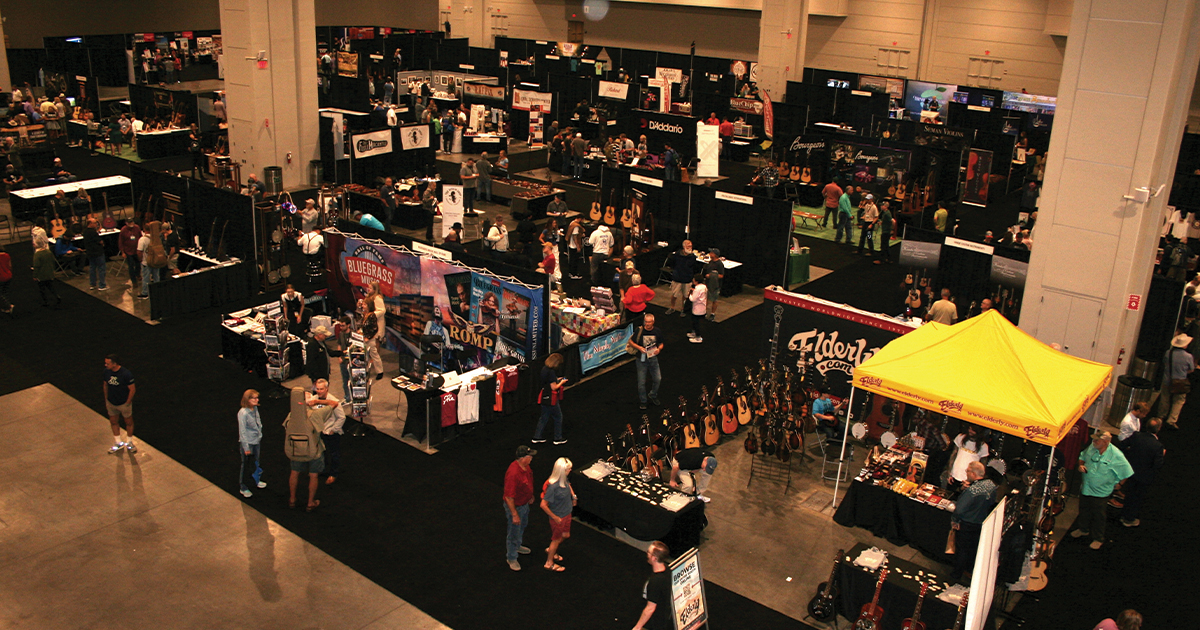
A festival attendee could have spent their entire time without stepping out of the Exhibit Hall and gotten a belly-full of bluegrass. Instruments were on display like a musician’s fantasy of Christmas morning. Stages were interspersed throughout the expansive expo to feature recognized and up-and-coming bands, allowing for intimate performances. The Ozark Music Shoppe Live! recorded shows while IBMA attendees shamelessly stood and gawked. One included five sisters and a brother from Pennsylvania who called themselves “Echo Valley.” They wowed the audience not only with their colorful dresses but their original tunes that featured tight sibling harmony, like “Lies, Lies, Lies,” and their own rendition of “Don’t Bring Me Down.”
The Bluegrass Standard Stage kept a stream of performers going, including Old Time Country Music Hall of Fame member, Dennis Cash, and his duet partner, Ashley Bullard who sang favorites spanning the bluegrass and country spectrum, like “Long Black Veil” and “Blue Kentucky Girl.”
A stage in the exhibit hall, as well as a youth stage on the street, featured a stream of young performers that would extinguish any concern about the future of bluegrass.
Workshops were offered throughout the convention center on specific instruments, vocal harmony, as well as jamming. A special session was offered on “The Making of ‘Will the Circle be Unbroken’.”
The Dotted I: International, and Inclusiveness
There may be no “i” in teamwork, but building on previous foundational efforts, this year the IBMA emphasized the leading letter and the reciprocal influence of international musicians more than ever.
The International Pavilion stage banner in the exhibit hall had the word “Welcome” written in more languages than the Tower of Babel. But even with lingual limitations, there was one common language that was universally understood: music.
Performances with international connections were scheduled throughout the festival. One was by members of the Red Wine bluegrass band from Italy, joined by The Kruger Brothers. Martino Coppo and Silvio Ferretti accepted the band’s IBMA Distinguished Achievement Award.
“Keeping a bluegrass band going for 40 years is an accomplishment,” Coppo said, “but keeping one going for 40 years in Italy is like keeping an ice cube in the desert for 40 years.”
Banjo player Silvio Ferretti said it’s actually been 45 years now, and they played an original song about it, including the lyric: “Here’s to the class of ‘78 / Let’s keep making bluegrass great.”
It was clear from the workshops, sessions, and showcases offered that a concerted effort is being made by the IBMA to remove barriers and encourage young people, as well as all genders, races, orientations, and nationalities to engage in the genre.
Artist Showcases
IBMA veterans know that the place to go (and sometimes it seems you have to be “in the know” to realize it) is the Marriott hotel. Not only are musicians jamming in every nook and cranny, but official showcases are offered by record labels and such into the wee hours. It’s there that some of the most intimate performances by both established and new bands are experienced.
During a late night showcase, Chris Jones performed his chuckle-tune, “Turn Your Lanyard Around” with the lyrics, “This is the world of bluegrass and we’re too tired to pretend / Turn your lanyard around and we’ll be best of friends.” Introducing “Waltz of Regret” he said, “Like George Jones, I’ve recorded this song 3 times under different labels. I differ from George Jones in that every time it has been a spectacular non-hit.”
One unexpected standout on the last night was a band of brothers, plus one, called “My Brother’s Keeper” from Cincinnati, Ohio. Their bluegrass musicianship and gospel sibling harmony was capable of stunning even a shopworn audience that had been baptized in bluegrass for days.
An Old-Fashioned Guitar Pull
A new addition to the World of Bluegrass was “an old fashioned guitar pull” hosted by Daryl Mosley. It was so named after impromptu sessions where friends would have to pull the guitar out of someone’s hands to get their turn. A panel of singer/songwriters each took turns playing one of their originals, and then passing the guitar to the next.
Tim Stafford, who won the 2023 IBMA Songwriter of the Year award, joked that he needed to see lyrics, saying, “If you know the words to all the songs you’ve written, you haven’t written enough songs.”
Country and bluegrass musician Irene Kelley followed Joe Newberry, who did a remarkable job of making his guitar sound like a train. She said, “I always say I’d do anything to play guitar like that…except take lessons and practice.”
Rick Faris (who has amassed a string of awards in his career) confessed vulnerability that most musicians can identify with when he said, “I always struggle with things like this…I feel like such a poser.”
Before launching into his original, “I’m only so good at being good,” Jim Lauderdale may have summed up best the goal of the IBMA and associated musicians when he said, “We’re bringing bluegrass into the future. Bringing the old into the new and the new into the old.”