Bill’s Music Shop and Pickin’ Parlor
40 Years of Bluegrass Music Advocacy
Written By Pat J Ahrens and Larry Klein
Photos by Staci Jones
It’s been over 40 years since the late Bill Wells placed an advertisement in the South Carolina State Newspaper inviting local musicians to bring their instruments for a “Friday night bluegrass jam session.” Despite moving into “bluegrass country” in the Carolinas, Bill was disappointed to learn that there was little bluegrass being played in Columbia, especially after fronting his own band, the Blue Ridge Mountain Grass in Chicago, so he decided that scenario needed to change!
Bill had always harbored the idea of a home for musicians where they could meet and play on a regular basis. He knew that the joy the music brought to the musicians as well as those who came to listen would be self-sustaining. Initially, in 1985, Bill rented a small store on State Street in Cayce, South Carolina, where he intended the event to take place. He later recalled “about 10 people showed up that first Friday,” but after a few months the crowd had grown to 50 or so, and he was running out of room.
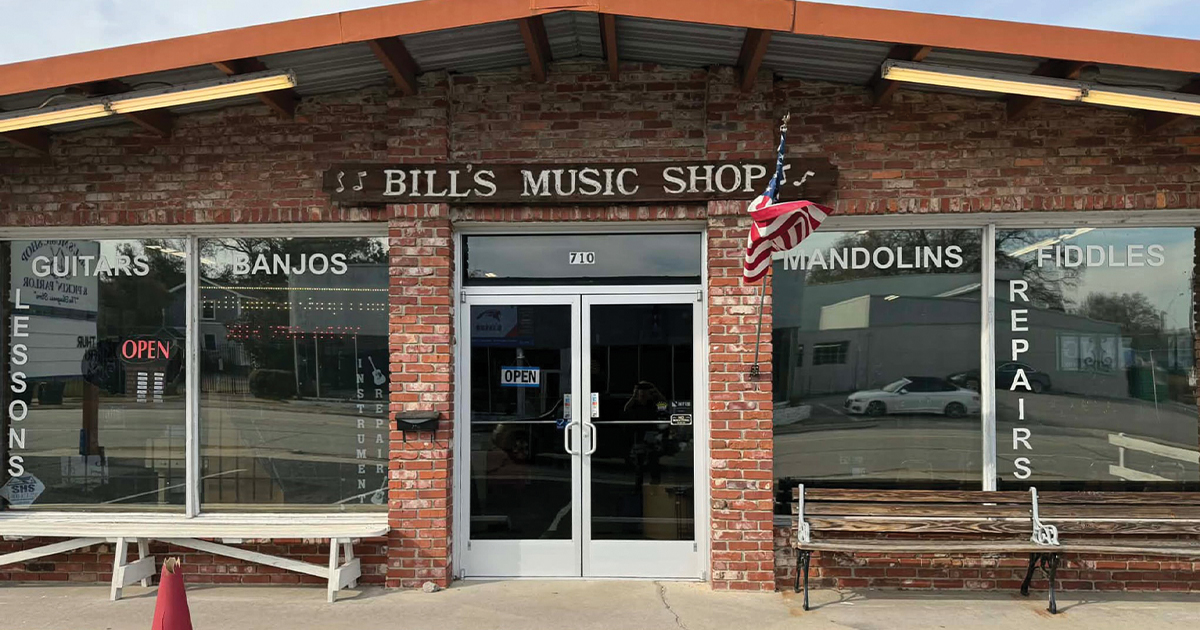
Bill soon realized that he needed a larger space for his dream to become reality. Fortunately, in November 1987, he found the perfect building at 710 Meeting Street in West Columbia just over the well-known Gervais Street Bridge and almost within sight of the state capitol. It became “Bill’s Music Shop and Pickin’ Parlor.” After the fact, he was once quoted is saying “I didn’t exactly intend to open a music store. It just happened.”
Bill’s rapidly became bluegrass music’s most important advocate in the region. Bill continued to expand his original small inventory to include acoustic guitars, banjos and fiddles. He took instruments on consignment. The list expanded as he was also carrying accessories including strings, straps, picks and capos. He stocked instructional books for the instruments as well as magazines related to the genre. Later on, he acquired a dealership for Martin guitars as well as Gibson banjos, the gold standards of acoustic instruments used to play bluegrass music.
The always popular snack bar was stocked with a variety of sodas, candy bars, and popcorn. The coffee pot stayed on all day and night. Blenheim ginger ale was a big seller, but the snack that lent itself to fame was the RC Cola and Moon Pie. Bill always welcomed his audience at open stage each Friday night by stating his shop was “the home of RC Cola, Moon Pies, and good old bluegrass music“. Bill always ran a family friendly business and never allowed alcohol on his premises. His wife Louise was as important as anyone in keeping the venue going, especially if Bill was out playing with the Blue Ridge Mountain Grass!
The shop soon offered music teachers for instruction on guitar, banjo and fiddle. As the Pickin’ Parlor began to become the epicenter for bluegrass in the state of South Carolina, musicians would come from Charleston, Sumter, Lexington, Greenville, Orangeburg, Aiken and surrounding communities to jam.
Beginning small, by using local musicians and then expanding to professional touring bands for authentic concerts, the shop became absolutely THE place to be on Friday nights if you loved bluegrass. Open stage long belonged to the amateurs and after a brief, but friendly “audition” they were allowed to perform. This simple, but important, innovation allowed musicians of all ages to play on stage with a superior sound system in front of a family, friendly audience. It was a confidence-building experience that could occur on a regular basis. In addition to good musical fellowship, the shop was known as a place to meet life-long friends, form bands and several marriages resulted.
It was 1991 when Bill and Pat Ahrens established the South Carolina Bluegrass and Traditional Music Association (SCBTMA), a 501 C-3 nonprofit organization chartered by the state. The association immediately began work to meet it’s primary objectives to preserve, promote, publicize and support this unique musical style through concerts, workshops, and public education programs, working with close support from Bill’s Music Shop and Pickin’ Parlor.
The SCBTMA diligently worked to meet its goals and in 1994 took a huge leap of faith and contracted to bring Alison Krauss and Union Station to town. Since Bill’s could not accommodate an audience of this size, the event was held at Columbia’s first-class performance venue, The Koger Center, with a capacity of over 2000. Although early in Alison’s storied career, this event was so successful that the association contracted Alison and Union Station as well as the Cox Family again in 1995 at the Koger Center.
Applications to the South Carolina Bluegrass and Traditional Music Association were always available at Bill’s where he maintained a table covered in flyers advertising upcoming bluegrass festivals and events. The South Carolina Bluegrass and Traditional Music Association remained closely interwoven with activities at Bill’s in recognition of the shared vision of preserving and promoting bluegrass music.
Never one to remain idle for long. Bill decided to form a new version of the Blue Ridge Mountain Grass in 1995 and chose musicians, Chuck Roe, banjo, Lewis Price, fiddle, Ben Boatwright, Bass and Larry Klein, Dobro. Bill was lead singer and guitarist. Besides being the “house band” for Bill’s, the band performed widely in the region and strove to maintain the goal of promoting and preserving traditional bluegrass.
Some reflections from Larry Klein about Bill and the Blue Ridge Mountain Grass: “One amazing thing to me was that Bill was not only one generational step away from the music’s major founders, but grew up in Maces Spring, Virginia: near the Stanley Brothers, the Carter Family, and Jim and Jesse. Bill had been classmates as well as friends and neighbors with these legends. In the band we were fortunate to be able to play at the original Carter Family Fold on several occasions. Imagine my personal thrill to find that Bill was on a first name basis with all the Carters.
“I remember Jeanette saying ‘before you go in the green room. I have to see how Johnny and June (Cash) left it.’ You have to imagine what a thrill that was! And no less, having Jeanette and Joe sitting on the stage and graciously complementing this transplant northerner’s Dobro playing was the thrill of a lifetime. And I remember vividly before the first show we played there, Bill and I walked up a few feet to the Carter Museum and Bill told me that it used to be the AP Carter General Store. When Bill was a child he would walk up there, chat with AP and buy bubblegum from AP himself! Needless to say this venue represents the most stunning link to the development of the music that could be imagined, thanks to Bill being a part of it.
“In over 20 years of playing in the band, I witnessed Bill’s dogged insistence that only acoustic instruments, particularly stand-up bass and not electric, be played at Bill’s or in the band. I came to learn that was NOT because he did not appreciate electric instruments. On at least one occasion I saw him tapping his foot happily and singing, along with a prominent contemporary band that included electric bass. I learned that because he had heard the original masters up close, that THAT was the increasingly rare sound he was searching to preserve.
“This insistence on the purity of the acoustic heritage manifest itself in the band also as dress codes, very traditional song lists (Lester n’ Earl, Bill Monroe, the Stanley Brothers and rarely anything else) and tight routines, including humor and choreography working a single mike.”
Of the numerous activities and events at Bill’s over the years, three especially significant cultural events sponsored by the SCBTMA that were held at the Pickin’ Parlor were as follows:
First: A concert by the eminent country music historian Dr. Bill C Malone. Accompanied by his wife Bobby, Dr. Malone explained the historic importance of each of his song selections. While in Columbia, he also lectured at McKissick Museum and the Coastal Carolina branch of the University of South Carolina during his three-day visit. We believe most readers will be familiar with Dr. Malone from his books and appearance in Ken Burns epic PBS documentary “Country Music.”
Second: The appearance of author and musician, Gary Reid whose unique theatrical performance of A Life of Sorrow: The Life and Times of Carter Stanley was quite a different experience and enjoyed by all.
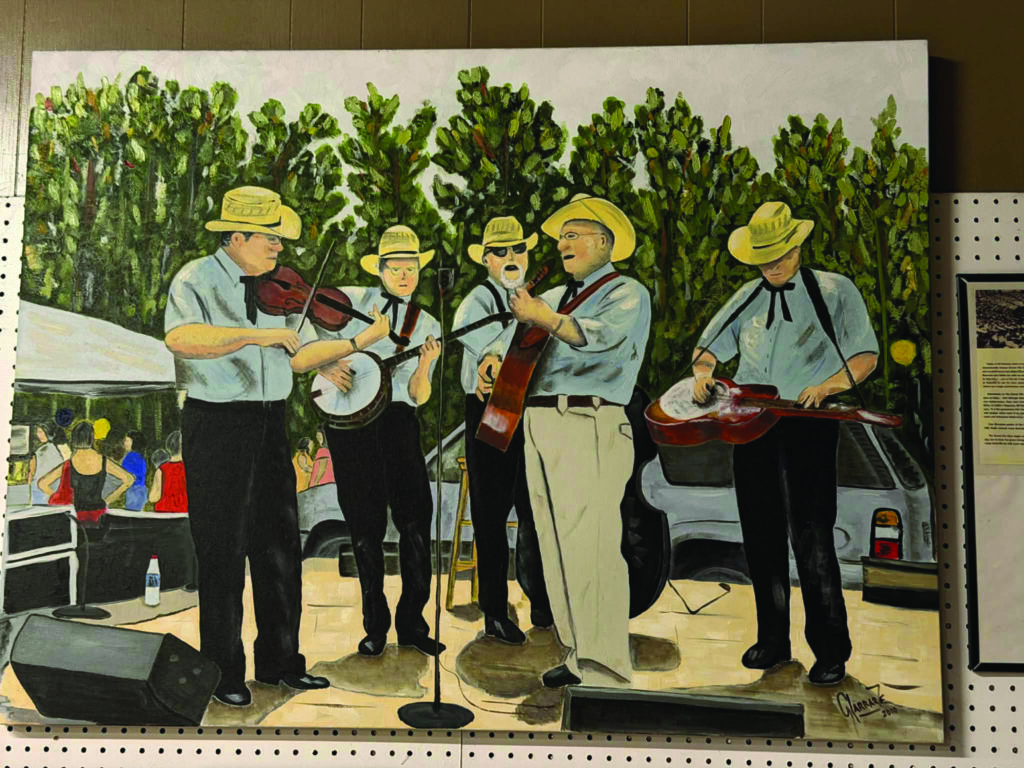
And Third: Larry‘s wife Kathy was President of the Log Cabin Art Guild who displayed 40 paintings at Bill’s, most with a musical theme for a month long exhibit. Kathy’s idea was a visual and beautiful way to bring art and music together at the SCBTMA annual covered dish dinner, brought new folks to the music and was enjoyed by all.
Bill was always very generous in allowing the Pickin’ Parlor to be used for worthy events. One of the biggest ever held was for the victims of hurricane Katrina. Eddie Kneece had graciously agreed to run sound for five of the local bluegrass bands who had donated their time and talent for the hours long event. When the donations were counted $1020.75 had been raised for the Katrina survivors.
The Pickin’ Parlor had many foreign visitors through the years and its guest book contains signatures from Australia, China, Brazil, Russia, England, Ireland, Canada, Japan, and Mexico. Bill’s close proximity to Fort Jackson, as well as the University of South Carolina, brought many soldiers and students to hear the music and participate when possible. There were even sessions when famous musicians dropped by for a visit, having heard of the shop. These included artists such as Doc Watson, Jack Lawrence, Robert Bowlin, Butch Robins and David Deese—the latter three all former Bluegrass boys with Bill Monroe. Local legends Snuffy Jenkins, Pappy Sherrill and the Hired Hands and the Lucas and Harmon Brothers were also often seen at Bill’s.
Grammy recipient John Hartford once came to jam following his earlier performance with Glen Campbell at the Carolina Colosseum across the bridge. Banjo wizard Tony Trischka, co-author of Masters of the Five String Banjo elated the local folks with his amazing skill following his concert at another venue. It was not uncommon for music teachers and college professors to bring their students to Bill’s to hear the music. There was a special name for those who showed up most Friday nights to jam. They were called “regulars” yet one of the most amazing things about Bill’s was the great diversity of those who came. Doctors and lawyers thought nothing of rubbing elbows with dairy farmers. A small town mayor was a regular and mechanics, machinists, teachers, journalists, carpenters, and electricians all enjoyed the music fellowship. There were always musicians who could play better than you and those who should’ve stayed home to practice more, but there was no division between them and their enjoyment of the music they shared. Age made no difference either and participants ranged from elementary school children to octogenarians.
There is a story about a certain group of musicians that over the years became local legend: Bill always closed the Pickin’ Parlor promptly at midnight every Friday. But there were those of us who did not want to stop the music, even in the dead of night or winter when it was too cold outside to feel our fingers, much less play. However, Russell Franklin had devised a remedy for us. Russell was a carpenter by profession and a clever problem solver in general. So he would pull his pickup truck into the Pickin’ Parlor’s front parking lot and unload two sets of gas fireplace logs, and their propane cylinders, carefully placing them several feet apart. The small crowd of musicians would then maneuver themselves around the logs and continue pickin’ under the dim light thrown down by the shop’s after hours marquee, sometimes until dawn. The police understood that this was all good fun and would frequently wave when they went by on patrol.
Every so often the Pickin’ Parlor would be “rediscovered” by the media. Three musical documentaries were filmed there. The usual media interest would occur occasionally when someone famous was booked for a concert. Before Bill passed away, he had been honored for his Herculean efforts in keeping acoustic music available for musicians and audiences. Among his many awards were:
1) The South Carolina Bluegrass and Traditional Music Association’s Heritage Award 1996
2) The state-awarded South Carolina Folk Heritage Award for Bluegrass Music Advocacy 1998
3) The West Metro Small Business Award 2006
4) The Order of the Palmetto (the highest civilian honor awarded by the governor of South Carolina) 2011.
Throughout the years, the real magic of the Pickin’ Parlor was in the musicians themselves who came and make no mistake, they were loyal.
Often times Danny Creamer and the Sugarloaf Mountain Boys “opened” open stage and the late Harold Lucas and friends would close it. Bands such as the Blue Iguanas, Palmetto Blue, Cottonwood Bluegrass Band, The Pickin’ Pearls, Savannah River Bluegrass Band, Amick Junction and The Carolina Rebels often performed. The dynamic and hard-driving Flatland Express from Orangeburg always gave us stellar performance and the Randy Lucas Trio were among the favorites to ever climb the steps of Bill’s stage. A core group of individuals who were nearly always there to jam included Tom Atkinson, Allen Fisher, Tony Frazier, Dusty Rhodes, Jim Graddick, Dave Holder, Ella Thomas, Roffie Griggs, Charlie Johnson, Johnny Fenlayson, Ken Baldwin, Russell Franklin, Ashley Carter, Merdick Brown and Donnie Williams.
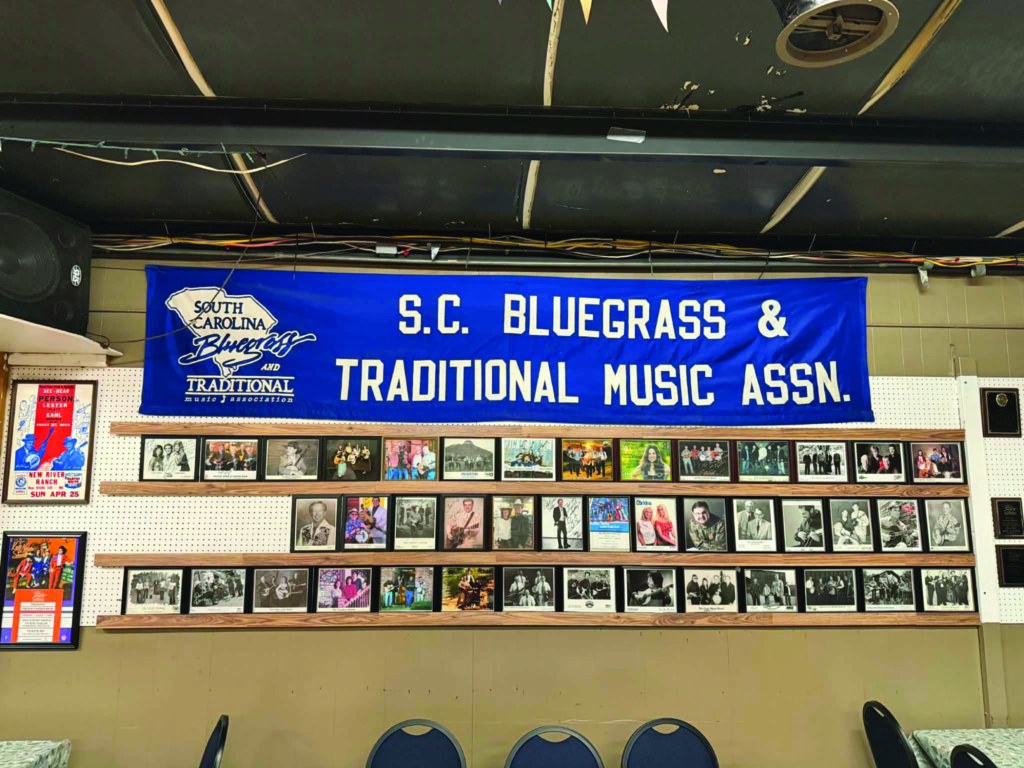
The building’s walls are lined with numerous and interesting photographs of artists who have appeared throughout the years. A life-size portrait of Bill Wells graces the right side of the stage and a life-size portrait of his wife Louise, an integral part and core of the store’s success lies in the front area.
To validate the mission that Bill saw in his mind, there are numerous young musicians who are benefactors of their time spent at Bill’s. Two musicians who deserve special recognition because they are living proof of Bill’s legacy are fiddlers Ella Thomas and Jim Graddick. Both have interesting stories that began at Bill’s before they were teens. Both have since been awarded numerous fiddle championship awards.
Raised in a musical family who performed regularly, Ella Thomas was one of the first young ladies to receive a South Carolina Bluegrass and Traditional Music Association Youth Scholarship. She began playing at age 4 in the Suzuki method. Ella is capable of performing in many genres—old-time, bluegrass, jazz and concert violin. She has a strong trained voice and sings both lead and harmony. Her performing experience began with the South Carolina State Fiddle championship as a youth division winner in 2017 and in 2019. A 2024 graduate of the highly regarded East Tennessee State University music program (degree in Old Time, Bluegrass and Roots Music Studies), Ella presently performs with several bands and artists including Caroline Owens and New Company.
Jimmy Graddick had originally wanted to play banjo, but since middle school had neither the instrument nor a teacher for it, so he changed his mind and chose the fiddle instead. Already proficient at an early age he first played on open stage at Bill’s when he was about 11 with the late Ralph Cox, another veteran player at the shop. Now a University of South Carolina Music Education graduate and teacher, as well as a member of several bands he most often performs with the Randy Lucas Trio. Jim was invited to perform as part of a special concert held in Greenwood, South Carolina in 2022. This unique project, Violins of Hope, rescues and then restores antique violins that had once belonged to holocaust survivors. The violin Jim played for the concert was over a century old. The piece he played, “Joseph Joseph” is an old Israeli instrumental. These two exceptional musicians are living proof of Bill Wells’ vision.
Youth scholarships always working in tandem with Bill’s became one of the most important traditions established by the SCBTMA under Association President Leo Pearson‘s guidance for the last 10 years and have helped a number of other aspiring young musicians advance.
Some national bands who have performed at Bill’s include Ralph Stanley and the Clinch Mountain Boys, Larry Sparks, The Edgar Loudermilk Band, The Dillards, Rhonda Vincent, The Crowe Brothers, Special Consensus, Daley and Vincent, the Reno Brothers, The Dry Branch Fire Squad, The Nashville Bluegrass Band, Bluegrass Cardinals, Del McCoury Band, Quicksilver, Blue Highway, Junior Sisk, The Wood Tradition, J.D. Crowe and the New South, Longview, Sideline, The Country Gentlemen, Little Roy and Lizzie, Russell Moore and IIIrd Thyme Out, Kevin Richardson, Butch Robins and many others.
In 2011, Bill sadly passed away. His son Willie Wells vowed to carry on the mission of Bill’s as well as carrying on with the Blue Ridge Mountain Grass. In pursuit of this goal, Willie has made a number of innovations in the shop, while maintaining a keen eye on preserving the tradition as he promised his father. Among the innovations was a series called “Pickin’ with the Pros” with the idea that if scheduling allowed a pro band would stay after the concert to pick with audience members. It was a thrilling and inspiring happening for those who were lucky and brave enough to participate. Slow Jams are held once a month to accommodate anyone who wants to play in a slower and more comfortable “jam” session. Songwriters and even country dance has a night at Bill’s!
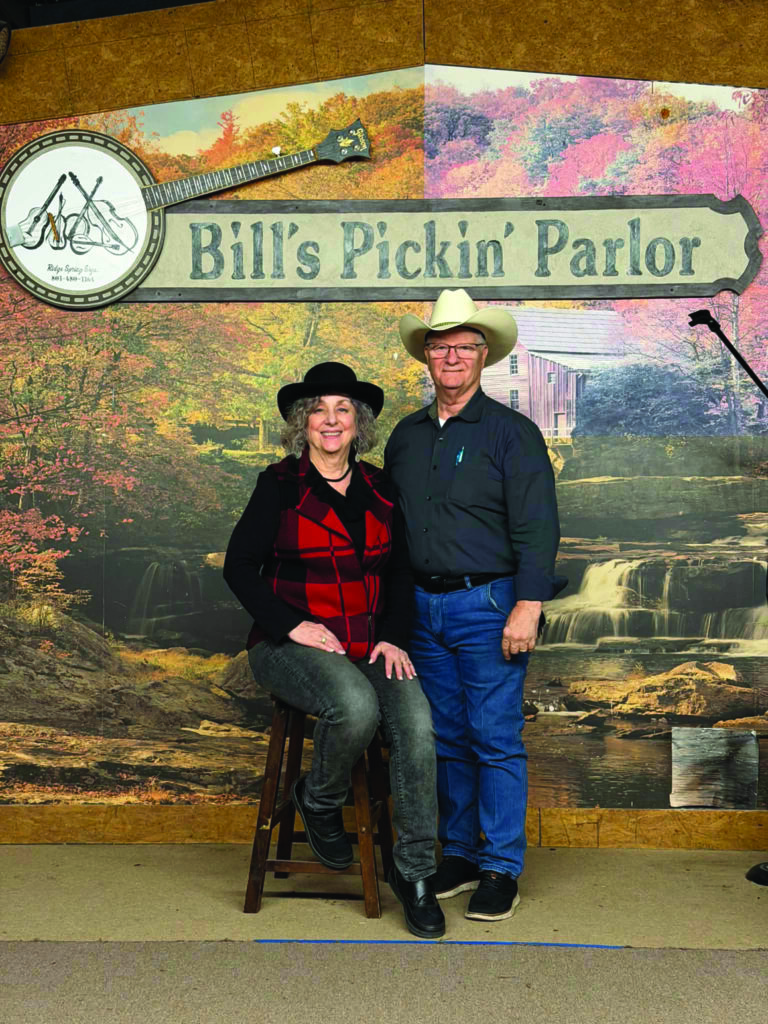
Jan and Willie Wells
For “First Friday Fixings” Willie contacted celebrated Columbia chef Tommy Kasperski (also a picker) to cater a simple homestyle meal on the first Friday of each month. Needless to say it was a well-received idea in the true Southern tradition. Willie has also added to the teaching roster at Bill’s and has instituted student recitals twice a year.
Willie spoke about growing up in a bluegrass family and his vision for the shop, “You know, for the longest time before I came here my main instrument was drums. I’ve played drums for country and country rock groups for years. And I love country music and country rock. But it’s just like, I don’t know if I ever told you the story about, you know, I talked to my dad every couple weeks or so (before moving to Columbia), and occasionally he would say, ‘Hey, I got some CDs I want to send you’ and the first thing I’d say was, ‘Are they Bluegrass?’ and what am I gonna say? So, he’s sending them to me and I get them and put them in the corner. One day I was going to work back about 2004-2005 and he had just sent me some CDs and I had them on the seat of the car there I was driving. I still had the packet over there. I just grabbed one on the top stuck it in my CD player and I went, ‘Whoa! What is this?’ I’m going ‘Man wow!’ so I called him. I said, ‘Hey dad what’s this? Who is this group Lonesome River Band?’ He said, ‘Yeah they’re good.’ After that happened, man I never looked back. To me, as long as it’s tasteful, if it’s got to be electric, I mean I’m fine with it. But would I rather have them playing upright bass— absolutely.
“Since I’ve been here the biggest challenge has been, and you have to realize it, when I first got here, you know, on a Friday night, man, we’d have 100, 150, 180 people in here. Well, over, we’re talking what, 15 years now? But even in the middle teens, we had to start dealing with attrition. People are not able to make it, you know, they can’t drive at night. We’re losing people, for age or some other reasons. So, from that standpoint, you can ride that as far as it’ll go, but you gotta start thinking ahead.
“So one of the things that, and I did this early on, probably in 2014, is to start looking at the youth. You’ve got to start looking at the younger people. You have to reach out and get them involved. So, you know, from that standpoint, that’s where I really felt, you know, by reviving the SCBTMA because of being involved with the kids, not only around here, but upstate, and just start reaching out to them.
“And, you know, it’s paying off—we’re starting to get a lot of the younger people that like bluegrass. They’re here. The crowds are nowhere near what it was, but keeping bluegrass alive, as you know, and reaching out to these kids or the younger crowd is probably the only thing that can keep this thing alive. So that’s what it’s all about. It’s pushing it, pushing it and growing the presence of bluegrass in the community so you know that by doing that I really feel and I already see it. I see a lot of the kids that are coming out a regular basis now.”
“Like over here at Ben Lippen school (a local high school), boy they are really, really going after having a school bluegrass band and really pushing and promoting bluegrass. And now out at the University of South Carolina, there’s a bluegrass club that is really starting to take on a lot of people and getting a whole lot of interest. They’re actually starting to come on Friday nights here at the Pickin’ Parlor.
“We started a youth jam which hasn’t been as successful as I would like to see it, but I think now that we’re starting to get more youth, it’s going to start resonating with them and they’ll be more involved and there again it just takes the right facilitator to make it happen.”
In speaking about the importance of running the business of a music shop, Willie says, “The key is the versatility of what we do. Just to give you an example, when I first got here, Dad laid such a great foundation for what this place is. And he actually had about four lines of income that was coming into the store here, which was: sales of instruments, Friday night donations, lessons, and maybe some instrument repairs and an occasional concert. So there’s four or five that was coming in at that time. Right now we have 17 streams of income.”
In speaking of key people who have contributed to the legacy of Bill’s: “Well, Jan, my wife, of course, and she helps me in so many different ways. She takes a pretty good load off of me so that I can concentrate on other things. I let her take care of all the dancing when we have country dance. We have a four week dance series. We’ve got all kinds of stuff. She’ll take care of all that. She takes care of the snack bar for me. You know, so it gives me the chance to concentrate a lot more in the music part of it and the ambassador part of what the music is.”
Staci Jones: “I’ve known her, golly, since we first started. She’s been taking banjo lessons ever since and she’s taking care of our online appearance. She is so adamant about things: I’ll tell her. ‘Hey, do this, put this on, put that out and she’ll come back and she’ll say, ‘Oh no, that doesn’t sound good. It’s gotta be this way,” or I’ll make a flyer up quick and she’ll come back and say, ‘Oh no, you can’t. We gotta do it this way,” So she’s sort of like my eyes in the sky, you know? She knows what to do. She keeps an eye on it and makes sure everything is on point that goes out to the world. She handles the technology. I don’t know what I would do without her, I’ll tell you. We maintain a website at, www.billsmusicshop.com and she takes care of that, she takes care of our calendars, she takes care of making sure that all the events get out, all the events have flyers that get passed through and down and around in the social media so she’s very very important.
Larry Threatt: “From what I understand, [Larry] is the only certified master luthier anywhere around this area who got his background at the Cascade School of Lutherie in Asheville, North Carolina. He’s been of major importance to our players and students and his repairs are exclusive to the Pickin’ Parlor
“Our teachers: Martha Patterson: “I remember when I first got here, she walked in the door and wanted to know if she could teach at the Pickin’ Parlor. I said, ‘Sure!’ I didn’t know her. I had no idea, so she started teaching and she’s probably as much a part of this Pickin’ Parlor from that standpoint as I am. She is a machine. She teaches electric guitar, acoustic guitar, banjo, mandolin, ukulele, dulcimer…you name it. She’s amazing and so she’s been with me since what, golly, 2013.
“Jim Graddick teaches on Wednesday and Thursday, then I have Brent Hall and he’s my go-to for the 9-10 year olds. He’s great with kids. Besides guitar he even teaches drums. Morgan Soares teaches piano and vocal and we’re getting ready to take on one more teacher. You aren’t gonna believe it, but Kayleigh McCoy—she’s grown up now. She’s 17—came back to me this fall and said, “Mr. Willie I’d like to teach violin,” so she will start with some younger students.
“And Leo Pearson is one of the Pickin’ Parlor’s most valuable assets. In addition to his role as President of the SCBTMA, he has served as Open Stage MC for 8 years and keeps the calendar to book bands. Leo is also a wonderful photographer and usually documents the events occurring at Bill’s.
“There are also retired folks and others who like to hang around the store with instruments and they often volunteer to help out with various things.”
Willie continues, “One of my main goals for this year for Friday night is to get musicians back in here. I want musicians to come in. I want to start jamming no later than 8 o’clock. Folks like to get on open stage between seven and eight which is fine but at 8 o’clock I want to shut down open stage and let’s start jamming and that’s my goal for this year. Once they get a taste of how much fun it is to play with somebody else it will sustain itself.”
Willie has kept the Blue Ridge Mountain Grass going. Current Blue Ridge mountain grass members are Steve Smith, banjo; Patrick Russell, fiddle; Ed Dalton, guitar; Parker Wade, mandolin; Boyd Burdette, bass. We’ve won the Christian Voice Magazine Favorite Bluegrass Gospel Group of the Year and have recorded several CD projects.
A partial list of other well-known regional bands playing in 2025 at Bill’s includes the Blue Iguanas, The Randy Lucas Trio, Front Porch Boys, Split Rail, Flatland Express, Blue Faith, Tom Coolidge and Leftovers, The Millhands, The Picken Pearls and Ken Baldwin and Igor Agafonov.
Today the Pickin’ Parlor hosts many musical activities and a convenient location—only two minutes from the famous Gervais Street Bridge. Music lessons for the instruments to play by ear, slow jams, songwriter nights, jamming, concerts, open stage, lutherie and other extensive instructional programs are available. The Pickin’ parlor can be rented by the public for special events. If you’re ever in South Carolina, come visit Bill’s. It’s a given that most any day of the week somebody will be there picking. It’s been a Wells family tradition for over 40 years!