
A 21st Century Bluegrass Guitar From Oregon’s High Desert
The D-MA from Preston Thompson Guitars in Sisters, Oregon has almost no interest in impersonating a vintage D-18. And that’s exactly what makes it such a compelling and distinctively modern flatpicking guitar.
Even though it shares the basic D-18 DNA of a mahogany dreadnought body with a forward-shifted, scalloped-braced, tap-tuned Adirondack top, the Thompson D-MA is a forward-facing, 21st Century flatpicking guitar. Think of it as a 5G D-18 aimed squarely at the incoming generation of bluegrass guitarists inspired by the likes of Molly Tuttle and Billy Strings, both of whom endorse Thompson. This is a bold, potent and highly projective D-18 for today’s flatpickers needing powerful rhythm and tightly focused single notes to cut through modern band mixes and loud jams.

The idea of Preston Thompson Guitars building a bluegrass cannon shouldn’t surprise anyone. Preston lived at the very heart of the early years of competitive flatpicking, with three consecutive Winfield champions choosing a Thompson as their prize. During that time, Preston became close friends with Charles Sawtelle and Peter Rowan, building Rowan a 000-42 Style guitar he plays to this day. And after meticulously measuring Sawtelle’s legendary 1937 D-28, Thompson built a D-42 Style replica that became Charles’ main stage guitar with Hot Rize. Those D-28 specs are now incorporated into every dreadnought Preston Thompson Guitars builds.
Thompson built the guitar company bearing his name on one simple principle that has become the company’s motto: “Ours get played.” This instrument shows why that’s probably true. Straight out of the case and tuned up, the first note from the 6th string sounded remarkably loud and focused. Single notes exit the soundhole like they’re on a mission. Chords are balanced and clear, with ample horsepower to drive a bluegrass band’s groove. The guitar is vividly alive with natural reverb, not dry like Uncle Norman’s D-18 we all love. Oh yeah, and expect the banjo player to ask you to keep it down in your next jam, whenever that may be.
As one expects from a top-end shop like Preston Thompson Guitars, the attention to detail and fine craftsmanship on this guitar equals any other boutique marque. All joints, edges and ends fit nearly flawlessly. The FBI couldn’t find any glue slop between the kerfing, and the braces look like a surgeon shaped them.
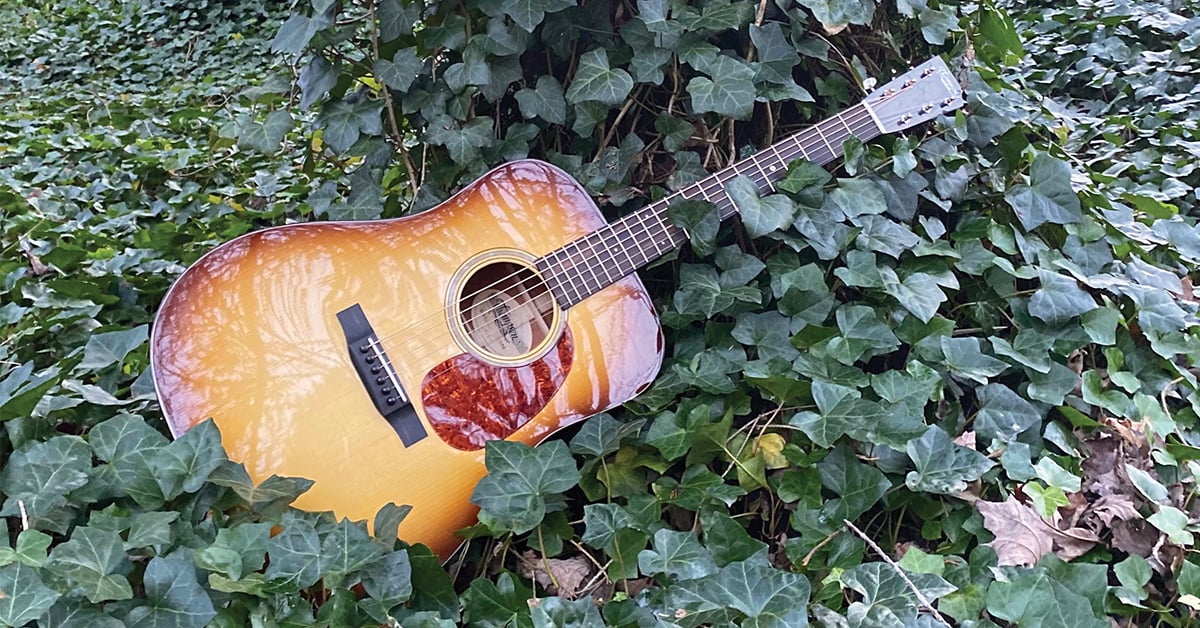
For a more modern look, this D-MA sports a lovely, rather delicate sunburst. Shaded tops are always personal, but to my eye this lighter sunburst looks great. It definitely enhances the look of the non-torrefied Adirondack top’s remarkably wide outer grain. Even better, instead of hiding the beauty of this mahogany under a dark stain, Thompson has chosen a light natural color for the back and sides. Pairing a lightly shaded top and natural mahogany colors certainly helps this D-MA stand out in today’s crowded D-18-style marketplace.
The guitar builders in Sisters, Oregon know superb playability is non-negotiable on an instrument in this price range. This particular D-MA plays very cleanly and is setup by the factory at .109”at the12 fret on the low E and .078” for the high E so the guitar has enough string height to take advantage of the guitar’s light build and propulsive voice.
The D-MA comes standard with 1930’s style pearl position dots on an African ebony fingerboard with a 16” radius, fitted with nickel-silver standard frets measuring .043” crown height, and .083” wide. The satin-finished mahogany neck has a comfortable “D” profile that has been expertly rounded at the shoulders so the nut, neck, fingerboard edges and fret ends have a nice played-in feel, a set-up that reminds any player of a late 1930’s C.F. Martin D-18. The test guitar also has a highly compensated bone saddle, giving this instrument excellent intonation.
Are there downsides here? Honestly not many. When shipped to us for review, this $6,000+ guitar arrived in a cheap hardshell case which alarmed me. But further communication with the team at Preston Thompson Guitars revealed that this was a one-time choice based on the needs of that particular guitar’s buyer. Every Thompson guitar leaves the shop housed safely in a suitably high-end Harptone case, PTG general manager Christine Funk assures. And buyers wanting the ultimate in protection can order their Thompson with a new Hoffee case with a Preston Thompson Guitars nameplate.
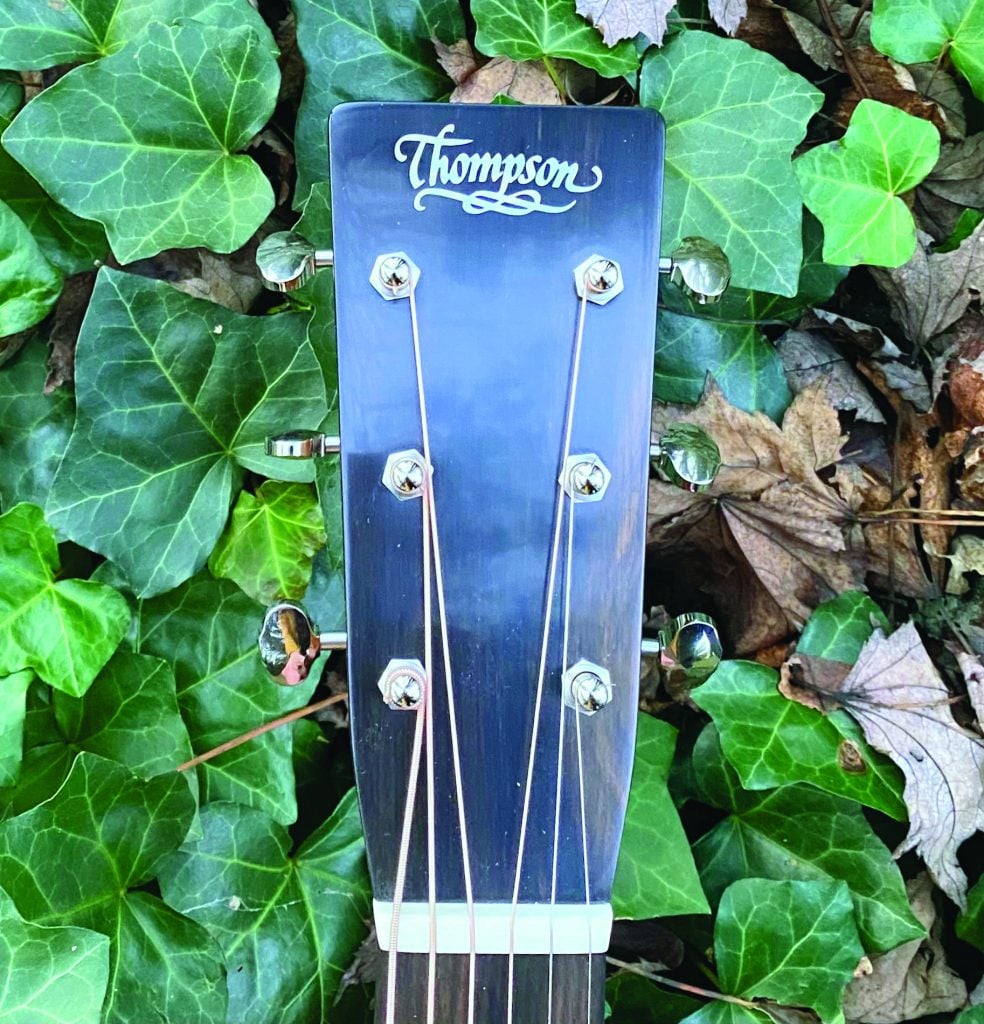
The set-up is quite good, but the 1st and 2nd strings are seated too deeply in the nut, which can dampen the strings’ vibrations and sometimes lead to sticky tuning on those strings. A common issue with factory set-ups that’s easily remedied.
Another issue I might raise cannot be answered now. Guitars built this lightly sometimes end up with serious structural issues years later. I expect this high-end guitar probably will be properly humidified and lovingly cared for. But the Thompson D-MA sits right at that critical luthiers’ balancing point between lightness for maximum sound versus heavier construction for longevity. However, given how long Rowan’s 000-42 Thompson has been in professional use, my bet is this guitar will still be played many decades from now.
The original 14-fret D-18s and D-28s created in 1934 in Nazareth, PA, were Martin’s answer to the growing need for guitars that could be heard in unamplified concerts and over the primitive radio mics of the day. Since then, the versatile mahogany dreadnought has served as a test platform for luthiers seeking to find new voices for new generations of players. With the D-MA, Preston Thompson Guitars hot-rods this timeless design, creating a high-powered, easy-to-play flatpicker’s guitar for a new audience and a new millennium.