Shades of Blue
Photo by Katrina Burgoyne
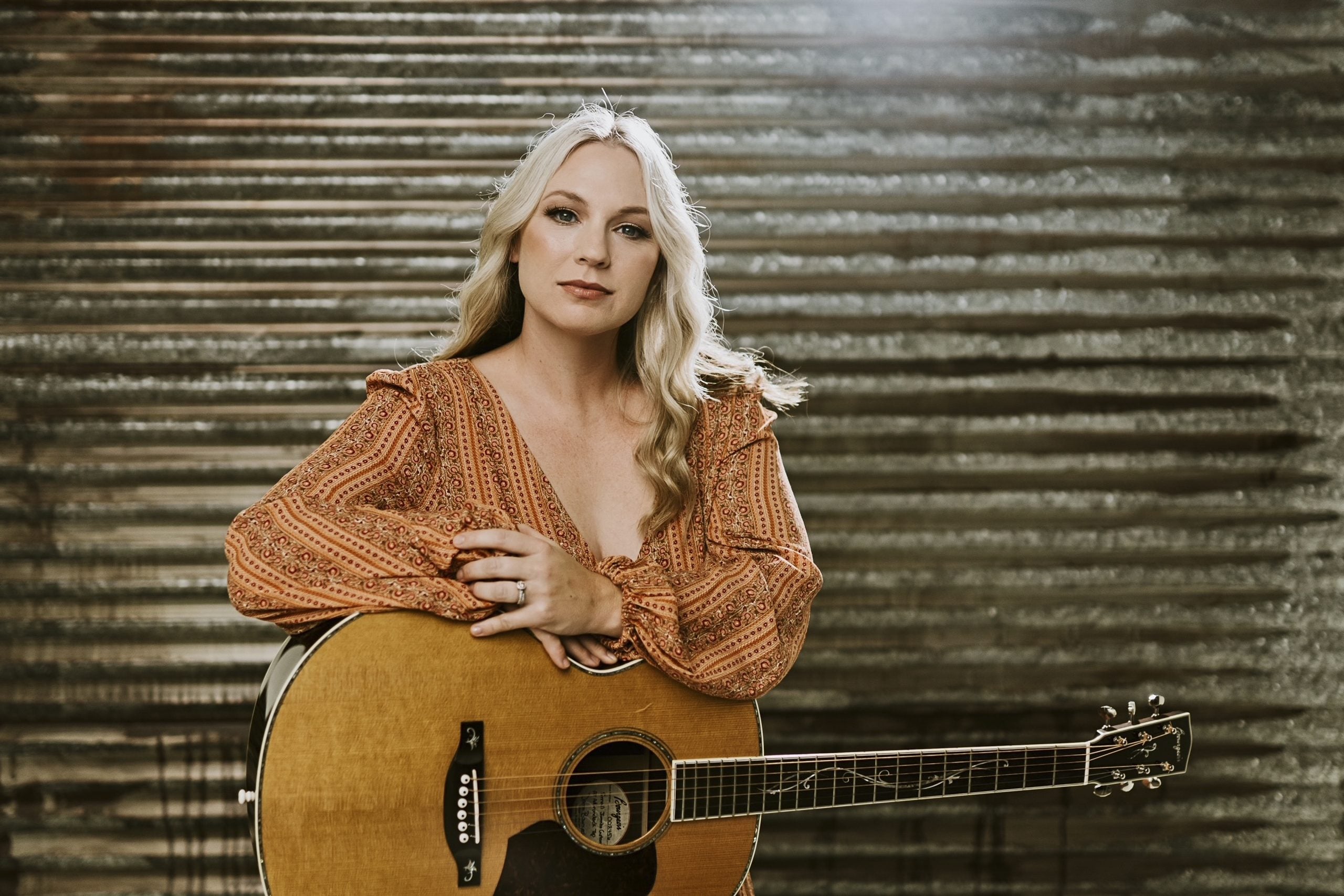
Don’t try to pigeon-hole Kristy Cox into one set category of music. The bluegrass artist/songwriter from the Land Down Under has a colorful singing voice that can cover traditional to contemporary to country. Born in Adelaide (capital city, 800,000 people), Australia, Cox grew up in a nearby mountainous country town of 12,000 people. A country music festival breathed excitement into the farming community once a year as part of her musical upbringing.
“We never really watched a lot of television growing up,” Cox tells Bluegrass Unlimited from her Nashville area home. “I grew up listening to a lot of 70s and 80s rock and a lot of bluegrass and country music, especially from my granddad. He used to play me the Grand Ole Opry every weekend. I guess I ventured into that area more.”
“The first album that I bought was Emmylou Harris’s Blue Kentucky Girl. The first song I sang on stage was “Blue Moon of Kentucky.” I think my biggest influences as I got older were probably Alisson Krauss and Rhonda Vincent. That’s who I wanted to be when I was a teenager. They’re just two amazingly talented ladies. I like the traditional stuff. I like the harmonies and the stories in bluegrass music. That’s what I love about it the most. I like the storytelling part of the songwriting, and the three and four part harmonies get me every time.”
Before she was in school, the young Aussie already had her sights set on a singing career. “I told my parents when I was four that I was going to be a singer when I grew up. I always knew what I wanted to do. I used to put shows on in the lounge room. I went down to the local country music club that had bluegrass and country music bands on.”
While it was always her dream, her practical thinking parents wanted their daughter to have a back-up plan. “During my senior year of high school, I worked myself to the bone a little bit,” Cox remembers. “I got really sick and had to spend some time in the hospital. I was exhausted by the end of my senior year.”
After graduation Cox asked her parents for a year off to pursue her music passion. One year turned into seven, but eventually, she went to college where she earned her law degree. Her eyes, though, remained focused on music, and in time her devotion paid off, first in her home country. “They started a ‘Bluegrass Recording of the Year’ category at our CMA Awards,” Cox said. “I managed to pick up the inaugural one, which was a huge honor. It’s really exciting that the association over there is giving bluegrass its own category, and I’ve been really blessed to win five of those awards now.”
In 2007 Cox traveled to the IBMA’s annual World of Bluegrass, which was held that year in Nashville. Not only did she fall in love with the people but also their serious appreciation for her musical aspirations. “I love that here in America you say I play bluegrass music, and they’re like, ‘Oh, wow! And they want to know about your music. A lot of people (in Australia) see music as a hobby, and here they don’t see music as a hobby. It’s everywhere, and I love that about this culture. There’s just so much more opportunities here I guess.”
Fast forward to the 2012 IBMA event when Kristy and Ty Gilpin from Mountain Home records struck up a conversation, and she gave him a copy of one of her albums. Two days later he called with an offer for Mountain Home’s Imprint, Pisgah Ridge. “I nearly fell off my chair. It was not something I expected,” Cox recalls. “I was like, ‘If I don’t take it, then I’m only going to regret it.’ I packed up the guitar. I thought, ‘What’s the worst that could happen? I call mom and dad and say, ‘Mom, Dad, you’ve got to fly me home; I’ve run out of money’,” she adds, chuckling.
Thankfully, for Cox and bluegrass fans, she was a hit in the U.S. while maintaining her popularity in Australia. Her album, Ricochet, debuted at number one on the Billboard Bluegrass Album chart in 2018, and she followed that album with No Headlights which first appeared at number two on that same chart near the end of 2020. She also became one of the most decorated female bluegrass artists in her homeland when she picked up her fifth Golden Guitar Award from the Country Music Association of Australia. Among her celebrated recordings were Finger Picking Good with guitar great Tommy Emmanuel. Already, Cox has an impressive track record, but when she began to record with Billy Blue Records, she still wanted to top herself. Needless to say, it was a challenge in the studio to bump up the quality of Shades of Blue even higher. “It’s always a little nerve wracking. Can we actually get better with this album? Is it actually possible?” she says, laughing.
After seven albums that Cox has recorded with producer Jerry Salley, she says she was more confident this time with herself as an artist. “I’m more comfortable knowing that I do many styles of bluegrass. (traditional, old-time country, contemporary bluegrass) I don’t have to pigeonhole myself into one subcategory of the genre. I can do a little bit of everything. By the time you go through the twelve tracks that we have on the album, the title Shades of Blue kind of made sense because it does have lot of different styles of bluegrass.”
Cox loves her time in the studio watching a song grow from its infancy to a fully-produced creation. “I love seeing a song come to life. My favorite thing to do is to sit down and listen to a demo tape. That’s how I like to hear my songs. I don’t want to hear a demo track already produced. If I even write it, I want to listen to it with a guitar and a vocal, and imagine in my mind what I think the song could be and then take it to Jerry. Seeing that process come to life in the studio, it’s really exciting.”
Cox relies on the listening ears of Salley with whom she has a professional and personal relationship. They have recorded, co-written and toured together, and he is her son’s (Ryman) godfather. “We just have an incredible working chemistry,” Salley says. “She trusts me with her vocals. She trusts me with songs although she is a great song person. There’s been a couple of songs that I thought were good songs that were worthy of being recorded, but she picked as singles. I was like, “I don’t know if that’s really a single.” And she was right every single time. Every one she picked was one of the biggest songs from those particular albums.”
“I think Jerry sees more in me than I see in myself if that makes sense. He definitely pushes my boundaries and my limits to get out of me what he knows that I can do that I don’t think I can do. I don’t think I would be the artist that I am today if it wasn’t for him pushing me over the last seven albums. He’s definitely made me a stronger vocalist. He’s very easy to work with. At times I may end up in tears,” she says, laughing. “He wants me to sing a line a certain way, and I’ve tried it fifty or sixty times, and I haven’t got it right.’ I can’t do it like that! You can do it! No, I can’t!’”
Truly, the two have a solid working relationship. “If he tells me to do something, I trust him completely. I know he’s going to make the right decision.” Sally said, “I call her the hardest working girl in show business, and that’s the truth. She doesn’t wait around for other people to do things for her. If something needs done, she makes sure it gets done. She’s just a good hard-working girl with a whole lot of talent. What drew me to her was her voice. When I first heard her sing, I thought, ‘Wow! She has got one of the most beautiful voices that transcends not just bluegrass—but some of the records we’ve made, even though they’re bluegrass records, lean a little more toward the country stuff.”
Cox, who grew up in a low to middle income home, says her work ethic developed from extremely hard-working parents. “I grew up with concrete floors,” she remembers. “Our carpet was paint on top of the concrete. My parents worked really hard to make sure that their kids never missed out on anything. Dad always used to say to me, ‘You don’t get anything out of it if you don’t put the work in. If you want to succeed, nobody else is going to do it for you. You’re going to have to do it yourself.’ I guess I learned from then not to take no for an answer, to just keep working, and if something doesn’t work, the only mistake in life is trying the same thing over and over again and expecting a different outcome. Try to look at things in a different way, and if that doesn’t work, try something different. That’s been the way I’ve lived my life both in music and in my [personal] life. There’s always going to be somebody who’s just as talented or more talented than you. I think if I was to give any young artist any advice, it would be it’s the work that you put in that makes the difference.”
Cox has enjoyed the fruits of her hard labor with success in two countries, but she longs for even more. “I’d like to be playing shows every weekend. I’d like to play the Grand Ole Opry. I’d like to write more songs than I do now and maybe make it so my husband doesn’t have to work so hard. He’s a musician that builds houses for a living. He works 60-70 hours a week to keep the roof over our heads so I can play bluegrass. I really appreciate it so, hopefully, one day he won’t have to work so hard.”
With her determination, that next level of success may not be far from transpiring. “I’m still not where I want to be,” Cox admits. “I’ll keep working hard until I get there. I’m not going to take no for an answer.”