The Earl Scruggs Center
Photos Courtesy of The Earl Scruggs Center
It’s no exaggeration to say Earl Scruggs changed the course of music globally with his innovative 3-finger style of banjo playing. “Scruggs Style,” as it is universally known, is a cornerstone of bluegrass music, and has served as inspiration for latter-day banjo innovators, including Bela Fleck, Tony Trischka, Bill Keith, and others.
Earl Scruggs was born in 1924 in the Flint Hill community of Cleveland County, North Carolina, near the town of Shelby. Two years after his death in 2012 at age 88, the Earl Scruggs Center opened in a restored 1907 building that served as Cleveland County Courthouse during Earl’s childhood. The Center was conceived as a way of honoring the achievements of their famous citizen, and as an engine of economic growth through cultural tourism.
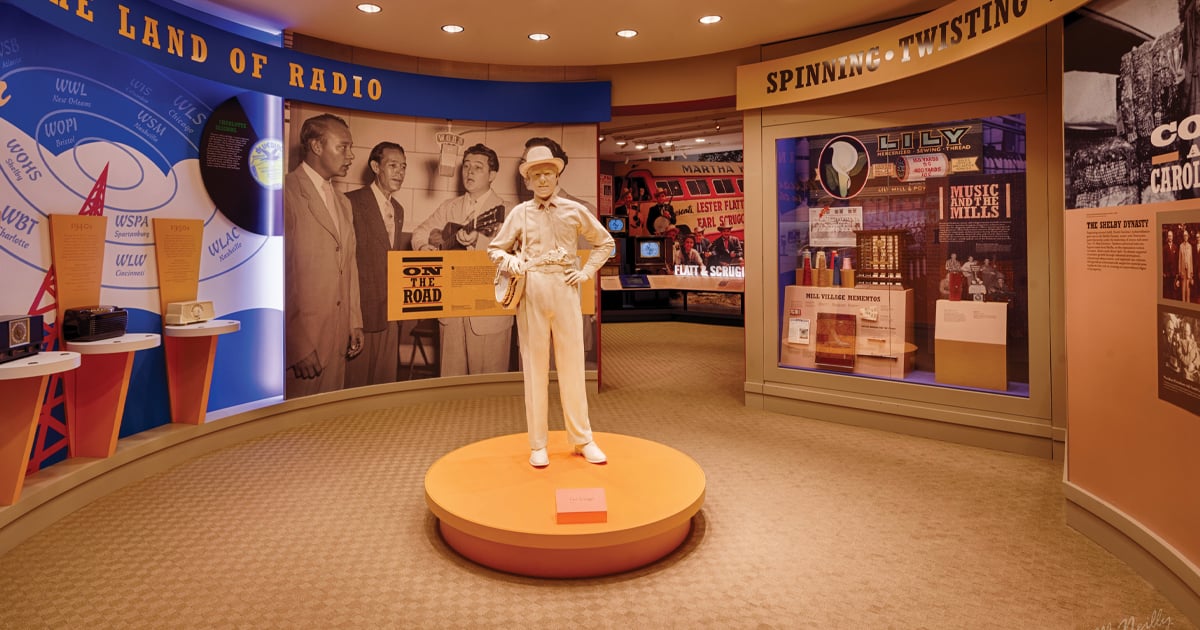
The Center’s mission is to tell the story of Earl Scruggs within the cultural, environmental, and economic contexts of Cleveland County. Its staff has fashioned a museum elegant in its presentation, reflecting the personality and artistic genius of Earl Scruggs and the community that nurtured him. A diverse array of visual, tactile, and aural exhibits inform but do not overwhelm, allowing the observer space to savor and reflect.
Exhibits are imaginatively conceived and accessible to bluegrass aficionados and to those with more casual interests. Exhibits feature items on loan from the Scruggs family as well as the Cleveland County Historical Collection, which the Center also manages. In three galleries of permanent exhibits, multi-media presentations are organized thematically, guiding the visitor along Scruggs’ journey from his Flint Hill childhood to international superstar.
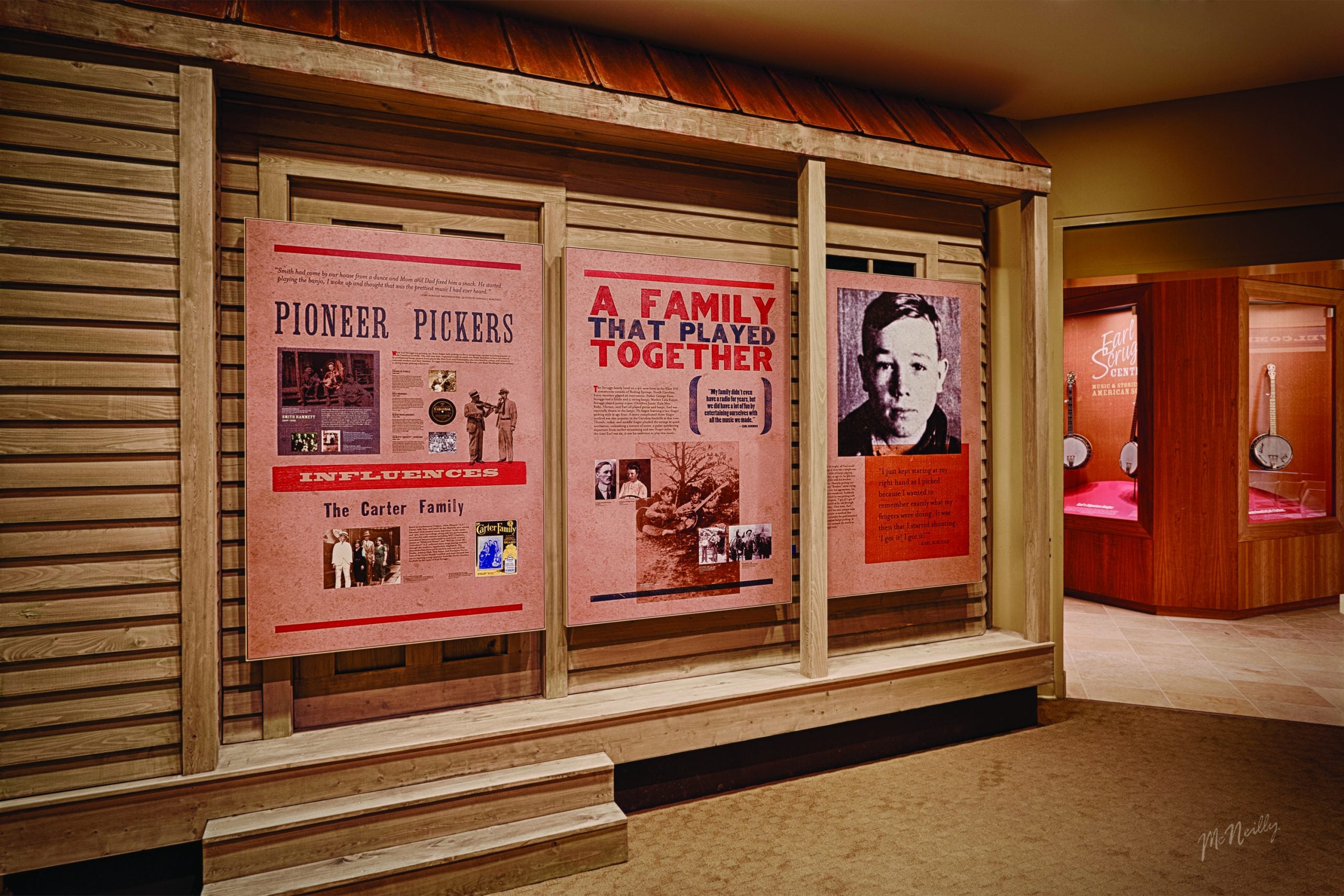
Entering the rotunda, one is greeted by a case displaying two of Earl’s banjos. A fiddle and open back banjo belonging to Earl’s father, George, along with instruments owned and played by Earl’s brothers Horace and Junie, and sons, Randy and Gary, attest to the importance of music as a family affair. In a display titled “A Family that Played Together,” Earl states, “My family didn’t have a radio for years, but we did have a lot of fun by entertaining ourselves with all the music we made.”
“The story you’ll see throughout the museum is told alongside Cleveland County history, because this area shaped [Earl] and his music,” says the Center’s Executive Director Mary Beth Martin, 2021 IBMA Industry Momentum Award honoree. “We tell his story through the history and culture of Cleveland County.”
Author and musician Tommy Goldsmith agrees. “I think it’s a wonderful amenity and attraction for Shelby and Cleveland County. It employs Earl’s achievement and reputation to bring people to enjoy the history and cultural contributions of Cleveland County.”
The Scruggs story is told through a combination of artifacts, photographs, film clips, comments and oral histories from more than 100 Cleveland County residents. Earbuds provided by the Center enhance the experience through music, and by stories told by local voices. “It’s not only a place where people who love and admire Earl and his music can come,” says Martin. “But also, and regional residents, or those from communities like ours, can make personal connections with the information presented in our exhibits.”
The museum situates the Scruggs legacy within the context of cotton farming and associated textile mills, which provided employment for county residents from late 19th through early 20th centuries. Earl Scruggs farmed cotton and was employed by Lily Mills Company prior to embarking on his career in music. The “In These Hills” gallery showcases the importance of cotton to the early history of Cleveland County. The room also features “Common Threads,” an imaginative interactive table, enabling the visitor to explore the interface of musical genres, artists, and cultural events contributing to American popular music.
The evolution of the banjo, from the West African single-string Akonting through 5-string resonator models is on display. Visitors unfamiliar with banjo styles can plug in and listen to the distinct tones of clawhammer, two- and three-finger styles of playing, and learn of early influences on Earl of Snuffy Jenkins, Charlie Poole, and other early 20th Century 3-finger banjoists.
The museum traces Earl’s life and career from his hardscrabble Cleveland County farm to world-renowned performer through a variety of concert, radio, and television footage. His tenure with Bill Monroe is explored from the 1945 audition through 1948, when he and Lester Flatt left Monroe and established Lester Flatt, Earl Scruggs, and the Foggy Mountain Boys.
From an early age, Earl Scruggs was motivated by an artist’s urge for discovery and innovation. He rose from conservative rural roots to embrace societal, as well as musical, change. As the Flatt and Scruggs partnership ended in 1969, Earl joined his sons in the Earl Scruggs Revue. “The Turning Road” gallery details how the band combined rock, jazz, and folk with Scruggs’ dynamic banjo. At a time of deep cultural division over civil rights and the Vietnam War, Earl held fast to his convictions, performing at rallies in Washington, D.C., and elsewhere, alongside counterculture figures, including Joan Baez, Bob Dylan, and Martin Luther King, Jr.
The global reach of Earl Scruggs and his crossing of musical boundaries is symbolized in “He Will Set Your Fields on Fire,” a sculptural collage by Bernie Taupin. Rock fans will recognize Taupin as the lyricist for pop treasure, Elton John. Created by Taupin in his studio near Santa Barbara, Calif., the permanent installation consists of disheveled acoustic instruments nestled upon an American flag, and a photograph of Lester and Earl and the Foggy Mountain Boys.
In a video accompanying the piece, Taupin explains his reverence for Earl and for bluegrass. Scruggs’ influence guided Taupin toward writing Southern-flavored songs for John, such as “Honky Cat,” and moving from England to his California ranch.
“When we start talking about the Earl Scruggs Revue and Earl’s impact beyond bluegrass to the entire world, we felt that this piece represents it well,” says Executive Director Martin. “You have someone [Taupin] who grew up in the U.K. who was influenced by Earl and went on to write songs that have been some of the most popular songs in music.”
A stand-alone exhibit honors Bluegrass Hall of Fame member, Louise Scruggs, Earl’s wife and manager, who served as model for other women in the male-dominated business of bluegrass.
The Center also serves the citizens of Cleveland County by working with schools and offering programs for the public. The spacious second floor serves as a performance space featuring annually some 40 concerts, book readings, and storytelling events. A second floor gallery hosts traveling exhibits, such as the current artwork depicting the folkloric genre, Jack Tales.
It’s impossible to imagine how music would sound today if, as a musically smitten 10-year-old, Earl Scruggs had not persisted in exploring the possibilities of the 5-string banjo, discovered its previously undisclosed magic, and shared his discovery with audiences beyond the rural confines of Cleveland County. The Earl Scruggs Center is a grand tribute to the community and accomplishments of the man who has meant so much to the town of Shelby and to musicians and fans around the globe.
The inaugural Earl Scruggs Music Festival will take place over Labor Day weekend, Sept. 2-4, 2022, at the Tryon International Equestrian Center in Mill Spring, NC. Sponsored by The Earl Scruggs Center, WNCW-FM and Isothermal Community College in Spindale, the Festival is rebooted from last year’s COVID-19 related cancellation.
Performers include Jerry Douglas serving as Host and with the Earls of Leicester, Nitty Gritty Dirt Band, Sam Bush Band, Alison Brown, Darin and Brooke Aldridge, Becky Buller Band, and others.
For information on tickets, seating, and accommodations, go to earlscruggsmusicfest.com.