
Building the Multi-Tool of Modern F-5 Mandolins
Photos by Bud Osborne
“Writing about music is like dancing about architecture,” said musician-comedian Martin Mull in a line often misattributed to Frank Zappa. Same holds true for trying to describe a musical instrument’s sound. In wine culture, reviewers and sommeliers have a glossary accepted by consumers, with terms like ‘oakey’ or ‘full-bodied’ or ‘closed’ or ‘rich in tannins’ conferring at least a general idea of the wine to educated buyers.
Not so in instrument reviews. After spending two days enjoying this superb Andrew Mowry F-5, I was left somewhat tongue-tied when I tried to describe its sound to my wife. “Sweetie, you need to invent a new vocabulary,” she kindly advised.
Which begs the question, why is this outstanding instrument’s tone and presence especially hard to categorize or describe? Many players lump mandolins into sub-categories of tone: dark and dry, Loar-like, bright and punchy, brilliant and present, percussive, etc.
With this Mowry, the instrument seemed to have a chameleon-like ability to move between categories, depending on pick choice, right hand attack, and whether the pick was over the extension or near he bridge. Of course, that’s true for all stringed instruments. But here Mowry incorporates elements of all those sounds while keeping a distinctive signature tone that’s as individual and recognizable as a Kimble or a McClanahan.
“I think it’s great that each builder seems to have our own sound, but I’ll admit that I think that it partly comes from chance, or at least is subconscious, as we each develop our process over the years. I’ve made a lot of gradual tweaks to arching, graduation, and tone bars, but I’m not sure I can encapsulate exactly how those have combined to steer the tone in a particular direction. In general, though I have a lot of respect for the ‘purity’ of the Loar tone, I’ve gravitated toward a bit of a richer tone, with a broader spectrum,”Mowry says.
The review instrument had only an hour’s playtime on it when it arrived, so it definitely sounded a bit green compared to how it will evolve. But it delivered the broad spectrum amply.
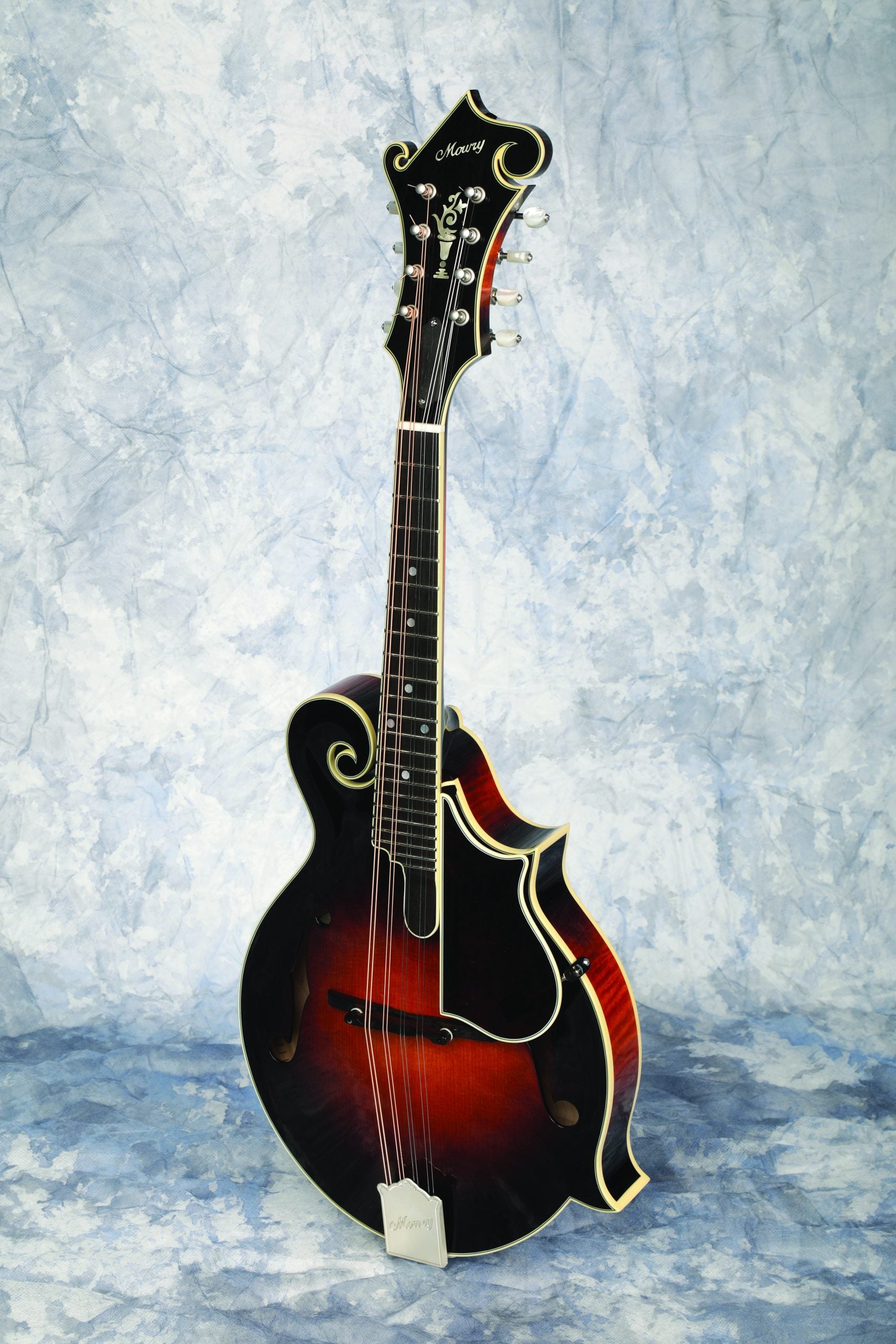
The build is typical of an Andrew Mowry F-5. The top is old-growth Englemann spruce paired with a choice red maple one-piece back. The F-5 carries a handsome oil varnish finish. One highlight of this Mowry F-5, SN #171, is its uncommonly good playability and setup. Strung with D’Adarrio EJ74s, Mowry avoided the common flaw of a poor setup and incorrect string slot depth at the saddle and in the 1 1/8” nut.
“I set the action to about 3/64” on the bass side and 2/64” on the treble side, unless someone wants it higher (many like it a little higher),” he says.
The fingerboard, loaded with standard nickel-silver “banjo” fretwire, “has a 12” radius, which is fairly flat. I often use a tighter radius or a compound radius,” he tells Bluegrass Unlimited. Andrew builds his own bridges and pickguards.
“I make the bridges myself, partly because I like to dial in the compensation and have the adjustability start out in the middle of the range with my preferred bridge height. You’ll see that there are curves instead of sharp corners like on Gibson bridges, which helps avoid cracking. The bottom of the saddle is especially prone to cracking under tension on the Gibson bridges,” he explains. “I made the pickguard, too. That one is unusual—I almost always use abbreviated ebony ones. I attached it a little lower than the traditional Gibson way, and I like to angle them down to mirror the arch of the body, both (design features) to help avoid pick contact.”
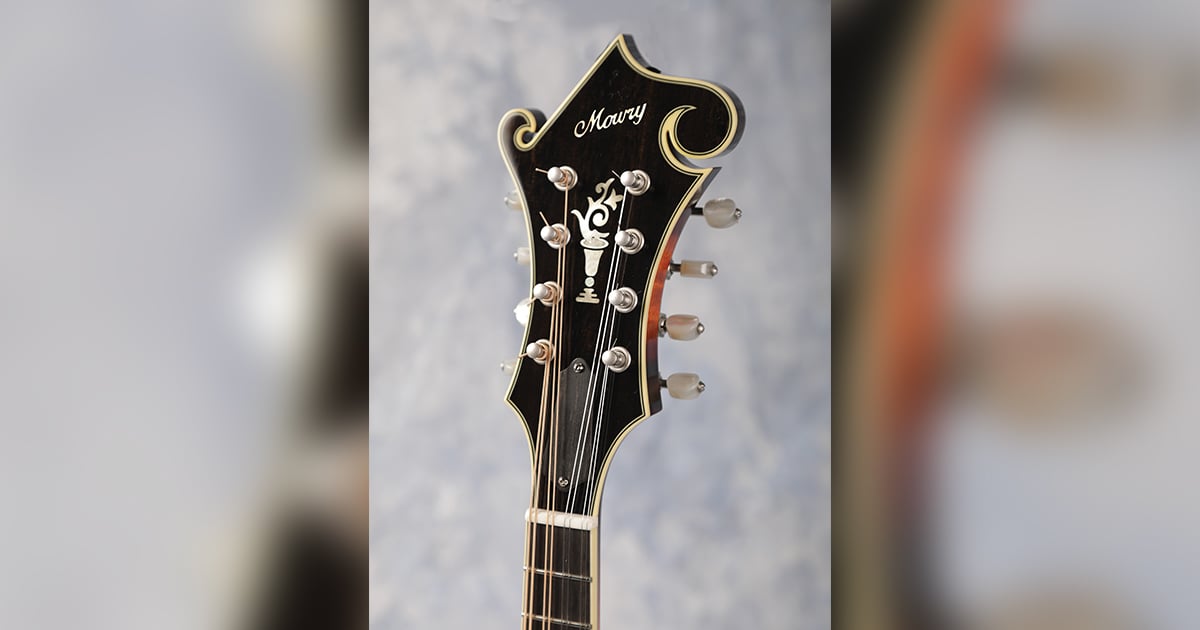
The temptation to call this new instrument a bright-sounding mandolin is strong, but it is in “treblesome” in an intriguing way, instead. Mowry has baked into his graduations and dishing and arching of the top and back a unique sound that doesn’t emulate a Loar. It’s a unique tone that can suit a wide variety of players in an equally wide array of styles. And as this mandolin matures, the lows will only rev up and enhance its sound.
“I think the main thing about the arching, graduation, etc. is that it is pretty specific to the piece of wood, so I use slightly different arching and quite different graduation for, say a floppy piece of quilted maple vs. a stiff/dense piece of red maple or sugar maple,” he says. “With tops in particular, I’m careful to never go too thin in order to get immediate gratification, because an instrument that seems too bright when new will sound great in a few years, but if a top is too thin it will lose a lot of its character later on, and of course you may run into structural issues.”
That’s not a fate this mandolin likely will have. It excels at, well, pretty much everything. Tight, punchy bass notes and chop chords emerge commandingly from the gracefully shaped f-holes. The upper end is bell-like and sweet, but never sounds syrupy or sugary in the highs. And individual notes generate that cherished crunch and sizzle in the upper harmonics that separate the truly great instruments from the pack. Of course, a new Mowry with an Adirondack spruce top would sound quite different.
Think of this Mowry F-5 as the mandolin multi-tool in your kit that gives you the sound and power you need for straight-up bluegrass, for Mandolin Orange/Watchhouse ballads or modern melodic mandolin ala John Reischman, and for swing and jazz tunes. I might not recommend this specific instrument for playing classical compositions because of its long sustain, which could sound muddy on pieces with abundant string-crossing passages and rapid-fire repeating motifs like the famous Bach Partita in E Minor.
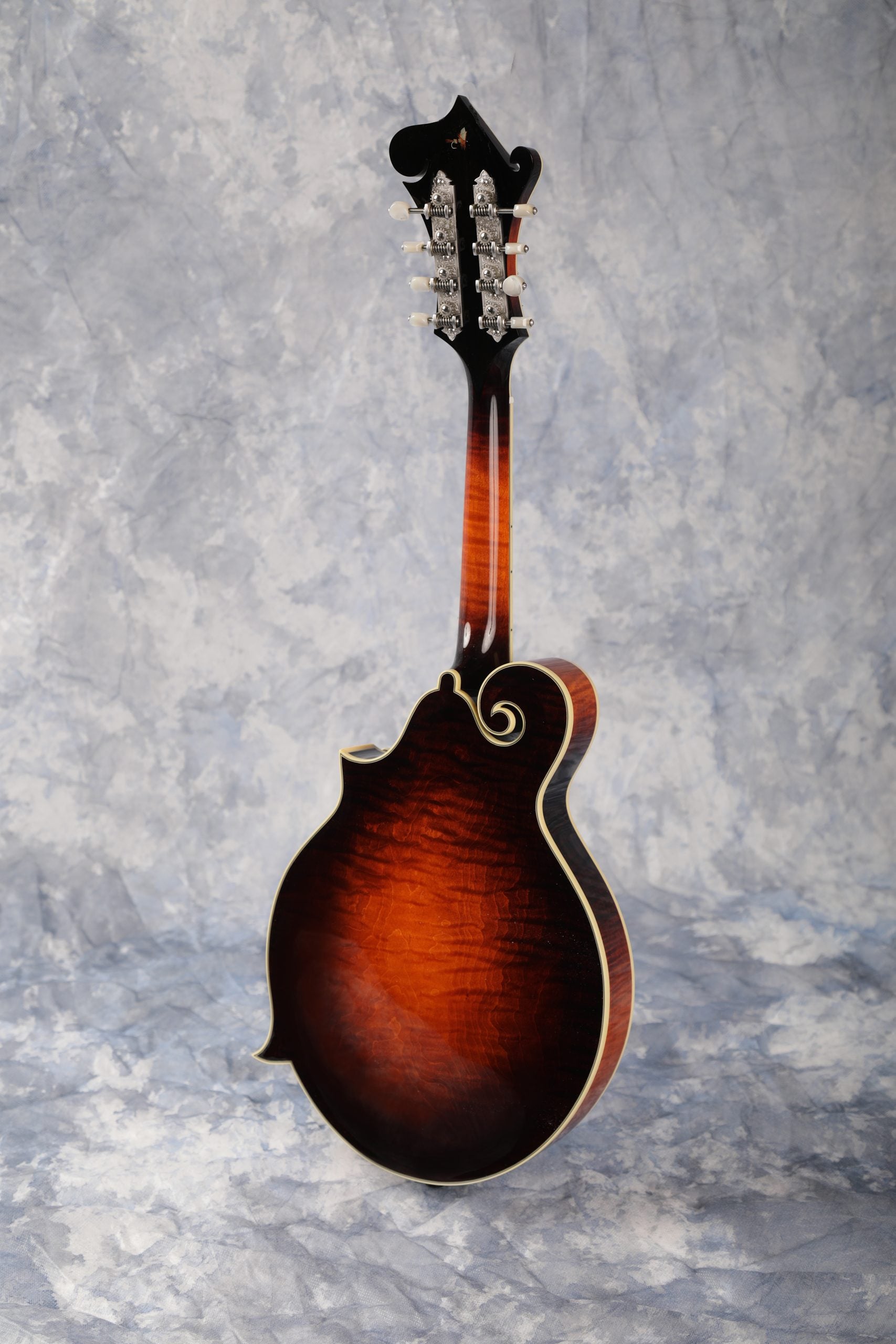
Under the hood, Mowry innovates in ways that add power and tone to his instruments. “There aren’t too many build details that are non-traditional,” he says, “but there are small design aspects that I’ve changed,” adding wryly, “I know that’s sacrilege.” But without those subtle changes, this wouldn’t sound like a Mowry. Even a perfunctory inspection through the f-holes showed a key difference in the kerfed wooden lining used to attach the top and back to the sides.
“There are some (non-traditional) structural things, like reverse-kerfed lining for added stiffness. I use a slightly thicker fretboard than some because I like the binding height to be about the same as in the body, and I like to have some ‘meat’ for future refrets and associated flattening. There’s also a two-way trussrod, and my headstock design is slightly modified to make it more difficult for the scroll to break off. I also do a few things to reduce weight, like a semi-hollow heel block.”
Indeed the unusually thick merging of the headstock binding inside the scroll initially looked like lazy binding work. But in the context of preventing the all-too-common scrollectomy so many F-5 headstocks suffer, it’s a valid trade-off to give up a bit of the visual appeal in that detail.
Flaws are exceedingly hard to find here, aside from the machining line at the top end of the scooped “Florida” extension that is far from parallel to the frets. The binding work is top-notch, and the interior displayed near OCD-levels of attention with no glue slop, and no orange peeling on the vertical edges of the f-holes.
The current base price for an Andrew Mowry F5 is $8,600, but he charges an upgrade for the Waverlys and the pickguard, so this one is $9,100 total with a nice Americase hardshell case.
For more info, see www.mowrystrings.com