
Home > Articles > The Artists > Missouri Mandolin Master
Missouri Mandolin Master
Photos By Caty Smith
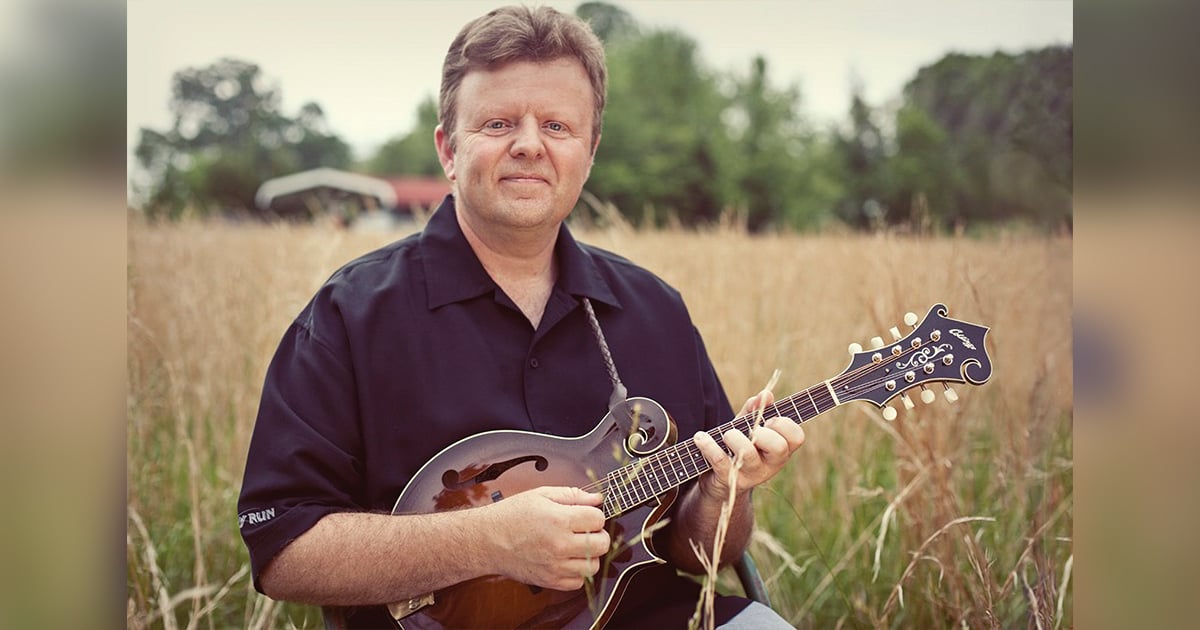
If you’ve spent time around bluegrass festival jam sessions you may recall hearing someone in the jam who is as good as anyone that you’ve ever heard play and wonder, “Wow, who is this?” There are many such local and regional bluegrass pickers and singers who are extremely talented but have not made a big name on the national level. Joey Wieneman is one of those guys.
Although Joey has played in bluegrass bands from the time he was a young kid, he has also opted—for the most part—to keep a day job and stay local. So, while Joey is known to bluegrass fans and pickers in his home state of Missouri, he may not be as well-known elsewhere in the bluegrass world.
One of the most famous bluegrass artists from Missouri, Rhonda Vincent, knows Joey well as he was a member of her bluegrass band—the Rage—back in the mid-1990s. Rhonda said, “I love Joey. We’ve grown up as kids playing at the Missouri bluegrass festivals. He was a member of the original Rage and I always love singing and playing with him. He’s so very talented and one of the nicest guys you will ever meet.”
Hailing from Eldon, Missouri, Joey was born into a musical family. His mother, Sue, and father, Bob, played 1950s style rock and roll in early 1960s rock bands—Sue on drums and Bob on electric bass. In 1967, when Joey was only six months old, his parents brought him along with them when they went to see Flatt & Scruggs play at the Austin Wood Auditorium in Lake Ozark. Seeing Earl Scruggs play live inspired Joey’s dad to build himself a banjo and start learning how to play.
While Joey was too young to remember seeing Lester & Earl, the bluegrass bug might have bit him that day just as hard as it bit his dad. The first bluegrass show that Joey does remember was the Osborne Brothers show that he attended in 1972. He said, “My grandma told me that every time I came to visit her I was singing ‘Country Roads’ like I’d heard from the Osborne Brothers.”
By the time he was seven years old, Joey—an only child—had been given a Silvertone guitar. His dad was looking for someone to back him up when he played the banjo and he started teaching Joey basic guitar chords. Joey said, “My dad knew the G, C, and D chords and he knew how to play lead guitar on ‘On Top of Old Smokey’ and ‘Wildwood Flower.’ That is where I started.”
Early albums that Joey remembers listing to from his father’s collection included Foggy Mountain Jamboree and Foggy Mountain Banjo from Flatt & Scruggs and Live At Kansas State from the Earl Scruggs Revue. He also recalls learning to back up his dad’s banjo playing on tunes like “Cripple Creek,” “Fireball Mail,” “Cumberland Gap,” and “Shuckin’ the Corn.”
In about 1974 or 1975 Joey and his parents were going to attend the Bluegrass Pickin’ Time festival in Dixon, Missouri, and they brought along Joey’s first cousin, Irl Hees, who was five years older. Joey said, “Irl got the bug at that festival and he wanted to learn how to play the bass. He immediately built himself a washtub bass so that he could play.” Irl later went on to play with Rhonda Vincent, Lost Highway, Chris Jones, Lonesome River Band, Cedar Hill, and the Cleverlys.
Shortly after Irl started learning how to play the bass, Joey’s parents bought a bass and his mom started learning to play. By 1978, his family had formed a band called Gateway Bluegrass with guitar player and lead singer Walter Dye. Since Walter played the guitar, Joey got a mandolin, quickly learned to play and was the band’s mandolin player by 1979. At first, Gateway Bluegrass played in churches, but by 1980 they were invited to play the Bluegrass Pickin’ Time festival in Dixon, Missouri.
Joey played in Gateway Bluegrass from 1978 through 1987. During that time period the band played at festivals ranging as far north as Canada. Joey said, “We played at festivals from Arkansas to Minnesota, and even went up to Thunder Bay, Ontario, Canada.” The two biggest festivals that they played were the Bluegrass Pickin’ Time festival run by Bill and Mona Jones and the Bill Grant Bluegrass Festival in Hugo, Oklahoma run by Bill Grant (of Bill Grant and Delia Bell fame). They typically played fifteen to twenty festivals a year. By 1987 Walter Dye had decided to step back from performing.
On the same weekend that Gateway Bluegrass performed their last show at the bluegrass festival in Dixon, Joey was hired to perform with Bill Jones & the Bluegrass Travelers. He stayed with that band, which maintained a similar touring schedule, for the next four years and then joined the band Down The Road with his cousin Irl Hees on bass, Dave Maravilla on guitar, and Allen Jones on banjo. Joey stayed with that band from 1991 to 1995.

During the first twenty years that Joey travelled to Midwest bluegrass festivals he had a lot of opportunities to jam with the members of other touring bands. He recalls meeting, and jamming with, members of various bands such as Bob Paisley, High Country, Weary Hearts, Bluegrass Cardinals, and many others. When asked about some of the jams that were most memorable, he pointed to jamming at the SPBGMA convention with Stuart Duncan saying that he and Stuart were both Stanley Brothers nuts and liked the same songs. He added, “I also had the opportunity to jam with Alison Krauss when she was young and only playing the fiddle. She wasn’t singing back then.” One of his fondest memories was jamming with Ron Block when Ron was a member of the Weary Hearts and then seeing Ron years later at an Alison Krauss show. He said, “Ron saw me and said, ‘Hey Joey!’ I couldn’t believe that he remembered my name.”
Joey had his first opportunity to join a nationally touring band when Rhonda Vincent called. Joey was a member of two different configurations of Rhonda’s band. One included Rhonda on mandolin, Allen Jones on banjo, Joey on guitar, and Irl Hees on bass. Rhonda’s husband, Herb, named the band by using the first letter of each of their names—RAJE (Herb didn’t know Irl, pronounced like ‘Earl,’ didn’t spell his name with an E). Rhonda fans will know that her band is now called Rhonda Vincent and the Rage. So, over time, the J was changed to a G.
The other configuration of Rhonda’s band that Joey was a part of consisted of Rhonda, Joey, Darren Vincent, and Randy Kohrs. Joey played guitar in Rhonda’s band, but said that sometimes he and Rhonda would switch instruments. When she played guitar, he would play mandolin. Joey stayed on the road with Rhonda from 1995 through 1996. He decided to leave the band when the touring schedule started to get busier. He had a day job and kids at home. At that point he decided to spend a couple of years away from playing in a band.
In 1998 Joey joined Lowell Appling’s band Twin Rivers and started performing at Midwest festivals again. But, by 2003 Lowell had found a day job that required him to work weekends and so ended that band. In 2005, Joey was asked to join the Old Missouri Band, another band that performed regionally in Missouri. His stay with that band was short lived because in 2006 he lost a day job that he had held for 16 years. Now out of work and in need of a full-time job, he recalled that Frank Ray had told him at one point in time, “If you ever need a job, give me a call.” So, he called and Frank hired him as a member of his band Cedar Hill.

With Cedar Hill, Joey was back with a nationally touring band and playing guitar. He stayed with that band for two years and they performed roughly 120 shows in forty states, with three trips to Canada. He also recorded an album with the band that was tracked at Tom T. and Dixie Hall’s recording studio. Remembering that band, Joey said, “Frank was a vintage instrument dealer, so one of the things I loved about being in that band was that I got to play some great vintage guitars on stage.” Joey left Cedar Hill when his mother became ill. He came back home and got another full-time day job late in 2007. Unfortunately, his mother passed in February 2008.
The next several years saw Joey playing in a couple of mid-Missouri bands. One was the Bluegrass Pickin’ Time band, which was a house band for the Dixon festival that was held twice a year. The other was the Missouri River Band that included his friend Alvin Deskins on banjo. Alvin was, and still is, the manager of Morgan Music in Lebanon, Missouri. Around 2009 or 2010 Joey also joined the Ironweed Bluegrass Band, based out of Columbia, Missouri. He continues to perform with Ironweed to this day.
A second band that Joey joined in 2013 was Rural Roots. This band saw him pairing back up with Alvin Deskins and Lowell Appling. Joey said, “Lowell got a different job that allowed him to be on the road again.” Kevin Schults joined them on bass. Rural Roots performed together until 2020 and disbanded after Lowell suffered a hand injury.
When asked about his main influences on mandolin, Joey said, “To me Herschel Sizemore is the bull’s eye of what a bluegrass mandolin player should sound like. He has the taste and he gets great tone.” Other mandolin players that he mentioned as influences were Bill Monroe, Sam Bush, and Roland White.
As a final note, Joey wanted to add, “I was very lucky that mom and dad enjoyed the music and took me to see so many shows. I got to see Lester Flatt and the Nashville Grass when Marty Stuart and Kenny Ingram were in the band. I saw the J. D. Crowe and the Kentucky Mountain Boys reunion in 1985 and I also saw the Bluegrass Album Band that same year.” Other bands Joey enjoyed seeing when he was young included the Seldom Scene, Hot Rize, Country Gazette, Buck White—when Jerry Douglas and Ricky Skaggs were with him—and many more.
Although he has had two short stints with nationally touring bands, Joey Wieneman has mostly stayed a regional Midwest bluegrass performer. He has now played with his current band, the Ironweed Bluegrass Band, longer than any other band that he has been with to date. This band consists of Jane Accurso on guitar, Joey on mandolin, Dierik Leonhard on banjo, Kelly Jones on fiddle, and Matthew Bossaller on upright bass.
Regarding having Joey as a member of the band, Jane Accurso said, “In Joey’s mandolin I can hear the soaring, soulful voice of Jimmy Martin, the powerful, high lonesome spirit of Bill Monroe and even the wailings of Hazel Dickens. Skillfully, fearlessly and effortlessly, he delivers these voices while also being able to push the edge of tradition. Seasoned with his Missouri Ozark roots, this makes for one amazing mandolin player. He is a Missouri treasure, a sweet friend and a delight to everyone who has the pleasure of hearing and knowing him.”
