
Skip to content
Register |
Lost your password?
Subscribe
logo
  • Magazine
  • The Tradition
  • The Artists
  • The Sound
  • The Venue
  • Reviews
  • Podcasts
  • Lessons
  • Jam Tracks
  • The Archives
  • Log in to Your Account
  • Contact
  • Subscribe
  • Search
  • Login
  • Contact
Search
  • Magazine
    • Current Issue
    • Past Issues
    • Festival Guide
    • Talent Directory
    • Workshops/Camps
    • Our History
    • Staff
    • Advertise
    • Contact
  • The Tradition
  • The Artists
  • The Sound
  • The Venue
  • Reviews
  • Podcasts
  • Lessons
  • Jam Track
  • The Archives

Home > Articles > The Artists > Back to Cuttin’ Grass

Sturgill Butcher Shoppe Semi Song
Photo by Semi Song

Back to Cuttin’ Grass

Matt Wickstrom|Posted on December 31, 2020|The Artists|No Comments
FacebookTweetPrint

Although it’s taken him five albums to put out a project with the bluegrass arrangements to match, this is exactly what Sturgill Simpson has done on Cuttin’ Grass – Vol.1 and 2 (The Butcher Shoppe Sessions).  Bluegrass music has long been a part of Simpson’s upbringing—something he credits to his paternal grandfather. However, it took many years of pushing it away before bluegrass unexpectedly hit home. Sturgill’s grandfather (a World War II veteran and Purple Heart recipient assigned as an Army sniper in the South Pacific) happened to be an avid connoisseur of bluegrass, and an occasional mandolin player.  Simpson described his late grandfather, who passed away from complications with Alzheimer’s in 1999, as a quiet, reserved and widowed man who spent most of his life after the war at home alone in Knott County, Kentucky…except when he’d jump into his camper in the summer and travel around to bluegrass festivals, where he captured field recordings. 

A fan of artists like J.D. Crowe, Ralph Stanley and Jimmy Martin, Simpson’s grandfather “liked his bluegrass hard and fast, the way it should be,” according to the artist. Simpson was first approached by his grandfather in the third grade about the subject of bluegrass. He sat Sturgill down on his bedroom floor and fed him recording after recording. However, at the time Simpson gravitated more toward albums from The Monkees, Michael Jackson, Cream, Led Zeppelin and even the soundtrack for E.T. The Extra-Terrestrial, rather than bluegrass, courtesy of an older cousin and “bad influence” neighbor. When confronted with his grandfather’s recordings Simpson was annoyed with what he heard.  His grandfather said, “One day it’s gonna get in ya, and it’ll never get out.”
Sturgill Simpson’s Bluegrass Band for Cuttin’ Grass
Sturgill Simpson’s Bluegrass Band for Cuttin’ Grass (from left to right) Mark Howard, Scott Vestal, Sturgill Simpson, Mike Bubb, Sierra Hull, Tim O’Brien, Miles Miller, Stuart Duncan

“He’d often come out to stay with us for a couple weeks in between shows,” said Simpson. “When he visited, he’d always be carrying a brown, faux-leather briefcase stuffed with cassette tapes recorded during his travels. He’d try to play them for me, but at the time I wasn’t having any of it. I remember my brain not being able to really process bluegrass at the time and thus rejecting it due to my own insecurities. It was beyond where I was musically at the time.”

Despite not being around to see Simpson’s journey come full-circle, his grandfather was right. Straight out of graduating from Woodford County High School in Versailles, Kentucky, Simpson joined the U.S. Navy (1996-1999) working in the Combat Information Center of a frigate. His duty included time in Japan. Following his military stint, Simpson returned stateside, where he waited tables at an IHOP in Seattle, Washington for a brief time before moving back to Lexington, Kentucky.

Soon after moving back to Kentucky, now in his early 20’s, Simpson was taken aback driving down the road one day when an old Monroe Brothers song popped up on the radio. The experience caused him to fill up with emotion as he was brought back to his grandfather’s foreshadowing message about bluegrass music.

“It sounded like home. Bluegrass music is healing. I truly believe this to be true,” said Simpson in a letter penned to fans accompanying the surprise October 2020 release of Cuttin’ Grass – Vol.1 (The Butcher Shoppe Sessions). “It is made from ancient, organic tones and, as with most all forms of music, the vibrations and the pulse can be extremely therapeutic.”

In the years that followed, Simpson scoured the bluegrass archives, dated from post-World War II to the 1970s, listening to anything he could find from Ralph Stanley and other traditional masters of the genre.

In 2004, Simpson formed the country/rock band Sunday Valley. He moved to Nashville for the first time the following year, and started to frequent the famous Station Inn. He played bluegrass standards and other familiar tunes at the Sunday night jam sessions.

After struggling to gain traction in Nashville, in 2006, Simpson decided to push his musical ambitions to the side and move to Salt Lake City. In Utah  he worked for, and eventually managed, a shipping yard for the Union Pacific Railroad until his future wife Sarah inspired him to chase after his musical passions again. This decision lead him to return to Sunday Valley in 2012 in advance of disbanding the group and moving back to Nashville.

Since his return to Music City U.S.A. Simpson has explored all ends of the musical spectrum starting with the straight up honky-tonk of 2013’s High Top Mountain. This was followed by the psychedelic country sounds of 2014’s Metamodern Sounds In Country Music. The orchestral ballads of the 2016 release A Sailor’s Guide To Earth netted him the 2017 Grammy for “Best Country Album” along with a nomination for overall “Album of the Year.” Following that, the dystopian and post-apocalyptic progressive-rock of 2019’s SOUND & FURY has now been nominated for the “Best Rock Album” Grammy. Now, bluegrass with Cuttin’ Grass – Vol. 1 (out Oct. 16) and Vol. 2 (out Dec. 11).

For Simpson, the idea of returning to his catalogue of songs and re-recording them with bluegrass arrangements is one that he’d floated around for the past few years with renowned producer and engineer David Ferguson (Johnny Cash, John Prine, The Del McCoury Band, The Steeldrivers, etc.).  He realized about 80-85 percent of his songs were originally written from a bluegrass frame of mind, on his 1997 Martin HD-28VR acoustic guitar, when he first moved to Nashville and frequented the Station Inn. Notably, Simpson is an “ambassador” for Martin guitars. Martin defines their ambassadors as “a collection of today’s top artists from all musical genres” who endorse Martin guitars.

“This isn’t a fluke for [Sturgill],” said Ferguson. “He’s got bluegrass running deep within his veins or else this wouldn’t have worked. Bluegrass is something you simply can’t fake.”

Between the idea getting lightheartedly proposed to finally coming to fruition, Simpson ended up gathering a few players [including Ferguson (bass), Sierra Hull (mandolin), Stuart Duncan (fiddle), Scott Vestal (banjo) and longtime drummer Miles Miller] to perform with him during a debut bluegrass performance at the Grand Ole Opry in May 2019. That occasion  further helped cement the certainty that these songs would someday get recorded with bluegrass stylings. The players supporting the project immediately recognized Simpson’s strong roots in bluegrass, despite his previous recordings not navigating into the genre.

“Del [McCoury] always said that any song could be a bluegrass song so long as it has a good melody and story to it,” said Mike Bub, who was brought in for the Cuttin’ Grass sessions.  Mike was a longtime member of the Del McCoury Band, and five-time winner of the “Bass Player of the Year” as well as “Instrumental Player of the Year” at the International Bluegrass Music Awards (1996-97, 2002-03, 2005).  

Bub continued, “What makes these songs of Sturgill’s so compelling to me is how personal they are. These songs are from the heart, and when you can write like that your music is going to resonate with people no matter the genre.”

“A lot of time when you’re playing with artists who don’t do bluegrass often, you have to soften things up and tilt toward their musical strengths. But the forward thrust of bluegrass was very natural to Sturgill,” Tim O’Brien comments. O’Brien, a founding member of Hot Rize, a 2006 Grammy winner for “Best Traditional Folk Album” and a two-time winner of the International Bluegrass Music Awards “Male Vocalist of the Year” in 1993 and 2006, sang some harmony vocals and played guitar on Cuttin’ Grass.

Time opened up to record the Cuttin’ Grass sessions after Simpson’s nationwide tour with fellow Kentuckian Tyler Childers was cut short.  After a March 10, 2020 show in Charleston, S.C. Simpson began feeling ill. The next morning he was taken to the Emergency Room with pre-stroke blood pressure levels and feeling like he had an invisible ratchet strap around his chest. This lead him to cancel the following week of shows and eventually the entire tour once the COVID-19 pandemic took hold. Then, in early April, Simpson tested positive for COVID-19, forcing him to a break from relentless touring—something he’d hardly been able to pull himself away from in the previous eight years.

      Simpson began spending his days in the woods and with his wife and three sons, catching up on lost time. After a couple of months, and with help from Miles Miller, Simpson revived his Instagram account and began posting about “Dick Daddy,” a fictional backwoods survivalist instructor he’d fabricated. 

     Seeing interest from fans for corresponding “Dick Daddy” merchandise and getting flooded with video submissions of prospective students wanting to attend his “Dick Daddy Survival School,” Simpson went into action. He printed “Dick Daddy Survival School” shirts and held a charity drive that raised over $250,000 for Musicares COVID-19 Relief, Equity Alliance Nashville Tornado Relief, and the Special Forces Foundation. This strategy shattered goals he’d set with the promise of performing a concert of his musical backlog, done bluegrass style, if the threshold was reached.  He also promised to put out a new record later in the year. 

To oblige, on June 5, 2020, Simpson took the stage at an empty Ryman Auditorium with the all-star cast of Hull, Duncan, Bub, Vestal, Mark Howard (guitar) and Miller to perform a 13-song, hour-long set, giving fans a taste of the two eventual surprise releases. 

“This was supposed to just be a mixtape for the fans as a thanks for the money they helped to raise for charity this past summer,” said Simpson. “It’s crazy all of the attention it’s getting and how we’re getting television slots from it. On November 10, the band appeared on The Late Show with Stephen Colbert and on December 10th were featured on Jimmy Kimmel Live!).  “It’s just cool to see bluegrass music getting this sort of exposure considering it oftentimes gets far less recognition than it deserves.”

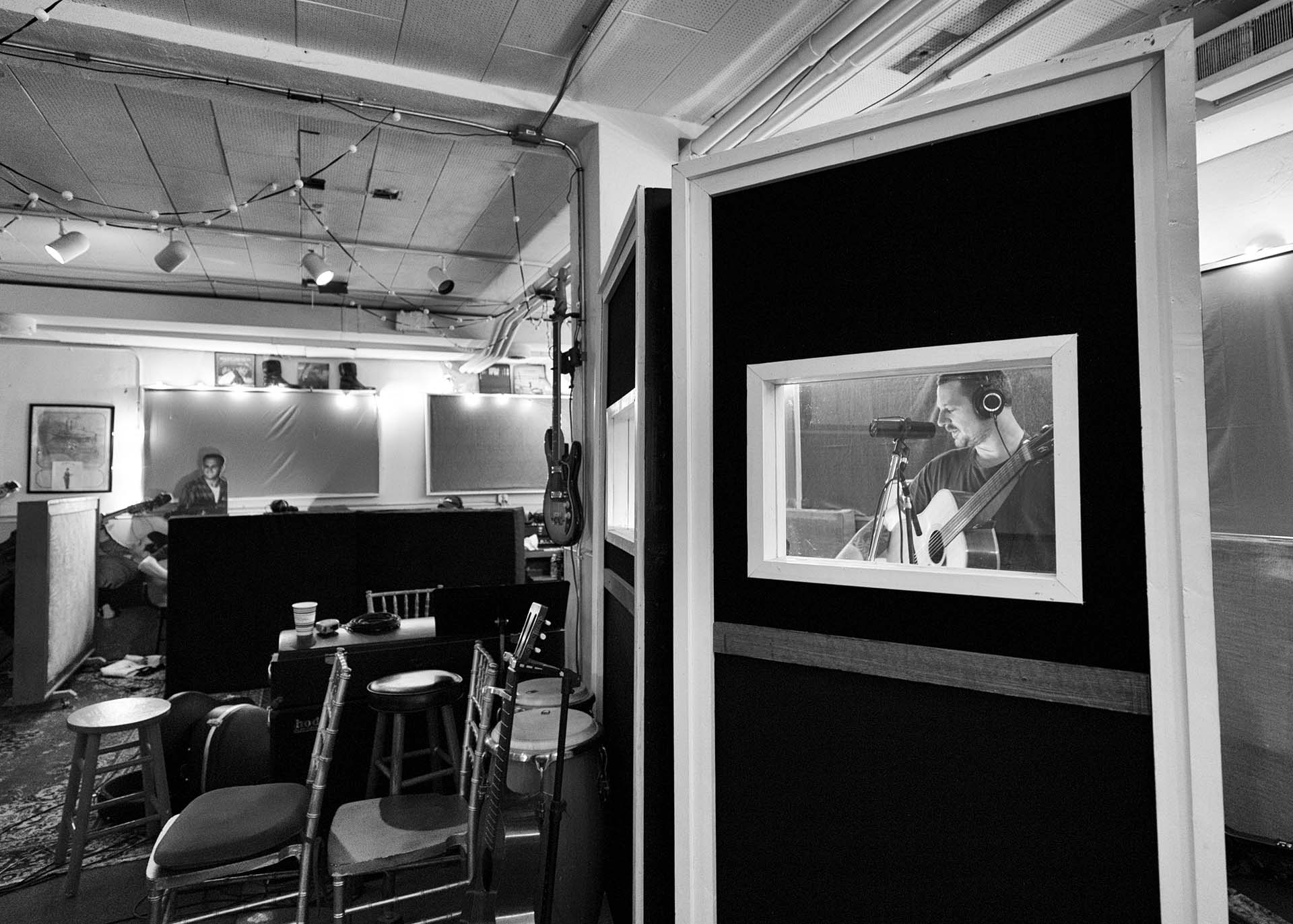
After the livestream from the Ryman, Simpson called up Ferguson to let him know that the project was on and to “get all the best players in town” which he did. He brought back everyone from the livestream, plus Tim O’Brien, to knock out each volume of Cuttin’ Grass in two separate three-day recording sessions. The sessions were comprised of nothing but live takes, void of nit-picking and production effects, at the now defunct Butcher Shoppe Studios in Nashville. The recordings were mixed by Ferguson and his partner Sean Sullivan. The decision to record the songs live was one of the few decisions from both Ferguson and Simpson, with the later opting to focus exclusively on being an artist in the studio rather than juggling being a producer as well.

“[David Ferguson] and I have worked together a lot in the past (the two collaborated on A Sailor’s Guide To Earth and co-produced Tyler Childers’ Purgatory and Country Squire) and approach things from the same place, so I have a lot of trust in him,” said Simpson. “There might be three people on the planet with the same amount of recording experience as him. His knowledge, particularly with bluegrass music, is second to none, so during these recordings I just wanted to be another person in the room singing, playing and focusing on being an artist. I’ve done the ‘other’ in the past and, while it can be rewarding, I also feel as though it takes some of the enjoyment I would get from the music away from trying to juggle too many roles at once.”

While all of the Cuttin’ Grass instrumentals were cut live, the same can’t be said for all of the vocal harmonies, which still came together quickly after the other parts of each song were recorded. Despite being added after-the-fact, the harmonies are a colossal factor in giving the songs, specifically the ones on Vol. 1, a more traditional feel, particularly the chorus harmonies of “Life Ain’t Fair And The World Is Mean”, “A Little Light” and a duet with Sierra Hull in the chorus of “Voices.”

“I think the rawer things can get, the better,” said Simpson. “I’ve done the big, lush and orchestral stuff in the past and it’s fun but it’s also very expensive and I’m not sure it resonates more emotionally with all of that production than these bluegrass versions do. With the infinite possibilities and technology associated with recording nowadays you can second guess and finagle the soul right out of something that could’ve been really great if you had left it as the thing that bothered your ears due to you being too involved in the process.” 

Simpson continued, “If you’ve got a good song and some organic tones behind it, then you’ve really got to work hard to make it sound bad. These songs recorded very well live, which I feel left a bit more of a human fingerprint on the music. As a music listener, I think it makes for better records.”

In total, the two volumes of Cuttin’ Grass cover 30 of Simpson’s previously recorded songs, 20 on Vol. 1 and 10 on Vol. 2, with the newest release also including the new, unreleased Simpson original “Tennessee.” Another track, mostly written by the late Merle Haggard called “Hobo Cartoon” was sent to Simpson years ago. Haggard was still thinking as a musician and writer on his death-bed in 2016 when he sent a phone text attachment to Simpson with the message “from one railroad man to another.” 

Additionally, the volumes also include five songs originating from Simpson’s days with Sunday Valley including “All The Pretty Colors,”—which he described as the most definitive sounding bluegrass song on Vol. 1—“Jesus Boogie” and “I Don’t Mind,” a song first scribed in the mid-2000s and a favorite of his wife’s, who insisted the song be included in the project.

“It’s very gratifying to finally hear those [Sunday Valley] songs recorded in this manner,” said Simpson. “It’s also given me the chance to look back on that part of my career all these years later and how I’ve hopefully become a better musician from my past experiences and the exposure I’ve gotten since these songs were first written.”

While Simpson has come a long way, both musically and in life, over the past two decades—as evidenced on Cuttin’ Grass—the project is elevated to unfathomed heights by players such as Mark Howard (a longtime producer and player with bluegrass legend John Hartford) and Scott Vestal.  Vestal’s banjo playing was described by Ferguson as sounding like a “machine gun going off” and by Simpson as “some seriously scary stuff on Vol. 2, even for my ears.” 

     Another of the many performers on the album was Sierra Hull, whose sublime mandolin playing stood out throughout the entire project. Her vocal harmonies were prominent with the stacked approach presented on “Breakers Roar.” Her singing on this song was something that Hull said was done on the fly while recording and resulted in one of the most magical moments from the sessions.

“When you have good songs, they stand on their own two feet,” said Hull, a two-time winner of the “Mandolin Player of the Year” and “Instrumental Player of the Year” at the International Bluegrass Music Awards (2016-17). “One of the things I’ve enjoyed most about this experience is the opportunity to take a deep dive into Sturgill’s catalogue of music. A good song can be arranged any way you like and it’s still a good song whether it be a funk, rock’n roll, country or bluegrass tune. Sturgill is just a great songwriter, hands down.”

“I don’t think that you can overstate how much Sierra Hull brought to this project,” said Simpson. “For one, her talent is incredibly special, but it was also wise on David [Ferguson]’s part to bring her playing in because it is so fresh and contemporary. She also has a bubbly and positive personality that, balanced together with all of us cantankerous dudes, brought something to the project that would not have been there otherwise, had another player been used.”

Admittedly nervous throughout the entire process due to the talent surrounding him in the studio, Simpson says that, those circumstances notwithstanding, the time spent recording was some of the most fun he’s ever had, adding that the process went by for him so quickly that he wasn’t able to comprehend everything that had happened until reviewing the mixes afterward. 

     He then went on to compare the Vol. 1 and Vol. 2 sessions by referring to the first as leaning more traditional due to the band still getting their sea legs about them as a group. The second installment, he adds, features more unorthodox, exploratory arrangements created by the shared, built up confidence. 

“There’s only been a few ‘holy crap’ musical moments that I’ve had in my life since moving to Nashville,” said Simpson. “Playing with Hargus ‘Pig’ Robbins for the first time and watching Robby Turner shred on a pedal steel guitar (during the High Top Mountain sessions) are a couple. Truly seeing talent that is next-level up close is something to behold, and this experience has definitely been one of those moments. It’s freakish to hear the level of musicianship we were able to attain in these sessions.”

As the COVID-19 pandemic continues to unfold and uncertainty builds around the future of the live music industry, Simpson said that he looks forward to one day being able to play in front of an audience with the same band he recorded the Cuttin’ Grass sessions with. He will perhaps take the stage at some of the same festivals that his grandfather frequented in his camper many moons ago. The band was recently revealed as part of the lineup for FloydFest atop the Blue Ridge Mountains in July 2021 with more news forthcoming as Simpson plans out his next musical chess move. He is an independent artist with no creative restraints or oversight from a label. 

With plans for more volumes of Cuttin’ Grass in the future after a return to more of his signature “Sturgill” material, it’s apparent that no matter what Simpson’s next move, he plans it to be a checkmate rather than a pawn being sacrificed by the recording industry executives.

“It’s refreshing to have an artist so well-known and respected that puts their music first,” said Stuart Duncan. “The last thing that Sturgill is thinking about is our dress code. The first thing he’s thinking about is ‘we’re here to deliver these songs and put everything we’ve got into the music,’ ‘thank you!’”

FacebookTweetPrint
Share this article
Facebook
X (Twitter)
Linkedin

Leave a Comment Cancel Reply


This site uses Akismet to reduce spam. Learn how your comment data is processed.

January 2021

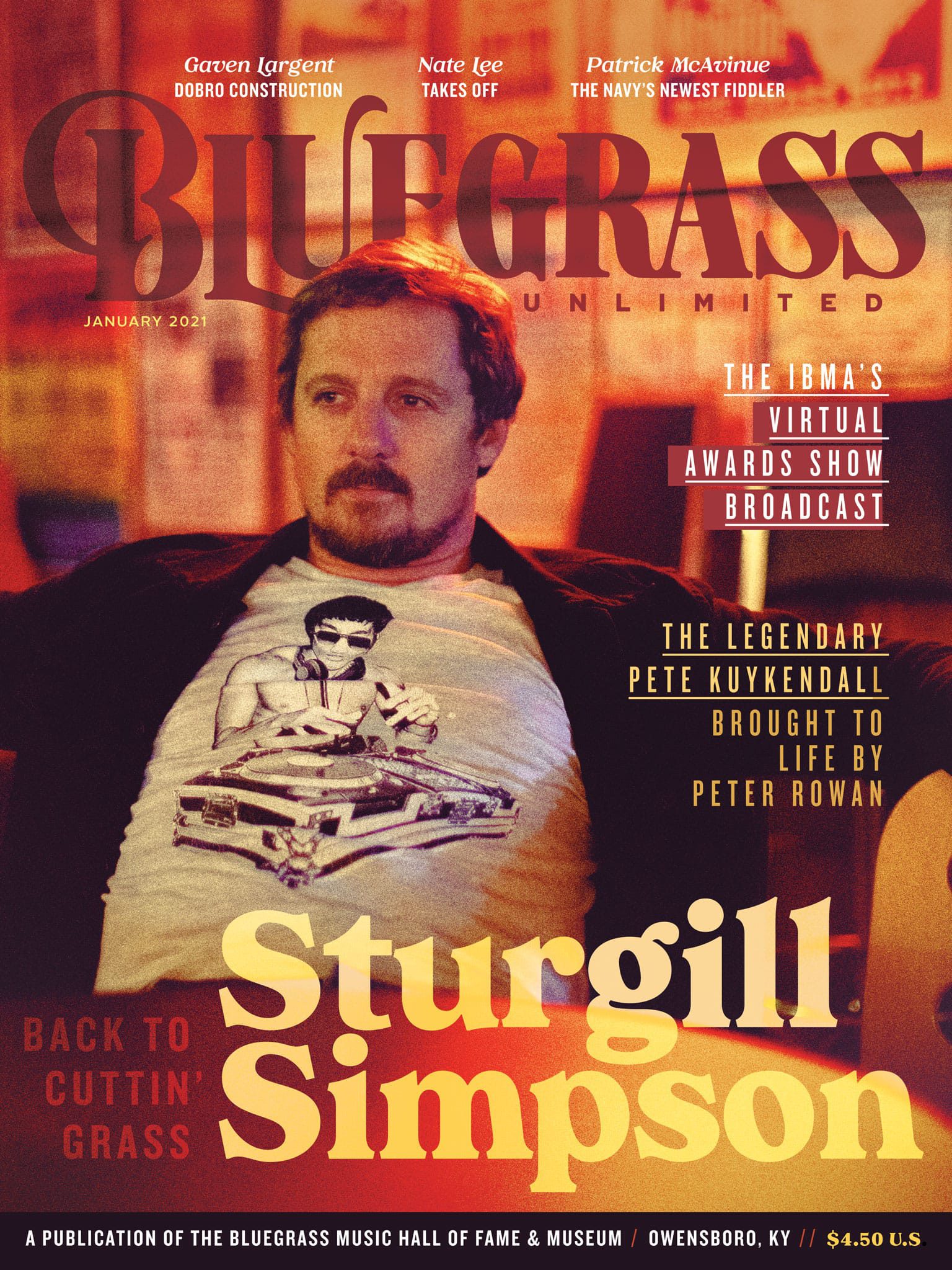
Bluegrass Unlimited Cover January 2021

Flipbook

logo
A Publication of the Bluegrass Music Hall of Fame & Museum / Owensboro, KY
  • Magazine
  • The Tradition
  • The Artists
  • The Sound
  • The Venue
  • Reviews
  • Survey
  • New Releases
  • Online
  • Directories
  • Archives
  • About
  • Our History
  • Staff
  • Advertise
  • Contact
  • Subscriptions
Connect With Us
Facebook
Instagram
Twitter
YouTube
bluegrasshalloffame
black-box-logo
Subscribe
Give as a Gift
Send a Story Idea

Copyright © 2026 Black Box Media Group. All Rights Reserved. Privacy Policy
Website by Tanner+West

Subscribe For Full Access

Digital Magazines are available to paid subscribers only. Subscribe now or log in for access.