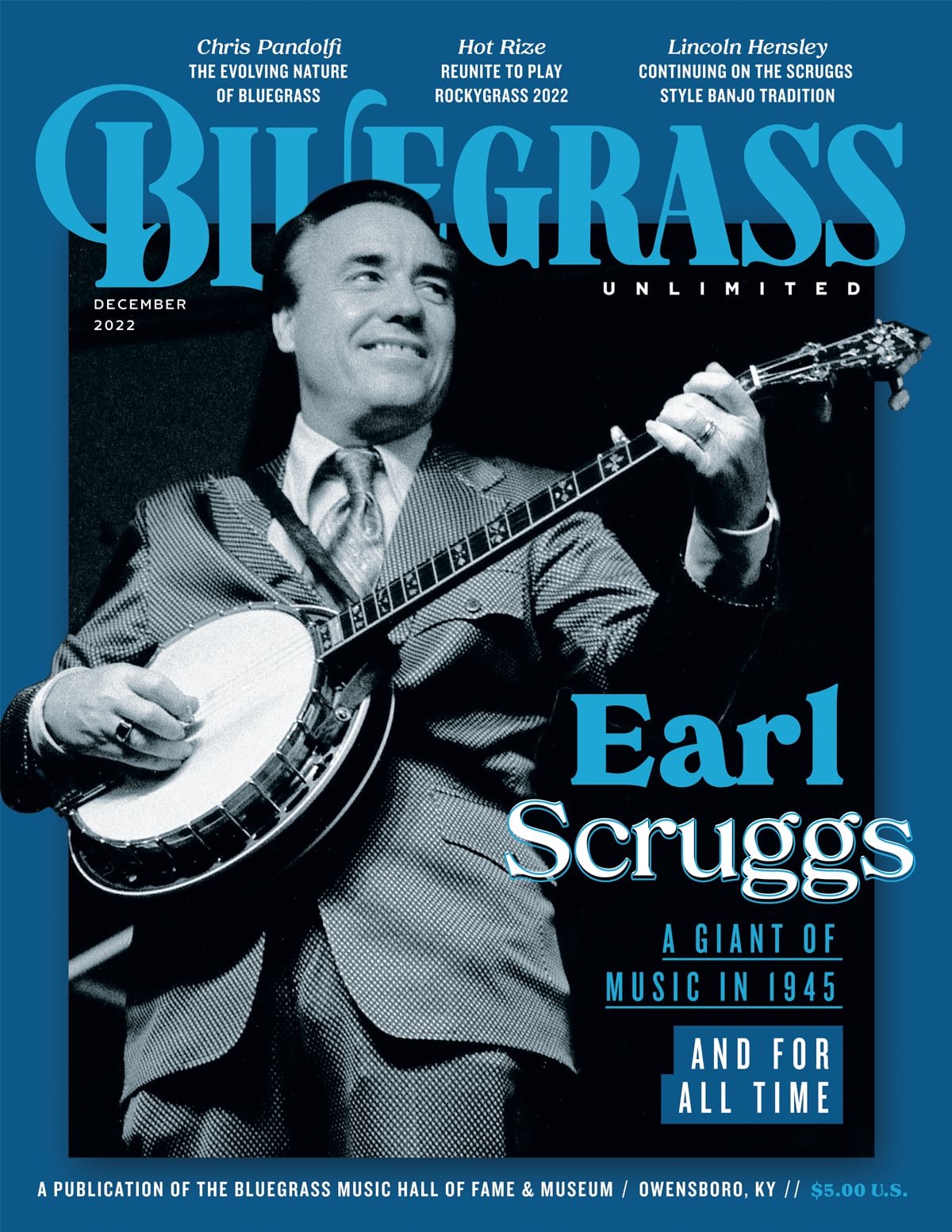

Chris Pandolfi and the Evolving Nature of Bluegrass
“I discovered bluegrass because of the banjo,” says banjo-picker Chris Pandolfi from the Grammy-Award winning Infamous Stringdusters. “I got into playing the banjo because of Béla Fleck. I was a Flecktone fan and really inspired by the music. That is what led me to buy my first banjo and of course everything points back to bluegrass, because that’s the native territory of the banjo. I took a backwards route to the music. Most people discover bluegrass and that leads them to the banjo. I was the other way around. I started learning and listening and everything pointed me back to bluegrass and more specifically Earl Scruggs. It was a great realization because I fell in love with the instrument and then fell in love with the music.”
Pandolfi, who was the first banjo principal at the Berklee College of Music, helped found the Infamous Stringdusters in 2007, has long been intrigued by the question, “What is bluegrass and how has it evolved and continued to evolve over the years?” Much of Pandolfi’s intrigue has stemmed from his own unique journey into bluegrass. For Pandolfi it was a more circuitous and less common route than for earlier generations of bluegrass musicians and fans, as many fans discovered the music through familiar or community ties. Pandolfi’s journey, while at one time a rarity, is becoming more the norm as a new generation of fans and players have arrived on the scene through an introduction from less traditional, but no less relevant bands.
This new generation of fans has often grown up outside the traditional bonds of the genre. While still influenced by what Bill Monroe first created, this new generation has often come into bluegrass through the backdoor, discovering the traditional sound through bands like the Grateful Dead, Old & In The Way, bluegrass inspired jambands like Leftover Salmon, the String Cheese Incident, Yonder Mountain String Band, and to a lesser degree Phish who, while not rooted in bluegrass, included bluegrass tunes in their sets. Pandolfi was one of those who came in through the backdoor, “I was drawn more to the progressive end of the spectrum with Béla Fleck representing the very cutting edge of the instrument and the way it can be used for all these different styles. Like every great banjo player, Béla as progressive as he is, talks about how the fundamentals of the banjo are all rooted in bluegrass and more specifically Earl Scruggs and his playing, and explains if you want to be a great banjo player in any genre you need to learn his stuff. That’s what I started to do. I fell in love with the music and I never looked back. That idea has informed everything I have done since then from the more traditional stuff with the Stringdusters like our Bill Monroe tribute (2021’s Grammy-nominated Tribute to Bill Monroe) to my solo stuff which is obviously on the progressive end of the spectrum.”

Perhaps the greatest gateway for many fans was through The Grateful Dead and all the Jerry Garcia acoustic off-shoots which reached a far larger audience than most traditional bluegrass bands. Garcia and the Grateful Dead’s importance and impact on introducing new fans, who may never have been exposed to traditional and bluegrass music, cannot be overstated. While not as overtly and readily obvious as other influences, the Grateful Dead’s role in helping introduce bluegrass and traditional music to a new generation of fans was massive. Many fans from this new younger generation in the eighties and nineties first discovered bluegrass when they heard the Grateful Dead play an old traditional number like “Dark Hollow,” “Deep Elem Blues,” or “Sitting on Top of the World.” Pandolfi agrees, “The mass effect the Dead has had on music, and specifically roots music, is so prominent in bluegrass. I am thinking about the way we write our setlists, the improvised jams, the song selection, and repertoire, all the things the Dead created out of thin air that have influenced so many styles. When you look at what’s going on now, the Stringdusters cover the Dead almost every night, and not because we hope Dead fans will hop on the bandwagon, but because we love the music and it is so important.”
Still, for many there was a natural hesitancy to dive into bluegrass, often due to ill-informed preconceived notions. Bluegrass can be seen from the outside as an extremely close and insular community, adhering to tight and rigid musical values and expressing a reluctance and consternation to anything deviating from what Pandolfi calls, “The Holy Grail of bluegrass, Bill Monroe and his Bluegrass Boys from The Opry in late 1945.” Specifically, Pandolfi is referring to the addition of guitarist Lester Flatt and banjo-picker Earl Scruggs to Monroe’s band. Flatt’s distinctive rhythm guitar helped set the standard for bluegrass timing, while Scruggs inventive three-finger picking style helped revolutionize the sound.
The insular nature of traditional bluegrass audiences is partly because the line between fan and performer is thinner than in other genres. “Bluegrass fans have a deeper level of involvement and investment in the music and it is because so many of them play,” says Pandolfi. “A large percentage of people at bluegrass shows and festivals, in addition to being there to see bands play, are there to play music themselves. There is this unique gray area between fan and professional in bluegrass. I am not here to judge anyone. I think it is great when anyone decides to devote their time learning and playing this music. But I think it is a good explanation of why we view the bluegrass world perhaps more insular and perhaps more judgmental because many have put in the time.”
Pandolfi’s assessment rings true as playing music is much more ingrained in bluegrass culture than other genres. You would be hard pressed to go to a heavy metal show and find groups of people hanging out in the parking lot before the show shredding solos, but at a bluegrass show or festival it is the norm. Bluegrass fans are generally more involved and personally invested than other styles of music. It’s a genre that, too many, is a cultural touchstone and finds some fans reluctant to see it change or evolve. Pandolfi understands this deep connection, that is often unique to bluegrass, and explains what he believes drives that feeling, “These are relatively new sounds and ideas and the people who were around for the advent of the music and who grew so close to it in its earliest form are still around. In the time I have been a musician we have seen the last of the first-generation players pass on. I never got to see Bill Monroe, but Earl Scruggs was performing at the same festivals we were and (Stringdusters bandmate) Andy Hall was in his band. We played the Ryman with Earl and you could get a taste of the guys who invented this style and that is powerful. It speaks to the fact some of the more old-school fans feel a strong connection because they got to see these people play and they are titans of music, not just bluegrass but music in general. They are some of the most creative and powerful artists the world has known.”
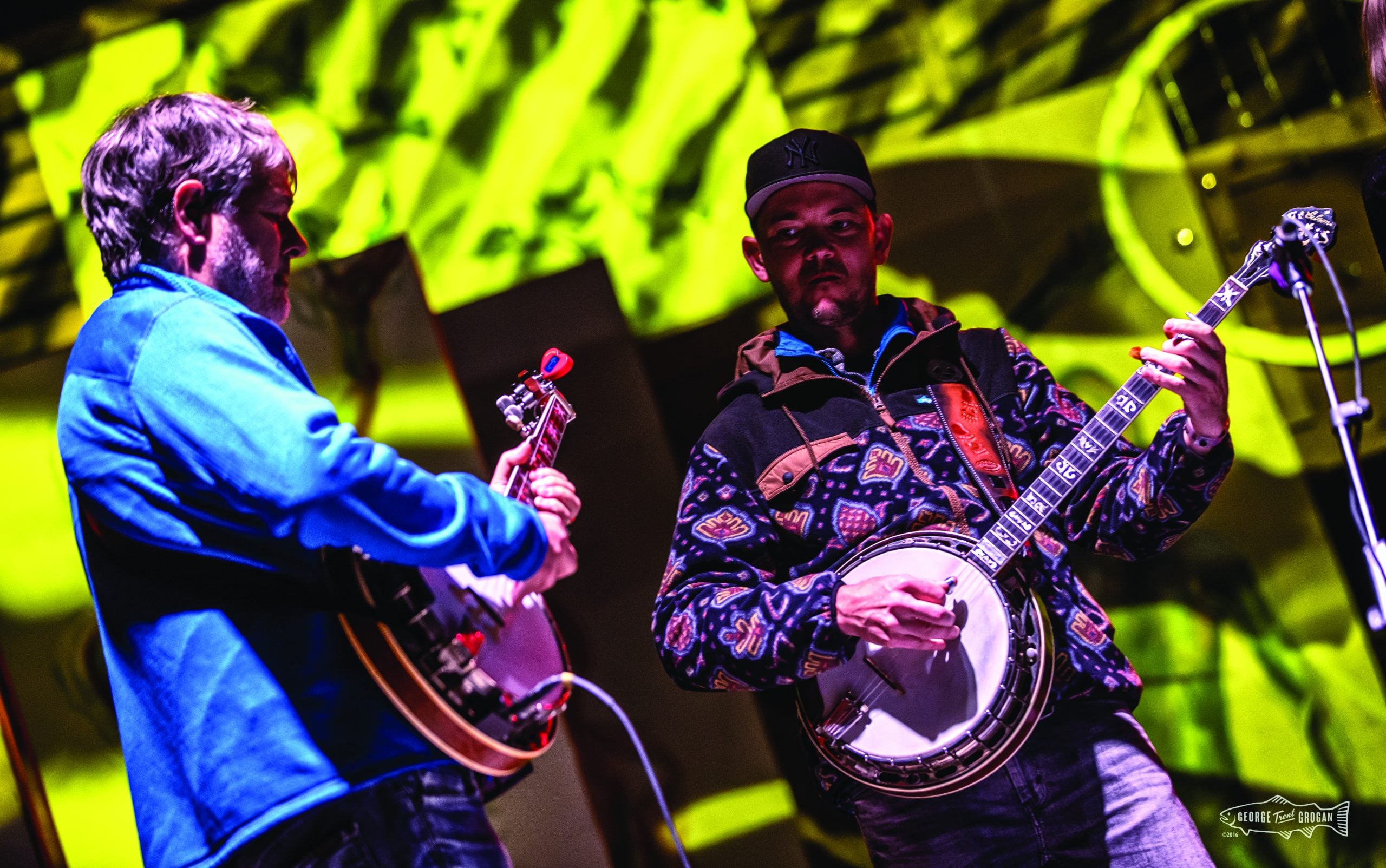
Pandolfi experienced this close-knit nature firsthand when the Stringdusters were starting out as a band in 2007. Despite having, a sound that is undeniably bluegrass with its instrumentation, songs, vocal style, and winning three IBMA awards in 2007 soon after starting, the Stringdusters with their adventurous sound and non-traditional look started feeling pressure to define exactly what they did and who they were, especially as they began to broaden their fanbase by playing alongside more rock-aligned bands. This was a struggle for the young band as Pandolfi says they were, “born in bluegrass,” and set out on a specific path following a more traditional plan with the gigs they played and audiences they were exposed to. “Because of our roots we were initially chasing something more traditional because that is what we observed. We definitely got some pushback, and it is an interesting and complex topic,” Pandolfi says.
“What is that pushback? You hear those voices; bluegrass is a very small and tight-knit world and when we were getting our start the music was in a very different place. When you are in a bluegrass band starting out now there are all these paths cut by bands like Yonder Mountain String Band, Leftover Salmon, the String Cheese Incident, trickling down to Greensky Bluegrass, the Dusters, and now we have Billy Strings who is the biggest bluegrass act there has ever been. People are seeing this music presented in a different way and bands are seeing other bands take a path towards success with a different look and feel not present before. When we started out, we had to figure a lot of that out ourselves. I give Yonder, Cheese, and Salmon a lot of credit for being influential, but still, from our experience it was not an obvious path to success and sustainability when we started. We didn’t have those things as influences so we were more in the bluegrass world in those initial years and I think coming back to this idea of push back we felt and heard that from other traditional bands that were experiencing the same thing.”
Following a tour with Railroad Earth early in their career, Pandolfi says, “that really changed everything for us,” he was inspired to put pen to paper and crafted the Bluegrass Manifesto, what he describes as a “message to the traditional world, that bluegrass is evolving and changing,” and declaring “it is in the music’s best interests to embrace these more progressive forms.” This led to him being invited to speak further about the evolution of bluegrass as the keynote speaker at the 2011 IBMA’s. In his keynote address Pandolfi argued the evolution of bluegrass and its acceptance by both fans and the industry will ultimately be what helps bluegrass in all its forms, from the traditional to the progressive, to survive and thrive.
This leads to the question as the sound changes, grows, and evolves, what is it that defines bluegrass? For Pandolfi it is clear what defines bluegrass. “It’s related to the playing and singing style, not to the repertoire. If you have an Elton John cover or a Metallica cover, but done with really solid rolling three-finger banjo, mandolin chopping on the back beat and playing sixteenth notes solos, the bass playing the down beat, and the guitar strumming the rhythm, those are the fundamental aspects of bluegrass. It doesn’t have to be ‘Blue Ridge Cabin Home,’ it does not have to be ‘Foggy Mountain Breakdown.’ “If it is presented in the styles that the early players pioneered, the specific instrumental and vocal styles, that is what is alive about bluegrass, and determines if something is bluegrass in my mind. Moving forward, it’s all about applying the fundamentals of those older styles to newer repertoire.”
Over the years there has been a slow “changing of the guard,” with new fans coming into the music who often do not have the same family or cultural connection so common previously. This has allowed fans to not feel excluded for their lack of personal history with genre. This rise of bands who have ditched some of the more conservative values of the genre, such as dressing in suits, instead opting for a more casual laid-back style has allowed a new generation of fans to look to the stage and see someone they can relate to more, someone who looks more like them, and perhaps shares similar qualities and values. “Perception by fans is a huge factor when it comes to how open the door is to appreciation for something new,” says Pandolfi. “People see something they can relate to on stage and that comes from how people look and how they talk. Something as simple as wearing a tie-dye shirt can open the door to connect with someone. We are all drawn to things we can relate to and now bluegrass is packaged in this new modern form and it goes far beyond music. It has almost been reborn and recreated in this modern image.”

This connection has opened the door for many new fans to the genre who come to the music with little preconceived notion of how it should sound, with little to judge it against, and able to appreciate it on its own merits. This has allowed a brand-new interpretation of the music from artists who are bringing their own individual style and background to bluegrass. They can leave their own distinctive imprint on the sound much as Earl Scruggs and Ralph Stanley or any of the other first generations of pickers did. Pandolfi says when you see that from an artist, “Whether it’s Earl Scruggs or one of these modern bands, that is the compelling thing about the music, and is the thing drawing new people in. The music is evolving and appealing to new people and bringing in new fans.”
As bluegrass has become more open to a new generation of bands sounds, it has allowed bands to reconnect with those roots in a way maybe not possible before. For the Stringdusters it was in the recording of their tribute to Bill Monroe (which ironically does not feature any mandolin.) “I think one of my proudest moments of our career was getting the Grammy nomination for the Bill Monroe tribute,” says Pandolfi. “I felt the project pays such respect to the forefathers of the music and will introduce the music to so many new ears through a more progressive avenue running from Bill Monroe, to Flatt & Scruggs, to the Stanley Brothers, and the other incredible soulful bands who started this music. It was us sort of walking the walk and paying respect while putting our own spin on things and introducing people to the older form of the music but still doing something we felt was quintessentially the Stringdusters. We didn’t do that project because we thought we should, we did that project because we love the music and it is one more link in the chain of this evolution of the music and the reverence for all the people coming before and paved the path we all walk on now.”
Pandolfi says the Monroe album was not one the Stringdusters would have taken on earlier in their career, but something the band felt comfortable with now because of not only their evolution within bluegrass, which has seen them able to keep their traditional roots but branch out in new inventive directions, but because of the changing nature of bluegrass, saying, “I think it is indicative of the growth of the music.” For a generation of progressive, forward-thinking bands like the Stringdusters, Leftover Salmon, and Yonder Mountain String Band they have long relied on a trove of traditional songs as part of their sets, which despite their progressive instincts, served to not only maintain their connection to the roots of bluegrass but help introduce new fans to those roots.
Current bluegrass superstar Billy Strings has continued this trend as he regularly includes multiple traditional songs from across the bluegrass spectrum in his set every night. This inclusion of traditional songs excites Pandolfi, “These days bluegrass is more popular than it has ever been. That has not always been the case and shows the evolution of the music is really the thing above all else that will keep the music alive. While I agree the influence of the songs are there and trends are changing, people are writing their own songs and bringing their own songs to the table, it can be argued the old songs are being presented better now than ever before. That evolution and process of introducing people to the music that’s the natural order of things and the natural progression of music. Those people can put their own stamp on it and that is what is keeping the genre alive.”
The next generation of bluegrass stars has Pandolfi positive about the future of the genre. The way they are combining their own unique journeys with their varying musical influences, influences often falling outside the traditional bounds of the music, to create the ever-evolving sound of bluegrass portends a bright future. “I think the music gets more convincing as you get more young artists with their own visions coming into the scene,” says Pandolfi, “and again that’s the gateway to draw people in. To answer the question of what will happen to bluegrass, I firmly believe traditional bluegrass will be around forevermore simply because it’s such powerful music, in all its different iterations. The elements that made it powerful at its inception are so well represented in the popular, modern bands at the forefront of the music today, ensuring that the legacy of all forms of bluegrass music will continue to thrive.”