

Zoe & Cloyd
Vibrant Branches Sprout From Deep Roots
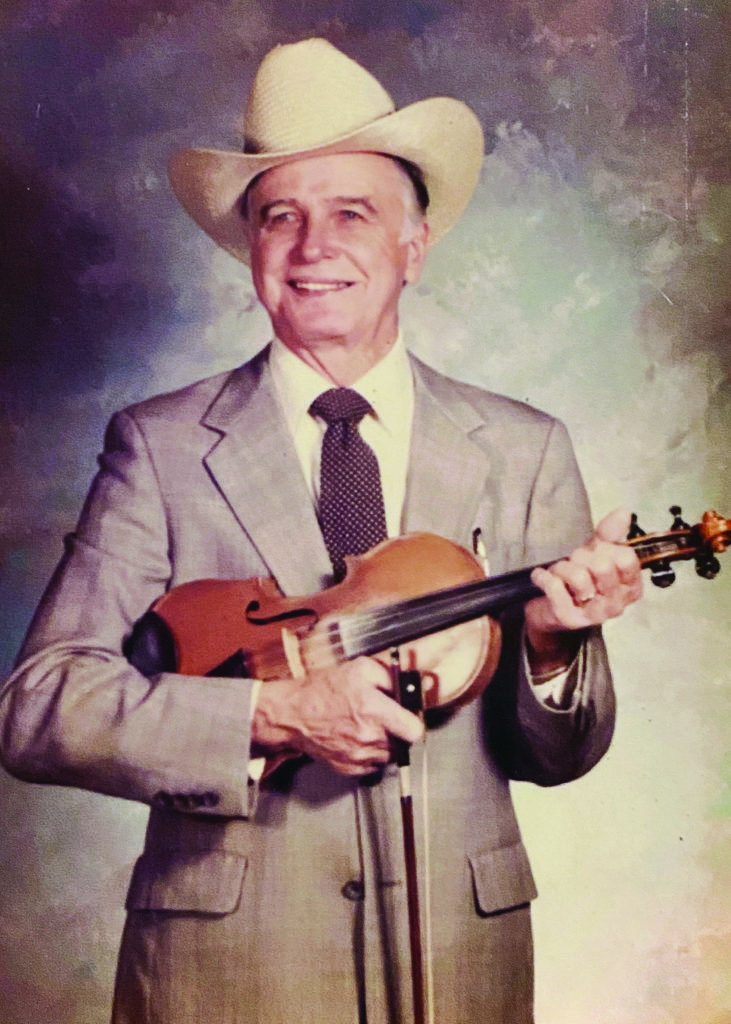
Married partners Natalya Zoe Weinstein and John Cloyd Miller are living proof that music brings people from vastly different backgrounds and geographical regions together, and that the result can be an amazingly rich creative collaboration. Natalya grew up in the college town of Amherst, Massachusetts, with a violinist mother and a piano-playing father. Her grandfather, David Weinstein, was a professional klezmer musician. John was raised in Hickory, North Carolina, a town historically known for furniture manufacturing, nestled at the foot of the Blue Ridge Mountains. He is the grandson of pioneering bluegrass fiddler Jim Shumate, who toured with Bill Monroe and was the original fiddle player with Flatt & Scruggs.
Natalya and John first met and played music together in 2005, at a party in Asheville, North Carolina. Soon they were performing together, first in a bluegrass band called Lo-Fi Breakdown and then in the Americana trio Red June, with singer/songwriter and resophonic guitar player Will Straughan. In 2015, Straughan moved on to start a non-profit organization, while John and Natalya started a family, with the birth of their daughter, and reinvented themselves musically as Zoe & Cloyd (their middle names). They decided, John says, “to strip it down to the roots and see what grows out of it.” Those roots led directly to their grandfathers.
Over time, the duo’s journey to explore, incorporate, and express their musical heritages has fostered the creation of a unique, diverse sound of their own that is both traditional and revolutionary. Now, after eight years and four groundbreaking albums, Zoe & Cloyd are shining the spotlight on the men who inspired them, with Songs of Our Grandfathers, a collection of songs and tunes from the repertoires of David Weinstein and Jim Shumate.
Natalya explains, “From the inception of Zoe & Cloyd, we have known that those influences are really important parts of our identities, but we had to lay the foundation with our own music first. Now that we’ve established ourselves as musicians, we can dig deeper into those legacies and bring them into focus in a new way.”
Both Natalya and John were exposed to and interested in music from an early age. Natalya was classically trained, while John was largely self-taught. Natalya’s mother played violin in a string quartet, performing at weddings and other social occasions. Her father played jazz piano and her grandfather played clarinet, flute, and saxophone. Natalya’s own moment of inspiration came at age five. “I went to a birthday party and I saw this other little girl playing the violin, and I said, ‘I want to do that!’ So my mother started me on Suzuki violin. I studied classical music for fifteen years. I was doing private violin lessons and orchestra, and then I did orchestra in college at the University of Massachusetts, but I did not finish my music minor.”
She chose, instead, to minor in anthropology. Still, music played an important role in her self-created major, which she called Social Justice Through the Arts. “It sort of combined teaching music with history,” she explains. “I was working with a community of Irish and Puerto Rican and African American violin students, using folk music in those traditions to connect with their stories and their heritage. That was my undergraduate thesis project.”
Natalya’s bluegrass epiphany came unexpectedly when she was at an anthropology conference in Tacoma, Washington. “I happened to be in this hotel right next to where the WinterGrass festival was held, and a guy came up to me in the lobby and offered me a free ticket. So I go with him over to WinterGrass, and there’s people jamming everywhere. Somebody gave me a fiddle, and by that time I had met a few people in college that played fiddle tunes, so I knew a basic repertoire. I remember jamming with these people I had never met before, and my mind was blown. The community element of it just really moved me, and I was hooked!”
After that, she formed a band with some college friends, playing folk, old-time, and “Garcia-Grisman-type stuff.” Following her graduation from college, Natalya’s newfound passion for traditional music prompted her to move to Asheville in 2004. “I really wanted to learn about bluegrass and old-time music from the source,” she says. “I wanted to come to the heart of the region, to learn from older musicians. [Fiddler] Arvil Freeman was a big influence. I played a lot with Riley Baugus and some of the old-time people in town, like Trevor and Travis Stuart and John Herrmann. And, then, of course, Jim Shumate was another big influence.”
After meeting John in 2005, Natalya got to know his grandfather, Jim Shumate, who passed away in 2013 at age 91. “We used to play with him,” she remembers. “Every time we’d go to visit him, he’d say, ‘Did you bring your fiddles and banjers?’” John adds, “They got to play together for about eight years. She learned a lot about bluesiness and syncopation from him, because he was a real master of that. When I first met Natalya, she was a stiffer player; you could tell she had a classical background. Being able to play with somebody as loose as Jim really helped her.”
Although he recalls hearing his grandpa Jim always playing fiddle around the house, John did not gravitate toward playing bluegrass himself until after college. As a child in the 1970s and ‘80s, he took piano lessons, sang in church and in a school chorus. While in high school, he played drums in a rock band, and began learning to play guitar. He may not have been playing bluegrass at that time, but he was paying attention to what his grandfather was doing. “Jim had taken a break from recording for a couple of decades, but he did a record in 1980 called Bluegrass Fiddle Supreme. Then, in the nineties, he did five recordings for Heritage Records. The first one was in 1991, so I was a senior in high school. As I was coming of age musically, he was recording a lot, so that was a formative time for me.”
In the 1990s, John attended Appalachian State University in Boone, North Carolina, majoring in anthropology. “I moved out west after that, and worked [in the outdoor industry] in Utah for seven years,” he says. “I was working with some guys that were really into bluegrass and old-time music, so we bonded over our love for those things and started playing a lot. I joined a band called Lo-Fi Breakdown. I was the main singer and songwriter, and also played mandolin.
“I came back to North Carolina in 2004,” he continues. “One of the reasons was that my grandparents’ generation was getting older and I wanted to spend more time with them.” When John moved back, his bandmates came along. Natalya joined the group in 2006. Initially, John was managing an outdoor store in Black Mountain, near Asheville, and playing music on the side. But once Lo-Fi Breakdown disbanded and he and Natalya joined with Will Straughan to form Red June, he dove into music full-time. In 2010, John and Natalya were married.
Red June toured together from 2009 through 2014, recording two self-produced albums, Remember Me Well, Beauty Will Come, and a third, Ancient Dreams, for Asheville’s Organic Records. The trio soon became regulars at such venues as MerleFest, the Americana Music Association conference, and Music City Roots. In 2013, John won first place in the bluegrass category at MerleFest’s Chris Austin Songwriting Contest with his song, “Cloud of Dust,” from the Beauty Will Come album. He also received a songwriting fellowship from the North Carolina Arts Council.
John has been writing songs for more than twenty-five years. “I got into it when I really started playing,” he says. “It all kind of went together. I used to write poetry, and I’ve always been a person who wrote things down and had a lot to say, so it was just a natural expression. Jim was a songwriter, and he was one of my main musical influences. His music, the bluesiness, the soulfulness of it, was the blueprint for me. Music has to be emotive for me. I identify as being more of a singer and songwriter [than a picker].”
The songwriting process is unpredictable, he says. “Sometimes a lick or a melody or a rhythm will come into my head and I’ll use that as a ‘song seed.’ Other times it’ll be a line or a little thing somebody says or an idea. I have a list of song titles that I carry around with me.” Sometimes John and Natalya collaborate. “Oftentimes something will come to me, a little lick or a line, and I’ll say, ‘OK, go write that song,’” Natalya reflects. “He’ll write it, and then I’ll usually help finalize it. I have more music theory background, so I help arrange it and help with the chord structure, but John’s definitely the lyricist of the group.” John adds, “I think one of my strengths in songwriting is feel and phrasing. But we bounce a lot of stuff off each other. She always has really great ideas.”
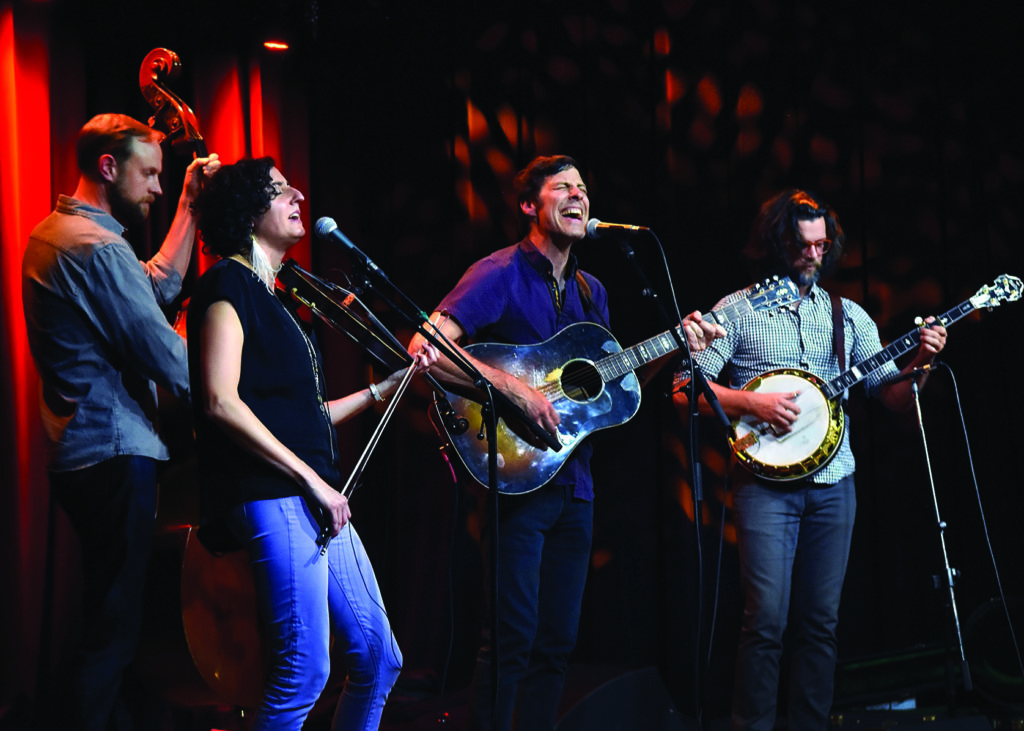
Many of John’s songs are topical, referencing themes that are playing out in the world. “I do come at songwriting from a bit more of a modern perspective,” he confirms. “I think that songwriters have a responsibility to cast light on feelings or issues in our time. I try to write in a style that fits with bluegrass instrumentation. I do like being true to the roots of the music.” Natalya notes, “Often John is feeling a certain way, so he writes a song. ‘Looking Out For You and Me,’ he wrote one day when he was feeling upset about the way that companies were treating the environment. ‘Rising Waters,’ he wrote that on a day when he was driving to work through waters that were rising up around the car. ‘Neighbor’ is kind of a universal song that people everywhere have really responded to and connected with. And something like that is also a way to bring people into the fold that don’t necessarily think they’re a fan of bluegrass.”
In 2013, John began teaching mandolin and clawhammer banjo at Warren Wilson College in Swannanoa. (He later added string band and songwriting to his course offerings.) That same fall, Natalya enrolled in a masters degree program at Appalachian State University. Her thesis was titled “Jim Shumate and the Development of Bluegrass Fiddling.” She explains, “I’m a teacher, and I wanted to know more about the region, so I decided to enroll in the Appalachian Studies program. It seemed natural to focus on the development of bluegrass, and specifically Jim, because his story hadn’t really been told before. He passed away in October of 2013, right before I was going to start the interviews, so I ended up interviewing his wife Naomi, and I got so much great information. I had a video from the Bluegrass Museum that told his story, but it was really interesting to hear her perspective.”
While in graduate school, Natalya took a class on Appalachian literature, and one of the assignments was to do a family history project. “It was during that class that I ended up digging into my family story,” she says. “My grandfather has an interesting musical story as well, and I hadn’t really explored it much.”
Natalya’s Jewish grandfather, David Weinstein, fled Russia after World War I and spent several years in Argentina before arriving at New York’s Ellis Island on July 9, 1923. (Mandolin aficionados may recognize that as the production date on Bill Monroe’s Lloyd Loar mandolin.) Weinstein was a professional klezmer musician who lived in Philadelphia. He passed away when Natalya was eleven, so she never heard him play and barely remembers him. And so she was thrilled several years ago when her father gave her some of David’s notebooks of handwritten sheet music. “We have about five of these little notebooks,” she says, “and they’re a mixture of different styles. There’s klezmer stuff, there’s tango and mambo, ‘Tennessee Waltz’ makes an appearance, there’s some jazz standards, and popular tunes of the time.” John adds, “It’s been really fun to dig through these tunes. A lot of the music is really obscure. So many of the klezmer songs didn’t even have names. It’s like a sleuthing project.”
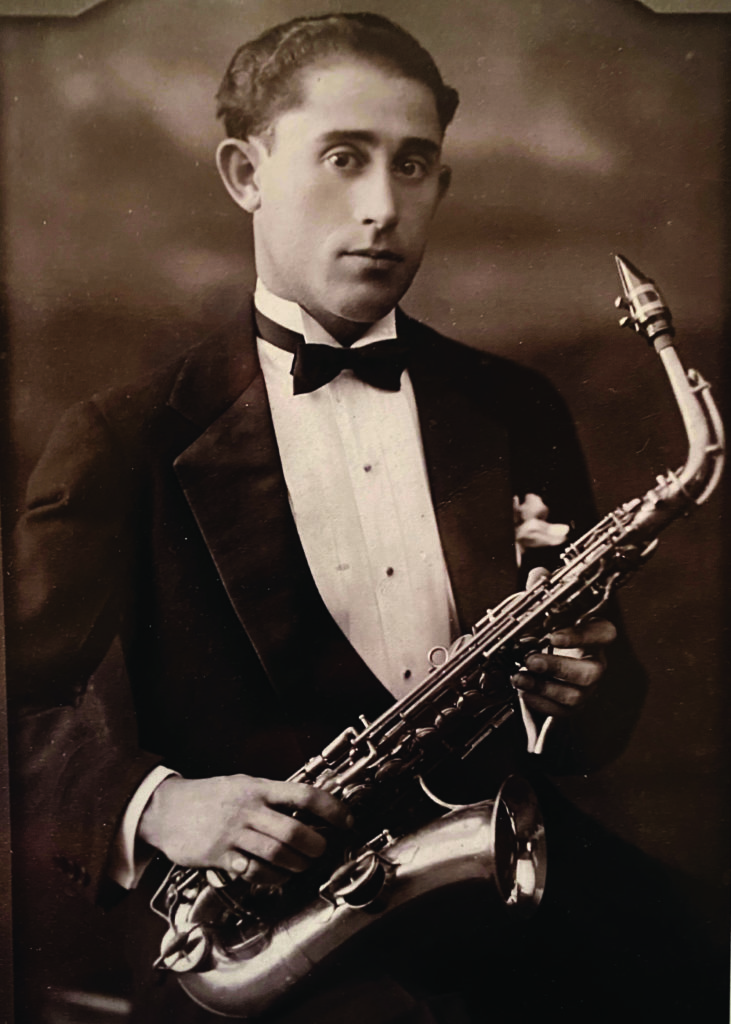
From the beginning, Zoe & Cloyd have included klezmer music in their repertoire. What exactly is klezmer music? “Often I’ll introduce it as Jewish folk music which originated in Eastern Europe and traveled throughout the Jewish diaspora as people immigrated to different areas,” Natalya says. “It originated as instrumental celebration music for weddings and special religious holidays, but klezmer musicians played a variety of different styles. They weren’t just playing for Jewish audiences, so they would incorporate anything from Romanian dances to polkas. Klezmer is often characterized by types of rhythm or dances, [such as] bulgar, frailach, hora.”
Although klezmer and bluegrass have different origins, there are actually many similarities. Both are types of folk music originally tied to a geographical region and taught generationally through oral traditions. Both are played at community gatherings, celebrations, and dances. Both feature various lead instruments in turn, and both are improvisational and very evocative. John points out, “One of the things that attracts everybody to bluegrass is that it’s powerful, it digs into emotions. Klezmer music is like that, too. The fiddle or the clarinet will evoke different kinds of emotions, and often they try to mimic the human voice, with crying or wailing or yipping or laughing. It’s just about the human experience.”
In fact, as former Blue Grass Boy Gene Lowinger details in his book, I Hear a Voice Calling; A Bluegrass Memoir, Bill Monroe was interested in and influenced by klezmer music. Lowinger, who is Jewish, recalled that Monroe once asked to accompany him to synagogue. After the service, which included music, Monroe thanked the rabbi and said, “I really liked the songs, and I’m gonna find a way to use some of those notes in my music.” Years later, Monroe played Lowinger a tune he had written, called “Lonesome Moonlight Waltz,” which he said had “a lot of Jewish notes in it.”
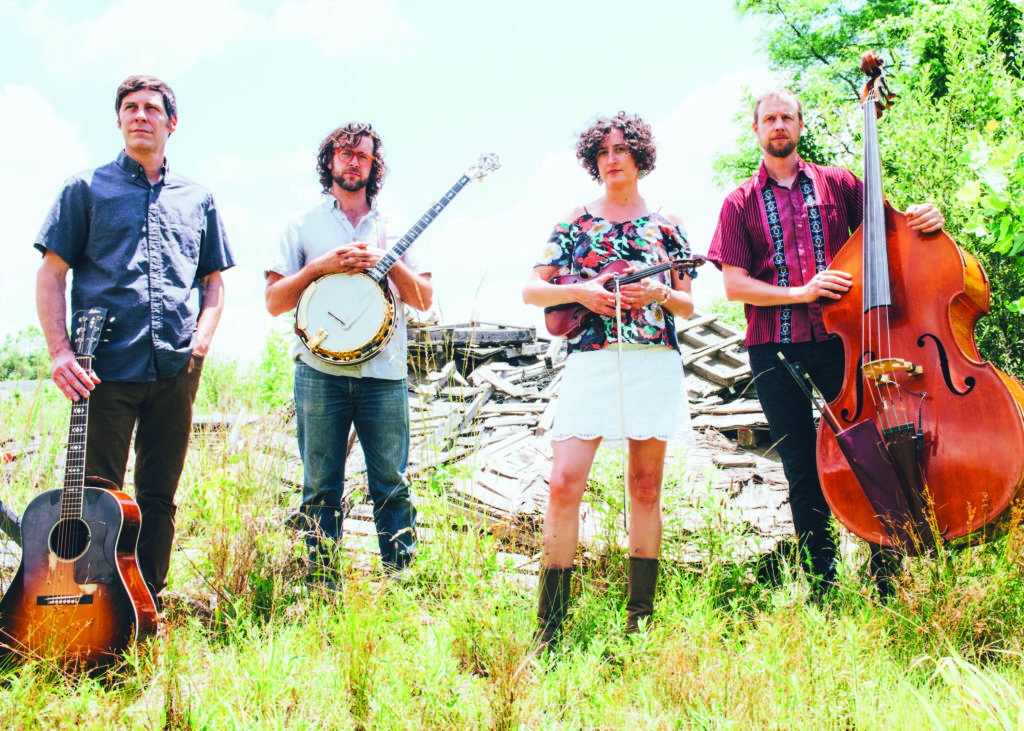
After two self-produced recordings (Equinox, 2015 and Eyes Brand New, 2017), Zoe & Cloyd signed with Organic Records, releasing I Am Your Neighbor in 2019 and Rebuild in 2021. Their fifth album, Songs of Our Grandfathers, will be released on May 19, 2023. While Equinox was a stripped-down duet album, on Eyes Brand New they were accompanied by Will Straughan on resophonic guitar, Jens Kruger on banjo, and their long-time friend and collaborator Kevin Kehrberg on bass. Kevin is the chair of the music department at Warren Wilson College, where John and Natalya both now teach. To date, they have recorded all of their Organic releases with Kevin on bass, Bennett Sullivan on banjo, and Jon Weisberger as producer.
“Bennett is a brilliant instrumentalist, can play just about anything on the banjo,” John says. “He can play guitar and mandolin like that, too. We’ve also been playing a lot with Ben Krakauer. He’s a stellar banjo/guitar player and composer with a wonderful jazzy style.” Natalya adds, “Kevin’s a phenomenal musician that we’ve admired for a long time. He’s such a solid rhythm player, but he also does interesting fills ,and he’s such an engaged player. We absolutely love what he brings. Jon Weisberger has been a big supporter of our music and has helped to bring our ideas to life in the studio.
“John and Natalya are great musicians and great to work with,” says Weisberger. “In my view, Songs of Our Grandfathers marks a big step forward for them in terms of finding a unique and also completely authentic musical voice.”
Part of the motivation for releasing Songs of Our Grandfathers now is the upcoming 100th anniversary of David Weinstein’s arrival in the United States. The project was inspired by the 1995 release, Songs of Our Fathers, a collection of klezmer music by David Grisman and Andy Statman. “On a whim,” Natalya emailed Statman and asked if he would consider participating in the new recording. He responded immediately and agreed to play clarinet and mandolin on several songs. “He’s been a real asset,” she says. “He has an amazing wealth of knowledge. It’s been cool to hear Andy’s clarinet on the recordings and make the connection through Andy back to [my grandfather’s] music.”
Among the klezmer songs and tunes taken from David Weinstein’s repertoire is the jazzy “Bei Mir Bistu Sheyn” (translation: “To Me You Are Beautiful), which was made popular by the Andrews Sisters in the late 1930s. They sang it in English, but Natalya learned the Yiddish words for this recording. “Bulgar Sigansky” was one of the first singles from the project, released in September 2022. It combines Andy Statman’s soaring clarinet and Natalya’s poignant fiddle with Bennett’s nimble melodic banjo picking—a mix that Natalya refers to as “klezgrass.” Statman is also featured on “Ich Benk Noch Mein Shtetele,” which translates to “I Long For My Little Town.” The syncopated rhythm of “Klezmer Clave Medley” likely reflects the Latin influence in Weinstein’s music. “Misirlou” is a famous tune with Turkish and Greek roots that gives everyone a chance to shine instrumentally.
The other single released in September, “Rainbow of My Dreams” is an obscure song written by Tommy Scott that Flatt & Scruggs performed live at WCYB radio in Bristol in 1948, but never commercially recorded. On the radio transcription, Jim Shumate played all of the breaks in his distinct, “greasy” style, which Natalya replicates admirably. “That was a tough break to learn,” she laughs. “He is just sliding all around, and used a lot of double-stops.” Also harkening back to Shumate’s time with Flatt & Scruggs is “We’ll Meet Again Sweetheart,” which highlights John’s expressive, clear lead vocal and Natalya’s sweet harmony. Andy Statman’s mandolin playing is featured on “Rocky Road Blues,” from Shumate’s time with Monroe, and “Up and At ‘Em,” a driving Shumate fiddle tune. “Buckle Up the Backstrap” is an old-timey Shumate composition, updated with a modern twist. The gospel quartet, “Old Country Baptizing,” one of Shumate’s best-known and most popular originals, features John on mandolin.
For Zoe & Cloyd, Songs of Our Grandfathers seems to be both reflective and dynamic; a celebration of where they come from and of their own growth as musicians. “I think this record is a good snapshot of both [Jim’s and David’s] musical legacies,” John says. “We’re definitely staying true to the roots, but we do it in our own way.”
The duo’s well-crafted combination of traditional and original styles continues to win them high praise. Among their ardent fans is Bluegrass Hall of Fame member Alice Gerrard, who says, “Zoe & Cloyd (Natalya and John) are two of my favorite musicians; creative, strongly linked to tradition, and it shows mightily in their music. John writes wonderful songs and they play up a storm on fiddle, mandolin, and guitar. And they can sing! I’ve known them for years and they just continue to get better and better, blending seamlessly both instrumentally and vocally. Love them both!”