
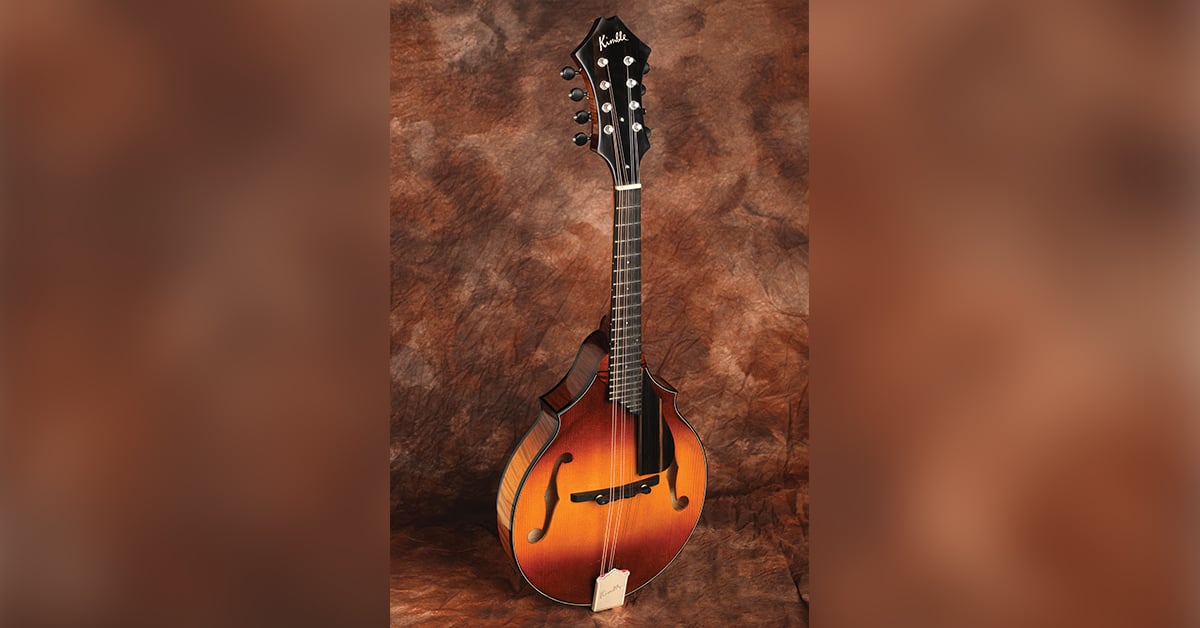
Will Kimble J Model Mandolin
Photos By Bud Osborne
Modern bluegrass mandolin players differ in many ways from their predecessors. Emerging players are more open to non-conventional bluegrass instruments, such as the lightweight Nechville banjo or the thin-bodied Bourgeois Guitars Odyssey Dreadnought played on stage by Andy Falco. Even Monroe acolyte Andy Statman joined that trend several years ago when he played a Kimble J, a two-point mandolin, instead of an F-5 for multiple projects and performances. (Current Kimble players include Mike Gugino, Nathan Livers and Phil Barker.)
Sitting in the middle of Will Kimble’s mandolin line-up between the traditional A-5 and F-5 style instruments we find his elegant, classically proportioned, J Model. This symmetrical two-point design echos classical mandolins from Lyon & Healy, among others. While the extra points do not add as much mass to the J body as the points and scroll of an F-5 do, that extra material certainly imparts a good bit of throaty bass and punchy midrange beyond your typical A-style here. This design edge lets the Kimble two-point project a powerful bluegrass chop. Yet it retains the sweetness and effervescent high harmonic response that many mandolinists find in their preferred A models. Think of it as a sonic bridge between the A and F body styles, with elements of both sounds.
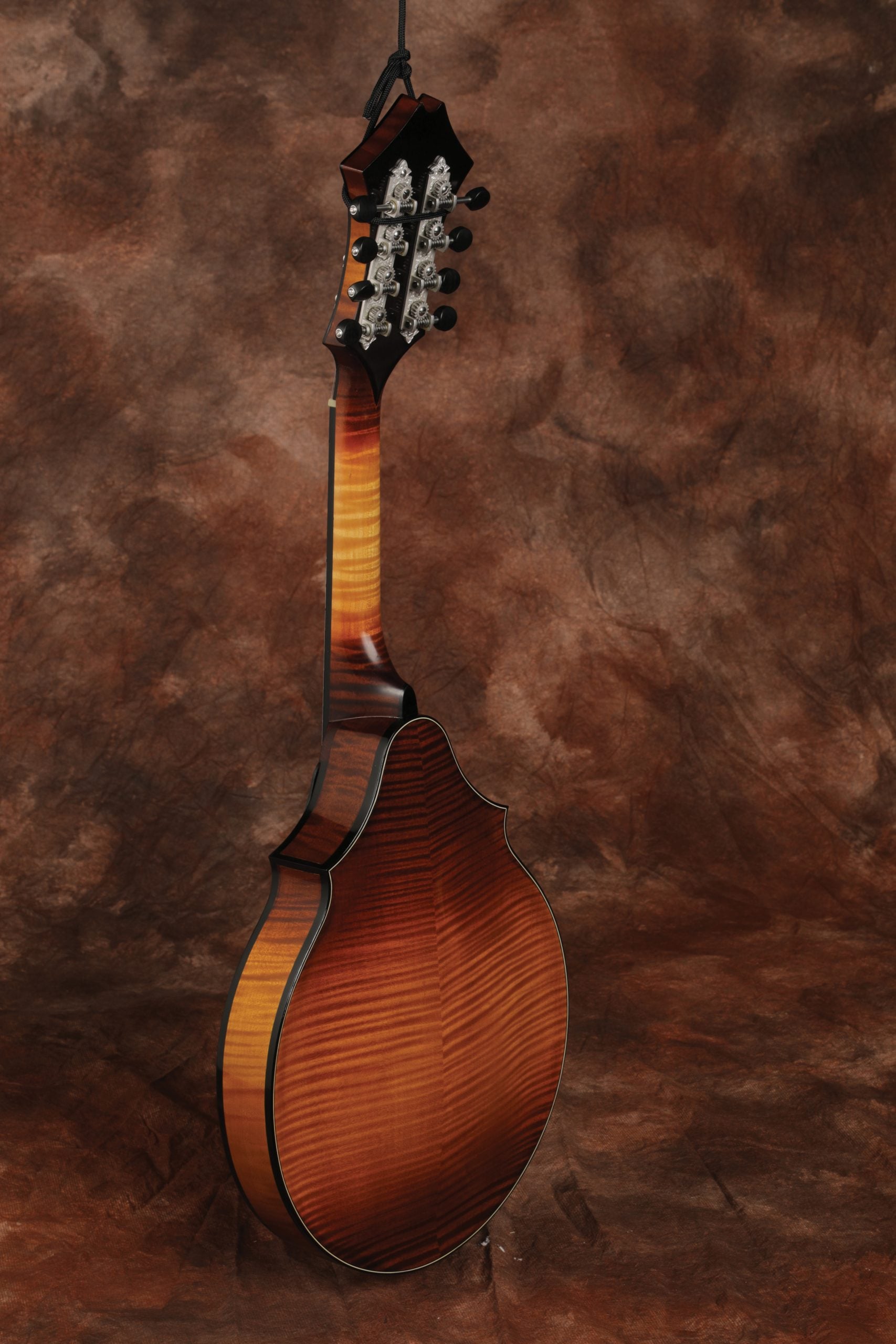
The review instrument, Kimble #282, loaned to Bluegrass Unlimited by the builder, features the popular combination of Adirondack spruce top, sugar maple back and sides, maple neck and ebony fretboard. The hardware is elegant and reserved; nickel Waverly tuners with ebony buttons and a silver James tailpiece engraved with the Kimble logo. The narrow Cumberland Acoustics ebony bridge also sports nickel thumbwheels to complete the subdued, but elegant, motif.
In my opinion, reducing the mandolin’s bling by not going with gold hardware is just what’s needed here, as the top and back staining takes center stage. This mandolin displays a unique, almost brave, color scheme that Kimble calls an homage to the great luthier John Monteleone, who dramatically expanded the boundaries of finish work on mandolins and archtop guitars to high art.
Instead of a typical sunburst, as the photos show Kimble took a daring artistic move on this batch of J models and employed linear coloration. Think “sunstreak” or “sunband” rather than sunburst. The gorgeous colors under its varnish finish create finely graduated colorblocks across the upper and lower sections of both top and back, which are then matched by the neck and headstock stains. It’s a bold, modern choice that should appeal to many contemporary players looking for a mandolin with great visual presence to help them make their mark as an artist. And if the nouveau finish here is not to your liking, Kimble offers a traditional burst on all his instruments
During his long, successful career as an independent luthier, Kimble has refined his appreciation for fine tonewoods and how to shape them into powerful, yet delicately expressive, mandolins. Kimble #282 presents a lovely red spruce top with tightly packed grain lines under the bridge spreading to about 1/8th inch at the wings, just the way many luthiers prefer to use Adirondack. Interestingly, unlike many contemporary builders, Kimble chooses not to use torrefied woods in his instruments. He prefers having his mandolins break in and naturally age to create the sound he chases.
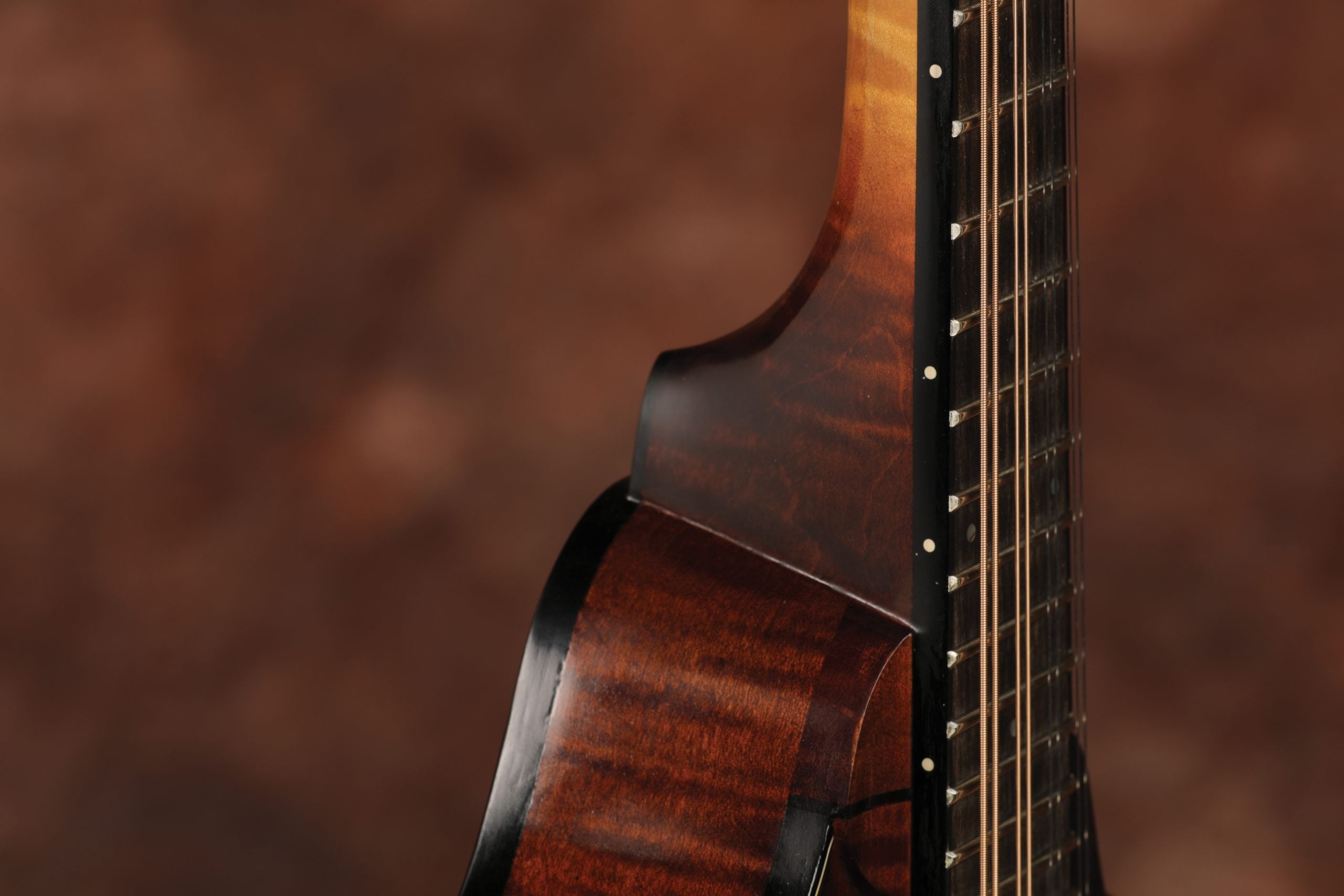
Kimble’s A and J models are $5,400 with HSC, and his F-style instruments sell for $10,900, including Waverly tuners and a Calton case. One key reason for his success is that he’s always focused on building instruments with world-class sound and playability, built in a way he can afford to sell at prices many musicians can afford. To accomplish that, Kimble puts the majority of his time into graduating the top and back, and meticulously voicing both soundboards and the braces to bring the absolute best out of his materials. As a result, compared to works of wooden art like Nugget and Gilchrist mandolins, Kimble #282 may display a few minor, imperfect details that have no impact on sound or playability. For example, the binding on both top points show a visible gap where the mitre wasn’t matched perfectly. There’s a thin, but noticeable, glue line at the heel on both sides where the neck joins the body. But aside from that and a few traces of orange peel finish on the sides of the f-holes, a close examination reveals an instrument made to a very high professional level everywhere it counts. As a good player himself, Will Kimble also does excellent instrument set-up, with the paired E and A strings perfectly slotted at the nut and the frets on the nearly flat board dressed to a perfectionist’s ideal.
Kimble has chased the “Loar sound” dragon, refining it into his own sound. I’ve played Loars, and countless F-5s aimed at copying that sound. Although tone rests ultimately with the player, Loar disciples tend to use terms like “strong, dense midrange”, “rich, crystalline highs all the way up the neck” and “a solid and ‘woody’ low end” where you hear the tone of the wood, not the metallic ping of the strings.
The review mandolin definitely ticks those boxes. Double stops in the middle of the neck are thick and quite punchy, perfect for a tune like “Bluegrass Breakdown” or “Happy Birthday, Bill Monroe”. This particular instrument shows a keenly cultivated upper harmonic range that requires careful attention to playing technique, and even pick choice. My usual Blue Chip sounded a bit too brash on the highest notes, while a softer sounding natural pick rounded the tone a bit, making a sweeter sound.
Surviving as an independent luthier for more than two decades means refining both design and fabrication skills to a truly impressive peak. With many more mandolins and mandolas to come, this Will Kimble Model J mandolin shows how well its builder has mastered those skills.
(Fair disclosure: I’ve owned two Kimble mandolins, including the instrument Statman played professionally. My opinions and observations are based objectively on the particular instrument sent for review, as well as my experience knowing Will and playing numerous Kimble instruments.)