What Are They Doing in Heaven Today?
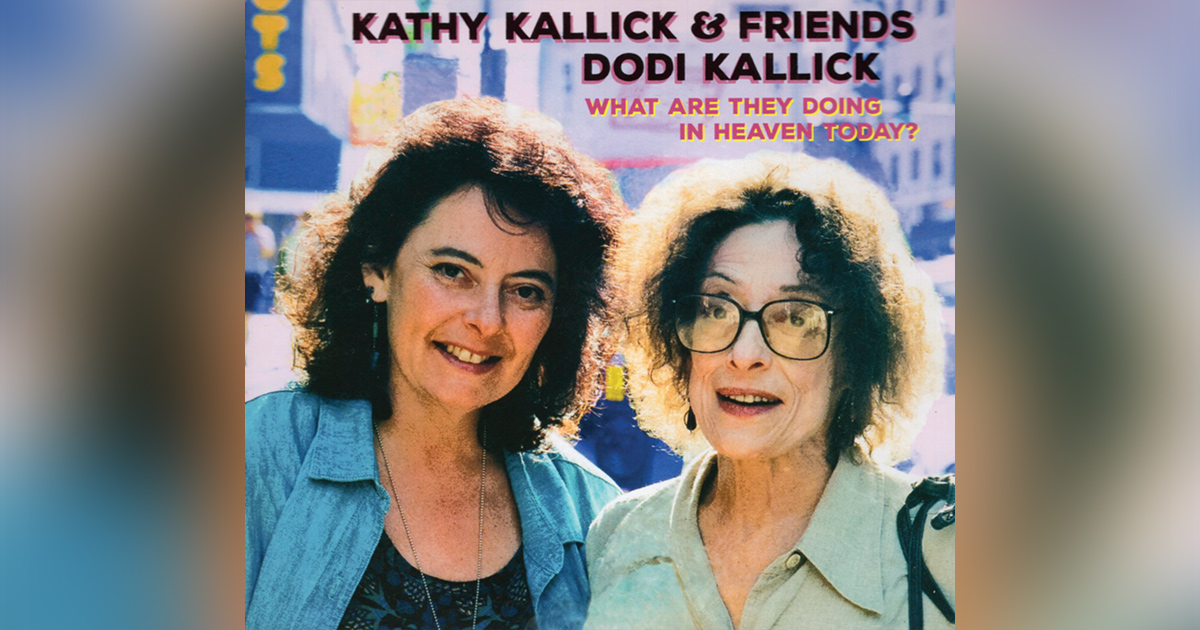
Dodi Kallick, Kathy’s mother, was a prominent folk singer in Chicago in the 1950s and 1960s. Playing guitar and dulcimer to accompany her singing, she was among the handful of performers and enthusiasts who established Chicago as a folk music mecca at the time. She was an early instructor at the Old Town School of Folk Music and often performed on the popular folk music program “Midnight Special” on WFMT-FM. Her performances on What Are They Doing in Heaven Today come from two appearances on “Midnight Special” in 1966 and 1969.
“The album started with me trying to figure out how to present these beautiful archived recordings of my mom done at Chicago’s WFMT radio in the 1960s. I was immediately moved by her performance of ‘What Are They Doing in Heaven Today?’ Her clear, high voice is at its peak, and the expressiveness she sang with swells in this track.
The chance to cover the same song was delicious, and it became the obvious title and theme of the album. When Laurie Lewis, Suzy Thompson and I—whom somehow have never sung together, despite being pals for decades—took our masks off and started playing the tune in Suzy’s backyard, we all knew it was perfect, and all we cried with the impact of getting to sing together after that isolation of the pandemic.
As I chose other songs from my mom’s repertoire to record, they each wound up with their own treatment. Asking Laurel Bliss and Cliff Perry to join me for ‘Little Moses’ was a clear choice, as they are so steeped in the Carter Family. I took the chance to write a new verse and expand on the story a bit, there’s so much in between the baby in the rushes and the Red Sea.
I’d never played with Jim Hurst, but he expressed interest in ‘Jimmy Brown the Newsboy,’ and, wow, what a pleasure to play and sing and get to spend a bit of time with him! His playing was spectacular, complex, and amusing; the best kind of fun.
Getting to collaborate with Molly Tuttle, Tristan Scroggins and Annie Staninec, three of the mightiest young players in our genre, was just as thrilling as anything could be. I grabbed on and went for the wild ride, letting each of them set the pace and tone for their track.
Joe Newberry and Mike Compton have their pretty specific duo thing going, but they opened that up and the three of us had great fun finding our trio on ‘Farther Along.’ It’s a song that means a little something different to each of us, but we found the common thread, the way our music allows for every time.
I love the way the KKB jumps into a bluegrass standard, and they really enlivened ‘Footprints in The Snow,’ with clever references to the older versions as well as newer interpretations. I again took the opportunity to form a new verse, this time using bits from traditional English ballads that pre-date the song we know with a bit of my own language woven in.
Perhaps the most surprising and satisfying track for me is ‘Wild Side of Life/I Didn’t Know God Made Honky-Tonk Angels.’ This was the first time I got to sing with my kids, and they knocked me out! Juniper fronts her own fabulous r&b/funk band and I knew she’d find a great way to launch into Kitty Wells’ answer, leading the lift to the higher key with confidence. None of us have heard Riley sing since her middle school rock band days, so when she sang the first line of that second verse, I was blown away, and her fluid, intuitive understanding of that lower harmony part is just plain magic.
My mom was a warm and magnetic personality and a riveting performer. She could carry the attention of a crowd without over-singing or over-emoting, sometimes bringing her singing down to a near whisper. She held people’s attention with her every word.
It was sweet, and informative, to hear and share my mom’s presentation of a few of the songs I recorded on My Mother’s Voice. ‘Row Us Over the Tide’ was one of her hits, one of those songs that vie for ‘saddest song in the world’ status. The intimacy of quiet dulcimer accompaniment makes this song even more poignant.
The acapella ‘Parting Glass’ has a bit of bleed-through from the disintegration of the reel-to-reel tape. At first, I worried this made the track unsuitable for the CD, but finally, it sounded ghostly and other-worldly, and that felt appropriate for the last track.
In fact, my mother most often performed solo, with subtle dulcimer or guitar accompaniment. The collaboration between her and Hobart Smith may have been at somebody else’s suggestion, but I love the way she matched the fiddle with her singing for ‘Down in the Willow Garden.’
When she led the large group of performers and audience in ‘My Home’s Across the Blue Ridge Mountains,’ I can see her quietly commanding that moment, letting her intentional singing take the lead, and holding the rhythm right where she wanted it. My mom was a force to be reckoned with, and she never let it get away from her. She would have been a heck of a band leader!
It’s taken me all this time to figure out what to do with these recordings, how to present them to the public. When I brought the digitized CDs to her in the nursing home and wanted to play them for her, she was completely uninterested, and said, ‘Leave the past in the past.’
I feel strongly that, if my mom had been performing at a different time, we would have Dodi Kallick recording projects, and she would have been better known and her singing more renowned. The fact that we have these high-quality recordings at all is a gift, and I’m so pleased to share them with you.”
—Kathy Kallick