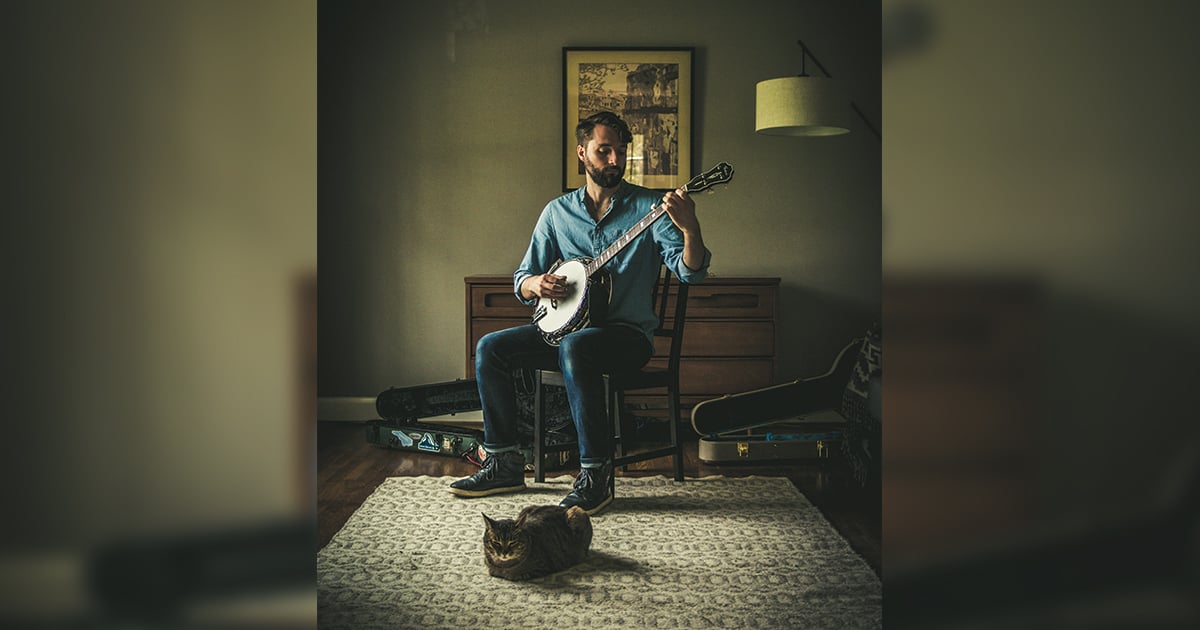
Wes Corbett
Pushing the Envelope
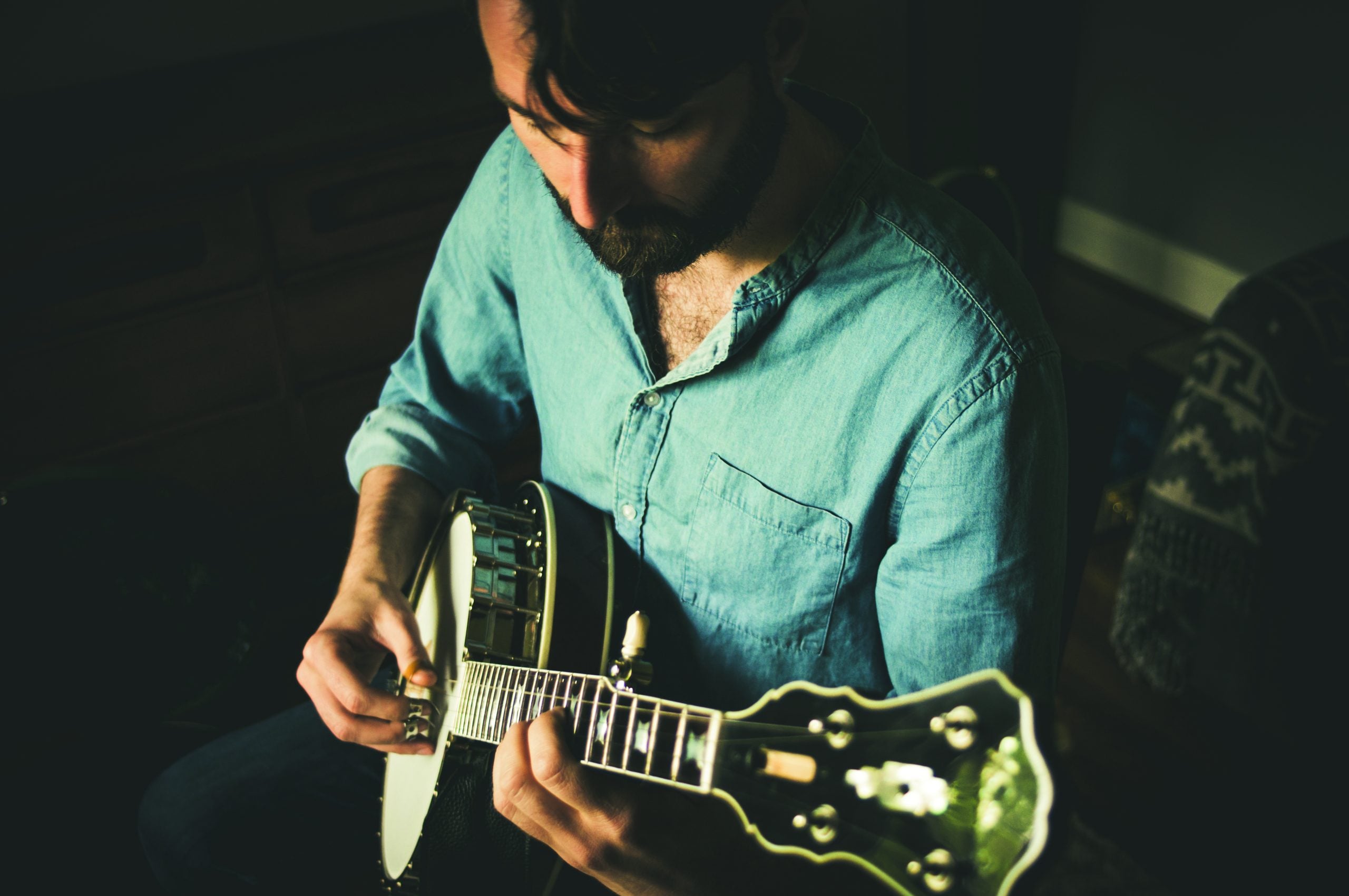
Photos by Kaitlyn Raitz
Growing up on Bainbridge Island, Washington, just west of Seattle, 5-string wizard Wes Corbett had heard bluegrass-style banjo on the radio, most memorably via the Car Talk theme. It didn’t immediately call out to the young, classically-trained pianist. Nor did the vocal strains of the high lonesome sound.
“When I first heard—especially vocal bluegrass—it was pretty jarring. I didn’t really understand it,” Corbett said. “And then it grew on me, to the point where I love it.”
The banjo-inflected sound that initially caught Corbett’s musical ear, at age 14, was Bela Fleck’s 1984 album of duets Double Time. It was the only Fleck recording then in Corbett’s collection, a gift to his brother from a friend, and hearing the banjo maestro play his compositions with a lineup of acoustic instrumental heavyweights like Tony Rice, Edgar Meyer, David Grisman, Mike Marshall, and Mark O’Connor amounted to a musical conversion experience.
Recalling his first encounter with Fleck’s playing Corbett said:
“The sound of the banjo is kind of like a lightning strike for me. The tone of it, and the timing, and way it was being used—the way he used the banjo really grabbed me.”
Before that, the only progressive acoustic music Corbett had heard was on vinyl—a David Grisman Quintet record that he and his brother had found in their parents’ collection.
Fleck’s intricate and inventive playing set Corbett on the road to becoming a highly versatile world-class banjo player. In the years straddling the 2010s he was part of a vanguard of young, virtuoso pickers in the Boston and New York area, some trained in conservatories and music schools, who pushed the envelope of string-band music. They incorporated the cello and even hammered dulcimer into the mix of traditional bluegrass instrumentation and made recordings combining disparate musical styles.
During that time Corbett toured and recorded with the indie-pop grass and chamber grass groups the Bee Eaters and Joy Kills Sorrow, as well as teaching banjo at Boston’s Berklee College of Music. But recently Corbett has been taking his talents in new directions, shifting from the experimental edges of what the Keepers of the Genres might call bluegrass a little closer to the music’s roots.
After a 2015 move to Nashville, where his wife was pursuing a nurse practitioner degree at Vanderbilt, he toured with IBMA-award winning guitarist Molly Tuttle in the Molly Tuttle Band, a stint that he said gave him a chance to focus more on the traditional side of the banjo.
“It really helped me solidify my bluegrass playing in ways that I’d just never quite had the opportunity to do because the bands I’d been in up to that point just weren’t bluegrass bands,” he said.
In January 2020, mandolin master Sam Bush hired Corbett to replace his long-time banjo ace Scott Vestal, publicly welcoming Corbett to the legendary band in a video in which Bush presents Corbett with a stunning pink cowboy hat with sparkly silver filigree, a hat that is traditionally passed down to the newest member of the group, according to Bush. “It’s gonna look great on you,” says bassist Tod Parks, its former custodian. “That’s beautiful,” Corbett graciously responds as a deadpan Bush ceremonially hands him the gaudy badge of belonging.
With limited time to learn the Sam Bush Band’s sizable song catalog before the pandemic-abbreviated 2020 touring season was to begin, Corbett said he played along with the band’s recordings, focusing in part on his intention to stay loose during live performances.
“Whenever I was playing along with (the Sam Bush Band) recordings I was actively imagining that I was on stage and also really trying to make sure that I was using myself the way that I would hope to when I was on stage. That’s the first time that I’ve been able to apply that concept unilaterally to an entire catalog of material I was going to need to play, and it worked pretty well.”
“Also that band just makes everything so easy,” Corbett said. “Their timing—everybody’s listening all the time. They all have such amazing rhythm but they’re also really generous in how they adjust it to what’s going on. It’s hard to disassociate me practicing in that way with playing with one of the most epic bluegrass grooves of all time.”
Corbett says he had met Bush briefly before but first played with him at an all-day recording session for the Nefesh Mountain Band at the Sound Emporium in Nashville, where the two were positioned across from one another in the big live room. “We just really connected, had a ton of fun,” Corbett says. “And then it turned out that the banjo slot was opening up and he actually asked me for my phone number that day at the end of the day.”
A week later Bush called with an offer. “My wife and I live about four blocks away from Paul Kowert and Brittany Haas in East Nashville and we were walking over to their place to have a cocktail and Sam called me on the walk over.”
Daybreak
Though he now plays in one of the world’s top bluegrass-inspired acts, Corbett’s musical journey started out with classical piano. His parents say he emerged from the womb humming, and his family, noting his incipient musicality, found him a Suzuki piano teacher, Peggy Swingle, on Washington’s Bainbridge Island, when he was two-and-a-half. From near infancy until his teen years, he grew up surrounded by and playing classical music. For a time, he considered a career as a solo classical pianist
“I was very privileged in that I grew up in a family that wanted to encourage my musicality and also had the means to do so,” Corbett said, noting that his maternal grandfather was a classical conductor and head of the music department at Ohio Wesleyan University.
Yet as Corbett approached his high school years a key connection was missing for him. He realized he loved playing music with other people. The piano didn’t scratch that itch. His relationship with the instrument waxed and waned. “I went through phases of liking the piano maybe more or less but I was never all that passionate about it,” says Corbett. He was also attracted to other sounds, and for a time during middle school, interested in the traditional music of Mali, he studied West African percussion and the kora, a 21-stringed harp-like instrument that defies easy categorization.
Crossing the Tracks
The sound of Bela Fleck’s banjo set Corbett off in a new direction. He quit piano entirely, and his Uncle Fred and his dad helped him find a banjo teacher. Corbett soon discovered Uncle Fred had contacts in the folk and bluegrass worlds. In the 1970s Fred played guitar and sang tenor in the band The Brandywine Singers. He had also played banjo and knew members of the Osborne Brothers and the Dillards. In fact, Corbett said, his Uncle Fred took lessons from Don Stover and gave Stover his first set of Keith tuners.
The name that kept coming up as the Corbetts worked their contacts was Dave Keenan, a Seattle multi-instrumentalist and performer who plays banjo in the Downtown Mountain Boys. Keenan, says Corbett, is a fluent improviser who turned him on to bands like Flatt & Scruggs, Bill Monroe, and the Bluegrass Album Band. Keenan, he said, gave him tablature for tunes yet always encouraged him to play with the elements of the music, to figure out how to use particular licks in different ways, and to mix and match phrases, an approach that informs Corbett’s own teaching style.
In gym class at school one day, shortly after taking his first banjo lesson with Keenan, Corbett told a classmate that he was going to be a professional banjo player.
Peggy Swingle’s piano teaching and his experience learning music by ear, he says, eased his transition to a new instrument. He picked up banjo fundamentals quickly. “She taught me how to practice in a pretty deep way,” he said of Swingle. “I was privileged enough to have people really help me learn how to learn in a way that I think some people are never exposed to.”
During high school he was practicing four or five hours a day, developing his sensitive touch and expressive voice on the instrument.
Tales From the Acoustic Planet
Around the same time that Corbett began his deep dive into banjo he met a kindred spirit in Simon Chrisman, who also lived on Bainbridge and shared similar musical tastes. He first saw Chrisman, a hammered dulcimer player, when Chrisman opened for the eclectic guitarist Bill Frisell at a concert at Bainbridge Performing Arts. A few days later, by chance, Corbett and Chrisman ran into each other in town.
“He gave me a business card, which he has now admitted to me a couple of years ago that that’s the only business card he ever gave out. Which if you knew or know Simon, it makes sense,” Corbett said.
In an unlikely pairing of hammered dulcimer and five-string banjo the duo started playing together multiple times a week, experimenting, writing tunes, and performing locally. “He was my first musical friend,” said Corbett.
Chrisman, 20 at the time, had been studying the hammered dulcimer for 11 years. Corbett had been playing banjo for about six months. “He was really, really patient,” says Corbett, “and I think he was just genuinely really excited to have somebody to play with on the island that liked the same music he liked. It was a very symbiotic relationship in that way. We pushed each other, and it’s continued to be that way. I don’t think I’ll ever encounter a better musician than that guy. He transcends that instrument.”
To hear Corbett and Chrisman as a duo check out their 2018 album Simon Chrisman and Wes Corbett.
Corbett also began traveling to music festivals and workshops and forging friendships with other young pickers, relationships that along with Chrisman’s friendship have been crucial in feeding his passion and motivation for playing. “That’s one of the things that made the banjo stick, I think, is that I immediately made friends,” says Corbett. “I met Simon, I met Alex Hargreaves, and Jake Jollif, and Sarah Jarosz and Dominick Leslie. We would meet up at festivals. Those were my buds.”
At workshops and musical events teachers were noticing Corbett’s development and encouraging him. IBMA-award winning banjo player Kristin Scott Benson told him that he could pursue banjo professionally. Corbett and Bill Evans, the noted player and teacher, struck up an ongoing friendship, and Corbett traveled to the Bay Area to visit Evans, where the two would play music and talk about the finer points of banjo playing—fretboard ideas, harmonic concepts to expand the banjo’s range, and how to play interesting lines behind vocals. Evans was the first teacher, Corbett says, to give him true transcriptions of the playing of J.D. Crowe and Earl Scruggs (John Lawless and Bill Evans AcuTab book of J.D. Crowe transcriptions) and helped open his eyes to “how deep Scruggs-style playing could be.”

Natural Bridge
As high school graduation approached, Corbett looked for college music programs that would focus on the banjo. Most wouldn’t. He took on student loans and enrolled in the California Institute of the Arts in Valencia, Calif., which offered formal theory and ear training but lacked a dedicated banjo program. After a year at Cal Arts he reassessed, moved home, worked in a bakery for nine months and saved up his money, and with the encouragement of banjoist Chris Pandolfi he moved to Boston, which was becoming a hotbed of innovative acoustic music, with schools like the New England Conservatory of Music and Berklee College of Music attracting top-notch young talent.
“I made the choice that instead of going to music school I was just going to surround myself with musicians who’d kick my butt,” Corbett said.
Boston at the time (2006) was full of butt-kicking players who were writing original music and were open to trying different things like picking the banjo with four fingers and taking cello solos on bluegrass tunes. Many of the players were already part of Corbett’s circle.
“It ended up that almost every single one of my peers growing up was living there,” Corbett said. “It was super formative. When your whole friend group is musicians of that caliber you can’t help but practice a ton and also just learn by osmosis if you’re paying attention.”
He was jamming weekly with Sam Grisman, Stash Wyslouch, Mike Barnett, Alex Hargreaves, Jordan Tice, Dominique Leslie and Sarah Jarosz, and rejoined Chrisman in a band called The Bee Eaters with brother/sister fiddle and cello virtuosos Tristan and Tashina Clarridge.
The Bee Eaters, according to Corbett, was the melding of two duos, each with its own established sound. “It was almost more like chamber music than anything. There was a lot of improvisation but there was also a huge amount of through-composed music that we wrote together and separately.” Corbett toured with the Bee Eaters and recorded with the band on their 2009 self-titled album, produced by Darol Anger.
Inroads
Corbett’s nine-year stint in Boston expanded his musical horizons in other ways. One day in 2011 when he was on tour with his powerhouse quintet Joy Kills Sorrow he got a call from Matt Glaser and Darol Anger, both on the faculty at the Berklee College of Music. They offered him a job as banjo professor at Berklee, which had started an American Roots Music Program. Corbett took one day off a week from his busy touring and recording schedule with Joy Kills Sorrow to teach private lessons to Berklee students.
In a 2012 story in Banjo Newsletter he said of the experience “It’s an interesting balance to try to make, putting this banjo in academia, trying to make sure that people who graduate from Berklee both are well balanced musicians in terms of the academic sense, but they can also play the banjo like ‘banjo’.”
Corbett, who gives private lessons and also has a course on Peghead Nation, says that for the most part when he teaches banjo, except at very advanced levels, he is teaching his students how to practice and how to teach something to themselves. At the core of teaching, he said, is helping people learn “how do you hear the things you need to work on and once you’ve identified them how do you actually work on them in a functional way.”
Cascade
With touring on hold for most of the year, Corbett recently decided to release his first solo banjo album, Cascade, a rich and emotionally evocative set of instrumentals that he’s been writing since 2013 and that he recorded with the help of good friends, who also happen to be some the most accomplished young acoustic players out there—Paul Kowert on bass, Chris “Critter” Eldridge on guitar, Casey Campbell and Sierra Hull on mandolin, Alex Hargreaves on fiddle, and Simon Chrisman on hammered dulcimer. (see the review in this issue’s reviews section).
He has called Cascade a love letter to the people he plays music with, and said that making a banjo record with a bluegrass band was a long-time goal, citing Fleck’s Bluegrass Sessions Volume II as one inspiration.
A couple of years ago he approached Eldridge, guitarist for Punch Brothers, about producing and playing on it. Eldridge agreed, and he and Corbett workshopped the tunes together as a duo.
“I was writing out whole arrangements and we would play through them as a duo both imagining the sounds of the players on it that we both had played with and really loved playing with.”
Corbett said he had really specific musicians in mind when he was writing and arranging the music that became Cascade. “Not only is everybody super virtuousic,” he said of the players on the recording, “they’re amazing ensemble players. They all listen so much to everything that is going on.”
He said knowing which musicians he was writing for and understanding aspects of their playing allowed him to take a more hands-off approach. “What that means is that you, as an arranger, can take a step back and say to yourself ‘I know that if I set this up this way and hand it off to Simon or hand it off to Alex Hargreaves with changes like this or with a texture underneath it like this, they’re going to make magic happen.’ That’s all I need to do.
“My goal with arranging this music—and with a ton of input from Critter—was to barely have to tell anyone what to play, other than here’s the chart and that the shape of the music itself should be informing their choices,” he tells Bluegrass Unlimited.
The ensemble that recorded Cascade had never played together as a group before the two days of rehearsal and the five-day recording session. Corbett said when he heard the takes he was surprised by just how good they sounded.
“One thing that still blows me away is at the end of ‘Boss Fight’ in the last C section of the tune Alex Hargreaves improvises while I play the melody and he improvises this counterpoint line. And we had five different takes, that were all wildly different, and all amazing. Critter and I spent 20 minutes trying to decide which 20 seconds of music to use there because they were all so good. Every musician on the session was like that.”
Evans, who has kept in touch with Corbett since they first met and later had Corbett’s band Joy Kills Sorrow record with him on his 2012 album In Good Company, said Cascade made a big impression on him. “That record is just wonderful,” he said. “Cascade could be the best project of all original banjo music to come out in a really long time.”