Wayne Henderson
An American Treasure
Photos by Mike England
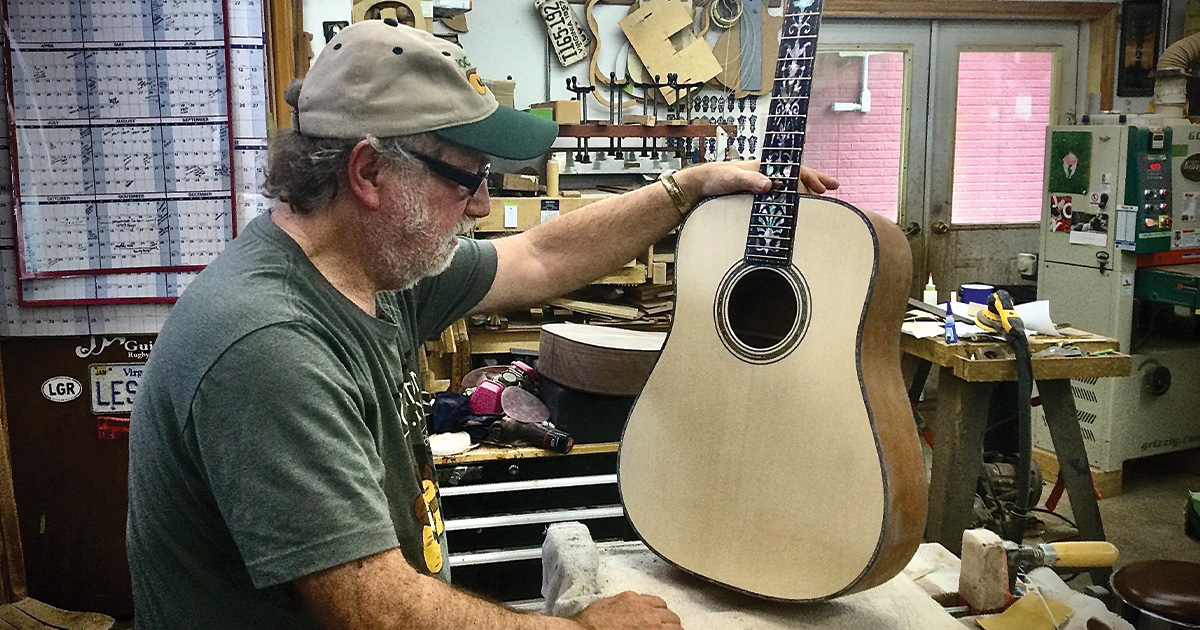
In this day and age of shake-and-bake stardom, reality television, and fifteen minutes of fame seekers it is comforting and refreshing to know that there are still authentic individuals out there diligently working at their craft and continuing to leave their mark and make a difference. I recently made the pilgrimage, to Rugby, Virginia, population seven, to spend time with one such individual. Wayne Henderson is legendary for his skills as a luthier and as a musician.
Henderson has built instruments for people such as Doc Watson, Ricky Skaggs, Peter Rowan, Vince Gill, Trey Hensley, Brad Paisely, Gillian Welch, Tommy Emmanuel and Eric Clapton. The story of Clapton’s Henderson guitar was captured in the widely acclaimed book by Allen St. John Clapton’s Guitar: Watching Wayne Henderson Build The Perfect Instrument. Additionally, there is a documentary about Wayne called From Wood to Singing Guitar by Appalshop that provides an intimate glimpse into Wayne’s world. As if that were not already impressive enough, in 1995 Wayne was honored with a National Heritage Fellowship Award at a White House ceremony in recognition of his exemplary skills as a luthier. To date Wayne has crafted over 850 guitars and 150 mandolins.
As formidable as his skills as a luthier are, his talents as a guitar player are equally as impressive. Wayne has played at the White House, for Queen Elizabeth II, at Carnegie Hall and the Smithsonian Institute. He was selected to be part of three “Master of the Steel String Guitar” tours and has played internationally. Over the years, Wayne’s unique fingerpicking guitar style has garnered him over 300 ribbons from various guitar contests.
What makes his accomplishments even more amazing is that he managed to do much of this while working for 32 years as a rural mail carrier. I was so intrigued by this unique man that I, like legions of people before me, travelled Virginia’s Crooked Road to the doorstep of Wayne Henderson’s workshop. As the miles rolled away beneath my car tires, my mind raced with anticipation of meeting Wayne and getting a firsthand account of his fascinating journey.
The first thing that strikes me as I drive the last few miles is just how rural an area Rugby, Virginia is. Wayne jokes that Rugby is so small you have to take turns being the mayor, preacher and town drunk. Pulling into Wayne’s driveway I notice there are no signs on his workshop. This aligns with how Wayne does business. He also does not have a webpage or advertise in trade magazines. The phrase “build it and they will come” could have been written with Wayne in mind. People have indeed come as over the years word about him has spread far and wide. He is in such demand that customers are willing to wait several years for one of his instruments.
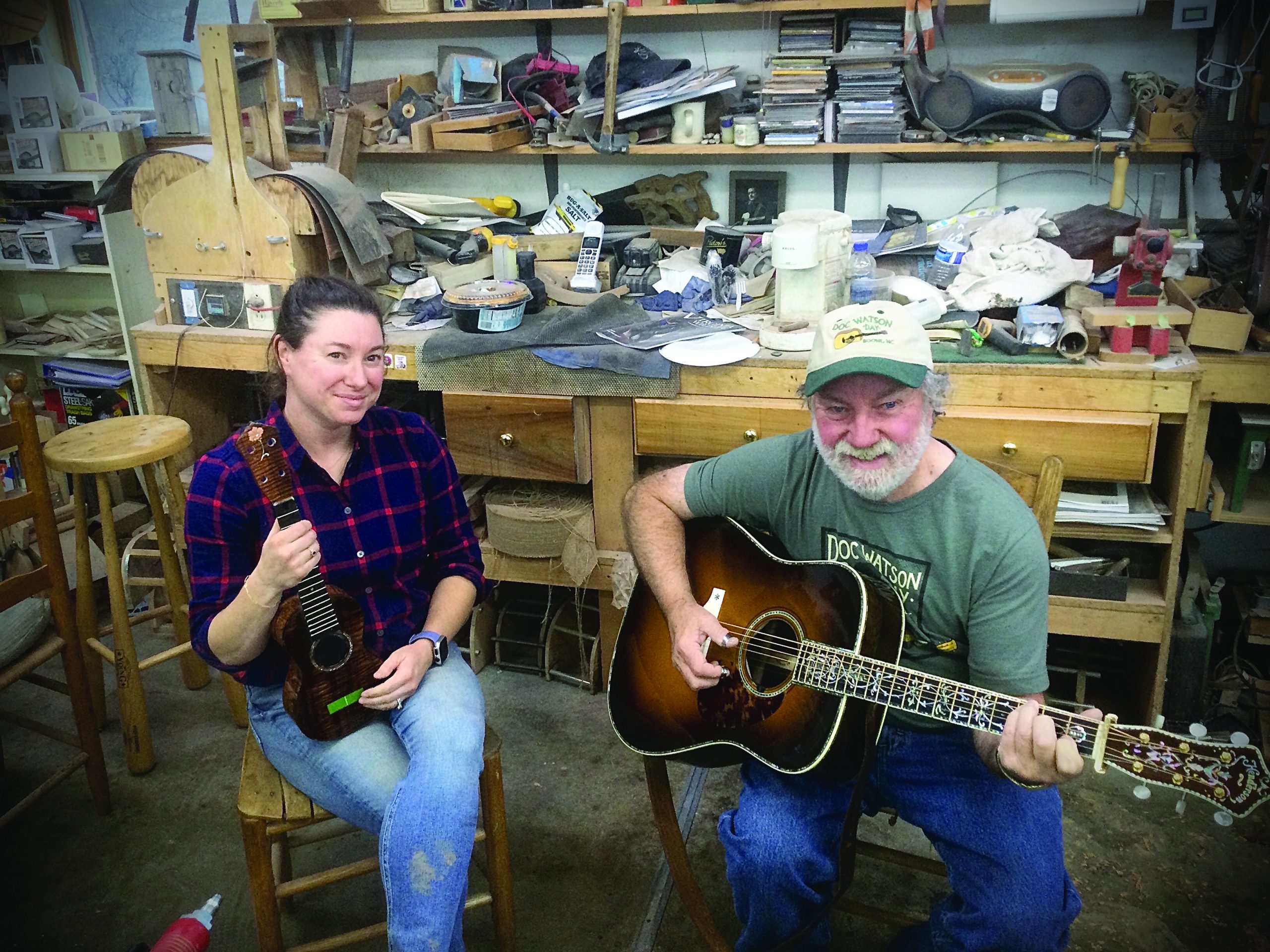
Entering his workshop Wayne greets me as if I were an old neighbor and welcomes me in. It just so happens his daughter Jayne, an accomplished luthier in her own right, is there fretting one of her creations. As our conversation begins, it is readily apparent that Wayne is in his element as he begins to weave his story about how he learned to build instruments and play guitar. Over the years Wayne has probably told this story more times than he can count, but as he relates it to me like it is the first time he has ever told it. He has a gleam in his eyes and a hint of excitement in his voice as he recalls the two people from his youth that were the catalysts for his life’s work.
The first person was E.C. Ball a local musician who owned a 1949 Martin D-28 and played it fingerstyle. No one else in the community had a guitar with the quality of a Martin. Wayne said E.C. Ball was someone he looked up to and as such, he wanted a guitar like his and wanted to play just like him. After E.C. Ball died Wayne acquired his Martin, and it is evident that it is an instrument that still holds deep meaning for him. Wayne laughs as he tells me that E.C. Ball told him “all good guitar players played with their fingers.” Wayne took that advice to heart because he has gone on to become an award-winning guitarist. His fluid fingerpicking style is often mistaken for flatpicking. Wayne wanted a guitar like E.C. Ball’s Martin and knew the only way he was ever going to get one was to build it himself and he set out to do just that.
The second person Wayne cites as a major influence was Albert Hash, a local builder and repairer of violins. Wayne credits him for teaching him about different types of wood and how to work with wood to bend it. More than anything he says Albert provided him with encouragement and Wayne looked at Albert’s work and realized what one person can do another person can do. Wayne acquired violins made by Albert after his death and he still marvels at the craftsmanship.
So, armed with desire and basic woodworking skills, Wayne built his first guitar. To build his guitar he used a pocketknife, file, saw, and miscellaneous tools found around the farm. He used an old mahogany door for the back and sides and ordered a piece of spruce for the top. The level of detail and what he was able to accomplish, even making the bridge pins from cow bones, is extraordinary. He completed his first guitar in 1964 and appropriately numbered it #1. While it did not approach the quality of E.C. Ball’s 1949 Martin D-28, it was an impressive effort that served to ignite his desire to continue to learn about and build guitars. It was not long after that Wayne sold one of his guitars for $500 and he invested the money into buying more tools and told his mother building guitars is what he wanted to do.
Wayne became an expert on Martin guitars and had the opportunity to study them up close when he went to work in the 70’s for Gruhn Guitars Inc. located in Nashville. In Wayne’s opinion the old Martins remain the epitome of what guitars should be. He adopted many of the techniques used by Martin and while Henderson guitars are not Martin reproductions as such, you can say they are closely related. What is it about Henderson guitars that make players willing to wait years to own one and why do they command $25,000-$30,000 or more in the resale market?
I contend that the reason for these things is the person building the guitars. Over the course of 58 years of building, Wayne has refined his techniques and continues to hone his craft. Spending time with him in his workshop, you soon find his passion contagious as he tells story after story. Whether he is talking about how Doc Watson used to frequently stop by the workshop to pick some tunes or showing you a guitar neck that he carved using nothing but a pocketknife, his love for what he does is readily apparent. You can take a room full of luthiers give them the same woods and equipment, have them build the same model guitar and they will sound different. Just like so much of a musician’s sound is the result of the player’s hands. I think the same thing can be said regarding luthiers and Wayne has that special touch and that sets him apart from the herd.
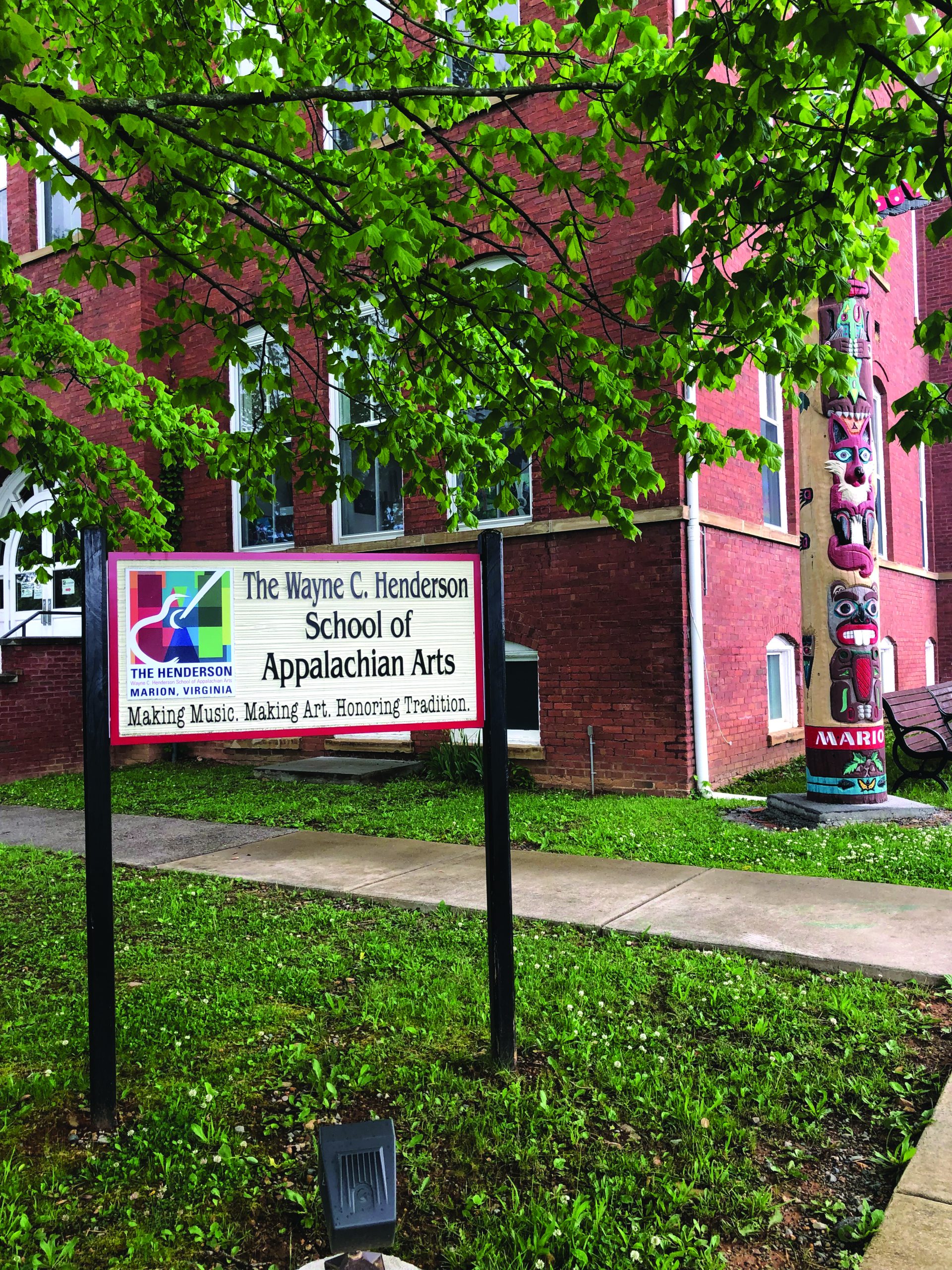
Wayne’s legacy goes far beyond the guitars that he builds or his abilities as a guitar player. In 2015, the town of Marion, Virginia turned a 1908 former school building into a center for Appalachian arts to promote and preserve the heritage of the region. The school is named “The Wayne C. Henderson School of Appalachian Arts” in honor of the contributions Wayne has made as an international ambassador for the music, heritage and culture of the Southern Appalachians. The school offers an array of classes to include letterpress, painting, weaving, and guitar and fiddle building workshops. While Wayne does not lead the guitar building classes himself, he is involved as his busy schedule permits. He makes sure that he is there at each class as the budding luthiers string up the new guitars they just completed. Wayne plays each one and after he is satisfied, signs the label inside the guitar. The guitar building course runs 5 days and is offered three times a year. The course is very popular any perspective participants should plan on scheduling ahead of time. There is more information regarding classes available on the school website.
On the third Saturday each June at the Grayson Highlands State Park located in Mouth of Wilson, Virginia the Wayne C. Henderson Music Festival and Guitar Competition is held. Bluegrass and Old-Time music are the theme of the festival and some of the finest musicians from the region will be found there performing and shade tree jamming. The guitar competition is a highlight of the festival is a non-profit event and Wayne has made it a mission of the festival to preserve and continue the traditional music of the region. As a result of the festival’s commitment, more than $350,000 has been awarded to date to aid young traditional musicians in continuing their music education and exploration. There is more information about this event available on their website.
Wayne, rightfully so, is proud but humble about his accomplishments. There is one thing he is particularly proud of…and that is his daughter Jayne and her accomplishments as a luthier. Jayne went to college for Environmental Law and was working at a non-profit in Asheville, North Carolina and approached Wayne about building her a guitar to auction off to help payoff her student loans. Wayne told her he would not build one for her, but he would assist her in building one. They completed the guitar and it sold for $25,000 and that set the wheels in motion. She built a couple more guitars and decided being a luthier was what she wanted to do. She left the non-profit she was working for and opened her workshop in the basement of her house in Asheville in 2012 and builds guitars and ukuleles as E.J. Henderson.
I had the opportunity to spend some time with Jayne and found that she inherited Wayne’s passion for building and doing things the right way. However, make no mistake…Jayne is no Wayne Henderson clone. While she has adopted many of Wayne’s techniques, she has blazed her own trail. She specializes in small body guitars (O, OO, OOO, and OMs) and is a strong proponent for building with sustainable woods rather than those varieties that are endangered and in limited supply…think Brazilian rosewood for example. Jayne favors woods such as walnut and oak but is more than willing to work with the customer to build the custom guitar or uke of their dreams. Jayne also does masterful custom inlay that is artistic and tasteful and personalizes her instruments. Wayne says with confidence the future of Henderson guitars is in good hands.
As my visit with Wayne came to a close, I could not leave without requesting he play a tune or two. He was more than happy to accommodate me and picked up build #500 and played a spirited version of “Sally Ann” that put a smile on my face. On my drive home through the winding roads and rural countryside, I reflected on what Wayne Henderson has accomplished and contributed to lovers of traditional music everywhere. I am thankful to have had the opportunity to spend a few hours with this unique man….Wayne Henderson, master luthier, guitar picker extraordinaire… a true American treasure.