
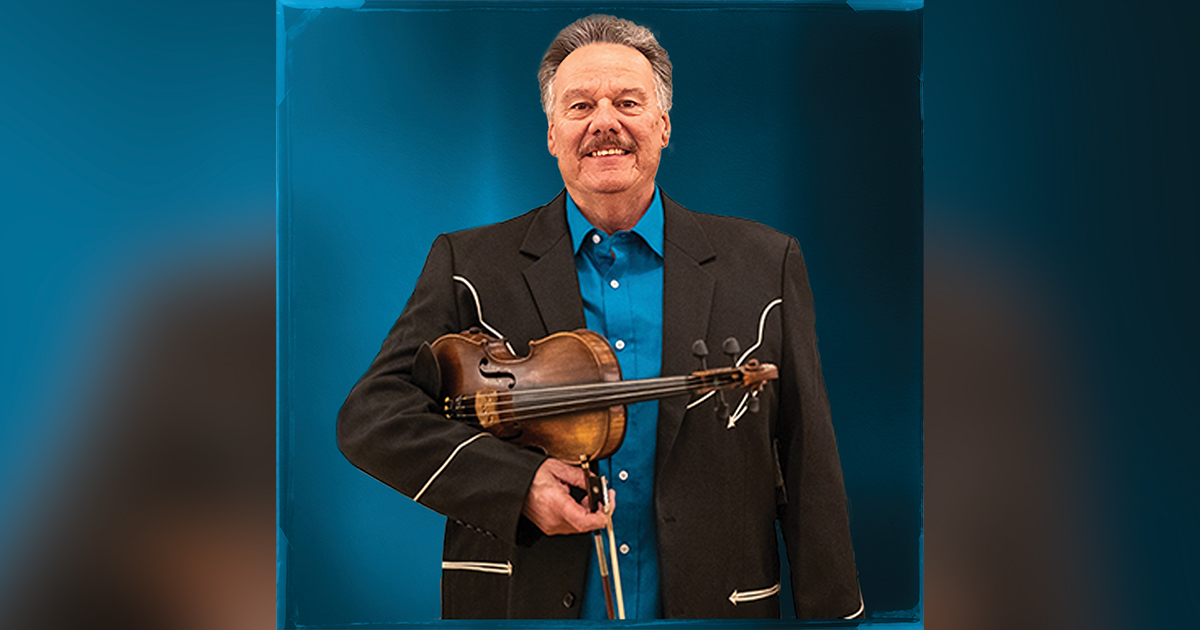
Warren Blair
A 50-year career of the “Hired Gun” of Bluegrass and Country music
Photo by Brian Auburn
It has been an amazing ride for Warren Blair in the bluegrass world. Hailing from the Baltimore area, Blair’s career with a fiddle in his hand has seen him play with many bluegrass legends since his prowess on the instrument became known in the early 1970s.
While Blair earned his nickname of “The Hired Gun” by being a go-to fiddler for artists who were coming through town and as the fiddler who was brought in by various bands on an interim basis until they could find a permanent replacement. This flexibility led Blair to opportunities that many other musicians would not have had if they were tied to a single group for a long period of time. As a result, Blair’s musical history represents an important part of the bluegrass genre’s history from the early 1970s to now, including his last year onstage as the current fiddler for Lorraine Jordan and Carolina Road.
Warren Blair grew up as the son of renown fiddler Kimble Blair, a regional musician who performed with Walter Hensley, Earl Taylor and other acclaimed artists. As a teenager, however, the younger Blair became interested in playing rock & roll with Chicago being his favorite band. Eventually, however, unbeknownst to his dad, Blair decided to pick up the fiddle and mess around with it. He instantly became intrigued with it and learned to play the instrument in a relatively short period of time.
With both Warren and Kimble Blair, the desire to learn how to the fiddle came from within, while at the same time their musical legacy became a part of the history and the legacy of the Great Migration of rural folks who moved to the big eastern cities looking for a better way of life during the last century.
“My Mom and Dad were both born and raised in Kentucky, and I was born in Baltimore,” said Blair. “Dad was from Cumberland, Kentucky, and Mom was from Ashland, Kentucky. All of my kin from my mom’s side are gone, but my dad’s side of the family still has a slew of kin that are still down there. A lot of them were coal miners. He started coal mining when he was 13, and he moved up here to Baltimore when he was 16. Back when I was growing up, Baltimore was great. It was a beautiful city with a lot of attractions, and it was a big bluegrass Mecca for a long time. Hazel Dickens and Jack Cooke spent a lot of time here, and Del McCoury did as well before he joined Bill Monroe’s band. In fact, before Del joined with Bill, my dad, Del, Jerry McCoury and Jack had a band called The Virginia Mountain Boys and they were a top-notch crew and a really hot group.”
When Blair’s father Kimble was growing up in the bluegrass state, he learned to play the fiddle through sheer determination. “His connection to the outside world was by a radio, like everybody else in the mountains back then, and he would listen to the Grand Ole Opry on Saturday night,” said Blair. “He told me that his Dad traded a hog for a fiddle, but he did not have a bow, so he went and got a tree branch and some sewing thread and made a bow out of it and used tree sap for rosin. I taught myself how to play the fiddle and he taught himself how to play the fiddle.”
In Warren’s case, rock & roll came first, yet his mind had soaked up all of the patterns and melodies of the bluegrass music his Dad played around him while growing up. “I started out playing drums and then the bass and the guitar, playing rock music by Led Zeppelin, Deep Purple, Grand Funk Railroad and my favorite, Chicago. I also played traditional country music on the guitar,” said Blair. “I would babysit my two younger brothers while my mom and dad would be out at one of the honky tonks where my dad would play. One night, I listened to a Jimmy Martin recording called ‘Going Ape.’ The fiddle kick off and the fiddle break on that song was just so unique compared to the other things I had listened to. I always loved the fiddle, naturally, being raised on bluegrass and traditional country music and with my dad being a fiddler, but I never had a desire to play one until I heard that song. When I heard that recording, there was a fiddle and a bow sitting in the corner and I went over and grabbed it and said, ‘I bet I could learn how to play that.’”
This sudden interest in the fiddle all played out on occasions when his dad was not around. “By the end of the night, I was sort of simulating what that fiddler was doing, and I haven’t laid the fiddle down since then,” said Blair. “Before that, I had already learned how to play the mandolin, guitar and the bass when playing bluegrass. But up until then, I never had the desire to play the fiddle. I loved hearing it, I just never wanted to play one. My dad always had jams at our home, and many times they would spend the weekend with us and Mom would make them breakfast and it was just a normal thing at our house. So, I was raised in a good bluegrass home.”
After taking up the fiddle, however, Blair did not play in front of his father for a full 12 months until the day of the unveiling. “My dad was a house painter for 53 years, while also playing music for extra income,” said Blair. “My mom would work in a factory on occasion and she would play guitar and sing a little bit. But because there was music in the house constantly, all of the time, and the sound of it would input into my mind long before I ever picked up an instrument. I knew what the music sounded like and how to play it because I had seen it in front of me all of my life. But when I learned how to play the fiddle, I didn’t tell my dad or mom about it for over a year. I would wait until they went to work and would practice the fiddle before I went to school, and I’d rush home from school and practice again before they got home from work. I’m not sure why I didn’t want them to know, other than I think I wanted to surprise them.”
That event happened when Blair’s dad was playing at a place called The Chevrolet Inn with Walter Hensley. “The Chevrolet Inn was right down the street from the General Motors plant,” said Blair. “I would sit there and watch them play and then Dad would get me up there at the end of the night and I’d be a nervous wreck, ready to throw up and everything from stressing out by wondering when he was going to call me up onstage. I wanted to do it, but I was afraid to do it at the same time because I didn’t have very much confidence then. But finally, at a jam session at our house, I just decided to pick up a fiddle and started playing it. My dad was tickled to death. He said, ‘When did you learn how to do that?’”
Blair formed the band Southland with his brothers around the same time the Johnson Mountain Boys formed in Maryland and the two groups would play a lot of same venues over the years. Blair learned about the inner workings of the business side of bluegrass as a young man. Yes, he had always watched his dad’s career up close, but as a kid you usually don’t get to hear the nuts and bolts and egos and attitudes that one encounters along the way.
Kimble was a long-time friend of the great fiddler Kenny Baker, and Warren loved him as well. But a situation came up one time that truly brought Warren in contact with the adult side of the music business. The outcome of the encounter would help him to set the stage for how he would approach his own career in the future. “Kenny Baker was playing the fiddle with Bill Monroe up at the Indian Springs Festival in 1971, before I started playing the fiddle, and he asked me if I would play bass that weekend and I said yes,” said Blair. “I always loved playing the upright bass. At the end of the weekend, Mr. Monroe walked up to me and shook my hand and said, ‘Mister Blair, I’d like to ask you if you would like to be a Blue Grass Boy.’ I was also playing my rock music at the time and my hair was long then. He said, ‘There are only two things that you have to do. You have to get a haircut and wear a cowboy hat.’ I said, ‘Mister Monroe, I appreciate that, but no thank you.’ Kenny got furious with me. But, I did not ask for the job, because it wasn’t anything that I wanted at the time. Still, Kenny had put a good word in for me and it put him in a bad spot with Bill, even though Bill took it well.”
Baker did not speak a word to Blair for about five years afterwards, but they eventually became friends again. That day, however, set the tone for Blair’s career, which was to become one of the best go-to musicians to fill a niche when called upon. “I never took a full-time job with Bill Monroe, but I did play fiddle with him on a couple of jobs years later,” said Blair. That was the beginning of Blair earning his well-earned nickname “The Hired Gun,” He did play with a few bands along way, including with Charlie Moore right out of high school, but ultimately he was the on-call fiddler of the day.
“If you counted all of the country bands as well as bluegrass bands that I played with, local, regional and national, it probably adds up to 150 or more,” said Blair. “That is why I was known as ‘The Hired Gun,’ because not only did I play the fiddle, but I also studied the music of all of the bluegrass and traditional country music artists and knew how their recordings sounded. Say, for example, Jimmy Martin needed a fiddle player, which he did many times. Jimmy would call me because I already knew all of the kick-offs and fiddle breaks from all of his songs. I did the same thing for Jim and Jesse and many of the artists that would come through town. I loved their music and I loved the fiddle playing that was on their records. That was sort of my vocabulary, or my library of learning to play music. They could call me, and I would know what to do. The same thing would be true for Nashville artists when they would pass through.”
Blair tried out for the fiddle chair in the great George Jones’ band and ended up being in the Country Music Hall of Famer’s group for about four months. This was during the ‘No Show Jones’ period of Jones’ career, so there were rough times while on tour. There were also great moments experienced, of course, when the legendary vocalist was singing those famous country hits as only The Possum could do.
Blair also played with country artists such as Bobby Bare, Faron Young, Mel Street, and many other great performers. When he was back home in Baltimore, Blair would go back to playing with artists like the previously-mentioned Walter Hensley and Roger Bellow, with the latter being the first person that Blair ever recorded with on vinyl back in the day.
Blair also did two memorable stints playing and recording with Don Parmley, David Parmley and Randy Graham with the Bluegrass Cardinals. In the early 1990s, there was an album recorded on Rounder Records called The Families Of Tradition – Parmley and McCoury that featured David Parmley, Don Parmley, Del McCoury, Ronnie McCoury, Rob McCoury and Warren Blair on the fiddle. The project won the 1991 IBMA “Collaborative Recording of the Year” award.
Blair also found some success with the band called Fastest Grass Alive, which featured his brother Kenny Blair. During a memorable period between 1992 to 1995, Warren and his brother also were tapped to back up many great country artists, including playing with Johnny Rodriguez, Marty Haggard, Connie Smith, Melba Montgomery, Tommy Cash, Tommy Overstreet, Hank Thompson, Jack Greene and Jeannie Seely, Grandpa Jones, Skeeter Davis, Stonewall Jackson and many others. Blair was inducted into the Maryland Country Legends Hall of Fame in 2010 and also the Maryland Entertainers Hall of Fame in 2011.
Along the way, Blair also became known for a technique that combined playing double stops with his fiddle—which roughly means playing two fiddle strings at the same time—and simultaneously adding a third part to the chords with his voice. While the technique amazed and perplexed other fiddlers, the innovation just came out naturally for Blair.
As a result of a very busy, diverse and historic career, Blair has influenced many of his peers in the business. One example of this is the acclaimed bluegrass multi-instrumentalist Ron Stewart, who currently performs with the Seldom Scene.
“I first met Warren when I was 9 years old,” said Stewart. “I was a guest appearing on a show with Lester Flatt and the Nashville Grass at the Tennessee Mountain Bluegrass Festival. I remember hearing the Bluegrass Cardinals and aside from loving the band and vocals, I heard this amazing fiddle player who immediately captured my attention. He had the smoothness of Kenny Baker, but he also had this other side of his playing that harkened to the fiddlers of Flatt and Scruggs. That fiddle player was Warren Blair and I’ve been a lifelong fan and I consider him a dear friend.”
Fiddle master Glen Duncan agrees. “One of the big things that has always impressed me about Warren’s playing is his great musicianship,” said Duncan. “He doesn’t just play the fiddle, his fiddle playing makes the whole band sound great when he’s playing in the band. I think that’s the greatest thing that a musician can achieve is always doing whatever it takes to make the whole band sound great on every song. Warren has always done that from the very first time I heard him, and he’s still doing that today.”
Multiple IBMA “Fiddle Player of the Year” award winner Jason Carter is another fan of Blair’s work. “Warren Blair is one of my fiddle heroes and biggest influences,” said Carter. “The recordings he played on are what inspired me to play music. I loved his playing on the Welcome to Virginia record by the Bluegrass Cardinals. Another favorite is the Families Of Tradition – Parmley and McCoury album. I think Warren is one of the most inventive players of our time. His playing is exciting, fiery and still smooth as silk. I learned to play fiddle by listening to The Del McCoury Band records that Warren was on before I joined the group, on recordings like ‘Blue Side of Town’ and ‘Don’t Stop The Music.’ These recordings changed my life. A few of the highlights for me were his fiddling on ‘Trainwreck of Emotion,’ ‘Seasons Of My Heart,’ and ‘I Feel The Blues Moving In.’ In fact, when I was a senior in high school, my mother would take me to school and we would have enough time on our drive to listen to just one song. So, we started every day of my senior year in high school listening to ‘I Feel The Blues Moving In.’ Thank you Warren for the inspiration and for making the blueprint of what a bluegrass fiddler should sound like.”
Blair has influenced way more musicians over the years than just the great artists mentioned above, and he has done so by giving private lessons on how to play the fiddle, banjo, bass, guitar and mandolin to a great number of students for the last 45 years.
Another reason that Blair went the ‘Hired Gun’ route during his career, however, was to create time for his other love and passion, which came about after his Mom became ill. “My mom was diagnosed with terminal emphysema when I was 12 years old,” said Blair. “So, I started studying natural medicine and that became my ministry, which I have had for over 40 years. God provided me with this knowledge, and I’m not the boastful type, but I know what I know, and He gave me a love for it and a gift for it and a desire to do it. I did not want my Mom to die and I wanted her to feel as good as she could. Under their normal prognosis, they said she wouldn’t live past 6 or 7 years. She had Scarlet Fever when she was a child and then had asthma real bad and then smoking led to emphysema.
“The healing is based on all natural plants and herbs removing toxins and eating good foods with healing compounds,” continues Blair. “I just believe that God designed our bodies to heal itself. I’m not a health freak or anything like that, and I eat whatever I want to, I just know how to compensate for it. We’ve put too much chemicals and additives into our systems, and breathing bad air. The main thing I studied for my Mom was to find out what the best nutrients were for the respiratory system and to remove the things that were harmful to the respiratory system. By God’s grace, she lived until 1996.”
Blair would face his own health issues later in life, both of which directly impacted his ability to play the fiddle. In 1988 after returning from a European tour in the fall of 1987 with Bluegrass veteran Jimmy Gaudreau and the Bluegrass Unit he crushed his left fretting hand in an accident. He was unable to play the fiddle for a very long time, especially after having to undergo surgery as a result of his injuries. The damage was so severe that doctors told Warren that he would never play again. Yet, through sheer determination, he fought his way back to playing shape.
In recent years, Blair has had to deal with the onslaught of an ailment that was at first a mystery. This time, it was his right bow hand that was affected, which began to shake with tremors one night while onstage in 2002. He was tested for a stroke, but that came out negative. After tests for other diseases, four years ago the doctors finally reached the correct diagnosis of Progressive Supranuclear Palsy.
With Blair, this rare brain ailment especially affects his fiddle playing, as his hand and arm will tremble when he draws the bow slow across the strings. “I can still play, but I have to press hard into the strings with the bow, which means that I’ve lost all of my dexterity and textures,” said Blair. “Say, if I’m backing up somebody and they are playing a really pretty ballad, I have to back away from the microphone because I can only play full volume and I can’t play soft anymore. I can still play as fast as ever, with no problem, because you don’t have to have as much bow control with the fiddle.”
Despite his unique playing situation, Lorraine Jordan was determined to get one more bluegrass season out of Blair because she had been a fan of his work for a long time. “Lorraine had listened to me for years and tried to hire me for years, but the timing was never right,” said Blair. “Originally, I filled in on the fiddle for about four months at the end of last year when her regular fiddler took a break from the road. I actually then retired on New Year’s Eve night, and decided to quit playing altogether, unless it was just for fun. I put that announcement on Facebook and everything, and told all of the local bands here that I was done as well. One night, Lorraine said, ‘Warren, can I talk to you for a minute?’”
It was then that Jordan asked Blair if he wanted to play another season of bluegrass music. Blair and his girlfriend Shari were ready to move down to Florida. As it turned out, Shari wanted to work at her job for another year, which opened Blair up to consider Jordan’s offer. Despite the fact that playing the fiddle is tiresome these days, as it takes more physical labor to do it, this fiddle great decided to do one last year on the road.
“Warren and my banjo player Ben Greene started their careers together, at the same time,” said Lorraine Jordan. “As a result, with Warren onboard for this year, I am blessed to have two bluegrass legends in my Carolina Road band. Warren is as professional as they come when performing onstage. This tribute to Warren is long overdue, especially with some of the best fiddlers in the world admiring him so much, so I am so glad that it is happening for him now.”
Blair’s bandmate Ben Greene is thrilled with the pairing with Blair as well.
“Warren and I both started playing in a professional band together with Charlie Moore right after high school,” said Greene. “The tools that we learned from being in that first professional band, we have carried them over with us to other bands. Warren is always a professional, on and off the stage. He knows the right licks to play, and when to play them. Because we now both play with Lorraine Jordan and Carolina Road, we started together and we will end together.”
As Blair’s career plays out to its final call, there is a lot for him to look back on and appreciate. Both Blair and his late father Kimble Blair played with IBMA Hall of Famer Del McCoury over the years, both are also a part of Tim Newby’s book called Bluegrass In Baltimore. Warren was inducted into the Maryland Country Legends Hall of Fame, and he has performed on the Grand Ole Opry over 20 times.
Blair’s greatest validation, perhaps, is the words said to him by the late Jimmy Martin. Martin had his problems and issues, and that is all well-documented. But, when he got serious about music, Martin was a true force to be reckoned with. A part of Martin’s legacy, and why his plaque is on the wall in the Bluegrass Hall of Fame & Museum in Owensboro, Kentucky, is that when it came time to introduce himself to Bill Monroe at the Grand Ole Opry and ask for a job as a very young man, Martin had learned nearly all of Monroe’s songs ahead of time and was prepared and ready. That was Blair’s approach as well, going back to Martin’s “Going Ape” song, which began Blair’s legendary journey on the fiddle.
“One night I was playing at a music venue near Corbin, Kentucky, called Tombstone Junction in 1992 and Jimmy Martin was there as well,” said Blair. “I had played with Jimmy many times over the years, but never did take a full time job with him. Anyway, that night I was talking to Vernon Derrick, who was one of Jimmy’s long-time musicians, and we were down in the dressing room, which was located underneath the stage. Jimmy came down and said, ‘Vernon, would you mind if I had a private minute with Warren?’”
One-on-one with the legend, Blair answered Martin’s questions about why he never took steady job with him, yet Martin still gave Blair the compliment of a lifetime. “Jimmy said, ‘From the first time that you ever played with me, when you were 17 years old, you already knew all of my songs,” said Blair. “Jimmy then said, ‘I have never had anybody that played with me who already knew all of my music.’ I said, ‘Well, Jimmy, I love your music, I thought you had great stuff, and a lot of what I learned came from your records.’ He said, ‘Well, I got to tell you something. And, I’ve told this to other people, including Earl Scruggs. As far as I’m concerned, there are only two fiddlers in bluegrass music; Benny Martin and Warren Blair.’ When he said that, I started crying and gave him a hug. I still get emotional thinking about it right now, because it touched me so deeply.”
Warren Blair, “The Hired Gun,” would like to finish this article by saying, “Thank you to anyone and everyone that I had the pleasure to grace a Bluegrass or Country Music stage with for these 50 blessed and memorable years. ❤️🙏🎻
More information can be found at carolinaroadband.com.

Congrats 🎉🥳👏🎻❤😊to Warren Blair