Walt Michael’s Full Circle Journey
Exploring Roots and Creating Culture at Common Ground on the Hill
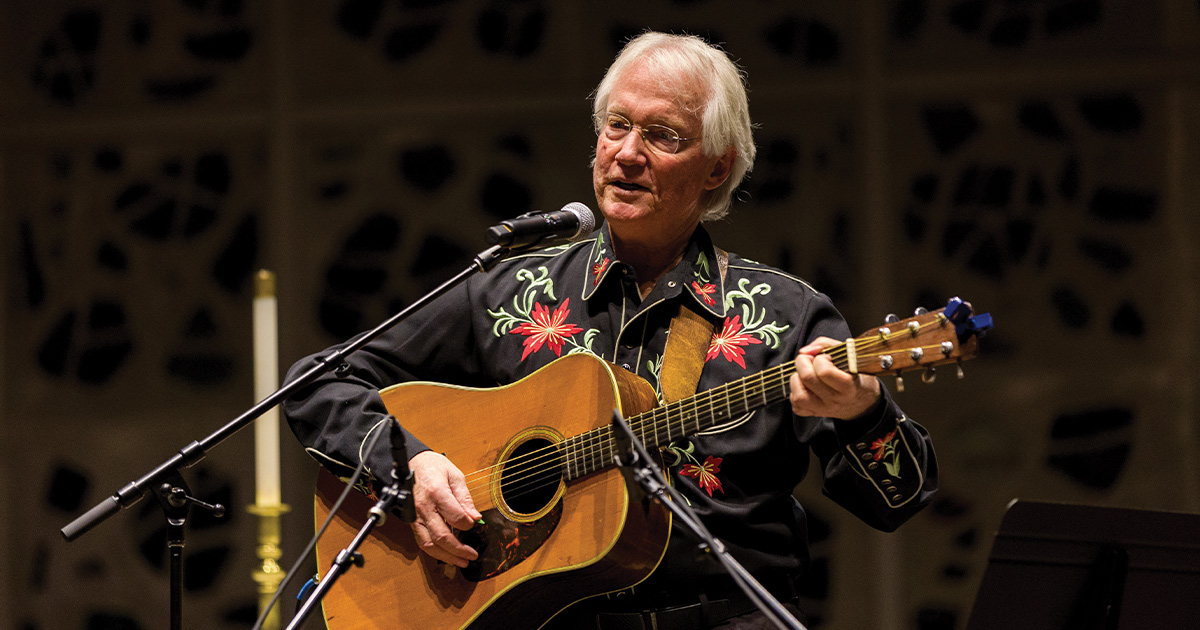
This is the story of a musician whose career path led him back to his roots to develop a music and arts community known as Common Ground on the Hill, where “the big tent of bluegrass” is welcoming. Walt Michael, whose peaceful outlook, and sensitivity about social justice sprouted from personal experience and events of the 1960s, has actively performed and taught as a musician for nearly sixty years. For half of that time, since 1994 he has been the Founder, Executive Director and Program Director of Common Ground on the Hill.
When events are in full bloom during summer Traditions Weeks, Common Ground is an exciting venue which welcomes master musicians, artists, craftspeople and creative thinkers to interact and provide a quality learning experience for a diverse audience. Participants reflect local, national and international communities. In describing Common Ground, Michael says, “There is room for everybody, but no room for hatred. . . I don’t try to convince people of things. I want them to come and see. . . A healthy society is one that has its arts happening.”
The Hill is the hub of Common Ground, and the geographic location of its three-person staff. Since 1995, Common Ground has offered a solid line-up for seasonal indoor concerts, monthly jams and summer festivals in northern Maryland. Then, Common Ground’s game-changing innovation during the 2020 summer of the Covid shutdown caused it to emerge as a leader in providing virtual programming opportunities for virtual attendees of Traditions Week, as will be explained.
The Hill is the historical name for the campus of McDaniel College, a small college that has been at the center of Westminster, Maryland, since 1867. When Michael graduated in 1968 as an English major, the campus was named Western Maryland College, a name that reflected a relationship with the Western Maryland Railroad but was otherwise misleading before it was renamed in 2002. Westminster is located just northwest of Baltimore, in the comparably rural and affluent suburbs of Carroll County, along the Mason-Dixon-line border that it shares with Pennsylvania.
When Michael returned to his alma mater in 1994 as an Artist in Residence, he quickly began to develop Common Ground on the Hill in collaboration with the late Robert H. “Bob” Chambers III, who was then serving as the college’s seventh president. Michael and Chambers shared a desire for the campus to become an accommodating space, or a “Common Ground,” for a variety of artistic expressions and cultural traditions to be presented and appreciated by a diversity of participants.
Michael says that “Common Ground on the Hill was founded on the premise that there is a common human thread unifying all people expressed in our various artistic traditions.” The aspirational mission is “to make this thread a path towards human understanding, tolerance, fulfillment and enjoyment.”
As an example of such a common thread, Michael recalls the revelation when the Footworks cloggers, spawned by the Green Grass Cloggers of North Carolina’s Appalachian Mountains, and the Baltimore-based Sankofa Dance Theater’s African Dance and Drum Ensemble, performed and taught at the Common Ground Traditions Week on the same date. Participants discovered that the otherwise unique dances from their diverse cultures both included an identical element of choreography. It was eye-opening for them to experience artistically how the roots of their cultural differences also had sprouted a similarity; and it was a uniting moment for them to share their human and artistic commonality.
Common Ground on the Hill has enlisted the essential support of the Carroll County Arts Council and the Maryland State Arts Council, which in 2020 honored Common Ground with the designation and funding to become a Maryland Folklife Center of the Maryland State Arts Council’s Traditions Program. Most recently, Common Ground’s 53-year-old Deer Creek Fiddlers’ Convention was presented with the Folklife Heritage Award. Numerous other organizations and businesses also have been significant sponsors and contributors to enable the success of Common Ground’s variety of programming opportunities on the campus of McDaniel College and otherwise.
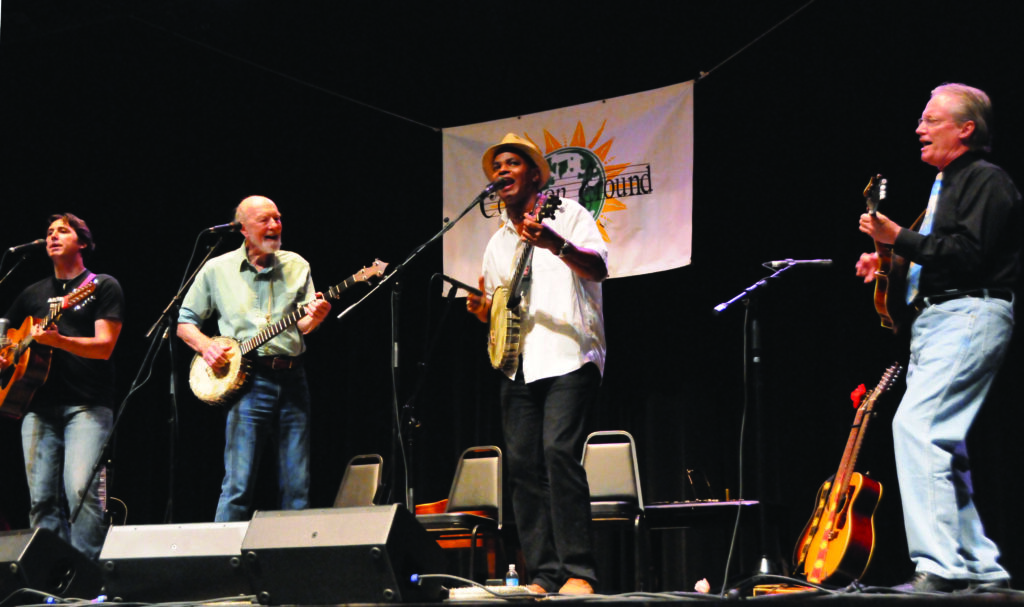
Common Ground is a place to appreciate and perform acoustic music that has been informed by the traditions of a variety of diverse cultures. Common Ground’s big tent includes acoustic string music that may be culturally different with broader roots than the Appalachian Mountains. Similarly, the father of the bluegrass genre described the source of the music he performed with the Blue Grass Boys as “Scottish bagpipes and ole-time fiddlin’. . . It’s Methodist and Holiness and Baptist. It’s blues and jazz.” Walt Michael’s eclectic curation of Common Ground’s music reflects the courage of Bill Monroe’s uniquely creative and nonconforming musical artisanship.
To understand how Walt Michael’s career as a composer and performer of acoustic music ultimately led him to return to his college alma mater as Common Ground’s founder in 1994, and to remain as the Artist in Residence, it is helpful to know about his formative experiences which molded his outlook as a pacifist and agent of social change.
Michael’s father, a third-generation Methodist pastor, was a district superintendent charged with leading the implementation of racial integration of the Methodist denomination in Washington, D.C. and southern Maryland. In the early 1960s, Michael worked as a page in the US Supreme Court during his teens while attending the Capitol Page School in the Library of Congress. Proximity to the United Methodist Building enabled the father and son to eat lunch together. Michael witnessed and admired his father’s commitment to the cause of advancing racial integration.
Michael regularly saw US Attorney General Robert F. Kennedy in the halls of the Supreme Court when his older brother, JFK, was President. He felt awed a few years later to be on the same plane as Dr. Martin Luther King Jr., while returning home from a student exchange program at Clark College, one of the Historically Black Colleges and Universities. Cultural change mandated by Civil Rights legislation was occurring gradually when Michael was studying at Clark; he responded to a plea for activists to help to enroll disenfranchised minority voters in South Carolina.
During his undergraduate years, Michael was selected to participate for three summers in the Students’ Opportunities Service (SOS), a program that was created by the Hill’s college students, who had felt labeled as “the apathetic generation,” as their initiative to “the war on poverty.” Michael recalled that the day he was selected to be in SOS, “I was surprised to be chosen and incredibly excited to know that I would be going to McDowell County, West Virginia. I knew that there would be mountain music in abundance and I had my guitar and banjo at the ready.”
Michael’s 2001 essay, “Of These Hollers I Sing,” recalls his life-changing summers as an SOS participant living among mountain folks who had never left the hollers of Appalachia. He learned about the roots of old-time and folk music as he also explored the culture in which at least a small part of his mother’s family was rooted.
Michael’s mother told him about visits to her maternal grandparents’ farm where she heard about their pioneering Scots-Irish ancestors who had lived in the Appalachian mountains of Kentucky before some of them crossed the Ohio River to farm in southern Illinois. As an adult, she enjoyed reading about Appalachia and frontier life, and made sure to share with her son the occasional articles she found in the media about the hillbilly culture of Appalachia.
Michael’s mother kept country and bluegrass music on the radio at home and played Mozart on the piano. He remembers being most fascinated by the Appalachian culture’s music, as he had been learning to play the guitar and banjo since his days at the Capitol Page School. His first guitar was an old Stella that his uncle won in a ticket raffle at a Burl Ives movie theater show.
Michael used the opportunity of those summers in Appalachia to collect ballads which he submitted to Joe Hickerson at the Folklore Division of the Library of Congress. He came to appreciate how the soulfulness of Hazel Dickens’s voice created a platform for her songs to be anthems of reform in the coal region. Eventually, Michael’s range of experience as a musician included both the occasions to perform for audiences of coal miners, and at venues of coal mine owners and operators.
Michael’s commitment to social justice endured after 1968, which was not only the year of his college graduation, but was also the year of the assassinations of RFK and MLK. While taking his first year after college to teach reading, writing and arithmetic to minority Bethlehem Steel workers in Baltimore, Michael’s reflection resulted in him becoming a conscientious objector. He then enrolled in the Drew Theological School in Madison, New Jersey, during the peak of the Vietnam War.
As he thought about his college experiences, Michael felt contradictions between what he experienced during summers in Appalachia, his experiences at Clark College and his training while in college as an ROTC cadet officer. While in college, his role as the Editor in Chief of the student newspaper required his engagement in current events. His decision to become a “CO” was a cathartic response to the process of wrestling with his conflicting emotions.
It was shortly after Michael enrolled at Drew in 1969 that he was significantly influenced by seeing Pete Seeger perform. Eventually, he joined other folksingers, “feeling a bit like a stowaway,” aboard Seeger’s 106-foot, Hudson River sloop, the “Clearwater,” which in 1969 began its environmental mission to promote the clean-up of toxic polychlorinated biphenyls (PCBs) from the Hudson River. Michael recalls that by 1981, when he was living in Cold Spring, New York, thanks to Pete Seeger, people were again able to swim safely in the Hudson.
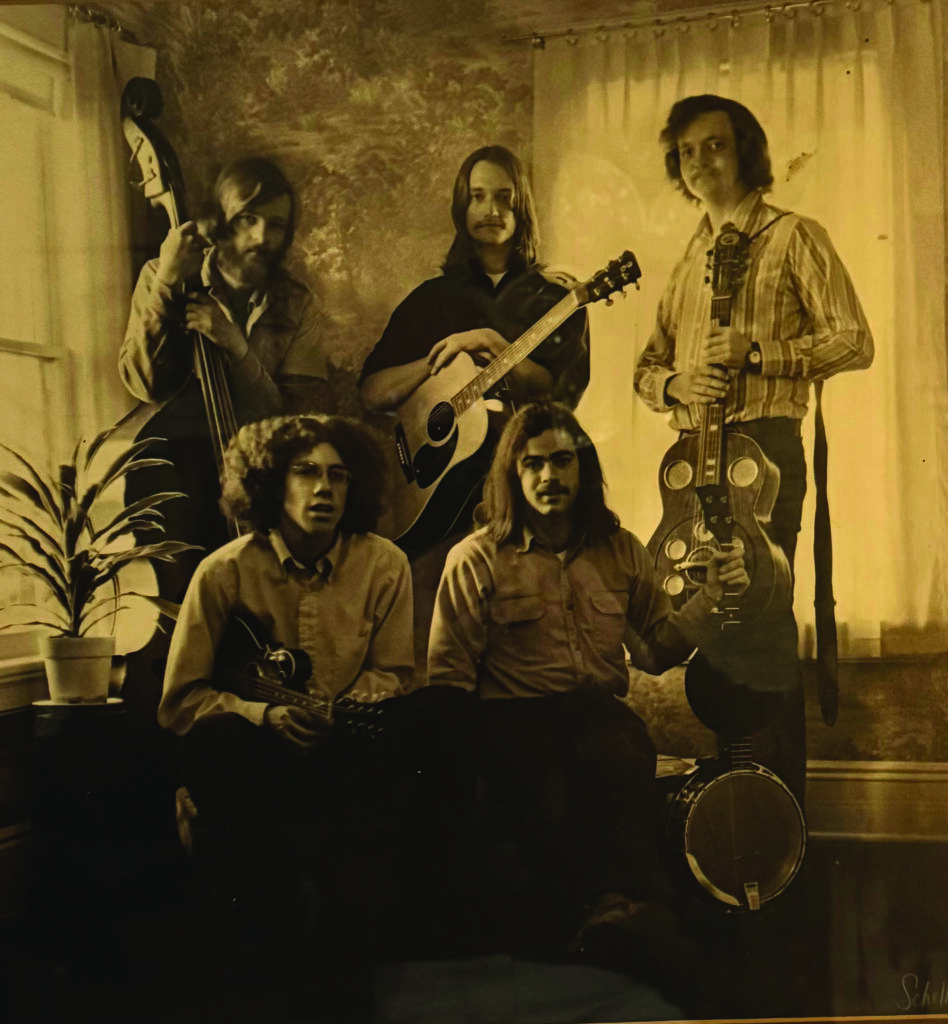
While studying theology at Drew, Michael encountered a robust folk and bluegrass music scene. “There was a coffeehouse near campus where great traditional musicians were featured. Tex Logan, one of the greatest bluegrass fiddlers of all time, frequented the Hayes House, and I was thrilled to play with him.” That fertile music scene in Madison, New Jersey, spawned The Bottle Hill Boys, a bluegrass band that in 1971 released the album A Rumor In Their Own Time, on which Michael sang lead, tenor and played guitar. That year, the band toured and traveled almost 100,000 miles to play 160 gigs, mostly on college campuses. He met many well-known string musicians on occasions when Bottle Hill was booked as the opening act.
In 1970, at the seminal Fox Hollow Folk Festival in New York State, Walt encountered his mentor, hammered dulcimer player and builder, Bill Spence. “Bill was really the Earl Scruggs of the hammered dulcimer. We hit it off. He built me a great instrument and I was up and running. I was in a hard-driving newgrass band and made it my goal to have the hammered dulcimer fit into and help drive the bluegrass sound.”
Bottle Hill played lots of bluegrass festivals, often hired by Bill Monroe’s promoter and Bluegrass Hall of Fame member, Carlton Haney. “At the 1974 Country Gentlemen Festival in Escoheag, Rhode Island, I came off the stage after an energetic set and Carlton pointed to his arm and said, ‘See these chill bumps on my arm? Bill Monroe’s mandolin playing made that happen too.’”
The comparative lack of portability of a hammered dulcimer limited its use by touring musicians, so Spence’s performance on it at a summer festival was unusual. The hammered dulcimer had been more common in nineteenth century American parlors, before it was supplanted by the piano as they became more available. Michael has contributed significantly over the last several decades to the revival of the hammered dulcimer that Bill Spence’s musicianship embodied until his death at age 78 in 2019.
Michael’s hammered dulcimer was featured as part of Michael, McCreesh & Campbell, a trio that formed in the 1977 and played a mix of Southern old-time, bluegrass, folk, Irish and original music. In 1980, MM&C released their second album, The Host Of The Air, and was selected to take part in the closing ceremonies of the Lake Placid Winter Olympics, where they played Michael’s original composition, “Snowblind,” to accompany a performance of the Pilobolus Dance Theater. That event was televised worldwide to 900 million viewers.
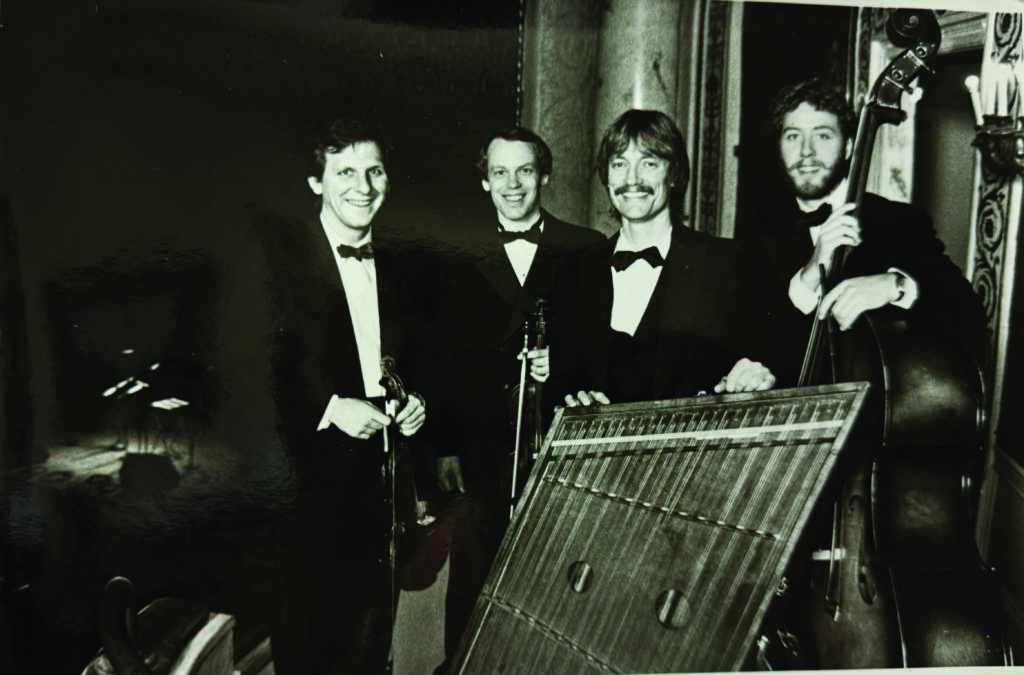
Michael recalls his mother’s encouragement of him as a 33-year-old troubadour that “maybe this will lead to something.” He responded “Mom, this IS the something!” Retrospectively, his mother’s understatement was prescient; the Olympic experience, which felt like a pinnacle at the time, was one of several meaningful milestones along the winding path of his journey.
Over his 50-year-plus career, Michael has received a substantial number of awards which recognize his commitment and success as a difference-maker in human relations, as well as his career as a musician. In recognition of his status as a virtuoso on the hammered dulcimer, Michael was a 2016 recipient of the Maryland Traditions Apprenticeship Award from the Maryland State Arts Council. He has recorded fourteen albums which display a wide repertoire of music that he has performed for nearly sixty years, at both modest and prestigious venues around the world.
As Michael now reflects on his musicianship, career and passion, he says, “I absolutely love the music … the music is what took me into the heart of Appalachia and around the world. As I have done the work of Common Ground on the Hill, I have continued to play music with a passion. The music comes first. If the music is good, the rest follows. Sixty-two years and counting!”
Development of Traditions Week and Virtual Programming
Since 1995, when Traditions Week was initiated as Common Ground’s flagship experience, a variety of in-person programming has been offered during the summer on the Westminster campus. Traditions Week is an unusual venue for participants “to let the art and music soothe and inspire,” as Common Ground encourages.
Traditions Week includes classes, concerts, dances, and other creative arts and activities reflecting cultural roots and traditions. It was created to reflect Walt Michael’s belief that “the quickest way to find common ground is to join with others in the
arts . . . by watching, listening, speaking, hearing, playing and participating with those who are like and unlike you . . . finding common ground through the lens of the traditional arts.”
During Common Ground’s first 25 years, programming was accessible most easily by those who could attend events located in central Maryland. Covid triggered change in 2020. Just before the March 2020 Covid shutdown, Common Ground staff had mailed 7,000 catalogs to promote registration for the three Traditions Weeks which had been planned for that summer.
Michael gives special credit to Maria Wong, Director of Promotions and Development, for Common Ground’s successful Covid response. Wong’s extensive background and training in both computers and communication enabled her to anticipate the potential use of streaming for education and the performance of music. The circle of Traditions Week was not broken by the grief many experienced during Covid, but was expanded creatively when Common Ground offered its first Virtual Traditions Week in the summer of 2020.
Michael greeted 356 virtual attendees at the orientation session, while practicing safe-distancing through use of video technology as he sat in his campus office, decorated with a stained-glass peace symbol that had been created by a Traditions Week Veterans’ Initiative participant. With his guitar, he led a sing-along of the song “Hello Stranger,” recorded by The Carter Family in 1938. From the safety of their homes, participants shared a cornucopia of music, art, dance, film, lectures and evening concerts. The annual Roots Music and Arts Festival took place virtually as well.
When many “non-essential” organizations did not have the resources or knowledge to quickly adapt during the summer of 2020, and the music industry suffered to the tune of a $30 billion global loss, Michael and his small staff pivoted smoothly with unusual organizational agility. Having recognized that they were at the forefront of the use of live-streaming and creative adaptation to Covid, the Maryland State Arts Council subsequently recruited Common Ground to demonstrate the process of virtual education to other organizations.
2024 Traditions Week Options
Two different Traditions Weeks are offered in 2024, when Common Ground on the Hill is celebrating its thirtieth anniversary. June 24th through 28th is a “virtual-only” week available through Common Ground’s YouTube channel. The second week is “in-person-only,” held in conjunction with the DC Bluegrass Union’s Camp at the McDaniel College campus in Westminster, Maryland from July 7th through 12th.
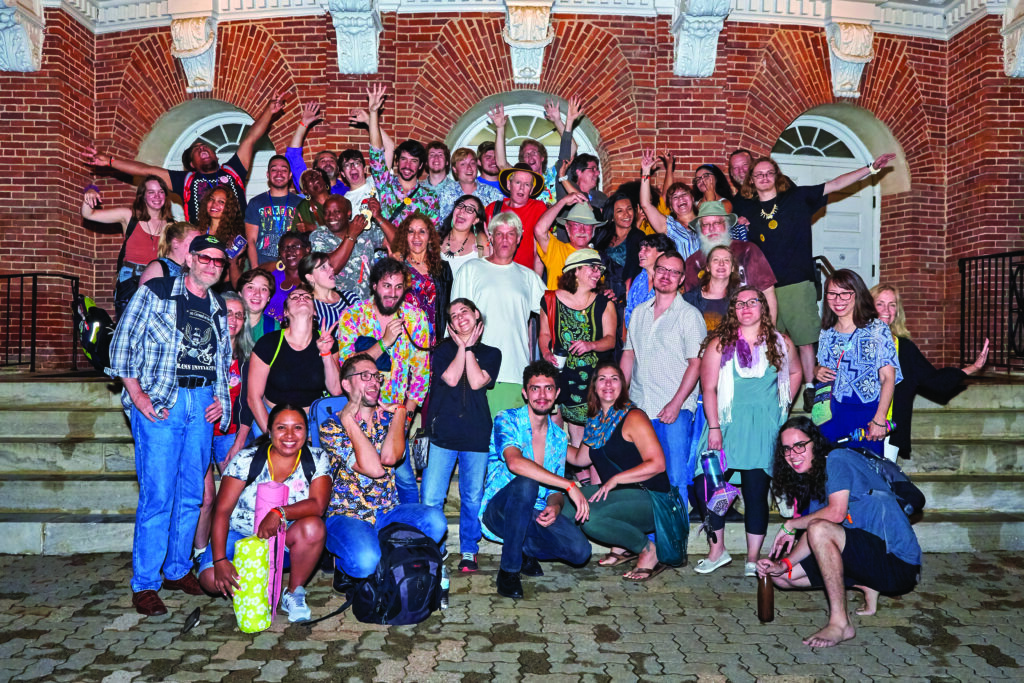
It is not too late to register for this year’s wide variety of courses. Registration details about specific courses, instructors, schedule and cost are available by going to the Common Ground on the Hill website, clicking on the “Experience” tab, and selecting “Programs and Workshops.” Curriculum includes distinctive lectures, special gatherings and evening concerts; performance art lessons including acoustic instruments, singing, songwriting and dance; instruction in human and visual arts; and more topics too specific to mention categorically.
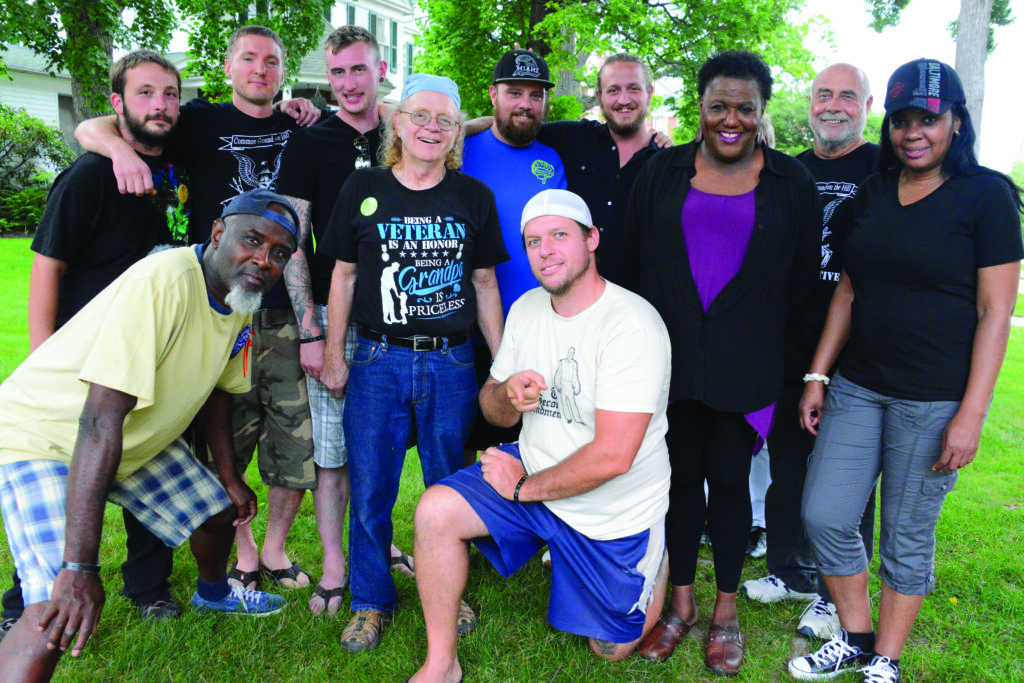
Now in its fifteenth year, The Veterans’ Initiative at Traditions Week will provide a creative space for Veterans to share their common experience among themselves, as well as with others who listen. Michael said, “We take the warriors who serve our country and we train them; they do their work as requested; and then we forget about them. . . We honor them, but unless we hear them, I’m not sure that we follow up right.”
Programming is accessible for a full-time weekly fee, or a part-time fee per class period. College credit is available for an additional fee. Courses are offered and labeled as appropriate for the categories of true beginner, advancing beginner, beginner/intermediate, intermediate and advanced.
Room and board is available at an additional cost for both out-of-towners and locals who want to become immersed in Common Ground’s culture and linger for fellowship after evening programs have ended.
The Roots Music and Arts Festival on July 13th on the McDaniel campus is the culmination of the second Traditions Week and open to the public. It will feature songwriter Kristen Grainger & True North; the three-instrument national champion Bryan McDowell; Steve Martin Banjo Award winner Victor Furtado; Mandolins on the Hill; Walt Michael & Co.; Grammy nominee Guy Davis; and many others. Attendees can enjoy a juried art show and food vendors.
Each year at the Roots Music and Arts Festival, Common Ground on the Hill presents the Robert H. Chambers Award for Excellence in the Traditional Arts. Doc Watson was the first winner in 2000. Other notable bluegrass legends who were award recipients include Ralph Stanley, Hazel Dickens, Jesse McReynolds, The Kruger Brothers, Tim O’Brien and Tony Ellis. This year’s recipient will be Lea Gilmore.
The first show aired by David Letterman after the terrorist attack of September 11, 2001 was broadcast on September 19, 2001 and featured Odetta (Holmes) when she sang “This Little Light of Mine” with The Harlem Boys Choir. Chosen by the Letterman producer to radiate hopeful optimism, it was not the first time Odetta had been held out as a cultural icon. Dr. King had referred to Odetta as the “Queen of American Folk Music” and others have referred to her as the “Voice of the Civil Rights Movement.”
In July 2002, as the United States was rolling out the National Strategy for Homeland Security and building up the military forces for the eventual invasion of Iraq, Common Ground presented the Robert H. Chambers Award to Odetta. Odetta’s acceptance speech came at a time when many Americans were still grieving from the shocking events of September 11, 2001.
Her remarks summarized the purpose of Traditions Week and validated Common Ground’s hopeful mission when she said, “I’ve been needing some good news and I found it here at Common Ground on the Hill.”
Deer Creek Fiddlers’ Convention
In March, the Maryland State Arts Council presented the coveted Heritage Award to Common Ground on the Hill for production of the annual Deer Creek Fiddlers’ Convention, now in its 53rd year. The award commended Common Ground for offering “supportive space in which musicians, dancers, singers and songwriters from diverse traditional music backgrounds can connect, learn from one another, and compete.”
Until May 31st, entries from virtual contestants will be accepted by Common Ground as contestants in The Fiddlers’ Convention. Video entries will be judged separately from those competing in person. Tuition for Traditions Week will be awarded as a contest prize.
This year’s annual Deer Creek Fiddlers’ Convention will be held at the Carroll County Farm Museum on Sunday June 2nd. Danny Paisley and the Southern Grass will perform at 6:00, following a full day of individual and band music competitions, and southern Appalachian clog dancing.
Fall Programming
The October issue of Bluegrass Unlimited will provide results of this year’s songwriter and Fiddlers’ Convention contest winners; announce Common Grounds’ fall and winter program schedule, which includes a January event in the Arizona borderlands south of Tucson and a concert lineup from October through April; explain the creation and opportunities of The Steve Mandell Memorial Music Scholarship Fund; and the share colorful and moving story of the Veterans’ Initiative, which has evolved since 2010 from Traditions Week.