Walkin’ in My Shoes
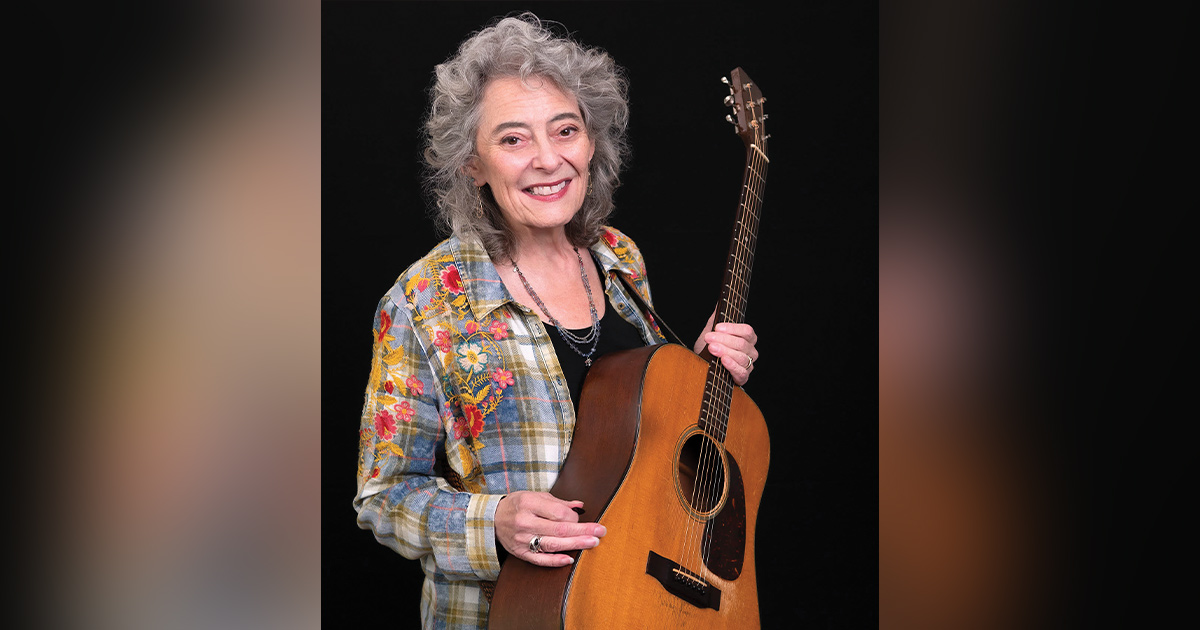
Photo by Irene Young
Maybe there really was something in the water in San Francisco back in the day. “The City,” as it’s called throughout northern California, is different from other American cities in countless ways: historically, culturally, politically, demographically and on and on. The poet Dylan Thomas once wrote, “You wouldn’t think that such a place as San Francisco could exist,” and he wasn’t far off the mark.
One of the many ways the San Francisco Bay Area—which includes Oakland, Berkeley, San Jose, Santa Rosa, Sunnyvale, Fremont and several more cities and towns—differs culturally from the rest of the world is the leading role played by female musicians in the bluegrass and old-time country music community.
Bluegrass came later to the Bay Area than it did to many other parts of the country, and because of that, the music and its surrounding community of musicians developed along its own trajectory. Bluegrass here has always been much more of a chosen path than a cultural inheritance with fixed traditions and proscribed gender roles. The players made up the rules as they went along.
As Kathy Barwick, Dobro player and lead guitarist in the All Girl Boys, pointed out in Murphy Henry’s landmark book Pretty Good for a Girl, “Because there was little or no established tradition of bluegrass in California, women didn’t need as much to ‘break into’ something…the bluegrass tradition was built by men and women together.”
Beth Weil, who played bass with the Good Ol’ Persons, said in the same book, “Music knows no gender here…It never occurred to us not to play bluegrass. We thought we could do it, because there was nobody saying we couldn’t.”
However it happened, and for whatever reasons, female musicians and singers played a much more central role in the Bay Area bluegrass and old-time world than they did anywhere else in the country. From the very beginning, the scene has been home to first-rate female instrumentalists; dynamic singers and songwriters; accomplished bandleaders; and mostly-female bands like the Arkansas Sheiks, the Good Ol’ Persons and the Any Old Time Stringband. One woman who has been there almost from the start is Kathy Kallick, who’s still blazing trails nearly fifty years after starting her musical career.
Singer / songwriter / guitarist / band leader Kathy Kallick was born in 1952 in Hyde Park, on the South Side of Chicago, not far from the University of Chicago, and raised 45 minutes north in Evanston, Illinois, not far from Northwestern University. Her father, Bruce, was a mathematician who studied at both schools and taught at UC. Her mother, Dodi, was a folksinger who helped establish the thriving Chicago folk club network and scene in the 1950s and 1960s.
Both of Kathy’s parents were musicians who had come to folk music in the 1950s. Kathy grew up surrounded by music and started taking guitar lessons from her mother at age 10. “All the Good Times are Past and Gone” was the first song she learned. She started writing songs four years later.
Her mother was her first musical influence and source of material. Kathy didn’t know it at the time, but many of the songs she learned from her mother’s singing—My Home’s Across the Blue Ridge Mountains,” “Down in the Willow Garden,” “Footprints in the Snow,” “Hello Stranger,” “Shady Grove”—were also in the bluegrass repertoire. Dodi also gave her a bit of advice that has stuck with Kathy throughout her career: “If you care about the words you’re singing, then sing them so people can understand what you’re saying.”
Kathy headed west in 1973 to attend the San Francisco Art Institute, intending to be a painter who made music on the side. Exactly the opposite happened. She heard bluegrass for the first time, and she was a goner. She hung out at Paul’s Saloon, ground zero for the lively Bay Area bluegrass scene, absorbing the music and the zeitgeist of the community.
She vividly remembers the moment the light switched on. “I remember it very clearly,” she says. “I went to Paul’s to see a band called Phantoms of the Opry. That band was definitely my introduction. I loved Pat Enright’s [later of the Nashville Bluegrass Band] singing. That was the first thing that hooked me in, his bluesy singing. I loved Gene Tortora’s dobro playing, which was also bluesy and went so well with Pat’s singing. I just loved that band.”
In 1975, while Kathy was still a student at the Art Institute, she (playing bass), Laurie Lewis (fiddle), Barbara Mendelsohn (clawhammer banjo), Dorothy Baxter (guitar) and Sue Shelasky (mandolin) performed three songs at Paul’s Saloon, and then at an open mic at the Freight & Salvage coffeehouse in Berkeley. That was the birth of the Good Ol’ Persons.
The GOP was one of the first all-female bands in bluegrass-adjacent music and, consequently, one of the first to showcase women songwriters and lead instrumentalists and singers singing in “non-traditional” keys for bluegrass. The band wasn’t quite bluegrass, but was open about that fact. The stance was: “We’re not a bluegrass band, but we do play bluegrass.” They also played folk, country, old-time, Celtic, Cajun and anything else they fancied, as well as a smattering of original material.
The band’s first album, Good Ol’ Persons, was released by Bay Records in 1977, the same year Kathy received her BFA from the San Francisco Art Institute. The only change in personnel from the original line-up was that Sue Shelasky had been replaced by her brother, fiddler, mandolinist and renowned joke wrangler Paul Shelasky. Helping out on the album were local friends Robbie McDonald (banjo), John Stafford (clarinet) and Ray Skjelbred (piano), the latter two on Paul’s timeless classic “Rutabaga Boogie.”
The material on the band’s debut set the tone for their subsequent albums—a mix of bluegrass (“Think of What You’ve Done,” “Another Night” and “Big Sandy River”); old-time tunes and songs (“Texas,” “High on a Mountain,” “Sweet Sunny South”); and originals by Kathy Kallick (“Pretend You’re Mine,” “Don’t Come to Me,” “You’re the Song”).
By the time of the band’s second album, I Can’t Stand to Ramble, was released by Kaleidoscope in 1983, Kathy and Paul Shelasky were the only hold-overs from the debut. They were joined by Bethany Raine (bass and vocals), Sally Van Meter (dobro, banjo) and John Reischman (mandolin). This was a durable line-up that lasted several years and recorded two subsequent albums, Part of a Story (Kaleidoscope, 1986) and Anywhere the Wind Blows (Kaleidoscope, 1989), with fiddler Kevin Wimmer replacing Paul Shelasky on the latter album.
The Good Ol’ Persons hung it up in 1995, after twenty years and five critically acclaimed albums. The band celebrated its time together with Good N’ Live: 20th Anniversary Collection on Sugar Hill. The 19-song album included selections drawn from five concerts over a seven-year period (1988-1991), three in the Netherlands and two in Vancouver, British Columbia.
Kathy began releasing solo records while still in the Good Ol’ Persons, with What Do You Dream About? (1990), a record for children and families, with assistance from GOP bandmates John Reischman and Sally Van Meter, mandolinist Butch Waller from High Country and others. She released three additional albums for Sugar Hill during the decade: Matters of the Heart (1993), Use A Napkin (Not Your Mom) (1995) and Call Me A Taxi (1996).
During her time with the GOP, Kathy also made time for a couple of short-lived projects that stretched her as a musician. After transitioning from bass to guitar in the GOP, Kathy got a chance to hone those chops in Old Friends, with Keith Little (banjo), Gene Tortorra (dobro), Laurie Lewis (fiddle) and Nancy Josephson (bass). From there, Little recruited the self-described “fledging guitar player” into the Frank Wakefield Band, led by the legendary (and legendarily weird) mandolinist. Fiddler Darol Anger and bassist Todd Phillips rounded out the group.
“That group was my trial-by-fire as a guitar player,” laughs Kathy. “The band got a lot attention because of who Frank was. It was daunting enough just to play guitar, but Frank would come over and stand by me and try to mess with me, turning the beat around like he does and grinning at me like a maniac. I felt exhilarated and terrified pretty much the whole time. I think of it as a brief and challenging part of my development as a bluegrass guitar player.”
Kathy formed the Kathy Kallick Band in 1996 with Avram Siegel (banjo), Tom Bekeny (mandolin) and Amy Stenberg (bass). This line-up stayed together ten years and recorded a pair of albums, Walkin’ In My Shoes (Live Oak, 1999) and, with the addition of fiddler Brian Wicklund, Warmer Kind of Blue (Copper Creek, 2005).
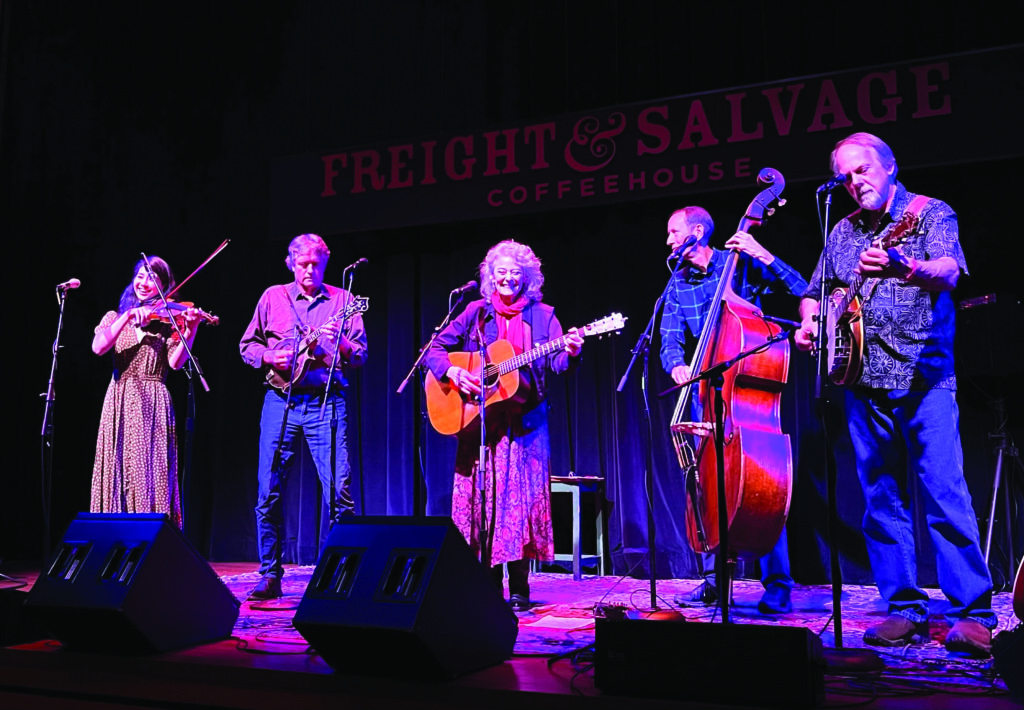
By the time the band’s next album, Between the Hollow & the High-Rise (Live Oak), was released in 2010, Kathy and Tom had been joined by Annie Staninec (fiddle), Greg Booth (banjo and dobro) and Dan Booth (bass). Renowned bassist Cary Black replaced Dan Booth in 2012 after the release of Time (Live Oak), and that’s the KKB lineup in 2023, and the quintet that recorded the two most recent KKB albums, Foxhounds (2015) and Horrible World (2018), both on Live Oak.
This is a band that has weathered remarkably little turnover during its nearly thirty years together: one guitarist, one mandolinist, two fiddlers, two banjo players and three bass players.
As Ray Edlund, a longtime bluegrass DJ on KPFA in Berkeley, notes, “Kathy picks her musicians well. She knows what sound she wants, and she gets it.”
“Kathy’s a wonderful band leader,” says fiddler Annie Staninec, who joined the band in 2008 and won the IBMA Instrumentalist Momentum Award in 2015. “I always feel very much respected and appreciated by the way she treats us and takes care of us. She’s extremely considerate about everyone’s needs, she always makes sure we’re taken care of financially, and makes sure travel and accommodations are comfortable.
“She’s a prolific songwriter, but a very democratic leader. She always asks for our input on a song she’s written, and I feel like her songs really develop during band practices as everyone contributes and discusses ideas for arrangements. I think that’s a big reason we have a unique sound. A lot of the original material comes from her, but the sound develops due to the specific personnel, because everyone brings their own influence, and it shows in each song.”
Tom Bekeny, the jazzy mandolinist who has played alongside Kathy for almost thirty years, agrees with Annie, saying, “As a bandleader, Kathy is generous…We feel valued, and I think it’s important to her that we stay happy and satisfied in our music-making. Aside from her wonderful singing, the best thing about playing in the Kathy Kallick Band is working with a bandleader who writes such great original material—material that covers a lot of ground from straight-ahead bluegrass to more folk-influenced singer-songwriter-oriented songs. It’s rewarding to have a hand in bringing these songs to life and getting the first crack at interpreting them on the mandolin.”
“My style of leading a band,” explains Kathy, “is to constantly consult with everybody and get everybody’s input all the time. It’s completely egalitarian; everybody has a voice. Everything is collaborative. That said, there are times when I have to be the bandleader and do things that don’t really come naturally to me. But that’s not often because everybody is as into this band as I am. There is no weak link in this band. It’s really pretty easy.
“I learned a lot about leading a band from my years of being married to Butch [Waller, leader of High Country, Kathy’s husband from 1975-91]. He was my mentor. He fed me a lot of bluegrass information. I watched him lead a band and all that went into it.”
Kathy reunited with Good Ol’ Persons co-founder Laurie Lewis in 1991 on the album Together (Kaleidoscope). In the album’s liner notes, Kathy said making the record took “me back to the days when I first got hooked on bluegrass…From the beginning there’s been something familial about our singing together, as though we’d been doing it all our lives.” Laurie agreed: “From the first duet that Kathy and I sang, there was an immediate feeling of ease and excitement.”
That came through loud and clear on the record, the highlights of which included a couple of Delmore Brothers’ classics, songs from Bay Area musicians Jody Stecher, Jim Mintun and Debby Cotter and three of Kathy’s originals, “Count Your Blessings,” “Don’t Leave Your Little Girl Alone” and “Just Like Rain” (co-written by John Reischman). Kathy and Laurie were helped in the studio by a stellar cast of musicians including Tony Furtado (banjo), Charles Sawtelle (guitar), Sally Van Meter (dobro) and mandolinists Tom Bekeny, Tom Rozum, John Reischman and Butch Waller.
Kathy and Laurie had a brief—but award-winning—reunion five years later when they collaborated on a superb version of one of Bill Monroe’s classic songs from the early 1950s, “True Life Blues” (which was actually written by Pete Pyle). It was the title song from True Life Blues: The Songs of Bill Monroe (Sugar Hill, 1996). The album won the Grammy Award for Best Bluegrass Album and IBMA’s Recorded Event of the Year award the following year. Kathy and Laurie were joined on the cut by Mike Marshall (mandolin), Tony Trischka (banjo) and the album’s producer, Todd Phillips (bass).
The two old friends got back together in 2014 for Laurie & Kathy Sing the Songs of Vern & Ray (Spruce and Maple Music), a tribute to Vern Williams and Ray Park, a powerful traditional bluegrass duo active from the mid-1950s to the mid-1970s. Vern and Ray are iconic figures in northern California, still revered there among bluegrass musicians almost fifty years since they last performed together. Laurie describes Vern and Ray as the California “bluegrass scene’s closest tie to the ‘real deal.’”
Joined by Patrick Sauber (banjo), Keith Little (banjo, guitar, harmony vocals), Annie Staninec (fiddle), Tom Rozum (mandolin, harmony vocals), Sally Van Meter (resonator guitar), Kathy and Laurie tore through a set of such Vern & Ray favorites as “Cabin on the Mountain,” “Montana Cowboy,” “Touch of God’s Hand,” “My Old Kentucky Home” and “Oh! Susanna,” the latter two songs a nod to Vern’s and Ray’s fondness for the classic songs of Stephen Foster.
“Laurie and I have been playing together for so long that sometimes we have the same thought at the same time,” says Kathy. “It’s a fairly sibling-ish relationship. Our tribute to Vern & Ray was such a labor of love that we just dove into the repertoire and divided it up pretty easily. Neither of us minded if one chose to sing the lead, as the harmony is at least as much fun!”
The next several years brought more solo records, including Reason & Rhyme (Copper Creek, 2004), Cut to the Chase (Live Oak, 2014) and Count Your Blessings—A Bluegrass Gospel Collection (Live Oak, 2011), with cuts drawn from earlier albums as well as previously unreleased cuts by Good Ol’ Persons; Laurie Lewis and Kathy Kallick; and Kathy, Keith Little and John Reischman.
Kathy has seen the world touring with the Good Ol’ Persons and the Kathy Kallick Band.
“I’ve been so lucky to travel all over Europe and the British Isles, Canada, Japan, and the U.S. playing music,” she says. “The Good Ol’ Persons played a wide variety of venues: famous clubs in big cities, tiny pubs, a tithing barn in England, a huge country festival in Switzerland with big stars, and a small restaurant in Austria that was close enough to the Czech Republic for a large group of fans to pile into one car and make the trip to see us, just as the iron curtain was falling.
“On one of the tours with the KKB, we played in a huge casino in Slovenia. We didn’t know what to expect, and, indeed, the people didn’t speak or understand much English, but we played all the different songs we could think of and tried to communicate. The audience, mostly men, just sat there, politely clapping their hands, but not really showing much reaction. As we finished our set, we turned to each other and said, ‘Well, they hate us, huh?’ “But then those guys came up to us with tears in their eyes, took our hands in theirs, and said, ‘This is the sound of freedom.’ They’d listened to Radio Free Europe on the radio forever, and this was the first time they’d ever seen the music played live. They were thunderstruck! We were humbled by this and it left an indelible mark.”
In 2002, Kathy recorded My Mother’s Voice (Copper Creek, 2002), a deeply personal album containing songs Kathy learned directly from her mother. In addition to a couple of songs featuring the Kathy Kallick Band, Kathy is also joined on the record by such friends as Lynn Morris, Peter Rowan, Suzanne Thomas, Jody Stecher and Kate Brislin, and Claire Lynch.
Kathy’s recording, What Are They Doing in Heaven Today (Live Oak, 2022), is an intriguing, wide-ranging and outstanding double-CD she shares with her mother, Dodi Kallick. The first CD functions as a sequel to My Mother’s Voice and features Kathy in a variety of formats and configurations with musical friends from throughout her career. There are duets with Molly Tuttle, Jim Hurst, Tristan Scroggins and Annie Staninec; and trios with Laurie Lewis and Suzy Thompson; Cliff Perry and Laurel Bliss; and Mike Compton and Joe Newberry.
The second CD contains performances by Dodi Kallick from 1963-69. With the exception of a cut from a concert at the Old Town School of Folk Music in Chicago, the CD comes from performances on “The Midnight Special,” a long-running folk music program on WFMT-FM. The tapes of the show were unearthed from the WFMT archives in 2007, and Kathy has wondered since then what to do with the recordings, which she talks about in the sidebar.
“The most recent album by the Kathy Kallick Band is The Lonesome Chronicles released in July by Live Oak Records. “‘Lonesome’ is such a big part of bluegrass,” Kathy explains, “and always has been. One doesn’t have to dig deep to get that, but the deeper you go, the more variety there is in the quality of lonesomeness—from the upbeat, happy-sounding lonesome to the heart-wrenching, desperate lonesome.”
This musical exploration of lonesome showcases six new Kathy Kallick compositions, several written (as you might guess from the titles) in response to the pandemic: “Just Lonesome Ol’ Me & the Radio,” “It’s Lonesome Everywhere I Go,” “This Old Lonesome Song,” “25 Chickens,” “The Weather Song” and “I’m Gonna Miss This House.” Original tunes by Greg Booth and Tom Bekeny and a few well-chosen covers of Ted Lundy, the Osborne Brothers and others round out the album.”
Kathy has been writing songs since she was a teenager, and has now had more than 100 of her songs recorded, but it took her several years to write what she considered to be a proper bluegrass song. “When I first started learning bluegrass,” she remembers, “there weren’t many bluegrass songs that spoke to my experience, to the woman’s point of view. I’d been writing songs since I was a young teenager so it seemed natural to try and write my own bluegrass songs. Not so easy! My first forays into this were more like country songs, or folk songs just played too fast.
“I finally cracked the code. It took recognizing that Bill Monroe wrote songs about himself, his life, and his experience, not because he knew he was creating the repertoire for a genre, but because that’s what he wanted to sing about. So, I wrote my first song [“A Broken Tie”] about my experience: a woman growing up in Chicago whose parents got divorced. New territory for bluegrass.
“When the Good Ol’ Persons went to play at Bill’s Bean Blossom Festival the first time, he stood out in the audience and watched our set. Afterwards he asked about the song and I told him I’d made it up. He said, ‘Well, that’s a fine bluegrass number and I want you to sing it every time.’ And so, I have.
“With any recording project, the first task is to choose material. Whether it’s one of my solo outings, or a band album, I start thinking about songs I’ve written, and working to collect things that form a theme. I have a lot of songs, old and new, and any new recording venture launches more new songs! I’ve been blessed with a generous muse. But the songs have to fit together and weave a story of some kind.”
In addition to writing songs, Kathy completed two novels and a short story during the pandemic. She is also an accomplished educator who has taught classes in singing, songwriting, guitar and band coaching as part of such music camps as the California Bluegrass Association Music Camp, Rockygrass Academy (Colorado), Augusta Heritage Center (West Virginia), Sore Fingers (England), Puget Sound Guitar Workshop (Washington), Nimblefingers (British Columbia, Canada), Bluegrass at the Beach (Oregon), Walker Creek Music Camp (California) and the California Coast Music Camp.
Kathy was five months pregnant with her and Butch Waller’s daughter, Jennifer (now Juniper) when the Good Ol’ Persons did its first grueling five-week tour of Europe and the U.K. On the band’s second European tour, Jenny was now fifteen months old and a road-hardened veteran. “The tours were challenging but okay,” Kathy remembers.
“The band wanted to keep our tours and concerts and continue performing even if it meant bringing a baby along. They were so supportive! I had a lot of people tell me I was crazy to tour with a baby, then toddler, and that may be true, but I did it anyway. There were friends who toured with us as a ‘nanny,’ and that was essential, as I didn’t have any family members or other way to do this. We wore those volunteers out pretty quickly and hardly anybody signed on for a second tour!”
When asked if she thought that motherhood had hindered her career as a musician, Kathy turns philosophical. “I’ve always juggled playing as much as I could with being with my children as much as I could,” she says. “I didn’t want parenting to take the hit. I hauled Jenny around with me pretty much everywhere we went until she was three and a half.
“When my second daughter Riley [with husband Peter Thompson, who she married in 1993] came along, things got a lot more complicated. I don’t think I pursued my career with the tenacity that would have been needed to take my career to ‘the next step.’ But it all feels fine to me. I feel like it went far enough. I’m not a household name, but I got to play all over the world and make a lot of records with a lot of truly wonderful musicians. I think it all worked out okay.”
Kathy is somewhat uncomfortable being called a trailblazer for other women in bluegrass. “In retrospect, I can maybe see a little bit of that,” she says, “but at the time, I was just putting one foot in front of the other. I was increasingly aware that I was doing something that felt uphill, and challenging. I was frustrated with the annoying things I had to deal with, like festival promoters who wouldn’t pay me, because you don’t transact money with women. I had to get one of the male band members go get our pay.”
But she thinks things are getting better. “Something that’s very dramatic to me,” she says, “is that when I started, the power in bluegrass was held by elderly gentlemen. They were revered and respected. Young people—men or women—were not respected or holding any of the power at that time. Now, I feel that much of the power in bluegrass is held by young women. It’s a complete, radical turnabout. But, still, the wheel of progress moves slowly.
“In recent years I’ve had a lot of women come up to me and tell me how important it was for them to see me doing what I was doing. That means so much, and the fact that some younger women are starting to cover my songs is wonderful for me. When I saw Molly Tuttle sing and play ‘A Broken Tie,’ I cried like a baby. It was ridiculous, but it was so very moving for me. I feel like if that continues, and the songs stay relevant, that’s a wonderful legacy.”