
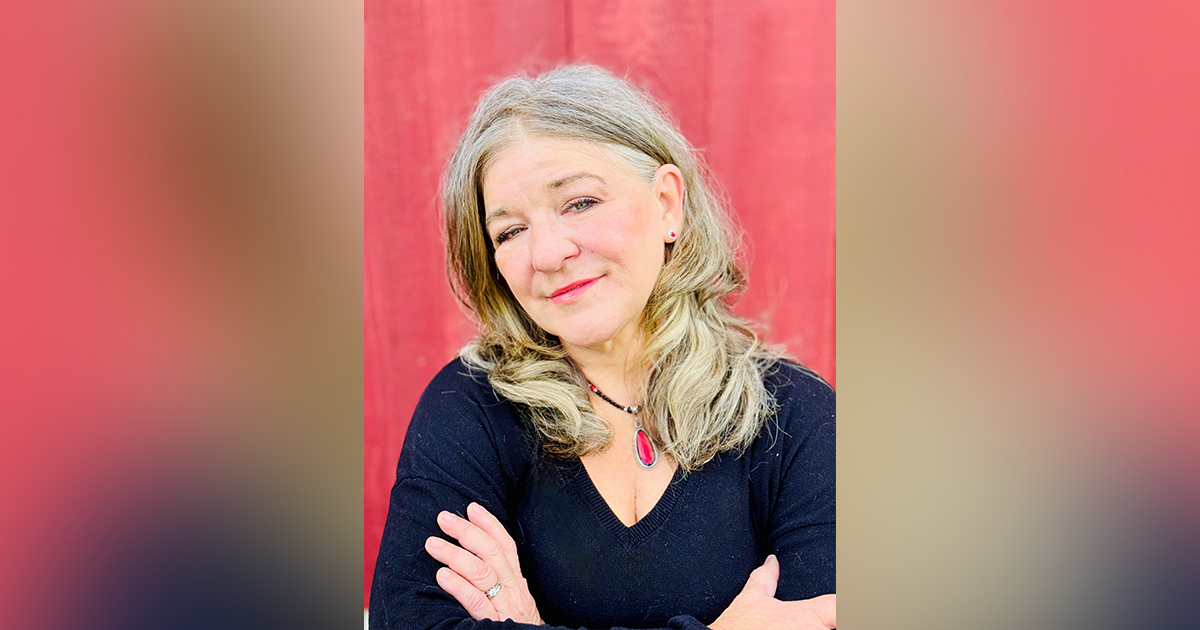
Valerie Smith Co-writes with her Great-grandmother in Maggie’s Journal
Photo by Joe Zauner
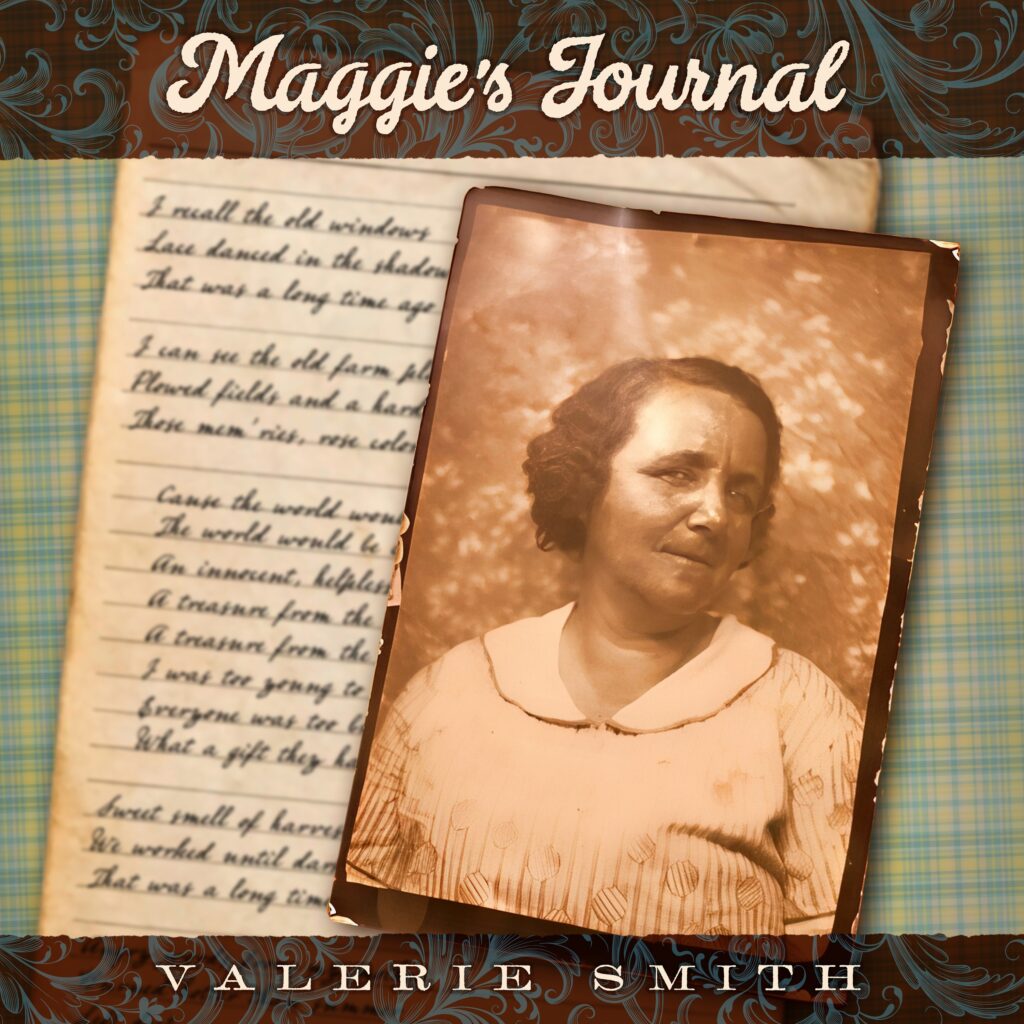
Maggie’s Journal, based on “true life” stories (as Bill Monroe would say) from Valerie Smith’s great-grandmother, was released January 5, 2026. The 30-track double album is a testament to the survival and incredible resilience of an ordinary American woman from Missouri in the post-Civil War era. It’s also one of the most emotional, heart-wrenching, starkly realistic concept albums ever to be recorded in the history of the genre.
Maggie’s Journal is a double album with 36 pages of lyrics and liner notes, and it’s also a musical that can be re-created onstage as a theatrical production.
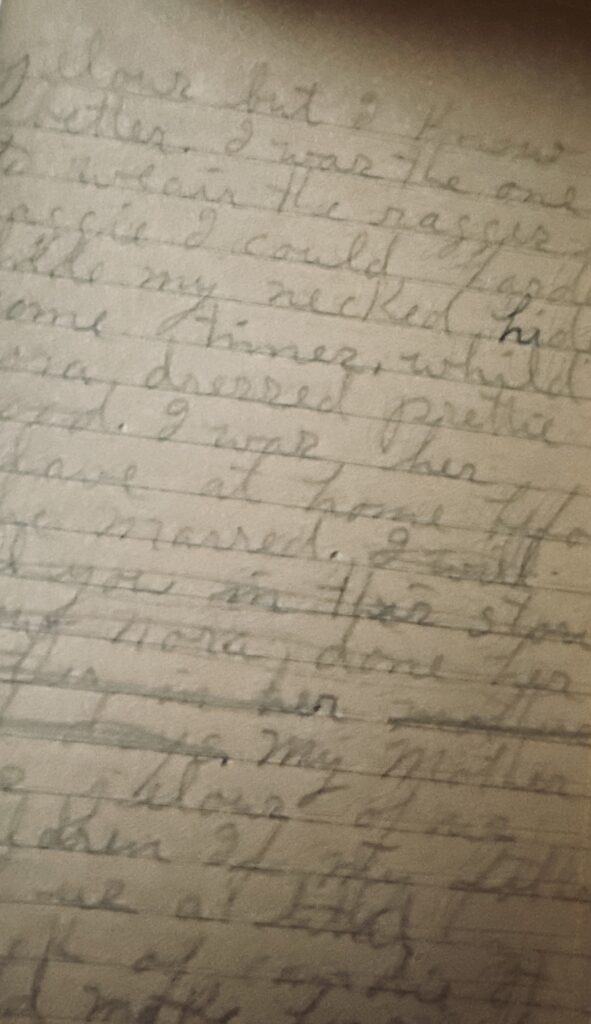
“Maggie’s Journal is the story of my great-grandmother Margaret Attebury Brooks-McCamis based on her own words. The Car Load Tablet notebook was found decades after her death in an attic trunk by my cousins Kathy Jones Eads and Fonda Wells,” Valerie explained. The handwritten journal revealed Maggie’s cruel and lonely early years. Married at 14 to a violent man, she hid a gentle soul in an effort to simply survive a cruel, unkind, sometimes violent upbringing in Gower, Missouri. “Her journal became the heartbeat of a 12-year labor of love,” Val said. “I set her raw, emotional entries to 14 original songs, blending bluegrass, folk, and Americana roots music, alternating them with readings from her journal, with me voicing Maggie’s words. Her personal and unflinching story is a window into Midwestern American history, women’s and children’s rights and education, and the enduring courage of the human spirit.”
The recording was produced by Donna Ulisse, who co-wrote several of the songs with Valerie, along with writers/singers Daniel Crabtree and Ann Miller. Musicians on the tracks include Cody Kilby, Stephen Burwell, Evan Winsor, and Scott Vestal, along with vocals from Smith, Ulisse, Crabtree, and Mike Rogers. It was recorded and engineered at Tim Carter’s Tree House Studio in Ridgetop, Tennessee and at Scott Vestal’s Digital Underground in Greenbriar, Tennessee.
Valerie said she remembered hearing about the journal when she was 12 years old. Maggie was his grandmother, and the family talked about how tough she was. She owned a general store in Plattsburg, Missouri, and she was known to be a very strong, stubborn, witty person. “When my second cousins found the journal, typed it up, and sent it to all of us, it was shocking to me,” Val said. “It really touched me. It taught me some things about strength, faith, and the will to keep moving forward when things are tough. I feel like I co-wrote with Maggie,” she said.
“I had a copy of the journal for several years, when one morning I dreamed about Maggie. When I woke up, the music was there. At first I thought the journal might be too private to share, but I kept dreaming about Maggie and songs kept popping out. I finally decided to take time out of my music career and go on this long journey. The more I thought about her and kept dreaming, the more I felt like she wanted her story to be told,” Valerie said.
“I thought her story would help people going through tough times,” Valerie said. “If Maggie had not escaped from the Jim O’Dell marriage at a young age, my father and my immediate family would not exist.” As a child and a young woman Maggie wrote that her life had no purpose, and she was only allowed to go to school through the fourth grade. “I became convinced that her story should be told, and the best way to do that was through music, co-writing with a great-grandmother I never met,” Valerie said. “It took 12 years! I had to learn how Midwestern people spoke in the 1880s—the language and the history of the time, just 20 years after the Civil War had ended. I had to look at Maggie’s life from different perspectives.”
It’s startling to realize how much life has changed for children and families in just four generations. Things were rougher, it was difficult for poor people to get an education, and young children worked like hired hands—some walking barefoot in the winter like Maggie to bring buckets of water to a cabin. She was beaten by both parents with belts and buggy whips if she didn’t meet their expectations, and she was forced to continue working when she was sick. She often didn’t have enough to eat. She was not her mother’s favorite, to put it lightly. “It took a long time for people to recover after the Civil War,” Valerie said. “Lives and livelihoods were destroyed. Family members died.” Maggie’s cruel story was not that uncommon, unfortunately, for children forced to grow up before their time. Valerie researched other diaries and journals from that era in the Library of Congress. “A lot of them talk about neglect and abuse,” she said.
Why write a concept album when the rest of the music world is releasing singles instead of albums? Valerie Smith is a uniquely creative force of nature, and the decision to bring Maggie’s Journal to life was not based on typical business models. “If we all made music for marketing and radio only, then nothing innovative would ever be created,” she reasoned. “I appreciate being played on the air, but not everything’s about radio. I’ve always been a tone painter with my music,” she said. “I believe in being true to the music, the project, and what they demand. It’s like a painting on the wall with many textures and colors. When I run out of things to say that mean something to me, then I no longer need to release music. I’d rather be known for doing things with great care and quality, and for the right reasons, than just cranking out songs so that people know my name. This idea demanded a concept album. It was a story.”
Producer Donna Ulisse said, “I had written an album years ago titled All The Way to Bethlehem where I became every character in the Christmas story. It turned out to be an eleven-song cantata, and I really enjoy sharing this show with live audiences every year. Valerie and Joe Zauner attended one of the performances in Northern Virginia a few years back, and afterwards she called wanting to know if I’d be interested in helping her with a similar concept. After hearing about the discovery of her great grandmother’s diary, I was intrigued, and then I became hooked when she sang me a few songs she had already started writing. Her melodies commanded attention, and I was inspired to help write lyrics and watch as Maggie’s life jumped out in song. Valerie put the incredible honor of producing this project into my hands and graciously gave me free rein over how it would sound. What a gift this has been, to get to know Maggie and Valerie through this incredible story. I can’t wait for the world to hear it!”
Ulisse enjoys producing, with a particular niche in working with singer-songwriters. “Part of what I offer as a producer is spending lots of time poring over the songs being considered and helping with rewrites and edits as needed,” Donna said. “I’m usually given a direction for the voice behind each song. With Valerie’s connection to the songs, it was like walking into a dream production. Valerie Smith is one of the most talented vocalists I’ve ever had the pleasure to work with. The one little hiccup was having all this laid at my feet during 2020! Because of COVID 19, we had to skate through most of the recording, limiting how many players we would have at any given time, and navigating being in close quarters at the studios. I actually think the struggle of getting this recorded added to the emotional aspect this album needed!”
The double album took a while to come together, both women agree. “After reading and re-reading Maggie’s words, we had to make sure all the elements were included in song,” Donna said. “If the story was lacking, we would start writing a new song, making sure we told the bulk of her story. Then we spent time putting the dialogue together for the interspersed speaking sections between the songs, setting each song up with background in Maggie’s own words, directly from her journal. I will admit, this story was a heavy one to write,” Donna said. “Maggie’s sorrow is ripe and raw, and Valerie, the other writers, and I did our best not to cheat a single teardrop. The redemption in this saga is reached at the very end, but getting there is an emotional ride. So, grab some tissues because you’re not going to want to miss the journey!”
“There were a lot of tears and sadness,” Valerie agreed, “but it was an honest reflection of Maggie’s story. When she started out her journal with the words, ‘Oh, dear readers…’ she was telling us she wanted her story to be told. It was never about me. It was Maggie’s story and what the world was like at that time. I would have loved to make up something happier,” Val smiled, “but that’s not how things went. I think artists are uniquely built to express pain and emotion. Music can be healing and cathartic for the singer and the listener.” Hard life stories are as important to tell as the glad ones.
“Some of Maggie’s songs I can’t stop crying about,” Valerie said. “I’ve battled learning disabilities all my life, and I’ve been so self-conscious about having dyslexia. I’m passionate about education. Sometimes after I perform ‘Dear Reader’ from the Maggie album, people will come up to my merch table and tell me about how they weren’t able to stay in school because they were needed to work on a farm or in a coal mine,” Valerie said. “Education is so much about our identities, how we view ourselves and the world, and about self-confidence. Everything looked backwards on the chalk board when I was in school, and reading comprehension was hard for me. In college I was in the library all the time, but I got through with a 3.8 grade point average. I earned a Bachelor of Science degree in music education in choir and vocal performance at the University of Missouri in Kansas City, and I wouldn’t trade that for the world,” Val said.
One of the things that lengthened the years of preparation was the process of getting legal permission from all of Valerie’s relatives. “In Maggie’s will she doesn’t specify who owns the journal,” Val said, “so I needed to talk to my family and say, ‘Is this OK?’ There wasn’t one relative who said ‘no.’”
Valerie was grateful to have award-winning singer songwriter and band leader, Donna Ulisse in the producer’s chair. “Sometimes the songs are so personal, they’re uncomfortable. Donna is so talented, and I wanted to work with someone who was a clever songwriter. I learned a lot from her, and a lot of the songs would not have been the songs they are without her. It was also wonderful to have a great singer like Daniel Crabtree, with his powerful voice and faith and empathy. Mike Rogers and Donna made the harmonies look so easy. I released it in the winter time, but it was meant to be listened to in parts. I can’t imagine listening to the whole thing in one setting. It’s like a book that you would read, a little at a time.” Perhaps the best advice is to start the album in the winter, finishing up in early spring or early summer.
Valerie has been approached by directors who would like to present Maggie’s Journal. Plans are being discussed for a music theater production at the Patsy Cline Theater in Winchester, Virginia. Smith has considered a historic videography, but for now she’s producing short videos.
Keep an eye on https://thevaleriesmith.com for more developments, and to ask Valerie questions about Maggie’s Journal. Autographed double-album CDs with the extensive liner note booklet may also be ordered at the website.
Valerie Smith taught music in Missouri and Tennessee schools before pursuing a music career. Her debut album, Patchwork Heart (2001), featuring the hit “Red Clay Halo,” was followed by multiple acclaimed releases including Turtle Wings (2000), No Summer Storm (2003), Here’s a Little Song (2013 with Becky Buller), Wash Away Your Troubles (2014), Small Town Heroes (2016), and Renaissance (2021). Several of her songs have topped radio airplay charts, she earned two IBMA Recording Event of the Year trophies in 2001 and 2006, and she contributed to the Grammy-nominated Clinch Mountain Sweethearts with Dolly Parton and Ralph Stanley. Val was a key voice in the Daughters of Bluegrass series created by the late Miss Dixie Hall, she leads a band called Liberty Pike, and she has toured globally. Valerie owns Bell Buckle Records, Bell Buckle Media, and Bell Buckle (internet) Radio.
Smith would like her friends and colleagues in the bluegrass music world to know that she is “enjoying life in Somerset, Virginia, growing tomatoes, and going to Friday night jam sessions where she plays old-time fiddle.” She has joined the Rotary Club and stays active in her community, while playing selected dates and writing songs. She also stays incredibly busy producing and mentoring other artists in the media and promotion—sometimes a number of bands and labels at a time. “It will be interesting to see where bluegrass music goes next, in the path of overcoming the challenges of technology,” Valerie notes. She wonders out loud if some bluegrass artists who have been in the business for several years could enhance their presentations with story-telling. “There are a lot of old, historical stories in bluegrass that artists could tell and create a very interesting presentation,” she said. “Something like that could really capture the imaginations and hearts of fans.”
Veteran radio broadcaster Bill Foster programs the schedule for 20 DJs on Smith’s Bell Buckle Radio, but she doesn’t tell the broadcasters what to play on their programs. At the time she started the internet radio channel, it appeared that FM and AM were shutting down a lot of bluegrass shows on terrestrial radio, and it was Val’s way to give back to the music.
As determined and persistent as her great-grandmother Maggie, Valerie Smith is a unique voice and creative force in bluegrass music. “One of the early marketing themes for Bell Buckle Records was ‘Dare to be different,’” Valerie recalls. “There are so many different kinds of bluegrass and old-time and folk…so many colors. I’ve always liked that. I don’t want everything to be the same. I’ve had a wonderful time, and I couldn’t ask for a better experience,” she continued. “I’m still a teacher at heart, and sometimes it’s time to let the spotlight shine on someone else.”
The current line-up of Liberty Pike includes Jack Dunlap (guitar and mandolin), Vince May (Dobro), Stephen Hu (bass), Joe Zauner (banjo and guitar), and Shannon Bielski (fiddle). Valerie says she has always enjoyed introducing young artists in her band who will go on to make their own marks in the future—people like Andy Leftwich, Matt Leadbetter, Brandon Bostic, and Becky Buller, to name a few. “I love the opportunity to share the stage with them,” Smith said. “Everybody needs a door opened for them, and you can learn from young people, too.”
On the last track of the new album listeners will be thrilled to hear that a bit of good luck and a lot of love are finally headed Maggie’s way in the next chapter of her life—but we won’t spoil the story with too many details!