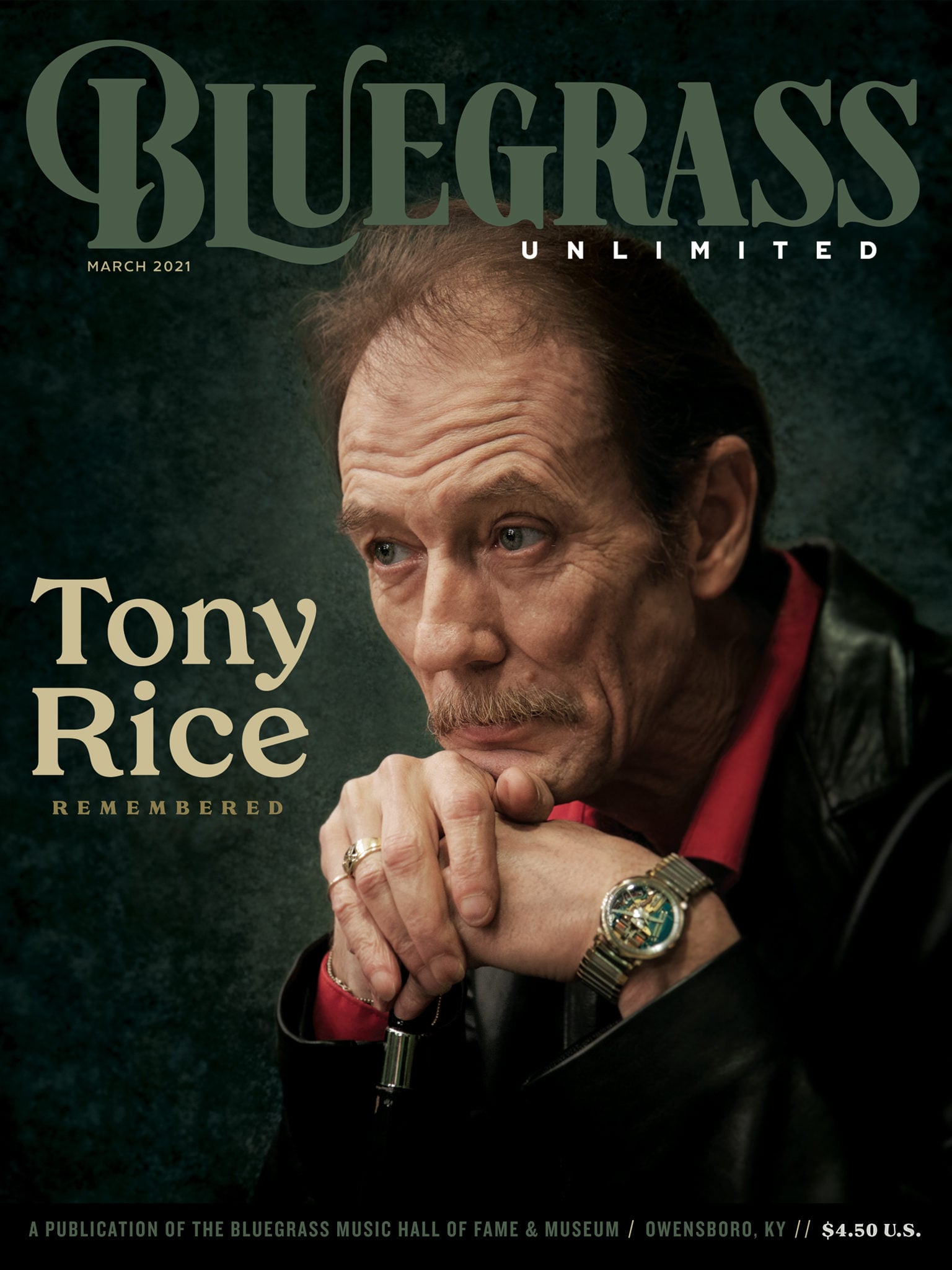
Tony Rice & The Grisman Years
During a video interview with Bryan Sutton, which was broadcast online shortly after Tony Rice’s passing, Blue Highway guitarist—and Tony Rice biographer—Tim Stafford pointed to three “schools” of Tony Rice’s development as a guitar player. The first occurred during Tony’s early years, when he was greatly influenced by Clarence White. The second was when he performed with J. D. Crowe in the early 1970s. The third occurred during the years Tony spent with David Grisman in the late 1970s. It was an astute observation which holds a lot of truth.
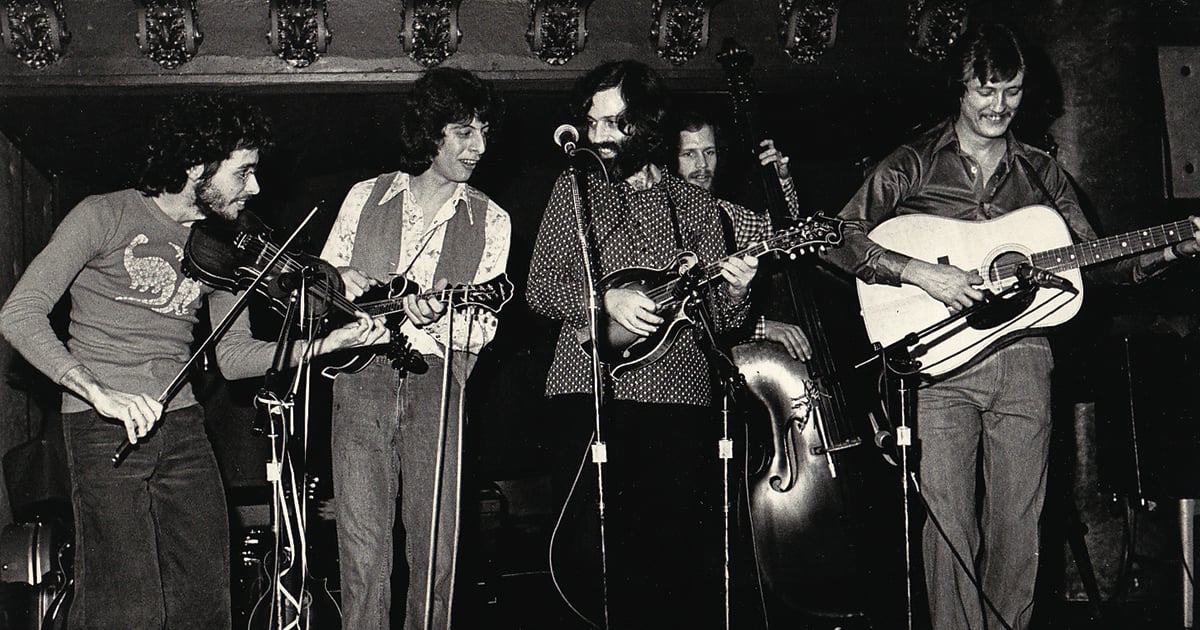
A few years ago, someone gave me a bootleg disc of one of the early live performances of the David Grisman Quintet. During the show, Grisman introduces the band members and then points to John Carlini—who was in the audience and was the band’s musical director—as the “sixth member of the band.” While the five band members who were on stage that night, which included Tony Rice, have been strongly associated with the group—and Dawg music—Carlini’s role with the band, and with the music of Tony Rice, is not as well-known or understood.
Carlini’s behind-the-scenes influence was integral to the band’s success and the development of its members as musicians. When asked about Carlini’s work with the band, Todd Phillips—originally the second mandolin player in the band and later the bass player—said, “John was an arranger and a coach. We were self-arranging at first. When John came in, he helped with harmonies and chord voicings. He’d say, ‘Let’s try this, let’s try that.’ It was constructive to have that outside influence. He also helped us rhythmically. He broke us down into sections and would rehearse two or three of us together. It was like being under a microscope. It was very revealing. We were tight before working with John, but he tightened us up and that was the goal. It catalyzed the band.”
When asked if Carlini worked with band members individually, Phillips said that John spent the most time with Tony.
As a result of John’s work with the Grisman Quintet, some have referred to Carlini as Tony Rice’s guitar “teacher.” However, John is very uncomfortable with that description of his relationship with Rice, referring to it more as a mutually beneficial collaboration. He says, “Some people say, ‘Here is the guy who taught Tony Rice.’ That is crazy! He helped me just as much as I helped him.”
John Carlini’s relationship with David Grisman dates back to the mid-1960s. Carlini first met Grisman in New York while filling in on guitar with Bill Keith’s band. John said, “Bill Keith was teaching banjo lessons at Izzy Young’s Folklore Center in the West Village. I signed up for lessons. Bill started helping me straighten out some of my Scruggs style technique and as we were working on it, I think it was apparent to Bill that I was a musician. He asked if I played the guitar. I told him that I did. I got a guitar out and we picked a few tunes together.”
After hearing John play the guitar, Keith asked “You working this weekend?” Evidently, Keith had a weekend gig at Gerde’s Folk City and his regular guitar player, Jim Rooney, was sick. Keith asked Carlini if he would like to sub and John agreed. When he showed up at the first show, John met the other members of the band, who were David Grisman on mandolin and Gene Lowinger on bass. After performing together that weekend, it would be years before John crossed paths with Grisman again.
In 1974, Carlini was playing guitar for a touring company of the Broadway musical Grease. Upon arrival in San Francisco, they discovered that the city’s musician’s union required that the theater company hire local musicians for the show. The road musicians had to sit out the run in San Francisco—which was to last six to eight weeks—but they still got full pay. John said, “I was staying in this hotel in San Francisco with nothing to do. I looked out the window at a club across the street called the Boarding House. The name on marquee was Artie Traum, with special guest David Grisman. So, I went over to the see the show.”
Grisman remembered Carlini from the Bill Keith shows in New York and asked John if he wanted to do some jamming after the show. John said, “He came over to the hotel room and we ended up jamming until about 3 a.m. We were playing tunes like ‘Dawg’s Rag’ and ‘Thailand.’
After the jam session, Grisman told John that he was losing his guitar player (Jerry Garcia) and asked if John wanted to join the band. Carlini traveled to Mill Valley, met Garcia, and rehearsed with the band. He loved the music that they were playing, but he had a tough decision to make. His job with the Broadway show included a generous contract and a pension. There was security in that job. But, Grisman was offering him an opportunity to be involved with writing and making new music, so John took the leap. This band, the Great American Music Band, included Grisman on mandolin, Richard Greene on violin, John on guitar, Ellen Kearney on guitar, and Joe Carroll on bass.
John said that the band began “rehearsing like crazy.” John helped with the writing and arranging. The band began to book shows and got jobs opening for headliners such as Maria Muldaur, Bill Monroe, and the Grateful Dead. John remembers, “Our last gig was at the Fox Theater in Venice, California. Kenny Loggins and Jim Messina came to the show and bought Richard Greene out of the band. So that was the end of the band.”
Carlini returned to the East Coast and got a job working as the assistant conductor for the Ice Capades show. After he had completed two tours with that show, John got a call from Grisman, who told him that he had put a new band together and had hired a great guitar player named Tony Rice. Grisman asked Carlini if he would be the band’s musical director. John said, “Every member of the band was a great bluegrass player, and they also could play some swing. But in order to play the music David was writing, they needed to be coached in how to play grooves other than the cut time of bluegrass, like samba and bossa.”
Once again, Carlini quit his stable gig and joined Grisman. He said, “I met the guys and they were such fantastic players. I was coaching, arranging and writing, and it was like a dream come true. When I was in college at Berklee I had always had it in mind to write acoustic string band music and here was that opportunity.”
John said that his challenge was to get the band to play as a unit in swing time. He said, “I conducted to a click until they got it together. I had them play phrases to a click, lines to a click, solos to a click, and whole arrangements to a click. Sometimes I worked with the whole band, sometimes just two or three guys at a time. Having them make the transition from bluegrass to samba, bossa, and swing jazz was the trick. David had a rigorous rehearsal schedule, and after those rehearsals I would rehearse the band without David. It was a 24/7 effort.”
When the band wasn’t rehearsing, they were listening. “We were listening to John Coltrane, Chick Corea, Bill Evans, Oscar Peterson, Sonny Rollins, and other jazz greats,” Carlini explains. Throughout this time, John and Tony Rice were forming a special bond that would last for decades. John said, “Our friendship grew and we had a lot of good times together. We were continually jamming and working on stuff. Some of it we would later record on our River Suite for Two Guitars album. We also went to see shows at the Great American Music Hall and other local venues. I remember seeing Bill Evans, McCoy Tyner, and Dexter Gordon, to name a few. We would listen to these guys and talk about the music.”
When asked what he specifically taught Tony about guitar playing, John replies, “I mostly helped him with jazz chord voicings and positions. Tony already knew some jazz chords, but he didn’t know how to put them together to introduce a strong growth within the changes using alternate voicings.”
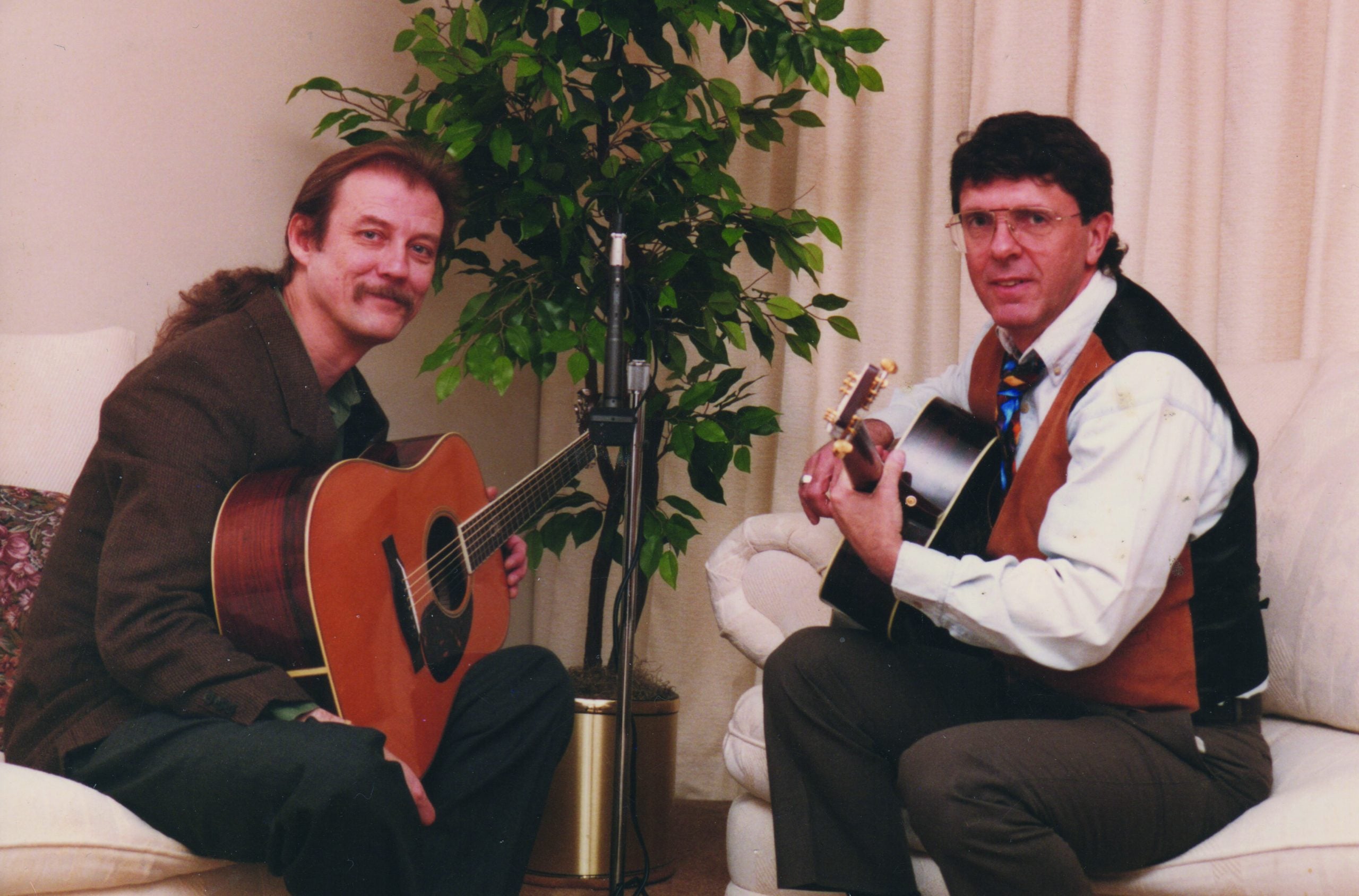
Beyond any physical or theoretical aspects of playing the guitar, John said that he introduced Tony to different kinds of music that he hoped would inspire him. He said, “Tony appreciated anyone who could play well, no matter what style of music. I would put on a recording of something like John Coltrane’s ‘Impressions,’ which is basically a Dorian modal tune. The sound of the Dorian mode minor scale has a major sixth. My goal was not to teach the theory to Tony, but to have him hear it, internalize it, and use it.”
Carlini continued, “Songs like ‘Pretty Polly,’ and ‘Scarborough Fair,’ are Dorian. For the most part, so is Grisman’s ‘16/16.’ We would do things like practice playing in the Dorian mode so that he could internalize that sound. Once you do that, you can recognize it when you hear it, and you can make that an instinctive part of your musical vocabulary. That is the kind of thing that Tony and I were chasing. That is what I brought to the table.”
Whenever he is talking about his time spent with Tony Rice, John is always quick to point out that he also learned from Tony. He said, “I’m an introverted guy and when I met Tony, I was an introverted player. Tony taught me how to take the sound of the guitar and make it front and center. He knew how to utilize a pick to bring out the sound of a guitar and put that sound out in front of you. He could play one note and that note would just live out in front of the guitar. It takes a lot of mastery and control and Tony got that across to me.”
Carlini worked with the David Grisman Quintet for about two years. “We rehearsed until David felt that the band was ready. Then they played some gigs. I was the musical director behind the scenes. I was listening to every note, every solo, every chord, and I would make notes. After a show we would go back and rehearse again and work on very specific stuff from my notes and we also worked on the things that David wanted fixed,” Carlini recalls. “The guys in the band were all committed to it.”
Carlini left the band when he got a job working with Federico De Laurentiis on the movie King of the Gypsies. “The movie producer, Federico DeLaurentiis (son of Dino DeLaurentiis) was producing the film, King of the Gypsies. One evening Federico was in Tower Records on Sunset Strip. The David Grisman Quintet album happened to be playing on the house system. He instantly decided that that was the music he wanted in the film. He contacted David and hired him to compose the score. Knowing that the film would also need an orchestrator for the scoring, David suggested that Federico hire me. Tony also had an opportunity to add some some blazing Gypsy/bluegrass guitar solos,” Carlini adds.
After leaving the Grisman band in about 1977 (he would return later as a member of the band and was the guitar player on the Grammy-nominated Dawg 90), John stayed in contact with Tony, explaining, “Tony and I always liked playing together. We have completely different styles, but it was that style difference that pulled us together. We found common ground.”
Over the years, the two guitar masters had talked about recording together and it finally came to pass in 1995 when they recorded River Suite for Two Guitars. Due to their respective busy schedules, they were only able to perform together live one time.
Recalling the time he spent with Tony Rice, John says, “We always had great times. When I was directing the band, it was very exciting. It has also been satisfying to me when I have listened to Tony’s later recordings and I hear things that were based in concepts that I showed him, and he had taken it in his own direction. He did his thing with it. I think that is what we all try to do.”
Todd Phillips was in the Grisman band when Tony first joined them and then he later played with Tony in the Bluegrass Album Band in the 1980s. Asked about Tony’s development as a guitar player during those years, Todd said, “The arc of Tony’s development between 1975 and 1985 was tremendous. He developed his craft, his skill, and his mechanics. Because I was there with him, I didn’t notice it happening. But now, I’ve gone back to watch him on YouTube and I realize it was happening.”
As a guy in the rhythm section, Phillips makes particular note of Tony Rice’s development as a rhythm player. “Tony’s bluegrass rhythm with the Bluegrass Album Band was more interesting than when he was with J.D. Crowe,” Phillips states. “His rhythm was strong and driving, yet fluid, gentle, light and comfortable at the same time. He was the grand piano of rhythm players in bluegrass. He didn’t just play boom-chick. There were polyrhythms superimposed on top of that. I think he developed his right hand from listening to great jazz drummers like Elvin Jones. His right hand was like a great drummer’s ride cymbal. Through that, he added a lot of new content to bluegrass rhythm. (Tony) had the beginning of that when he joined the Grisman band. That band gave him the opportunity to use it and expand.”
Tony Rice was an incredibly innovative guitar player. He took bluegrass guitar playing in new directions and influenced generations of guitar players who would come after him. But even innovators have their influences and without musicians like Clarence White, J.D. Crowe, David Grisman, and John Carlini, Tony may have not been able to blaze those same pathways or reached the level of musicianship that he was able to attain.
Isaac Newton is famously quoted as saying, “If I have seen further, it is by standing on the shoulders of giants.” It is by standing on the shoulders of musical giants that we continue to maintain the unbroken circle of bluegrass music.
For guitar players, Tony Rice was a guy who certainly had some very strong and broad shoulders…as did those whose shoulders he stood upon.