
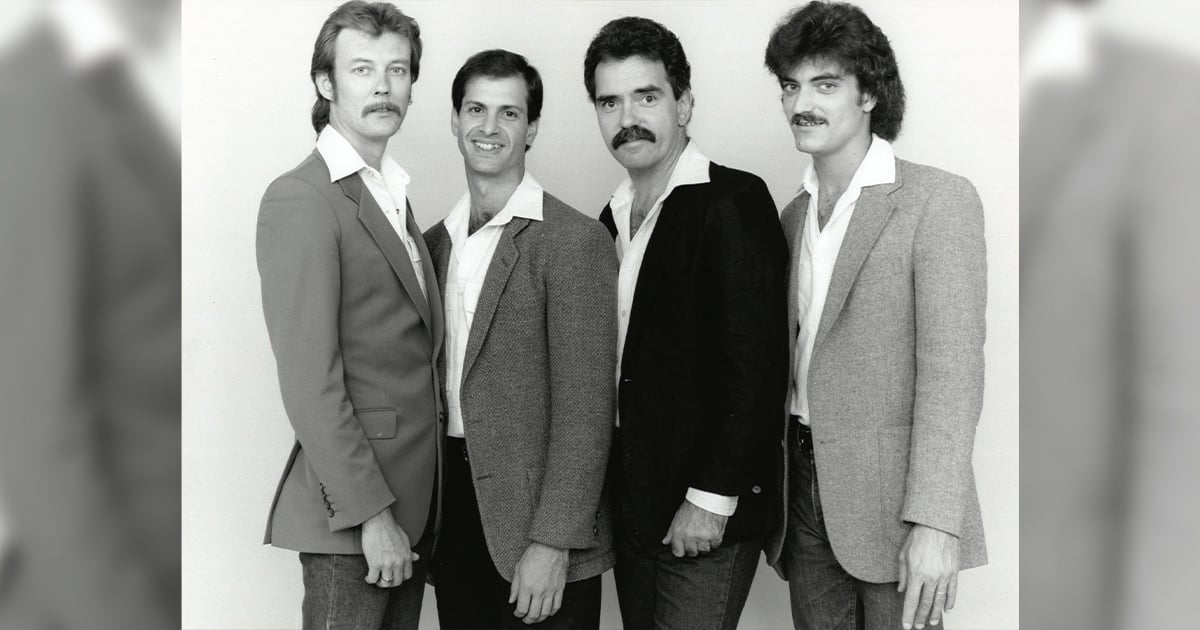
Tony Rice Interview with Pete Wernick
September 14th, 1985
Editor’s Note: This article is a transcription of a conversation between Pete Wernick and Tony Rice recorded in 1985—a transitional period in Tony Rice’s career. We thank Pete Wernick for providing us with the transcript and this unique glimpse into Tony Rice’s life at that point in time.
PW: …on the road in Dahlonega, Georgia. It’s the middle of September. I’m talking with Mr. Tony Rice.
TR: Mr. Rice to you is correct.
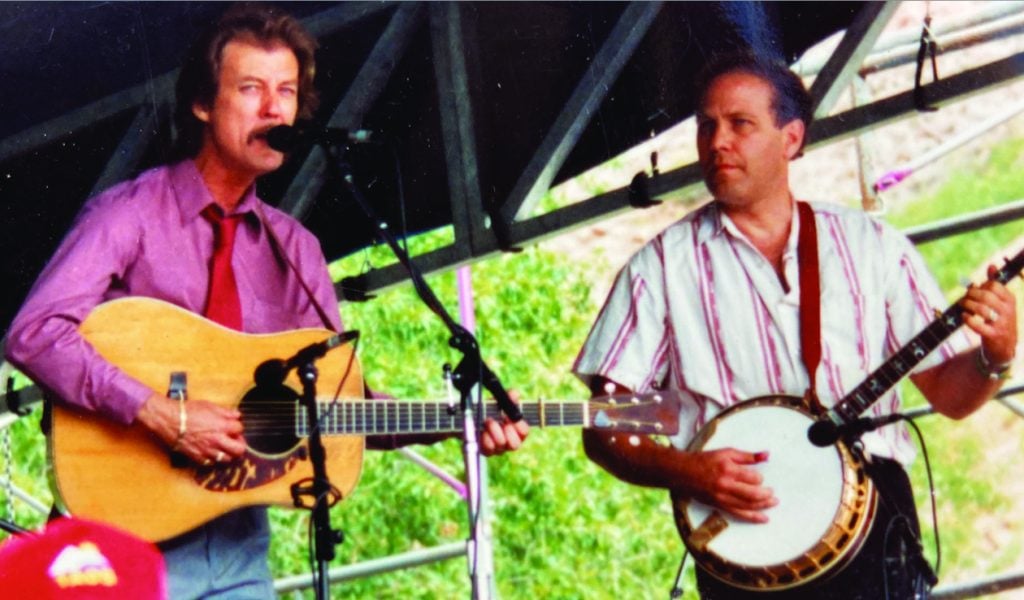
PW: Mr. Rice, right. Tony, we’re really glad to see you back on the road with a real fine band. Why don’t you just run down who’s in your band because out in Colorado we haven’t seen you yet except, well, in Telluride, but not in the eastern part of Colorado.
TR: Mark Schatz is on bass, Jimmy Gaudreau is on mandolin and tenor vocal, my brother Wyatt Rice is on rhythm guitar and some lead guitar, too.
PW: What got you inspired to hit the road with a band again after being inactive for a while?
TR: Just love of the music.
PW: You’ve been touring since when this year?
TR: It’s been an active band since February.
PW: We’ve seen you out in California and you were at Denton, North Carolina and here in Dahlonega, Georgia. Where are some of the other stops out and around where you’ve been?
TR: Boston we played, Washington D.C. we played two or three times, upstate New York we played, Sacramento, Norfolk, Virginia; Louisville, Kentucky, yeah. We’ve played around here and there. We haven’t had that many dates in over a seven-month period. But this band, I feel is like it’s in its infant stages, so it’s taken it a while to get off the ground. But nonetheless, it’s certainly going forward as opposed to backwards and there’ll be more work.
PW: And it sounds better every time, it seems like. You’ve got a really good sound jelling. One thing I’ve noticed is that there’s this real phenomenon, that there’s a real excitement out there when you get on stage. A lot of times people haven’t seen you in a real long time and there’s just this ferocious excitement somehow crackling through the air. What does that do to you when you get out on stage and everybody’s going, “[panting] There he is,” you know? What do you do?
TR: I don’t know. It makes me feel good, but it also makes me feel like I don’t want to overexpose myself. If I could play four dates out of the week I’d do it, but I feel like doing that at this point might be too much. So, I’d rather just expose myself on a level parallel to my acceptance—right?— to that level of excitement that I’m getting from the crowd. I don’t want to overdo it. Let’s put it that way.
PW: Well, I think that’s a good idea, personally. It seems really effective that, having laid low for a while, getting back out there, like I say, there’s this real excitement and you have a lot of new material that people haven’t heard you do before. And speaking of that, tell us about the album that you’ve been working on.
TR: Oh, the new album. I really don’t like to talk a lot about my new projects before they actually have at least been mixed, but this one is sort of a different thing for me. I will say that it’s an all-acoustic album. It has piano on it, it has a very light drummer on two or three cuts, soprano saxophone, Jerry Douglas is on it, Vassar Clements, Sam Bush, Jimmy Gaudreau, Mark Schatz, Todd Phillips is on a couple of cuts, brother Wyatt’s on some, Kathy Chiavola is singing the harmony vocals on some of it.
PW: And you mentioned before when we were talking that you add three originals on there, three original new songs?
TR: No, there’s only two. I dropped one of my originals. I’ve opted to redo it for a later project.
PW: Are those the first original tunes that you recorded, songs?
TR: No. There was a song about 12 years ago, “California Autumn,” which I still detest, but I mean, I haven’t made an effort to put stuff to pen and paper for a long time. In fact, my first effort to do it was a tune that was going to be on this album and I still don’t like it so I’m going to take some more time with it, maybe even try to author a few more tunes between now and the next recording project.
PW: Do those songs just kind of pop out of you or did you make a conscious effort and say to yourself, “I’d really like to get some vocals”?
TR: No, they really came from a bummer in my life [laughs].
PW: Did they help you? Writing them, did that help you work out the bummer at all or…
TR: Oh, no. I don’t think that was anything significant—that didn’t do anything.
PW: What are the names of the songs?
TR: Well, let’s see. There were going to be two vocals. One was “Beneath Southern Rivers” which is going to be the title of the album, and the other tune was “Never Meant To Be,” and two other originals are instrumentals. They’re still intact and they will be part of the project.
PW: Great. Well, you really had a lot of great creative output over the years and everybody, of course, will be looking forward to hearing the next step. And in particular I wanted to ask you a little bit about singing. For a while you weren’t advancing yourself as a singer.
TR: Right.
PW: You were putting out instrumental albums. And what was the progression that kind of got you back into getting out there as a singer as well as an instrumentalist?
TR: I don’t know. I started to take interest in it again, not as a singer but I started to take interest in songs again, you know, to express myself through the poetry medium. I wanted to do that, so I just started it. The voice has never been a challenge to me. I sing like I talk. I don’t practice scale-singing or none of that stuff and I don’t think about it. I just do it. Whereas, for years, the guitar was really a challenge. It was just about to beat me into the grave at some point I went at it so hard. But singing is just the opposite. It’s just something that I do, it comes natural to me, and I can express myself through the voice now which is something that I didn’t want to do before. I tried to do it with a guitar and it worked, but I didn’t make money at it [laughs], so…
PW: I see. Well, the recordings are still around and it could be that more and more interest in you as a performer vocalist might get people back into your guitar playing. Who knows?
TR: Maybe so.
PW: That’d be great.
TR: [laughs] I hope so.
PW: What was it about those songs—you said the songs got you in it. What were some of the things about them that made you want to sing them? If you can think of particular songs that you just felt like, “Man, I’ve got to hear myself sing this, I’ve got to get it out”?
TR: Well, a lot of Gordon’s material has always inspired—Lightfoot—has always inspired me to do stuff because he has songs that lend themselves to instrumental arrangements that are outside of the norm. You have enough within one of Gordon’s tunes, or quite a few of his tunes, you have the flexibility there to put together a tune that’s musically interesting as well as a song that is used to try to convey a particular message.
PW: Yeah. I like the way you put that. Of course, you’ve done the bluegrass albums. I guess there’s four of them?
TR: Right, yeah.
PW: And so you made part of your mark as a bluegrass singer and then you do other things that are—especially with the instrumentation that you’re currently working with on the record that you’ve been working on mixing now—some things that would have to be considered outside of bluegrass. Do you have a different way of going at bluegrass material than you have when you go at non-bluegrass material as a singer?
TR: Oh, no. It’s about the same. It’s not that drastically different, if at all.
PW: What is going on in your head or what do you try to do as you’re singing?
TR: Well, for one thing, with bluegrass it’s like there’s certain expectations that people have of you with that form of music, as you know, as a banjo player. There’s a certain drawl that you have to have with the voice to sing things. You have to sing “Blue Ridge Cabin Home” as if though you were born and raised in Tennessee or North Carolina or whatever, whereas with some of the other stuff that I do I’m a little conscious of it, of changing. To sing “Little Sadie” I would sing it phonetically different than I would “Your Love Is Like A Flower.” It’s just totally different.
PW: Why is “Little Sadie”? Because it’s an older-time tune or…
TR: I think of “Little Sadie” as coming from a different genre of music than “Blue Ridge Cabin Home” or something like that.
PW: Because of being older or just that it’s not typical bluegrass tune?
TR: It’s not typical bluegrass tune, right.
PW: Let’s see. Is there any particular thing that you look for when you’re singing or making selections for the bluegrass-album-type music? Are there any things that you really listen for in a bluegrass song that makes a special bluegrass song to you?
TR: Yeah. A tune that we all would like to do is what usually sets that up As it turns out it’s mostly from Flatt and Scruggs, Bill Monroe, Jimmy Martin, Jim and Jesse, occasionally Osborne Brothers, you know…
PW: Is it their original performance that kind of inspires you to get your hand in on it or…
TR: Yeah. Yeah.
PW: Is there ever a thing where you thought, “Man, I’d like to see what I’d sound like doing that particular song” or anything about your own way of…
TR: Of course, that is certainly a contributing factor to being motivated enough to do a sad tune, is that we like the original version enough, you know. We certainly don’t go after tunes that are like, “This performance stinks, but, given us doing it would sound good.” No.
PW: You’re not really exactly an elder statesman, but as a very respected figure in the field of acoustic and bluegrass music, is there anything that you’d like to say to teenagers out there?
TR: You know, I get asked that a lot and I still don’t have a definitive answer for it and maybe never will. I’m not going to say anything like “practice more” or “play scales” or any of that. I do what I do because I love it and when I do love it and like to do it, I do it. When I don’t like it, I don’t do it. So –
PW: Is that what you’d recommend to them?
TR: I would recommend that to them. I would certainly not recommend a rigid practice schedule of any kind, of making yourself play the banjo or mandolin or whatever four hours a day. I would recommend that if you feel like doing it from your guts, if you feel like, if you are hearing things in your head that you’d like to put down in musical terms and if you want to do that bad enough to do it, then you’ll find a way to do it. You’ll do it out of love of the music form. You’re not going to learn if you sit down for eight hours with a five-string banjo to learn Bill Keith’s solo in “Devil’s Dream” note-for-note. If you don’t really want to do it, you’re not going to do it. And even if you do work up his solo in “Devil’s Dream” note-for-note, he’s already done it better than you’re going to do it, so, I mean, do whatever you do because you want to do it, and as far as I’m concerned, there’s a whole lot of room for people as an individual. There’s a lot more room for creativity on a real individualistic level from people. Right? I’d like to hear more people out there playing their own stuff rather than being imitators. More innovators! More of them. I want to hear more of them.
PW: Right. Can you say what goes through your head if you happen to be walking through the parking lot at a festival and you hear 18 of your own licks strung together by somebody playing at a jam session? I’ve heard so many people who are borrowing heavily from your style.
TR: Well, a couple of things come to mind. One is that I’m definitely in appreciation of the fact that they have accepted my style the way they have and like it well enough to try to imitate it. But then on another level, I think they should be doing more stuff on their own because they’re not going to play my stuff like I play it. You know that yourself. You play banjo your own style. It would be worthless for you to play like J. D. Crowe or Earl Scruggs, so…
PW: Oh, I try anyway. [laughs] It’s an inspiration and it’s hard to—well, I mean, you probably have times where you want—where it kind of gives you a little charge to play something just the way Clarence White or Lester Flatt or anybody played something on the guitar that you admired, but obviously you have gone on to forge a very distinctive style.
TR: Well, you know, I like to think of my mentors. I really like to think of their individual levels of musicianship as being only skills for somebody like me. For example, Clarence White and Doc Watson, people like that. I don’t play like Clarence or like Doc. However, their particular styles were really instrumental in helping me find ways to create my own style, you know, and on that level, some plagiarism I think is valid. You know what I mean?
PW: I know what you mean.
TR: But, I don’t want to get too heavy with it because you can go on all night. But you hear what I’m trying to say.
PW: Yeah. I do. Well, just to kind of wind up, it’s almost been — you could even say it’s one of the bluegrass news stories of the year to see you out on the circuit, and the fact is, also you have moved from California now. Is that right?
TR: Mm-hmm. I’m in Florida, yeah, fishing. Yep. Absolutely.
PW: What part of Florida?
TR: It’s north of Tampa, a couple hours drive.
PW: Well, do you have any kind of reflection on the fact that you kind of had a whole life going out there in California for a while up sort of south of the Bay Area and now you’re back.
TR: Oh, I have no regrets, no regrets about the Grisman years in California, the totally instrumental years that I spent, you know. I have no regrets. I learned a lot of guitar from doing that. If I had, for example, moved out to California and got involved in a bluegrass band, I certainly wouldn’t have had that growth period that I had, you know, doing the thing with Grisman, that’s for sure. After I left him, I tried my own instrumental thing for a while, which I thought of as an extension of what he and Richard Greene had originated and it wasn’t publicly accepted and hence it wasn’t financially a feasible thing. But in any case, I’m pretty happy now musically because I like these tunes I’m singing and I don’t sing them the greatest but I have a good time singing them and I like the material, the chord changes. Some of the tunes are kind of a drag in terms of being a framework with which to really improvise over. Some of them are like vocally-oriented tunes and so they’re three chords or four chords and you know how boring that can get.
PW: I do it all the time and, boy, am I bored. Yeah. [Pete’s note: I was being sarcastic!]
TR: But I pretty much like the place that I’m in right now and the only thing I can hope to do is just expand on it.
PW: Well, that’s great. I’m sure looking forward to hearing the results, and I guess it’s been running through what I’ve said here, you’re overdue out here and it’s just great to see you back.
TR: It’s good to be back.
PW: In fine style, you know…
TR: And if everybody that interviewed me had questions as valid as yours, then it would be a lot easier done.
PW: All right. What’s one of the worst ones you get asked? And I won’t even ask it, but I just want to hear what it is.
TR: One of the worst ones is—what is a few of them? One is, “Where were you born?”
PW: Oh, that’s a wild question. I’d never think of that.
TR: Another one is, “How old are you?” Another one is, you know, “How did you start playing?” “How did you get involved in music?” Which to some people it might be interesting, but to me it’s not. I don’t remember starting to play. It’s always been part of me, so for that reason I don’t really like that question a lot.
PW: Well, you are from a musical family as far as I know. I don’t know much about your dad. I know he passed away a couple years ago.
TR: He was an amateur musician and he sort of liked Louvin Brothers, Reno, Smiley, Monroe Brothers, Delmore Brothers school of music. He was interested in it enough that he liked it on a level of being able to do some of it himself on an amateur level.
PW: Well, that’s something that you can tell people next time you get that question, go into a little tangent like that, really.
TR: Yeah, right. That’s what I usually tell them.
PW: I think it’s always inspiring to me to hear sometimes —well, like, Earl Scruggs is an idol of mine and he came from a family where everybody, just everybody in the family played, and that’s a lot different from the way I grew up.
TR: Good man, too, Earl Scruggs. Good dude.
PW: Good picker.
TR: Absolutely, yeah.
PW: Anyway, I don’t know. It’s natural for people to be interested in that, but you can’t make up a jolly new answer every time somebody asks you that one, that’s for sure. But anyway, life goes on and I’m glad to hear how your life has been going on.
TR: And I’ll tell you what I’d like to add, too, is that I’m glad to see Hot Rize progressing at the level that they are. That’s really satisfying to me. Absolutely. I’m glad to see that.
PW: You know, the Trailblazers are going to ask you to sit in with them one of these days if you get the right kind of outfit, you know.
TR: Hey, I’ll play with anybody, and if it don’t work out, they can always send me home, you know.
PW: All right. Back to Florida and go watch the hurricanes. Right? Well, the bus is about to leave and I better get on.