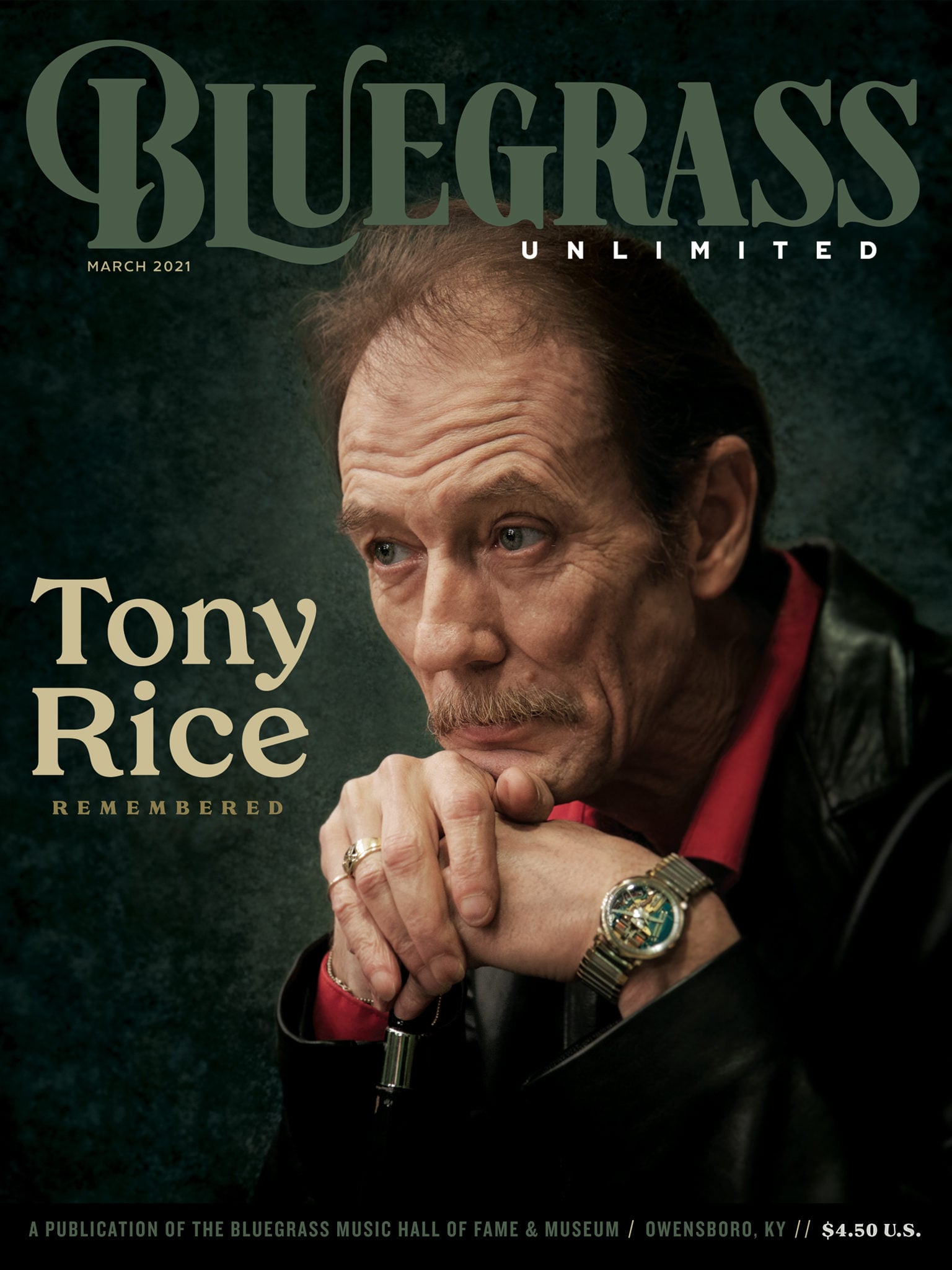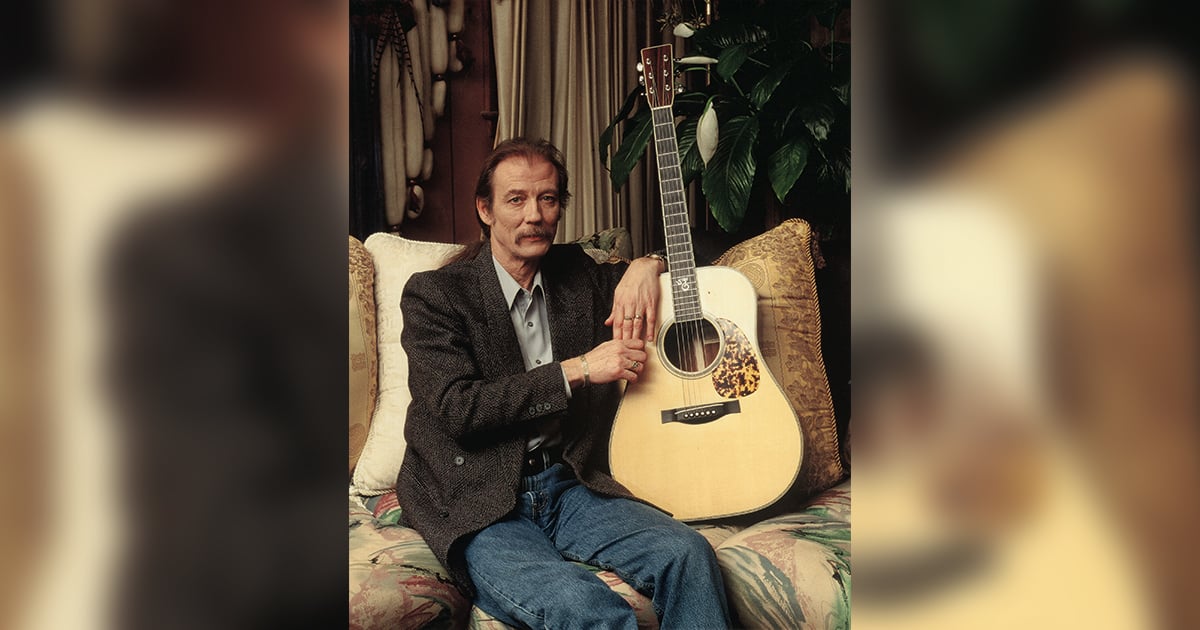
Tony Rice
A brilliant guitarist, vocalist, and creator of life songs who inspired a generation
In the summer of 2003, at the second Floydfest, the most anticipated headlining act on the bill was a special reunion of the David Grisman Quintet. Featuring Grisman, Darol Anger, Mike Marshall, Jim Kerwin and Tony Rice, it was the one show at Floydfest II where the rest of the top musicians still on the festival grounds showed up to watch this legendary band that fundamentally changed acoustic music in the 1970s. Earlier that day, while covering the festival for the now-defunct Gritz Magazine, I ran into Rice, whom I had met a few times previously.
“How is it going today, Tony,” I said. “Ah, Grisman has us rehearsing,” said Rice, in his trademark growl, not thrilled about the idea.
Under a tent backstage, the Grisman quintet did rehearse, and rightly so as Grisman’s dawg music is as complicated as it is delicate and beautiful. After they were done running through the concert’s set list, Rice called me over.
“Derek, do you mind doing me a favor?” said Rice. He pointed over to his big blue guitar case and said, “My shoulder is killing me today. Do you mind carrying my guitar up the steps to the stage for me?”
The Floydfest main stage sat high off the ground and there was about a floor and a half of steel steps that led up to it. When Tony was ready, he gave that look and I grabbed the guitar case, which was heavy and well-made, seemingly hurricane proof. As I followed him up the stairs, I thought about how cool this whole scenario was, as I helped a legend out on a summer day right before magic was to happen onstage. About 10 steps up, however, that is when it hit me. I was carrying “The Antique.” This was the exalted guitar that the whole world seemed to know about; the 1935 Martin D-28 that was once owned by flatpicking pioneer Clarence White and used to play some of the best music the bluegrass world has ever heard.
Once I was successfully on top, Tony put the case on a table and opened it up. I happily did Tony a favor, so I asked one of him. “Brother, would you mind if I just put my finger on this amazing guitar. I don’t want to pick it up. I don’t want to play it. I just want to feel the vibration from it.” He smiled and gladly said yes, and I rested my finger upon the wood. That is when I felt compelled to tell him the truth, because I might not ever have the chance again.
“I just want you to know that I have four pillars of guitar players that have influenced me the most in my life, that represent to me how the instrument should be played, and they are Duane Allman, for putting together a great inter-racial and improvisational rock band, Django Reinhardt, for the way he swung it, B.B. King, for teaching me that three notes can be better than 300, and Tony Rice, for showing me the way on the acoustic.”
If anyone out there was ever able to get to know Tony Rice even a little bit, there was a look that he got when he was truly humbled, a look down and a thing he did with his mustache when he didn’t know quite what to say, and a “Thank you” that followed. It was real.
It was also the last time I ever talked to him that way, and I think that is why we became friends. When we would see each other, I never asked him about his guitar technique, I never asked him how he played a certain lick or anything of the kind. In my opinion, he was bothered enough with that tiresome clatter of being surrounded by curious and worshiping guitar players and I didn’t want to add to it.
When I say I was friends with Tony Rice, I say it with a small ‘f.’ I never played with him onstage, I did not get that look that his band mates got when he wanted you to solo, I never did a road trip with him or anything of the kind. But, from that point on, every once in a blue moon, I would stay in touch with Rice and his wife Pamela by texting and the occasional phone call.
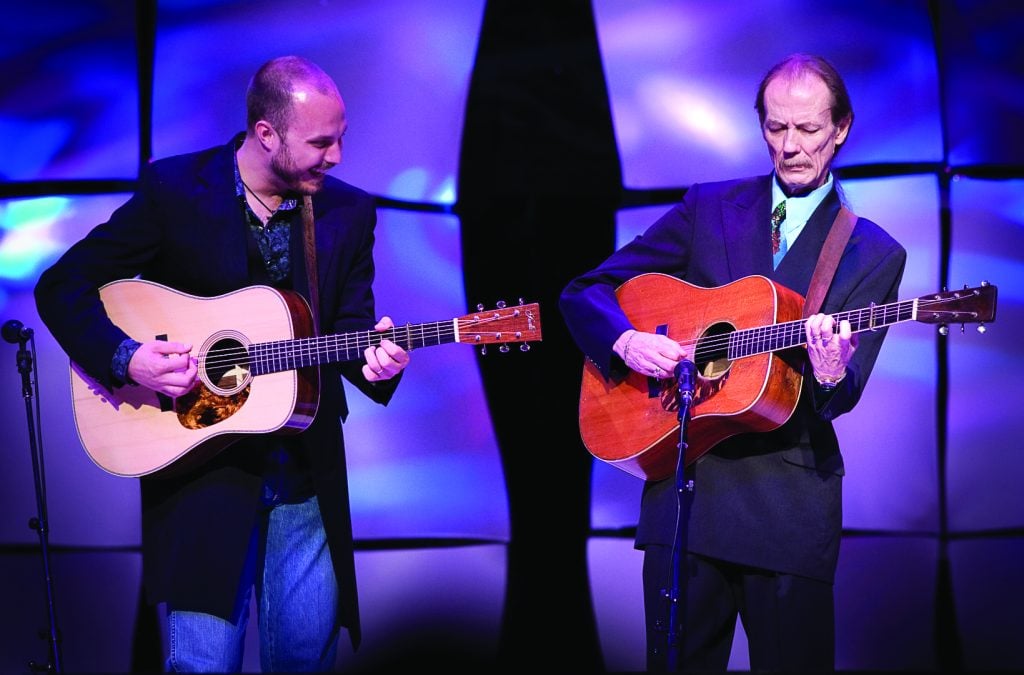
photo by Collin Peterson
Tony Rice passed on Christmas Day, 2020, but I did not hear about it until the next afternoon. I was standing in Honeycutt Music Store in Johnson City, TN, when the guy behind the counter said, “Hey, is anybody in here into bluegrass music? My friend on Facebook just said that Tony Rice died.” I didn’t believe it at first, asking to see the post on his phone. After I made my purchase, I sat outside in my car, stunned, calling folks that I knew in the business who could possibly verify this awful news.
It took me twice as long to drive back to my home that night. I pulled over to make sure the news was factual, and then after realizing it was true, I kept pulling over as it sunk in. I was just trying to stay steady. I waited on it to come over me like I was in a hospital, after getting a pre-operation shot of drugs that I knew would slowly creep up on me. And indeed, it did hit hard and that is when all my reactions uniformly swirled around and began to flow into the direction of his music.
By the time I got home, it seemed like the whole world knew that Tony Rice was gone. Everyone was suddenly mourning their lost hero and sought out the Tony Rice sound that they had clung to the most over the years. While Tony was the best lead and rhythm guitarist to ever play bluegrass music, the first music of his that I turned to was his vocal cuts. That seemed to be true of most of the tributes that appeared that night, too numerous to mention. For me, I turned to “Song For A Winter’s Night” and then “Church Street Blues,” followed by “Ginseng Sullivan.” I listened to them over and over again.
Rice was not only a master musician, he also recorded beautiful music that became life songs for many of his fans, songs that went deep into their emotional heart and reminded them of certain times in their life. Rice was more than an axe-slinger. He was a true artist.
For many hardcore bluegrass fans, Rice first appeared on the radar when he joined the Bluegrass Alliance at the urging of his new young friend Sam Bush in 1970. Not long after, Rice was grabbed up by J.D. Crowe and he joined the legendary New South band, which recorded the landmark “Rounder 0044” album that influenced many pickers of that era. Featuring Crowe and Rice along with Ricky Skaggs, Jerry Douglas and Bobby Slone, the recording breathed new life into the genre and Rice’s guitar playing turned the heads of many flatpickers.
After a hard run of many years playing straight ahead, open-minded bluegrass music with Crowe, David Grisman convinced Rice to join his quintet. It was a big leap of faith for Rice. What Grisman had in mind was some of the most progressive and ground-breaking acoustic music ever conceived, and it proceeded to make history. With Grisman and Rice along with Darol Anger, Todd Phillips, Joe Carroll, and Mike Marshall, a new genre was formed.
An interesting insight into Rice’s mindset at the time appeared in a 1977 Guitar Player magazine article when Rice is specifically asked, “Why did you leave bluegrass at the height of your popularity?”
“One reason was to appeal to a different audience,” replies Rice, 44 years ago. “Another was that bluegrass was getting boring to me. There was no longer a challenge. It’s such a die-hard trip that there seem to be rules. You know, like if you take a bluegrass break you have to play within the scale with the exception of a raised 4th once in a while to make it sound bluesy or something. I don’t hear that all of the time. I hear anything that I want to do, whether the note is on the scale or not.”
What is fascinating about this quote is that Rice was deep in the midst of creating Dawg music at that time and the exploratory door was wide open. Soon, however, he was taking what he had learned from Grisman and the great jazz artists that he listened to and incorporated that into his music. He brought all of that newfound musical knowledge into his bluegrass music when he returned to it. And he returned to his home genre in a big way. By 1980, he had recorded a landmark duet album with Ricky Skaggs. A few years after that, he became a member of the all-star Bluegrass Album Band.
Rice was now confident enough to add whatever riff or idea he wanted when it came to his more-evolved bluegrass lead solos. That is when he truly became the shining flatpicking beacon. It is also when the phenomenon known as the “Tony Rice Clones” first came into existence. Rice never encouraged it, but rather tried to inspire musicians to learn and borrow from others and use it to create their own style. But, Rice’s influence was so palpable that it became overbearing.
One of the great young guitar players that came along after Rice had established himself was Bryan Sutton. A western North Carolina native, Sutton’s early guitar hero was Doc Watson, but it was hard to ignore what Rice was achieving at the time.
Sutton would go on to not only perform with Rice onstage on occasion, but he also featured the living legend on his landmark 2006 duet album Not Far From The Tree. On the recording, Sutton also traded guitar riffs with Doc Watson, Dan Crary, Earl Scruggs, Jack Lawrence, Russ Barenberg, Jerry Douglas, Ricky Skaggs, Norman Blake, David Grier, Jerry Sutton and George Shuffler. On the project, Sutton performs two cuts with Rice including “Dusty Miller” and “Lonesome Fiddle Blues.”
Millions of music lovers who were caught by surprise at the news of Rice’s death. The same was true for Sutton.
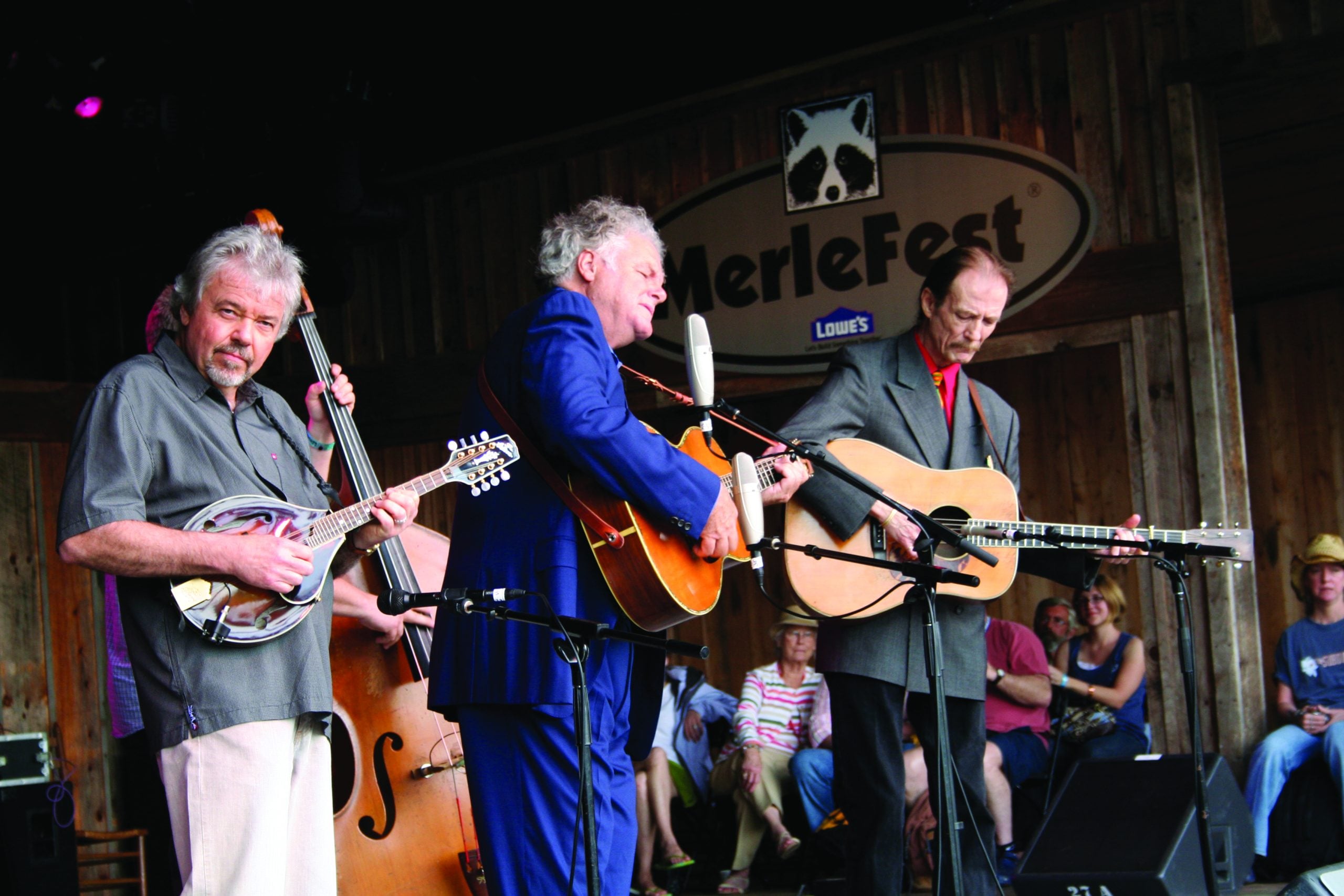
photo by Dan Miller
“It was a weird time because, for one thing, it was still the year 2020 and our Christmas was different than any other. On Christmas morning here in Nashville a guy blew up an RV in front of the AT&T building,” said Sutton. “So, I did not have any connectivity until later that day when we tried to do a Christmas Zoom call with my family. We had to go to our church and get on their internet to do it. Eventually, once connected, I learned about Tony’s passing and it was so surreal because there was so much going on that it was hard to just sit down and process it.”
After the bad news sunk in, Sutton’s thoughts began to swirl. As far as going down a beloved Tony Rice wormhole, reaching out to his music as the news of his demise settled in, Sutton took a while to go there. When he was ready to listen, he sought out Rice’s live recordings.
“I always loved his live recordings and my favorite era of Tony onstage is 1985 and ’86,” said Sutton. “That period just seems to be a peak for him as far as the stuff that I really enjoyed. I know the records that he made and have listened to them backwards and forwards, but those live shows are just exciting and a window into his real-time process of playing music. There are a few videos from that time out there, such as the Strawberry Festival, his show in Denton, and a Lonesome Pine special. And there are those Bluegrass Album Band recordings from 1983 and 1984 that are so strong as well. It is so good to hear Tony at the top of his game. For me, it is about the whole picture that was Tony Rice, and not just about the picking or just the singing. It is about everything that he exuded while playing rhythm, playing lead, singing, talking in-between songs, the way that he looked at different musicians onstage and the way he handled himself. Bluegrass doesn’t really have a quarterback-kind of player, but Tony Rice sort of was that, by default, because he held it all together and drove so much of what everybody else was doing.”
Sutton was lucky enough to share a few stages with Rice, with Vassar Clements’ 75th Birthday Jam at MerleFest being one great example.
“The thing that was tough was that with any of those moments, I couldn’t get the thought out of my head that, ‘I’m onstage with Tony Rice. I’m playing with Tony Rice,’” said Sutton. “I was always hoping that I could get past this whirlwind of energy, where I was thinking, ‘Wow, this is really happening.’ I wanted to get more comfortable, and I ultimately was when I played with him later on. But, I don’t know if I ever truly could have gotten there unless I had played hours and hours with him. I also knew that the moments I did have with him were really special and I will be forever grateful.”
With Sutton being younger than Rice and a top-notch picker to boot, he did experience some of the ‘Tony Rice Clone’ pressure at times during the 1990s and 2000s.
“For me, personally, that was a little weird because that idea has chased me around, whether it referred to Tony or Doc Watson or trying to replace Charles Sawtelle in Hot Rize,” said Sutton. “I replaced Tony on that Bela Fleck tour back in 1999 and 2000 so there has always been that line to ride concerning proving myself and wanting to be there and happy to be there to do the gig. But over the years I would hear, ‘Who is this kid?’ ‘Oh, that’s that kid who played with Skaggs that plays all the notes.’ Anybody that has played modern bluegrass music has been compared to whomever others want to compare you with, but I always just tried to do the best that I can do. I never really studied Tony’s playing at the note-for-note level that a lot of people have done. Instead, I really tried to understand what I feel is the essence of his playing and what I love about it and apply that stuff in my own way.”
Sutton puts Rice among the best guitarists to ever play the six-string, no matter the genre.
“When I think of Stevie Ray Vaughan and B.B. King and Jimi Hendrix, when guitar players around the world think about who to aim for on any level, I wish Tony Rice was more a part of that conversation, along with Chet Atkins and Eddie Van Halen,” said Sutton. “For me, Tony Rice is as big a deal as any of those guys.”
Sutton realizes, as time rolls on, influences are to be carried forward.
“I never liked the ‘heir apparent’ kind of stuff,” said Sutton. “I’m just happy to be able to find the space for what I do. If there is a lineage involved, that is fine, because that is what we are all doing. Somebody will come after me.”
One young picker that has followed both Rice and Sutton is Billy Strings, whom Sutton has described as “the future of bluegrass.” Still in his 20s, Strings has created an impressive following that combines original progressive acoustic music with straight up bluegrass. His pre-pandemic tours filled up big music halls including a string of sold-out concerts in 2019 that was impressive. And, with a 2019 IBMA Guitar Player of the Year Award under his belt, Billy Strings is leading a whole new generation of young music fans back to the sounds of his heroes like Doc Watson, the Stanley Brothers and Larry Sparks.
Sadly, because of his age and the fact that Rice last played publicly in 2013, Strings never got to see Tony Rice perform live. Fortunately, that also means that Strings avoided those crazy years of constant comparison during the ‘Tony Rice Clone’ era.
Early on, Doc Watson was Strings’ bedrock influence on the six-string. But as time goes by, he has begun to appreciate Rice’s music more and more. In fact, just days before Rice passed away, Strings posted a tribute to him during his String the Halls holiday video series. The video, recorded live with Strings and his fine band being shown on an old black and white TV set, began with Strings doing the introduction, “Hey folks, we’re going to do an instrumental for you today. This one is called ‘Tipper,’ and it is by the great Tony Rice.”
“For me, as a flatpickin’ guitar player, it just doesn’t get much better than Tony Rice,” said Strings. “As far as his knowledge of the fretboard, to me he was like a professor. Whenever he played, you could hear how smart he was. One of my favorite things is that while Tony was running up and down the fretboard and playing all of these crazy leads and stuff, he always had a chord shape nearby, and he always knew where he was at as far as what chord is going on. That made his rhythm playing so good, too, because he had such knowledge of chord shapes. It was just incredible playing and it was seriously inspiring.”

When Strings was still a kid being mentored by his guitar-playing father about all things Doc Watson, it took a while before the music of Rice sunk in. Eventually, he listened to the Bluegrass Album Band recordings and the first album by the David Grisman Quintet. Years later, however, Rice’s unique approach began to click in Strings’ ears.
“I admit that I don’t know a lot of Tony’s licks and chords and ideas, but where I’m at with it right now is I think if I could learn some of it, it would help me with my own playing,” said Strings. “In other words, I like to learn stuff like that because when you learn a riff or two, you find yourself pulling it out in random spots, as in where it’s not supposed to go, or when you’re improvising and you reach for that little trick that you learned. Tony has so many of those and I have added a few into my playing. I have also realized that as much as I have listened to Tony and studied his guitar playing and all of that; I haven’t even scratched the surface, man.”
After the news broke back in December, Bela Fleck announced that not being able to have Rice play on his recordings anymore is why he held off recording another bluegrass album. Rice appeared on Fleck’s two amazing bluegrass albums including 1988’s Drive and the 1995 project Tales From the Acoustic Planet, a mesmerizing collection of music that brought the brilliant instrumental “Whitewater” into the bluegrass lexicon.
The good news is that recently, before the coronavirus hit and totally upended the music industry; Fleck recorded a brand new double bluegrass album. The guest musicians that Fleck brought in to sit in Rice’s guitar chair include Molly Tuttle, Bryan Sutton, Cody Kilby, and Billy Strings.
“Those sessions with Bela were really exciting,” said Strings. “After I first began to become friends with those guys, I’m still blown away by it and can hardly believe that I have become friends with my heroes. I went from this kid who played in clubs in Michigan to being in the studio with Bela Fleck, Sam Bush, David Grisman, and Chris Thile. It is just wild. They are my heroes, yet they are also all good people. I have yet to meet any of my heroes yet that were boneheads.”
Knowing how important Rice was to Fleck, Strings is well aware of the gift that has been handed to him by being included on this highly anticipated Bela Fleck recording. Said Fleck, “No one takes Tony’s place, but wow, the guitar is in good hands.” Within the last decade, Doc Watson, Earl Scruggs, Ralph Stanley, Mac Wiseman and many other amazing bluegrass players have gone on to the Great Beyond and now Tony Rice has joined that amazing group. But with young, modern-day artists like Strings on the scene, selling out music halls and influencing a whole, fresh generation of music lovers, those names will not be forgotten anytime soon.
“Even though I never met Tony, I have listened to his music so much and I have listened to his voice and his sincerity and the emotion in his guitar and it has made me cry many times,” said Strings. “It has also made me laugh out loud, it has made me happy, and it has kept me occupied while I was driving at 3 a.m. when I was trying to get to the next gig. For all of that, you just want to say, ‘Thank you, Tony.’”