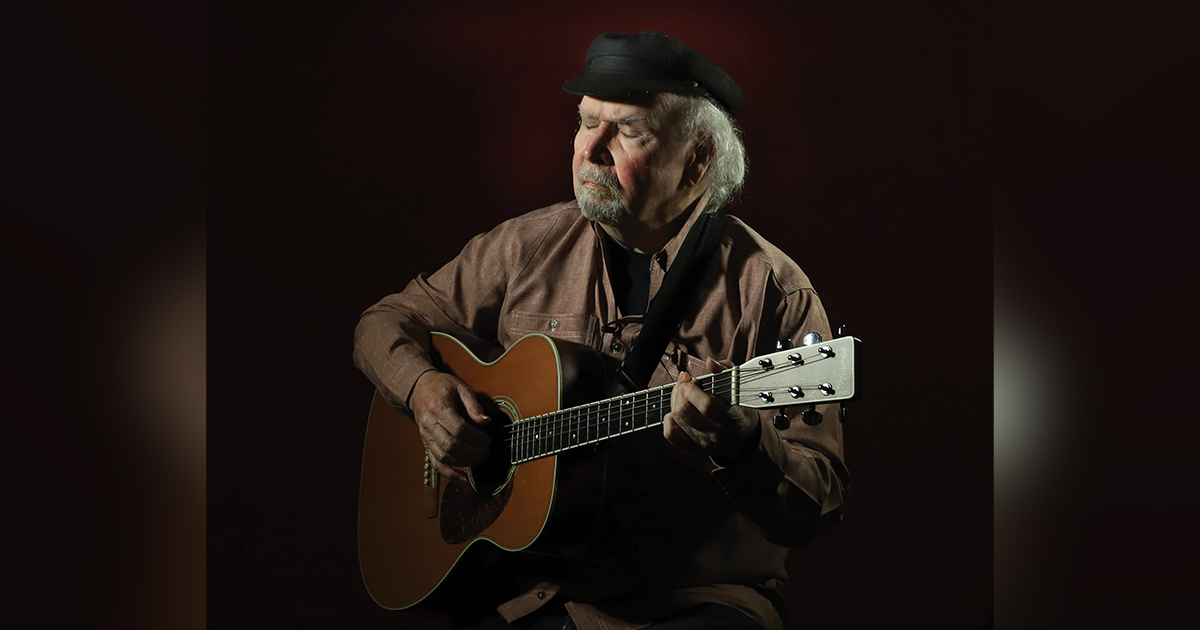
Tom Paxton
A Songwriter’s Songwriter
Photos by Michael G. Stewart
Tom Paxton has been an integral part of the songwriting and folk music community since the early 1960’s Greenwich Village scene, and continues to be a primary influence on today’s performers. The Chicago native came to New York via Oklahoma, which he considers to be his home state. His family moved there in 1948, when Tom was 10 years old, and he graduated from Bristow High School and The University of Oklahoma, where he majored in drama while his interest in folk music grew and eventually predominated. His numerous awards include a Grammy Lifetime Achievement Award, ASCAP Lifetime Achievement Award and BBC Lifetime Achievement Award for Songwriting.
Tom heard Flatt & Scruggs live in concert in 1960 in Greenwich Village at the Fashion Institute Auditorium with Joan Baez opening. “They were great and the song that sank into my soul was “Jimmy Brown the Newsboy,” Tom said. Earl played guitar on that song, very Maybelle Carter like. In those days there were less bluegrass specific events and bluegrass, traditional folk and singer songwriters were presented together in concerts and festivals along with Cajun music and other homegrown genres. Bluegrass was integrated into the folk scene and built much of it’s northern audience there. In the early 1960’s Ralph Rinzler brought Doc Watson to a New York coffeehouse and Tom heard him sing “The Blue Ridge Mountain Blues.” As a budding songwriter, the line “scratchin’ gravel” a common term from his Oklahoma childhood, caught his ear.
Tom’s songs became classics and seeped into folk, bluegrass, country music and other genres with a catalog of hundreds of songs recorded by Willie Nelson, Porter Wagoner and Dolly Parton, Earl Scruggs, Bobby Vinton, Glen Campbell, Charley Pride, Hank Snow, Chet Atkins, Judy Collins, Joan Baez, The Chad Mitchel Trio, Jose Feliciano, Johnny Cash, Anne Murray, Marianne Faithful, Nanci Griffith and of course, Pete Seeger. Tom’s own discography includes more than 65 albums. At 86, he’s still writing songs, a lot of them!
I’ve worked with Tom for over 35 years and I confess, he is one of my dearest friends. Our families are family. I’ve co-produced some of his albums, co-written at least 150 songs with Tom, and learned from an amazing mentor. We spent a few hours talking about his songwriting career and the new album Bluegrass Sings Paxton.
How did you start songwriting?
In 1958 I was a student at University of Oklahoma in the drama school. I have a degree in drama. I started out as an actor, and settled for security of folk music. I wrote my first song in a Shakespeare class. It’s the worst song anyone ever wrote, a phony Elizabethan murder ballad.
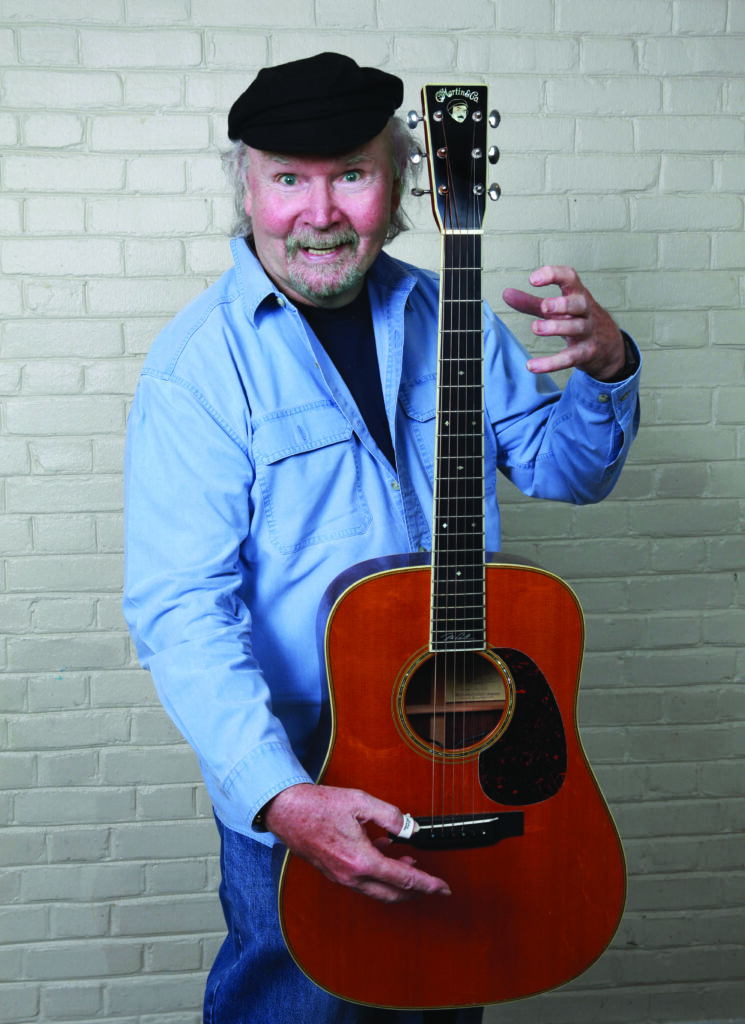
I imitated everybody I heard and liked. Then, I was in an imitation Kingston Trio group called The Travelers. I loved singing with other people. Thanks to the Army, I landed outside of New York City and came in on weekends to Greenwich Village. I hung out, listened and sang in coffeehouses. There were late nights, missed trains, and a lot of gettin’ in front of folks. Hearing “no” a lot is something you learn to deal with as a performer. But I know songwriting is what I was put here to do.
I wrote daily in a typing class in Fort Dix, New Jersey, in clerk typist school. It was two hours a day, four days a week in a hot Army classroom. I could have passed the final on the first day, but the Army is not persuaded by logic like that. So I used the typewriter to write letters. One day I ran out of people to write to and made up the words to the song, “The Marvelous Toy.”
Right out of the Army I immediately auditioned to replace an original member of the Chad Mitchell Trio. After a week of rehearsals it was clear that my voice wasn’t a fit for the group’s blend. It was a big disappointment, but during a break, I sang “The Marvelous Toy” to them. They recorded it and had a hit with it, playing it on Ed Sullivan, Dinah Shore, and other shows. It was their only hit. Milt Okun was their musical director and record producer. He formerly worked as conductor for Harry Belafonte and had started a new publishing company, Cherry Lane Music. I was the first songwriter he signed and we worked together for fifty years. Milt got my songs on other records he produced for John Denver, Peter Paul and Mary, and many others.
From what I can tell, you are never without a notebook and pencil.
Every night at The Gaslight I brought a pocket notebook and in between acts, I wrote some lyrics. I was working even when not on stage. I was a young writer and wrote a lot of bad songs, but I wrote a lot of songs. “Ramblin’ Boy” was written at the Gaslight. And I was the only original songwriter on the scene at that time. Woody Guthrie was off the scene, Dylan came in ‘61 and Phil Ochs in ‘62. I was writing all of the time and I still am.
Talk about the elements of a good song.
When I teach songwriting, I like to teach the basic song ideas. The most important one is that verses convey information and choruses convey emotion. In “This Land Is Your Land” the verse and chorus have the same melody, but the chorus is ALL emotion and the verses are information and narration. The chorus is an emotional reaction to the information of the verses. You find it over and over and over and over. Keep it simple. I like storytelling songs, simple love songs and often, lots of repetition so it’s easy for people to play these songs themselves, or sing along.
Advice for new songwriters?
Write your ass off. Write every day if you can. One of life’s simplest lessons—the more you do something, the more you are apt to improve. Then listen, listen, listen. Listen to other people’s music you love. Copy them. Learn from them. Then get out in public and try your songs out. You can never believe friends & family when they compliment you. You need to sing these songs in front of total strangers, preferably strangers who spent their own money to hear this thing. You can tell the reaction when you hear silence!
Motivated young songwriters are surrounded by a cloud of unknowing. We have no idea how bad we are and allow ourselves to be encouraged. So, the more songs you write, surely the better you get. If you had any talent to begin with it comes forth.
People, and I include myself, are apt to say they get an idea and the song comes pouring out. They say, “that song came directly from God or somewhere, who am I to alter it?” That’s a way of saying I don’t want to do more. Sing it to yourself. You’ll find little speedbumps that you can work on.
Go through the song. There’s a saying in music, theater and literature that you must “murder your darlings.” If it doesn’t work, get rid of it no matter how much pleasure it gives you the first time you sing your song. Or take out lines that just don’t work. Sometimes you can take out whole verses and the song stands better. Then, sing the song until it sings itself.
In my papers at Woody Guthrie Center in Tulsa, Oklahoma, you can see all of the pages of edits to my songs. There are edits in the margins, edits everywhere. I sometimes even edit a song after I’ve recorded it if I feel I’m making it better.
You are co-writing with ten people these days. How does that work?
I’ve done some co-writing through the years, but the pandemic brought on regular co-writing. With Zoom, we didn’t need to be in the same location, but we could write together in real time.
My regular writing partners are Tim O’Brien and Jan Fabricius, Cathy Fink, John McCutcheon, Dan Boling, Louse Mosrie, Jackson Emmer, The Accidentals and Buffalo Rose. Writing a lot like this keeps me well oiled. Our (Cathy & Tom) double album All New has some great bluegrass songs and musicians on it including Kimber Ludiker (Della Mae), Alex Lacquement and Marcy Marxer.
Your song “Leaving London” has been covered in bluegrass before, hasn’t it?
Billy Strings is now singing “Leaving London,” which he learned from Doc Watson. Doc and I played Wolf Trap together one year. I visited him in his dressing room he was singing “Leaving London.” He said, “Tom, I was in London when I heard that song, and it made me cry. If you don’t mind I wrote my own verse.” I told Doc he could write his own verse anytime! And Greg Blake does a killer version of this song on Bluegrass Sings Paxton. I heard he was the first to pick a song and immediately put dibs on this one.
How about “The Last Thing on My Mind?”
I wrote “The Last Thing On My Mind” right before recording my first album for Elektra and I’d been singing it in public. Cowboy Jack Clemens, the Nashville producer, came to hear me sing at the Gaslight in New York one night and “The Last Thing On My Mind” was of course in the show. He went back to Nashville and cut the song with Dolly and Porter. I had no idea. Dolly just rerecorded it on a tribute to Doc Watson and it got a Grammy nomination. There’s a fabulous clip on YouTube of Dolly and Doc backstage at Merlefest. It made me cry. You can also watch the Carter Sisters and Maybelle perform this on YouTube at the Tennessee State Prison. New bluegrass star AJ Lee has sung it, The Punch Brothers, Sierra Ferrel has sung it and there’s a bootleg recording of Graham Parsons singing that song.
What a compliment it is for someone to take your song and perform it. They trust your song. It’s a difficult thing to go out there and entertain people. The fact that they want to take your song is part of their armor.
Do you have more songs perfect for bluegrass?
Oh yes, indeed. “Virginia Morning” has already been recorded bluegrass style. From All New there’s “Since You,” “Dry Times,” “Dreams of Home,” and “Rust on the Rails.” I’d love to hear more bluegrass artists cover those. “Home To Me,” “Buffalo Dreams,” “The Losing Part,” “A Daughter in Denver,” “I’m The Man That Built The Bridges” and “Hobo In My Mind” all come to mind. I’m blown away by how some of my slower songs adapted to bluegrass on Bluegrass Sings Paxton and love how the new interpretations of some of my old songs made them feel new.
Let’s talk about a few other songs on Bluegrass Sings Paxton. There’s a few new ones and some classics that have fit right into the genre.
“Central Square”— Cambridge, Massachusetts has been central for plenty of folksingers and songwriters. I went to hang out at a Hoot that my friend Geoff Bartley ran in Cambridge and these words came to me, “Five roads led from Central Square.” I finished the song and felt like it was too sad to sing. But later at a show with Geoff, he sang it and the audience loved the song. So did I, and I decided to sing it after all. Laurie Lewis hand picked it out of my whole repertoire, a true honor.
“Ramblin’ Boy” — In 1963 I heard both Dave Van Ronk and Bob Dylan sing “He Was A Friend of Mine.” I never sang that song, but a month or so later between sets at the Gaslight in New York, I pulled out my pocket notebook and wrote this. I felt secure about being in touch with the tradition. That notebook is on view, open to this page, with my archives at the Woody Guthrie Center in Tulsa. Danny Paisley told me that he first heard it as a kid. His father played the Philadelphia Folk Festival and brought Danny along. He said he grew up with my songs.
“You Took Me In” — I’ve always wanted to write with Tim O’Brien. He’s the most outrageously gifted performer and musician. Tim, his wife Jan Fabricius and I have now written over 20 songs together on Zoom. It’s a traditional song style, reminiscent of the Brown’s Ferry Four with Merle Travis, Grandpa Jones and the Delmore Brothers. I love making new songs that sound old.
“I Can’t Help But Wonder Where I’m Bound” — I wrote that in 1962. It is the first song of mine, not counting the “Marvelous Toy,” that other singers began to sing. It doesn’t go away. Johnny Cash did this on one of his final albums with just himself and his guitar. I loved singing this with Della Mae for the album, a real treat.