
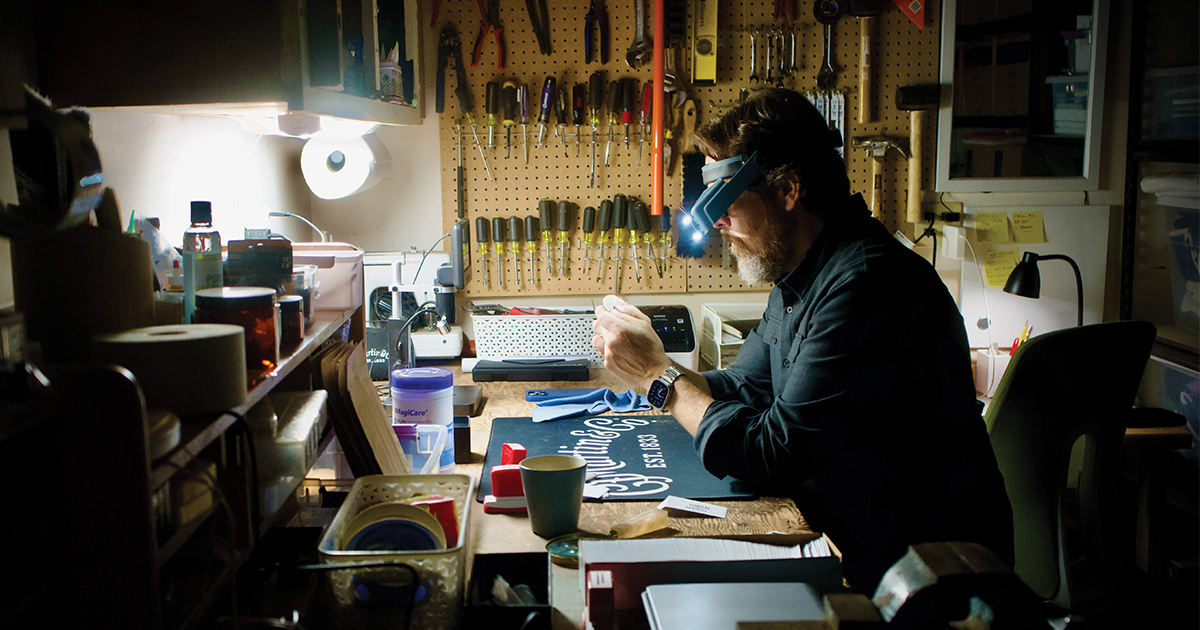
Token Picks
At the 2025 International Bluegrass Music Association (IBMA) conference held in Chattanooga, Tennessee, the exhibition hall featured a new vendor booth—Token Picks. I love to stroll through the exhibit hall and check out the new instruments and gear that are on display at the various booths; however, every time I passed by the Token Pick booth, it was so crowded that I didn’t have a chance to try out these new picks. I picked up a couple and felt them in between my fingers, but there were always so many other people testing the picks out on the instruments that were available at the booth, that I never had the chance to put pick to string.
I’ll have to admit that I have been using the same brand of pick for about the past 15 years, and I was not looking for a replacement. So, I wasn’t too disappointed that I didn’t get to try these new picks. Over the years, I’ve tried about every kind of pick that has come on the market because for 20 years I was the editor and publisher of Flatpicking Guitar Magazine, and every company that came out with a new pick sent them to me for review in the magazine. Needless to say, I’ve tried out dozens and dozens of picks made of every shape, every thickness, and every kind of material you can imagine. So, while I’m always curious, trying out another new pick was not that exciting to me.
About a week after I returned home from Chattanooga, I got a call from my friend Andy Falco. Most BU readers will know that Andy is the guitar player for the Infamous Stringdusters. I’ve known Andy for about 30 years and highly respect his guitar playing and any opinions he might have about guitars and guitar gear. When he called, Andy explained, “I have this friend who I grew up with on Long Island playing in bands together. After high school, we all went our separate ways. He went out West and got into solar energy. But in the last few years, we started reconnecting a little bit. He started getting deeper into flatpicking and was taking Bryan Sutton’s ArtistWorks course. He also started taking some lessons from me on Zoom, and he mentioned that he was making picks and he wanted to send me a few to check out. I thought to myself, ‘Well, sure, I’ll check out the picks. Why not?’ I thought I’d give him some feedback. When I got them, I was just blown away. I’ve been using them ever since. They feel great, they sound great, and they are so consistently made. They can also withstand the rigors of touring. Stringduster shows are very hard on my picks. They get beat up easily, and there are very few picks that can handle that. These picks definitely do, and I found that I was playing better because they felt so right. I was using 50s, and now I use 55s because, for some reason, I don’t feel as much of a resistance. I’m able to get the benefit of a heavier pick tone without feeling as much of a drag.”
Veteran flatpicker Jon Stickley (see article in the December 2025 issue of BU) agrees with Falco’s assessment regarding heavy touring. Stickley said, “Touring and performing live can really put a pick through the wringer. The Token picks really stand up to the challenge. They maintain a smooth, clear picking edge and bring a tone out of my instrument that I’ve never heard from any other pick.”

With recommendations like that from Andy and Jon, I became more interested in taking a closer look at the Token picks. Andy introduced me to his friend, Token founder Daniel Flanigan, and Daniel sent me some picks to check out.
One of the things that I had noticed in Chattanooga was that in addition to making picks of different thicknesses and shapes, Token was also offering picks that were made out of three different kinds of material. When I finally was able to check out the picks on both guitar and mandolin, I liked the feel of the picks in my hand, and I liked the tone that the picks produced. The only downside for me was that a pick of the exact shape and thickness that I had been using for years was not available. When I mentioned this to Daniel and texted him a photo of my favorite pick, he made a pick for me that was an exact copy in thickness and a near exact copy of the shape, and sent it to me overnight. This one felt much better in my hand since the thickness and shape were familiar.
I had a gig the next day, but didn’t get a chance to try the pick in that context because I was playing Dobro at that show. However, I did hand a stack of picks to our mandolin player, Joey Wienemen (featured in Bluegrass Unlimited, July 2021). He tried a bunch of them out before the show and selected the one that felt best to him and used it throughout the two sets. Afterwards, I asked him what he thought. He said, “It has a lot less pick noise and has a cleaner sound than the pick that I’ve been using, and the bass notes seem to be more clear. It has a nice feel to it. I’m using the B2-50.”
The Token Pick Story
Daniel Flanigan started playing the guitar in the early 1980s when he was twelve years old. He grew up near Andy Falco in Garden City, New York. He played guitar in some high school bands, and he played banjo in an Americana band, but music was a hobby. He played both the acoustic and electric guitars, and in addition to rock music, he enjoyed the music of Joan Baez, Joni Mitchell, the Grateful Dead, and Old & In the Way, among others.
After high school, in 1991, Daniel moved to California to attend California State Polytechnic University, Humboldt. He then got into the construction business as an electrical contractor (home and business wiring), then the solar energy business, then he worked in solar product design. Prior to launching Token, Flanigan had founded five different start-up companies. During his career, he had worked with every aspect of what was required to start Token—machining, prototyping, material science, product development, engineering, marketing, sales, fundraising, supply chain development, financial analysis, intellectual property, and commercial contractual systems and negotiations. He said, “With all of my businesses, I tended to be the guy who wore all of the hats.”
Flanigan’s work in the solar energy field is quite impressive. He was one of the founders of Zep Solar, along with Jack West and Christina Manansala. A Wikipedia search on Zep Solar reveals, “The trio invented a system that allowed solar panels to be installed without using rails, the long aluminum beams that had typically run underneath rooftop-mounted arrays to support the panels. Rails add material and manufacturing costs, and their bulk and weight add additional inefficiencies and expenses.” Daniel also later became a Senior Staff Member for Solar Systems Product Design at Tesla and co-invented the Tesla Solar Roof product.
After learning about Daniel’s business experience in the solar industry, I’m thinking, “How does this guy get interested in making flatpicks?” He explained, “Last December, I decided that I really wanted to learn the guitar. I love composition and arrangement and seeing how music fits together. But I never got good enough at guitar for the instrument to be a full and easy expression of what I’m thinking and what I’m feeling. I felt like I needed to master my fretboard fluency and let the music flow out of me through my guitar. So I started playing for hours a day. That got me on the track of realizing that I wanted to devote my life to music. I felt like I could do that by starting a music business, and that a pick would be an awesome thing to focus on.”
When asked when pick choice became important to him as a player, Daniel said, “There was a moment for sure. There have been a bunch of false starts with me trying to learn bluegrass music, and one of them was in about 2008 or 2009 when BlueChip picks first came out. I was working on ‘Red Haired Boy’ with a Fender medium pick. It was really hard. I was in the Grass Valley area in that time frame, and at some point, I saw Molly Tuttle picking at the Grass Valley Festival. She was a young girl at the time. I almost quit the guitar. I was very distraught. Here is this girl, and the guitar was bigger than her, and she was shredding. I thought, “What am I doing wrong?” I ordered my first BlueChip pick, and all of a sudden, I made progress. I realized that there was a huge difference in the pick that you use. That was a revelation.”
When asked what he felt was the quality difference between the Fender medium and the BlueChip, Daniel said, “I noticed the tonal difference immediately, but what was more impactful to me was the way that it aided in my ability to play a fiddle tune. The speed bevel is a real thing. It is there for a purpose. The combination of the rigidity of a thicker pick with the fluidity of a nice bevel edge is magical when you are playing that style of music. There was a huge difference in the playability. It was the difference between me technically not being able to play ‘Red Haired Boy’ and me being able to play it.” He continued to use a BlueChip pick all the way up until the day he put the first Token prototype on the strings.
Daniel said, “When I had the revelation that I wanted to start my own pick company, I was holding a BlueChip CT55 in my hand.” So, the question becomes, “If he had been happy working with a BlueChip pick for 15 years, why start a new pick company?” As he stated above, Daniel knew that the pick thickness combined with the speed bevel were key elements and so his engineering, materials science, machining and manufacturing brain went to work. He felt like he could come up with a selection of polymers that would make ideal pick material and that he could make the manufacturing of the speed beveling more efficient and precise.
Daniel explained, “You can buy something like a Dunlop Primetone that has a bevel for a couple of bucks, but because it is molded, it doesn’t have as sharp of a bevel edge as you’d get with a hand-beveled pick like a BlueChip or a Tone Slab. When you are hand-beveling, you can get that sharp edge.” His thought was that if he could design a manufacturing process that could get the same sharp beveled edge, but be more efficient in the manufacturing process, he could offer picks with a sharp beveled edge at a lower cost, without the time intensity of hand-beveling, and without the supply constraints that have become common in the premium flatpick market.
The first step in designing the Token pick was to select the material. He said, “I looked at all the different parts of the supply chain to find partners who could help me tweak their process to meet our requirements. I probably researched multiple dozens of materials. I received around a dozen or more physical samples to evaluate material properties, and we made finished picks out of six different materials, and then we down-selected to the three that we have now, two of which are common in the market—polyetherimide (PEI), known as ‘ultem 1000’, and polyetherketone (PEEK). Our green pick is a special material…the Torlon powder is not special. Torlon is the trademark name for polyamide-imide (PAI); but how it is processed is special, and ours has unique properties. I was happy to have two pick materials that have years of validation in the market and one that was special and new. It is a great suite of materials.”
Regarding the work required to come up with finding an efficient way to make the speed bevel, Daniel said, “I thought that there would be no reason why there can’t be a sharp bevel-edged pick that is fully CNC formed. I didn’t know how to do that because I am not a trained machinist. But I have a partner who I enlisted to work on the problem with me and he helped to solve it. I didn’t realize how technically challenging that was—and it is—but fortunately, my partner is brilliant, and together we figured it out. What we have done is not only design a pick, but we have designed a manufacturing process, and that included literally designing the shapes of the cutting tools. The geometries of the cutting tools are custom in order to get the geometries that are designed in the pick.”
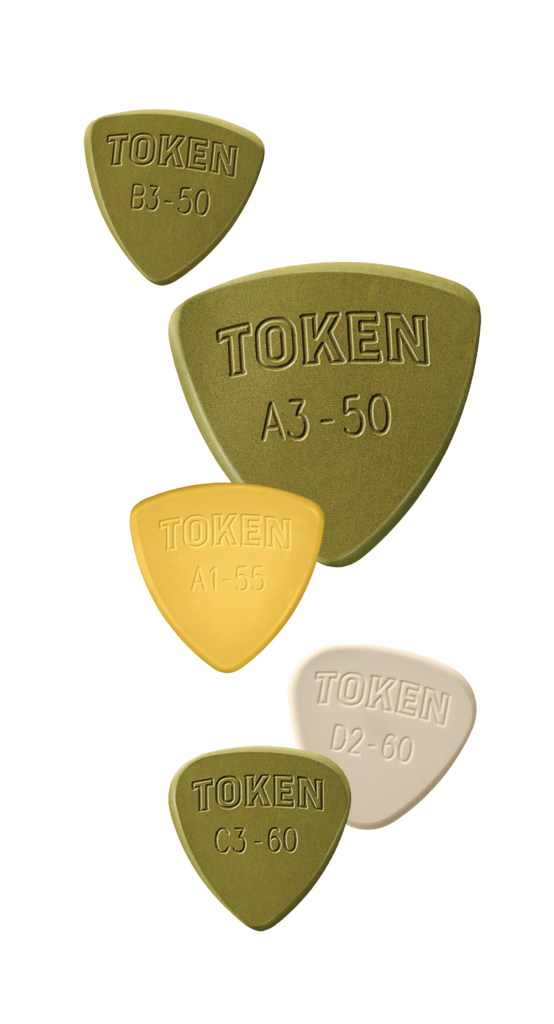
Currently, Token offers three different pick materials as discussed above. They also offer four different pick thicknesses—45, 50, 55, 60 (thousandths of an inch) and four varieties of pick shapes. The Amber (PEI) pick is $18, the Tan pick (PEEK) is $24, and the Green pick (PAI) is $28. Andy Falco loves the fact that Token offers three pick material choices. He said, “That is the cool part of Token. They have a few different materials. Using different materials is great for tone change or vibe change. I like to change the pick once in a while because it is inspiring to have a different feel and change things up a little bit. I also like to have different materials that produce different tones while I’m recording. In the studio, I have a whole kit of picks of various thicknesses and shapes, and materials, because sometimes just the right pick gives you that extra part of your color palette. I love that Token picks are made of various materials.”
The last question that I asked Daniel Flanigan before the interview ended was, “Why the name Token?” He said, “Naming companies has always been a fun part of starting a company. It is always just brainstorming. The name Token just popped into my mind, and I thought of a carnival token. Like a token you would redeem for a roller coaster ride. I love how it evoked the sense of a small object that you could fit in your hand, and it is a thing that you can get something of value from. And I liked that it was short and sweet. I had a few options, and my kids helped me determine that Token was the best one.”
You can find more information about Token picks on their website: tokenmade.com, and keep up with their activities on Instagram @tokenmade.
