
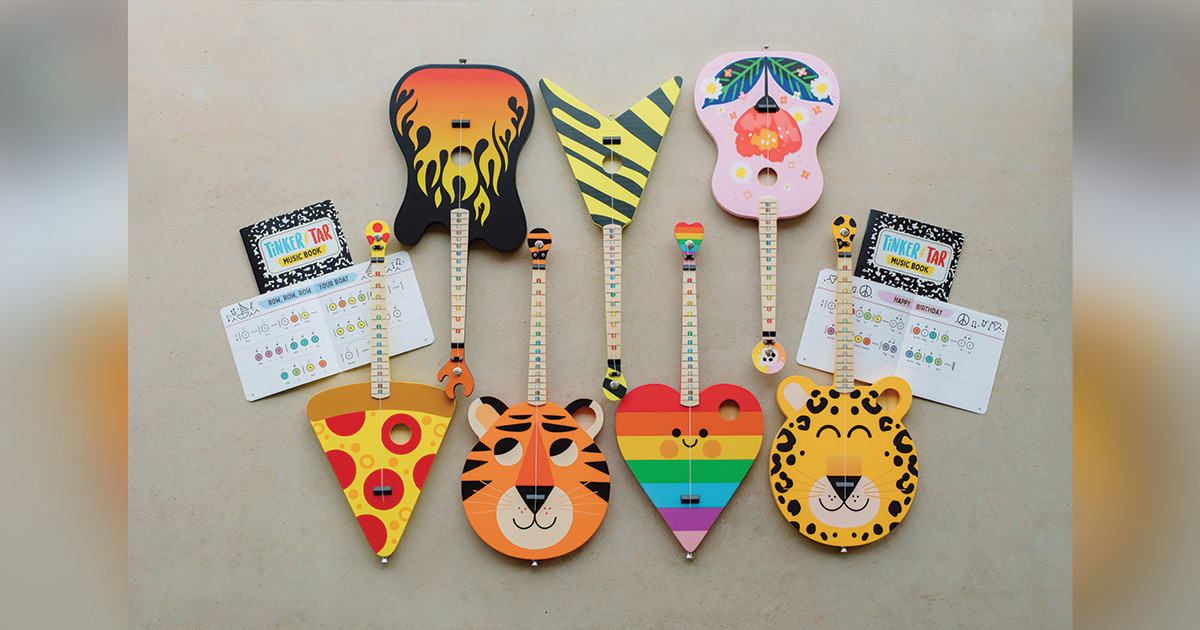
TinkerTar
The Best Way to Get Young Kids Started on Stringed Instruments
There are many equivalences that one can make between learning a musical instrument and learning a language. In fact, studies have shown that if a person learns to play a musical instrument when they are young, their brain processes it like a language, using its communication centers. When a person learns music later in life, the brain processes it differently, utilizing the listening centers. So, when a young brain is in its pique stage of learning to absorb language, it would make sense that this would also be a great time to learn to play music. However, one of the challenges is that kids who are two, three, and four years old don’t usually have the physical coordination and dexterity required to learn how to play a multi-stringed fretted instrument. Brain Calhoun’s TinkerTar is here to help solve that problem.
Bluegrass guitar players may know Brian as one of the two founders of the Rockbridge Guitar Company. Calhoun, and his building partner Randall Ray, have been producing high end guitars for over twenty years and some of the best flatpicking guitar players have been Rockbridge owners, including Jim Hurst, Steve Kaufman, Larry Keel, Peter McLaughlin, Rhonda Vincent, Roy Curry, Cody Kilby, Keith Sewell, Eli West, Matt Arcara and others. Rock, folk, country and blues guitar players who have owned Rockbridge guitars read like a who’s who. They include Dave Matthews, Brandi Carlile, Warren Hayes, Keith Urban, Jason Mraz, Mary Chapin Carpenter, Dave Stewart, Lukas Nelson, Ray La Montagne, Richie Sambora, Waddy Wachtel, Derek Trucks, Susan Tedeschi, Zac Brown, Miranda Lambert, Harry Styles and many others.
In addition to being an extremely successful high end guitar builder, Brian also is the inventor of the board game ChickaPig—A Farm to Table Game. He came up with the idea for the game in 2013 after playing another board game that he felt was boring. He started producing the game board and pieces by himself. Eventually, over time, the game was picked up by board game and puzzle giant Buffalo Games, who took over the manufacturing and distribution of the game. Since that time, Calhoun has come out with children’s books and stuffed animals based on the game’s characters and spin-off games based on Chickapig, such as Chickapiglets aimed and younger children. In 2019, Calhoun got together with his friend Dave Matthews and invented a poker-based game called 25 Outlaws that was released in 2019. To date over a quarter of a million Chickapig games have been sold.
The TinkerTar
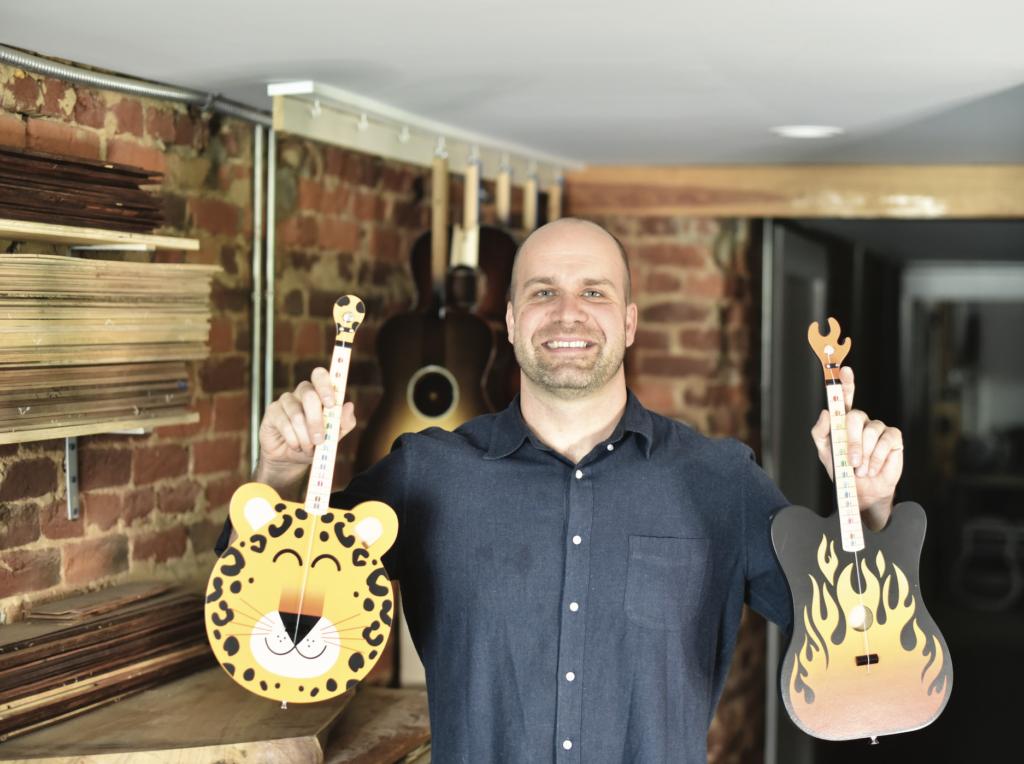
So, what do building high end acoustic guitars and inventing children’s board games and writing children’s books have in common? Probably not a lot until the TinkerTar came along. Calhoun said that he came up with the idea of the TinkerTar in an effort to combine his work with children’s products and the building of guitars. He said, “I wanted to combine my two worlds.”
The first thing that Brian did was talk with guitar teachers who worked with children to find out why it was difficult to teach younger kids how to play the guitar. The answer was that it was too hard for them to form full chords and suggested they felt like the ukulele was a better place to start. Brain, who has had a life-long fondness for drawing animals in cartoon form, created a dinosaur-shaped ukulele and took it to a child’s fifth birthday party. He said, “The kids at the party lined up to play it. They would bang on it and strum the strings, but as soon as I tried to show them how to play a chord, they lost interest. When I tried to show them a simple melody, it was too much for them to try and deal with all of the strings. They didn’t have the dexterity and so they couldn’t get it.” That night, Brian thought about it and realized that if playing chords was too hard and playing melody on multiple strings was difficult, then why not present the child with a guitar that only had one string? That way they could think linearly, like playing on a piano keyboard.
Brian went back to the drawing board and built a one-stringed guitar that was shaped like an elephant. He took that to some kids and let them play on it. He said, “Right away they were changing the pitch and playing melodies. I taught them how to play ‘Twinkle Little Star’ in no time at all. I had three year olds playing melodies.”
The first one string TinkerTar that Brian built had frets on it. Being an expert craftsman, it wasn’t hard for Brian to build a fretted instrument. However, his end goal was to get this one stringed guitar manufactured at a low price point and get it into stores. When he outsource the first production models, which included frets, he said that the fret jobs were really bad and he felt that he wasn’t going to reach his price point goal if the instrument included frets. He said, “I was almost ready to give up, but then I thought about violins. Kids learn how to play the violin and they don’t have frets and those kids are able to develop an incredible ear for pitch.” So, Brian then built a fretless version of the TinkerTar. He said, “It was easier to make and easier to play. The drawn-on fret markers enabled us to include a color-coded numbered circle and allowed us to print the fingerboards.”
The numbers and color codes on the fretboard allow children to easily learn the songs from a songbook that comes with the TinkerTar. The book includes twelve familiar children’s songs such as, “London Bridge,” “Pop Goes The Weasel,” “Old MacDonald,” “Twinkle Little Star,” and others. Brain said, “Five year olds can site read and play these songs quickly. Younger kids take a bit longer, but they are able to do it as well.”
Brian views the TinkerTar as a good window into the child’s next instrument. With the TinkerTar, the child learns how to hold an instrument, change pitch and coordinate the two hands. They also learn about intervals, scale construction and intonation. Not having to change strings also simplifies the right hand function. Because there is only one string, the instrument is never out of tune.
Part of the problem that comes with teaching a young child an instrument like the ukulele is that kids love to twist those tuning pegs. Even if they don’t randomly twist those tuning knobs for fun, inexpensive instruments are usually hard to keep in tune. Brian recommends that the one string on the TinkerTar be tuned to a C note, however, because there is only one string it will never really be out of tune because it is always in tune with itself. The number of fret markers and scale length allow for 15 half-step notes, which allows for a full octave, plus three notes. Brian used a mandolin scale length when designing the instrument.
Educational Benefits
One stringed instruments are not just for kids. Mick Goodrick, a long time instructor at the Berklee College of Music in Boston, had all of his guitar students spend time learning how to play on one string of their insrument—what he called the “unitar.” If you know anything about the Berklee College of Music, Goodrick’s students were not beginners. To get into that program requires an audition and they are very selective. So, Goodrick’s approach was recommended for, and given to, advanced students of the guitar.
In his book The Advancing Guitarist, Goodrick states, “In most guitar method books, no mention is ever made of playing up and down one string. This omission is a huge oversight, because playing on a single string is absolutely the most logical place to begin on the guitar.” Goodrick then goes on to describe ten “observations” about learning how to play the guitar that confirm this statement. After making these observations (too much text to include in this article), he writes, “All of the above contribute to support my personal contention that you have no real understanding of the fingerboard until you’ve spent a lot of time playing up and down the strings individually.” He adds, “Doing this (in itself) would begin to completely transform your understanding of the fingerboard within two to three weeks.” He then moves on to describe exercises for playing up and down one string, what he calls “The Science of the Unitar.” Applying this approach would be beneficial for anyone playing any stringed instrument. Now, imagine if you had done all of this work when you were three to five years of age! With the TickerTar, that can happen.
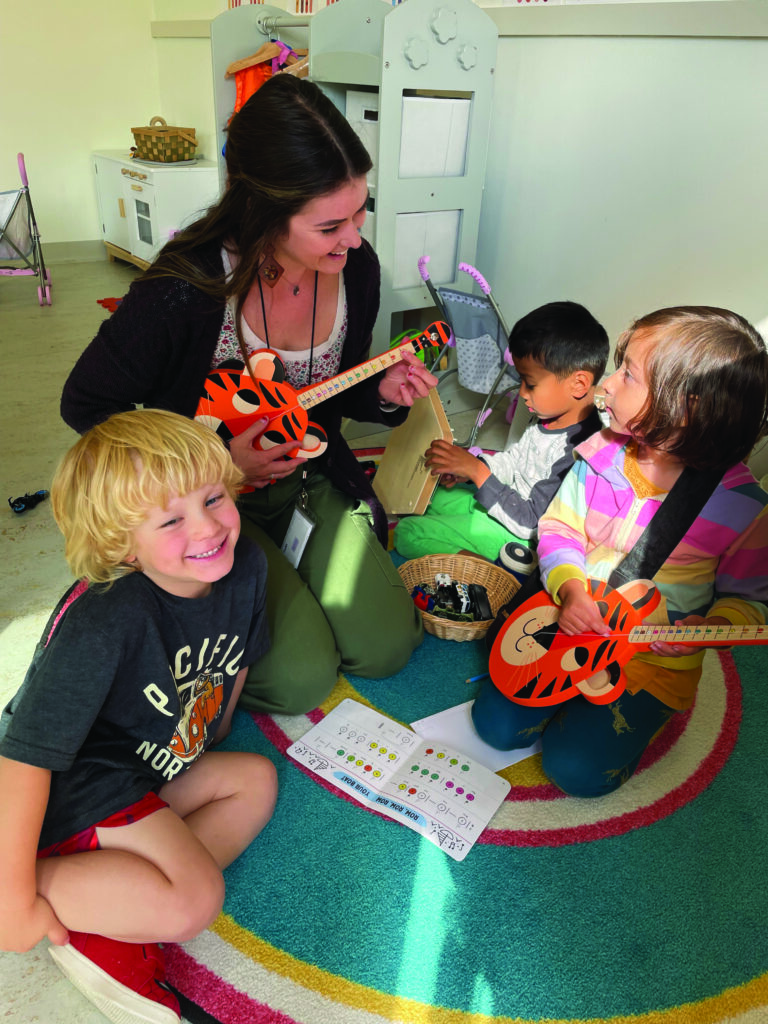
Sara Miller, who holds a Bachelor’s degree in Early Childhood Development and a Master’s degree in Education, is currently using the TinkerTar in her classroom setting, she said, “The TinkerTars are one of my favorite new teaching tools! I am a Pre-K teacher in a play-based environment and the TinkerTar is not only a great introduction to playing musical instruments, but they are also great tools for teaching beginning math concepts in a fun and interactive way. I love that each fret is both numbered and colored so those students who have not quite mastered all of their numerals still have a way of interacting with the instrument and song book. Through engaging with the TinkerTar and song book they get practice matching the color and number on the instrument to the one in the song book, as well as seeing numbers in order from 1 to 15 on the neck. These are lessons you see on worksheets in many schools, but with a TinkerTar students work on these basic math concepts without any sit down instruction. Its just fun!
“Learning instruments can be super frustrating for little kids when they are started on something with four or six strings. TinkerTar’s provide a way for kids to both work on strengthening those finger muscles needed for fretting an instrument, and learning how the sound of the instrument changes as you fret different places on the neck.”
Manufacturing and Distribution
Having formed a relationship with Buffalo Games, Brian said that when he began marketing the TinkerTar he “followed the Chickapig path.” Although Buffalo Games focused on board games and puzzles, during the COVID pandemic their games and puzzles sold so well that they had extra capital to create new divisions and expand into other areas. Brain signed a licensing agreement with Buffalo Games for the TinkerTars and the company took over the manufacturing and distribution.
Through Buffalo Games’ relationship with retailers like Walmart and Target, Brian was able to pitch the product and get the TinkerTar into these stores. The TinkerTar launched during the late summer of this year and can now be found in most toy stores and also at Walmart, Target and on Amazon’s website.
Brain Calhoun hopes that the TinkerTar can be a young child’s first exposure to a stringed instrument. Although Buffalo Games is in charge of manufacturing and distribution, Brian remains involved. He hopes to make other children’s instruments in the future and produce videos for YouTube that teach different tunes than those included in the song book. He also will be working to get the TinkerTar into schools. He said, “It is not a plastic toy. It is made of wood and is a great first instrument.” The TinkerTar comes with a strap and the tune book. The entire package only costs $25.
In addition to all of his work on the board games, children’s books, and TinkerTars, Brian and his guitar building partner continue to build high-end Rockbridge acoustic guitars at the rate of about 65 per year—rockbridgeguitar.com.

Simply an innovative and fantastic idea for developing young minds musically. Perhaps consider expanding into a version for BANJO !!!
Also, have you ever considered applying these learning concepts to the opposite end of the spectrum. That is, adult elderly/seniors or individuals with challenged mental/physical abilities? Both ends of the developmental life spectrum seem to share a similarity in mental and physical ability. Envision someone in their 90s being able to successfully play a stringed instrument. How rewarding !!!
Thanks for the opportunity to comment.
Stay Blessed.