Tim May
Bluegrass Renaissance Man
Photos by Madison Thorn
The small village of Pegram, Tennessee sits about 20 miles west of metropolitan Nashville on I-40. Take exit 192, drive north on McCrory Lane North, and turn left onto US 70 at Eddie’s Market. Drive west, and after the light at Hannah Ford Road is the Musical Heritage Center of Middle Tennessee (established 2008). The brainchild of Gretchen Priest-May and Tim May, it’s an unassuming one-story stone-and-clapboard 120-year-old building that has its own history: once a bank, once a post office, once a family market, and now—as the Fiddle & Pick—a frequent gathering spot for devotees of bluegrass, old time, jazz, and Irish music.
Tim May is not a musician who is easily categorized. He’s more in the mold of a modern Renaissance artist: a performer, a session player, a sideman, a teacher, a clinician, a singer, a songwriter, a repairperson, a luthier, a musical historian, a collector, and an author, and he generally assumes one or more of those roles during any particular day. Tim would not have it any other way. “I just like to keep busy,” he says.
Growing up in Mississippi, Tim started playing banjo at 11 after hearing Earl Scruggs. As part of his practice, Tim put a clock on Earl’s playing to figure out how many notes per second he was playing. “After a lot of practice,” Tim recalls, “I could finally get his speed, but never the quality.” At the same time, Dan Crary and Tony Rice were pushing the guitar musical envelope, and Tim applied himself to the task of learning what they were doing. “I may be among the last of my generation to have learned licks by slowing down LPs with my thumb.”
Those first few years Tim played guitar and banjo mostly with his brother Ben, who Tim credits for finding the music that fueled Tim’s musical fever. After graduating high school, Tim obtained a scholarship to attend David Lipscomb University in Nashville. At Lipscomb, he met and began playing with Dave DeLoach. “He watched me play and then told me that my pick direction was completely backwards—up-down rather than down-up,” Tim recalls. “I didn’t know; I had just been figuring out stuff on my own.” After some dedicated effort Tim eventually standardized his playing. “Learning that was very depressing, but actually either way seemed normal—or equally wrong—to me. At least I already knew the notes.”
All the time Tim attended Lipscomb he toured with Wind Song, the Lipscomb recruitment band, which toured high schools in the South and encouraged high school students to attend Lipscomb. Wind Song played more pop and rock than country, but that provided Tim with experience in performing and introduced him to a wide variety of musical styles.
While in college, Tim played banjo with Eddie Rabbit’s Hare Trigger Band for a while, “probably my first big-time gig.” Tim and Kyle Wood (another member of the Wind Song Lipscomb band) began playing together. Kyle’s friend Chris Joslin (who was attending Belmont) joined them on banjo, and David Holladay on bass completed what was to become Crucial Smith. Pat Flynn, who was taking classes at Lipscomb after having just left New Grass Revival, worked with the band to produce their first record right after Tim and Kyle graduated. “Crucial Smith was basically a progressive bluegrass band in a traditional music scene,” Tim recalls. All four members of the band were tunesmiths, which gave Crucial Smith its unique sound and broad thematic range over the 15 years of the band’s existence.
Tim’s musical resume since that time runs now into several single-spaced pages. Among many other citations, he’s been in demand as a sideman, playing with Patty Loveless, John Cowan, Rodney Dillard, and has been a regular with Mike Snider’s Grand Old Opry-based Old Time String Band. He’s worked as a session player with Charlie Daniels, as session leader and guitarist on the Rounder recording Moody Bluegrass: A Nashville Tribute to the Moody Blues, and as a session guitarist on the follow-up Moody Bluegrass 2.
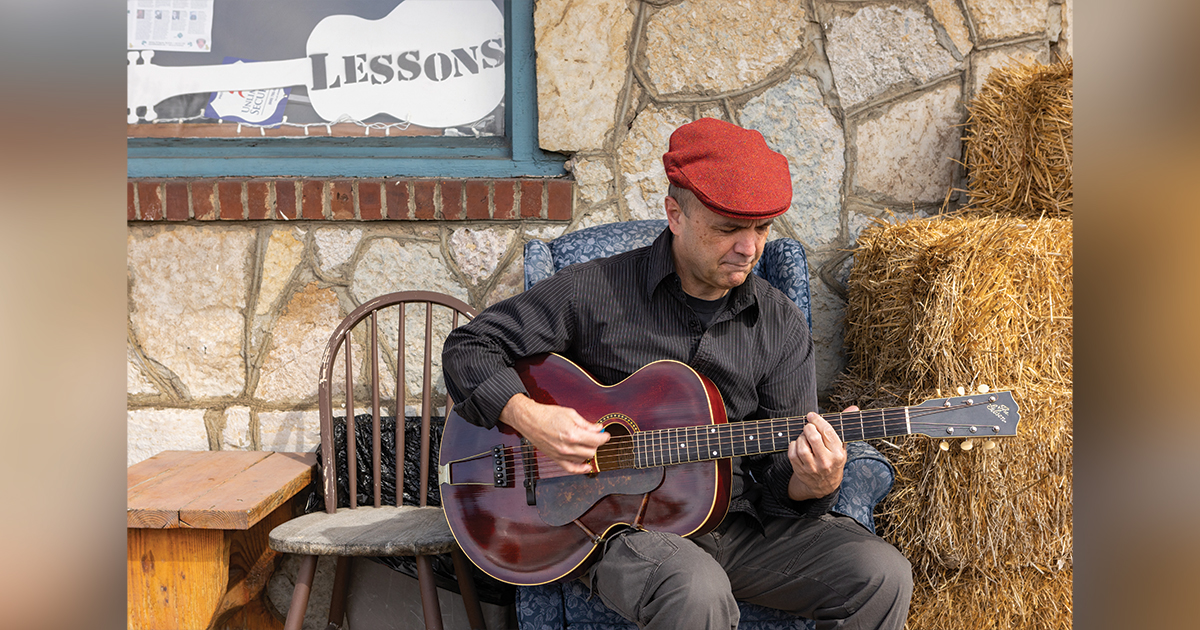
Tim’s interest in instrument construction began when he was 19 or 20. “My father built some instruments, so I started messing around with building. I had no shop and no real tutorials, but I had some very interesting ideas on how to build better.” That experimentation resulted in several tops failing, “which actually was a good thing: I learned what not to do. What took the longest time—at least for me—was getting a professional fit and finish. I was able to get the ‘sounds-good-and-plays-good’ aspect of construction down after a few years, but mastering finishing has taken much longer.” Although originally drawn to build dreadnaught size guitars, Tim has been building more OM and 000-size guitars, especially 12-fret 000s. “There’s just something about that combination of size and neck.” But Tim does not limit himself to flattops. “Seven years ago I was getting very interested in swing and jazz, so I built two arch-top guitars, designing one for power and volume and the other for sweetness of tone. One had parallel braces, the other X-bracing; one had smaller F-holes; one had Sitka braces and the other had Englemann braces. And despite everything, they sound exactly the same. [Laughs] So I still have stuff to learn.”
Tim’s repair skills blossomed in 2003 when he started working with Fred Carpenter, Brian Christianson, and David Harvey at the Violin Shop in Nashville. “I was learning mostly about violin repair,” Tim explains, “and that’s when I got really serious about fit and finish, about French polishing, and making repairs that were essentially invisible on instruments that are designed to be taken apart.” At the same time, Tim was doing repair work for Gruhn Guitars, which provided exposure to a host of other historical instruments. That exposure would be particularly useful when Tim was inspired to assemble a complete collection of pre-1920 Gibson instruments (mostly mandolins).
“It all started,” Tim recalls, “when my friend Rick Osborn just sent me a 1919 L4 guitar. His generous gift—and my interest in instruments from that time—just kicked it off. I remember seeing a photo of a mandolin orchestra in a Gruhn book.” Acknowledging that he would probably not be able to assemble a Loar-era collection, Tim realized that Gibson had made a lot of high-quality instruments between 1910 and 1920, so he focused on assembling a collection of those instruments. “Around 2007 I got a couple historical instruments and began to realize that it was still possible to find nice instruments, like a 1917 harp guitar that looked as though it just come off the factory floor!”
As instrument collectors often do, Tim would locate one instrument, soon after find another in just a little better in condition or with better tone and then sell the first one. Over the next several years Tim and David Harvey—who was also working at the Violin Shop and also had a few historical instruments—assembled a collection of 12 instruments, mostly mandolins, and all in sunburst finishes. “At the end I was so obsessive about this project that I was trying to find keys for all the cases. I found most, but not all. What surprised me was that most of those instruments did not come from eBay or places like that.” Although it was not Tim’s original intention, the collection did eventually find its way to the New York Metropolitan Museum. (For further information, YouTube has a series of eight videos from a Country Music Hall of Fame show where Tim and David demonstrate the instruments in the collection: https://www.youtube.com/watch?v=QNys8nsBxIc). “But,” Tim admits,” of course I kept the L4 that kicked that project off. I found another L4 to take its place in the collection.”
Tim found that assembling that historical collection inspired him in other ways. He’s added building an F-style octave mandolin to his palette of OM and 000 style guitars. “The excitement of putting that whole collection together invigorated everything musical in my life. I was more excited to play guitar and mandolin, of course, because it was a mandolin collection. That led to interests in jazz and swing: that one project made me generally more excited about everything.”
Teaching is another large part of Tim’s musical life. He first became involved in the workshop and camp experience in 2007 with Joe Carr and Alan Munde’s Camp Bluegrass at South Plains College in Levelland TX. Although he had no attendees for his very first class, Tim has become an in-demand instructor at numerous music camps across the country, including Camp Bluegrass, Steve Kaufman’s Acoustic Kamp, the Colorado Roots Music Camp, Nashville Guitar College, Nashcamp, and the Swannanoa Gathering.
An extension of his teaching was creating a series of instructional books for Flatpicking Guitar Magazine. In Improvisation & Style Studies and its companion Improvisation (Part II) & Advanced Technique Studies (volumes 5 and 6 of Flatpicking Guitar Magazine’s Flatpicking Essentials series of instructional books), Tim and Dan Miller (editor/owner of Flatpicking Guitar Magazine) laid out a pathway to improvisation for bluegrass guitarists that mirrors many of the techniques that jazz musicians have used for years. Tim explains: “with improvisation you need to learn some basic techniques, accept the fact that it’s going to take you a while to learn, and then just do it. In college, Kyle Wood and I would sit knee-to-knee and just play, just thrash the music out, the good and the bad of it, and we learned to improvise through trial and error.”
Tim is also a strong advocate for learning how to transcribe. “It’s not absolutely necessary and it is painful, but transcribing a tune enables you to recognize patterns, to see the underlying system in what’s being played. I’m not saying that’s the only way, but transcription puts that content out in front of you.” “And,” he adds, “now when I sit down to watch someone play—like at master classes at camps—I am very conscious of pick direction.” [Laughs] “I just don’t want anyone to go through what I did.”
Recently Tim has been conducting intensive one-on-one immersive banjo or guitar tutorial sessions. “I hang out with someone for three or four days, and we play probably for six to eight hours a day. That takes a certain amount of willingness on the student’s part, but I’ve found it very enjoyable, and the guys who want that tend to be very focused and ready to absorb as much as possible. It’s a fantastic way to accelerate playing skills, and something entirely new that I would never have predicted I might be doing.”
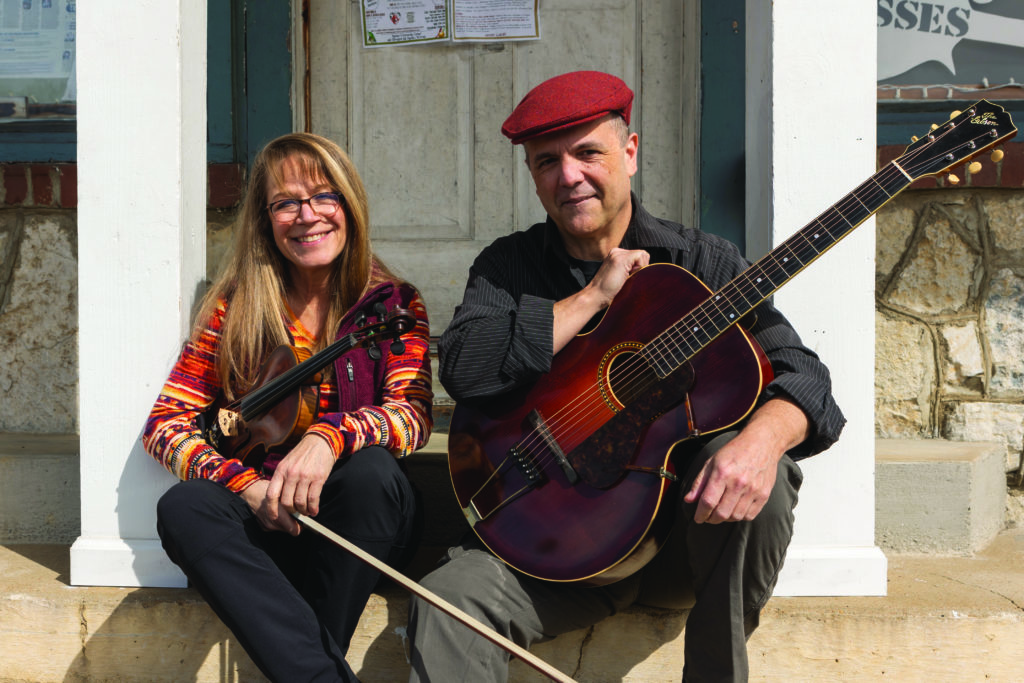
Over the span of a typical year, Tim performs or teaches an average of 200 days. In the past few years he has teamed with Steve Smith, interspersing performances with instructing at camps. Tim also tours with the fingerstylist Richard Gilewitz and finds time to perform with the Nashville-based band Plaidgrass (with fiddler Gretchen Priest-May).
As you might expect, Tim is looking forward to releasing a number of projects this year. “Steve Smith and I have an instrumental album scheduled for release this year, although we do have a lot of other material recorded but not currently tagged for an album. Lots of time Steve and I record stuff and figure out what to do with it later. I recorded with Richard Gilewitz a few years back and we have another album coming out this year. Gretchen Priest-May (my wife) has a project with Emily Wilson called Roadside Distraction on which I played rhythm guitar that should be released mid-year. I also have a solo project coming out towards the end of this year on which I get to play all the instruments, with the exception of the fiddle, which I leave to the professionals like Gretchen. And during the COVID era I started collaborating with Mike Laidley. While we have an instrumental recording coming out, we’ve also built a backlog of 30 or so vocal tunes. Lately we’ve been working with Erin Peet-Lukes (of Thunder and Rain) for her project, again scheduled for release this year.”
That’s a full schedule but Tim is invigorated by it. “I thrive—and probably actually need—that mix. For example, earlier this week I did a pretty intense jazz gig with Paul Abrams with tunes in Gb and Db and Ebm and then last night I did a jam with Buddy Green and Chris Joslin with old time and bluegrass music. One was a lot like solving a mathematical problem and the other was very physical with speed and power. It’s probably just me, but I’ve found that if I play too much jazz I cannot physically keep up with bluegrass, and if I play too much bluegrass I have trouble with the academic requirements of jazz. And the demands of each style require you to jump from one kind of guitar to another.”
Which is pretty much Tim in a nutshell: a performer/session player/sideman/teacher/clinician/repairperson/luthier/musical historian/collector/author who finds inspiration—and interconnections—in everything he does. To check out Tim’s performances, his camp attendances, his clinic schedules, or to arrange one of those intensive one-on-one immersive tutorials, go to www.timmaymusic.net.