There Is A Time, 1962-1967
One day in 1953, Earl Scruggs answered a knock at the door of his suburban Nashville house. Standing there was a sixteen-year-old kid with a banjo and a grin as wide as the Mississippi River. It was Doug Dillard, and he wanted to know if Scruggs would sell him a set of “Scruggs tuners,” a recent invention by Scruggs that allowed a banjo player to accurately and easily change the pitch of certain strings on the fly. Scruggs not only sold him a set of the tuners, but installed them right there at his kitchen table.
Dillard took his newly modified banjo back to his hometown of Salem, Missouri, and began learning what to do with it. His family was musical—his father Homer was a fiddler, his mother Lorene played guitar, older brother Earl played piano and younger brother Rodney played the guitar. They had a family band that specialized in old-time tunes like “Bill Cheatham” and “Sally Goodin.”
Doug Dillard vividly recalled his bluegrass conversion moment a half-century later: “I was driving a car the first time I heard bluegrass. I reached over and turned on the radio and there was Earl Scruggs playing ‘Earl’s Breakdown.’ My God, I went out of my mind. I was so excited by what I was hearing that I drove the car off the road into a ditch. I had to get it towed out.”
In 1956, Doug (1937-2012) and Rodney (born in 1942) formed a bluegrass band called the Ozark Mountain Boys with four friends. Doug also played at the time with the Hawthorn Brothers and appeared on the television program Lee Mace and the Ozark Opry in 1957 and 1958.
Doug and Rodney began their recording careers the following year, recording a number of songs in Doug’s living room, with a small band that included their friend John Hartford on fiddle. A St. Louis record company named K-Ark released seven of the songs, credited to the Dillard Brothers, on a pair of singles in 1961—“Doug’s Breakdown”/“My Own True Love” and “Mama Don’t Allow”/“Highway of Sorrow”—and a gospel EP including “I Saw the Light,” “Build Me A Cabin in the Corner of Glory Land” and “Jesus is Standing at My Right Hand.”
The Dillard brothers met mandolinist Dean Webb in 1960 at the Ozark Opry and began picking together occasionally. A native of Independence, Missouri, Webb (1937-2018) first played in a band around Independence and Kansas City with two of his cousins. He then hooked up with a banjo player named Lonnie Hoppers and formed a band called the Ozark Mountain Boys (not to be confused with Doug and Rodney’s band of the same name).
Dean, Doug and Rodney met Mitch Jayne when they took some Dillard Brothers records to the local radio station KSMO. Jayne was a disc jockey there whose Saturday morning program mixed bluegrass recordings and performances with his off-beat humor; a regular feature of the show was the “Snake and Tick Market Report,” a faux-agricultural livestock report that tracked prices of, for one choice example, “Hoo-Boy White Dot Crushproof Dry Valley Wonder Ticks.”
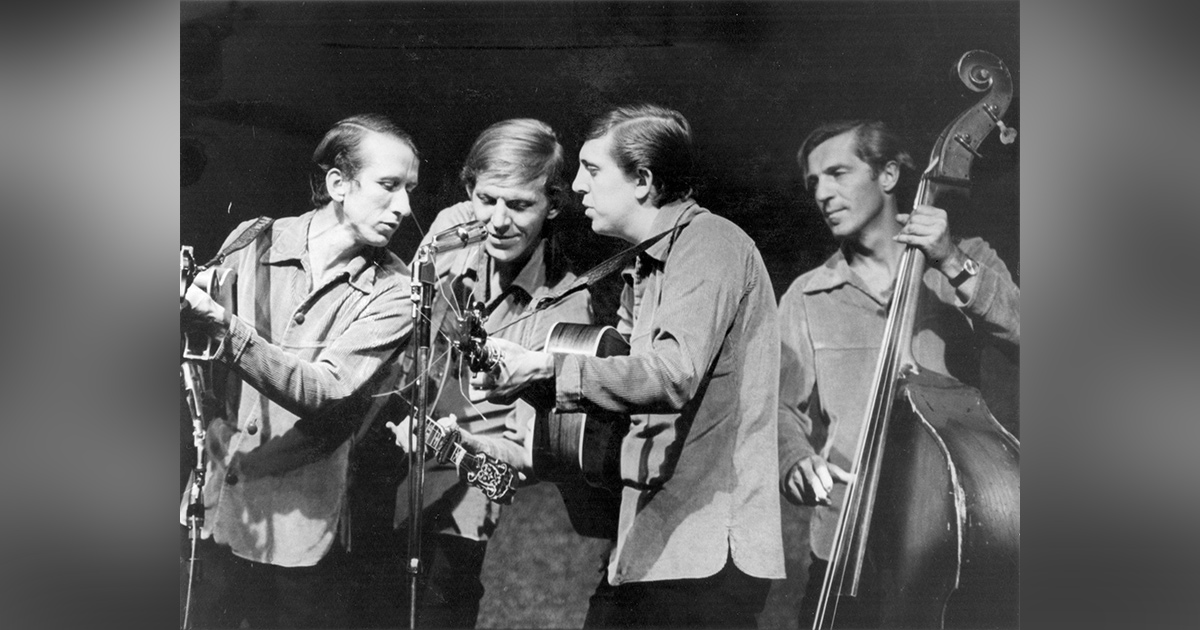
Jayne (1928-2010) was happy to play the records they’d brought, and he decided more or less on the spot that he wanted to be a part of the band. He couldn’t play an instrument, but he was funny and a great storyteller with a bottomless reservoir of mountain humor, sayings and lore and would make a great front man. Dean, Doug and Rodney quickly taught Mitch how to play bass and the original line-up of the Dillards was set—Rodney Dillard (guitar, dobro, lead vocals), Doug Dillard (banjo), Dean Webb (mandolin) and Mitch Jayne (bass).
The band practiced every day on Jayne’s back porch in the nearby town of Eminence and decided after a short time that Missouri wasn’t the most propitious place to try to make it as a professional musician. They decided to move to Los Angeles, because that’s where the opportunities seemed to be. The Dillards made its debut shortly before leaving with a well-received concert at Washington University in St. Louis.
The boys headed west in Dean’s 1955 Cadillac, planning to sleep in the car on the way. They’d driven about 500 miles when car problems left them stranded in Oklahoma City, their funds depleted. A hastily arranged week-long gig at the Buddhi Club, augmented by day labor found through a temporary employment agency, refilled the band’s coffers and the trip west resumed
On their first night in Los Angeles, in November 1962, the four members of the Dillards decided to go see the Greenbriar Boys, a bluegrass trio from New York City, at the Ash Grove. The Ash Grove was the top venue in the city for big-time, touring folk, bluegrass and blues acts. Most of the top bluegrass and old-time musicians who made it to California played there, including Bill Monroe, Flatt and Scruggs, the Stanley Brothers, Doc Watson and the New Lost City Ramblers.
An oft-repeated legend has the Dillards crashing that Greenbriar Boys gig—literally—unpacking their instruments in the lobby and cutting loose with some gold old fashioned Missouri bluegrass at the intermission. That impromptu performance got the band invited back the next night to jam with the Greenbriar Boys! It won the band a recording contract! With Elektra, a folk label on the rise! It’s a fantastic story, one of the best origin stories in bluegrass. Unfortunately, the truth is not nearly as dramatic.
Dean Webb set the record straight in a 2006 interview done with the four original Dillards as part of the Bluegrass Hall of Fame and Museum Oral History Project. On the drive west, Dean had picked up a copy of the folk music magazine Broadside that had an article in it about the Greenbriar Boys saying the band would be appearing at the Ash Grove when the Dillards hit town. They decided to go hear some bluegrass.
Greenbriar Boys mandolinist Ralph Rinzler was in the club’s lobby when the four walked in, and Webb made a beeline for him. They talked, as musicians will, and the Dillards were subsequently invited up on stage and jammed with the band. In the crowd that night was Jim Dickson, an independent record producer with connections at Elektra. He was impressed enough with the Dillards that he returned the next night with Elektra head Jac Holtzman. The Dillards went to sleep that night with a recording contract in hand. On their second night in Los Angeles.
Dickson rushed the band into the World Pacific Studio in Hollywood and cut one of the all-time great debut albums in bluegrass history, Back Porch Bluegrass, released in 1963. The album starts as if shot from a cannon, with a blazing fast traditional fiddle tune called “Old Joseph,” driven by Webb’s cross-tuned mandolin. That’s followed by a gospel quartet, “Somebody Touched Me,” an especially confident move for a young band.
Songwriting was from the start a hallmark of the band, and the album contributed several great original songs and tunes to the bluegrass repertoire, including three outstanding banjo tunes by Doug Dillard—“Banjo in the Hollow,” “Hickory Hollow” and “Doug’s Tune”—and two songs that have become modern standards, “Dooley” (written by Mitch Jayne and Rodney Dillard) and “Old Home Place” (written by Jayne and Dean Webb), the latter of which became ubiquitous in bluegrass circles after J.D. Crowe & the New South covered it in the mid-1970s.
Chris Hillman, who was then playing mandolin with the Scottsville Squirrel Barkers, vividly remembers the Dillards coming to Los Angeles. “When they hit town, they completely blew everybody away,” he says. “It wasn’t the old bluegrass thing. Their entire approach was very entertaining. Doug was an amazing player. I would put him at the very top level of proficiency on the banjo, right up there with Earl Scruggs. He was a great musician, and he greatly influenced me.”
Richard Linke, an associate producer of the popular CBS television program The Andy Griffith Show, saw a notice one day in Variety, an entertainment industry newspaper, that Elektra had signed the Dillards. Or perhaps he caught the Dillards at the Mecca; accounts differ. He contacted Elektra to set up an audition with the band. Desilu Productions wanted to again feature a bluegrass band on the program.
The bluegrass “position” had once been held by the Country Boys (Roland, Clarence and Eric White, Billy Ray Latham and LeRoy McNees), who had appeared on two episodes of the show in 1961. But the White family had moved since the second appearance, and apparently Desilu was unable to reach them.
The Dillards got the gig and went on to appear on five episodes in 1963-64. The band members were cast as the Darling family, socially inept but musically talented mountaineers, the adult sons of Briscoe Darling, played by actor Denver Pyle. (Fun fact: Though rarely referenced on the program, the first names of the Darling boys were Oether, Jebbin, Ward and Frankie.)
The boys rarely spoke and had hangdog, slack-jawed, expressionless faces, four backwoods idiot savants, one or two steps up from the odd, moonfaced kid in Deliverance. But those Darling boys sure could play some hot bluegrass!
The Dillards played three or four songs and tunes per show, and Andy Griffith encouraged them to include original material as much as possible, as that would earn them more money. The Dillards appeared in the following episodes: The Darlings Are Coming; Mountain Wedding; Briscoe Declares for Aunt Bee; Divorce, Mountain Style; and The Darling Baby.
It would be hard to quantify the exposure the Dillards received from being on The Andy Griffith Show, but a word like “massive” might be accurate. The program ran from 1960 through 1968 and was never out of the Top Ten in annual ratings. It’s not an exaggeration to say that millions of people got their first taste of bluegrass from these programs. That opened many a door for the Dillards.
The band played most of the major folk festivals in the country, including Newport, Monterey and UCLA, and also appeared at such uptown folk venues as Gerde’s Folk City in New York and the hungry i in San Francisco. The Dillards continued to bring bluegrass to new audiences, touring with rock acts the Byrds, Mitch Ryder and the Detroit Wheels and Sam the Sham and the Pharaohs, and performing on such television programs as Hootenanny, American Bandstand, Where The Action Is, The Johnny Cash Show, The Lloyd Thaxton Show, Hollywood Discotheque, Hee Haw, Hollywood a Go Go and The Judy Garland Show (where Judy had them perform barefoot in tuxedos).
The Dillards was the funniest band in bluegrass, and Mitch Jayne the funniest frontman. In his liner notes to the Dillard’s second album, Live!!! Almost!!!, Jayne wrote that “A great deal of what we do is entertainment” and also noted that a large percentage of the people who came to see the band had never before encountered bluegrass. Comedy was a way of breaking the ice and giving the audience more of a “show.”
Comedy had been part of bluegrass from the very beginning. Most of the first-generation bands included comedy in their stage acts, mostly of the rube variety with gags and concepts dating back to minstrel and vaudeville shows. The bands generally had one or two members who handled the funny stuff—sporting outlandish costumes, blacked-out teeth, painted-on freckles and that kind of stuff. Reno and Smiley’s band did little skits in which Don Reno played a character named Chicken Hotrod and Red Smiley, in a dress and a wig, was Pansy Hotrod.
Rodney was a gifted physical comedian who could crack up an audience just by pulling a sad-sack face, but the verbal humor was Jayne’s department. Mitch had formerly taught in one-room schoolhouses and was keenly interested in the various folkways of his adopted Ozarks home. He channeled that interest into hilarious comedy monologues and song introductions that were a big part of a Dillards performance.
Jayne took his creations seriously, feeling that the humor was his way of making more of an on-stage contribution. His deadpan delivery and twangy voice sometimes made his bits seem off-the-cuff, but in fact each little anecdote or story was a finely crafted work of folk humor and storytelling. Jayne took a portable typewriter with him on the road and worked on his routines constantly.
The Dillards brought bluegrass comedy into the modern age, freeing it from its cornpone past. Jayne’s humor was verbal, topical but not political, sophisticated enough for urban folk audiences but down-home enough for the home folks, and self-deprecating in a tongue-in-cheek self-aware way. Plus, it’s still funny after all these years.
Live!!! Almost!!!, recorded during a three-day engagement at The Mecca, a Los Angeles folk club, is perhaps an even better introduction to the Dillards than the superb first album, because it perfectly captures the feel—the vibe—of the band. Doug Dillard shows himself to be arguably the fastest bluegrass banjo player in the land, with rip-snorters like “Dixie Breakdown,” “Buckin’ Mule” and “Sinkin’ Creek.” The album is also notable for its inclusion of “Walkin’ Down the Line,” the first Bob Dylan song on a bluegrass album.
The third album by the Dillards, Pickin’ and Fiddlin’ (released in 1965), was recorded, at least in part, to respond to sniping by what Rodney Dillard scornfully called “the folk music elite.” The Dillards appeared at the Newport Folk Festival in 1963, shortly after recording Back Porch Bluegrass, and it was likely there and then that the band’s adversarial relationship with the folk music establishment began.
That establishment, or at least its intellectual, academic wing, had problems with the Dillards and “authenticity.” Few members of the folk intelligentsia could have explained what they meant by the term, and even fewer possessed any such folk authenticity themselves, but they found the Dillards lacking.
Sure, the band’s music was great, but they smiled and joked around on stage, actually having fun. As Chris Hillman pointed out, “Doug Dillard was the only bluegrass banjo player who actually smiled on stage. He really enjoyed himself.”
Didn’t the Dillards know that bluegrass was serious business, solemn if not downright dour? It was meant to be work, not play. The band’s sense of fun really irritated the purists. One of the folk magazines even accused the Dillards (or Elektra) of speeding up Back Porch Bluegrass to make it more impressive. The album, of course, wasn’t speeded up; the Dillards actually played that fast. Rodney Dillard later chalked it up to “youthful excitement.”
If the Dillards wanted to establish their traditional bona fides with the “folk elite,” Pickin’ and Fiddlin’ could not have been more on target, from a good selection of “authentic” fiddle tunes to the albums’ deeply folkloric song and liner notes by Ralph Rinzler. Rodney later joked that “reading the notes to that album is like watching public television.”
Pickin’ and Fiddlin’ was an atypical Dillards record in many ways: there was no original material, there was no singing and the album showcased an instrument the Dillards hadn’t yet featured, the fiddle. In fact, this was the first all-instrumental fiddle album in bluegrass.
The Dillards had met young fiddler Byron Berline at a concert in Norman, Oklahoma, where Byron was a student at the university. He was the son of a champion old-time fiddler, Lue Berline, and, even at nineteen, Byron was something special. “We thought he was such a great fiddler,” recalled Doug Dillard, “and we wanted to expose him to the world.”
Doug, Dean and Rodney all took breaks on the album, but this was basically Byron’s show, with the Dillards providing superb, unobtrusive back-up. Several of the tunes come from Texas fiddler Eck Robertson, whose 1922 recording of “Sallie Gooden” was an early country hit, and Byron learned several of the others from his father. Highlights of the album include “Hamilton Breakdown, “Tom and Jerry,” Byron’s original tune “Jazz Bow Rag,” “Crazy Creek,” “Black Mountain Rag” and “Sally Johnson,” done here as a powerful banjo/fiddle duet.
After three albums, the Dillards’ contract with Elektra had been fulfilled, but neither side was especially happy. The label was probably disappointed that the band hadn’t sold more records. The band was probably disappointed that the label hadn’t sold more records. The Dillards also felt that Elektra was not that supportive of the band’s desire to spread its wings a bit and move outside the confines of straight-ahead bluegrass.
The Dillards left Elektra after Pickin’ and Fiddlin’ and signed with Capitol. The band tried different things with different producers (including legendary hit-maker Ken Nelson), but nothing really clicked. Capitol recorded six songs and released two singles on the band, both in 1965, “Nobody Knows”/“Ebo Walker” and “The Last Thing on My Mind”/“Lemon Chimes.” When it became clear that Capitol wasn’t interested in finishing an album, the Dillards got their release from the label and re-signed with Elektra.
There was also dissension in the band about its musical direction. Playing traditional bluegrass had lost some of its appeal, but nobody really knew what to do next. Los Angeles was the epicenter of American music in 1966 and 1967, and change was definitely in the air. The Dillards was part of a cohort of young bands in the city that included the Byrds, Buffalo Springfield, the Turtles, the Beach Boys, the Mamas & the Papas, the Association, Love, Hearts & Flowers, the Mothers of Invention and the most successful of all of them, the Monkees.
These bands knew each other, recorded and rehearsed at the same studios, went to the same parties, shared ideas, joints and dreams with each other, hung out at the same clubs and music stores and on and on. Those were heady times and there seemed to be no limit to what a band could do, or at least try.
The Dillards wanted to do something different, but couldn’t seem to agree on what that might be. They’d already plugged in and used electric instruments some when they toured with the Byrds, so electricity figured to be part of their future. Looking back, and based on the recordings that followed, it seems that all four Dillards were heading in a similar direction, towards folk-rock, country-rock or something along those lines. But they wouldn’t go there together. Doug Dillard left the band in 1967. Dean, Mitch and Rodney Dillard continued as the Dillards, hiring Herb Pedersen to fill the banjo slot.
Doug, Rodney, Dean and Mitch would all go on to have long musical careers lasting for decades, but Doug’s leaving the Dillards was the end of an era. Between 1962-1967, the Dillards was arguably the hottest, most exciting and most creative bluegrass band on the planet. They were known to countless people who had never heard of Bill Monroe or the Stanley Brothers. The Dillards made an impact.
“During the Dillards’ career, we changed a lot of people’s heads toward bluegrass,” Mitch Jayne said in 2006. “It was a nice side effect. What we wanted to do was play what we were good at and make a little money. But to affect that many other people’s lives, well, that looms very large.”