The Violin Shop
Photos By Shelley Swanger
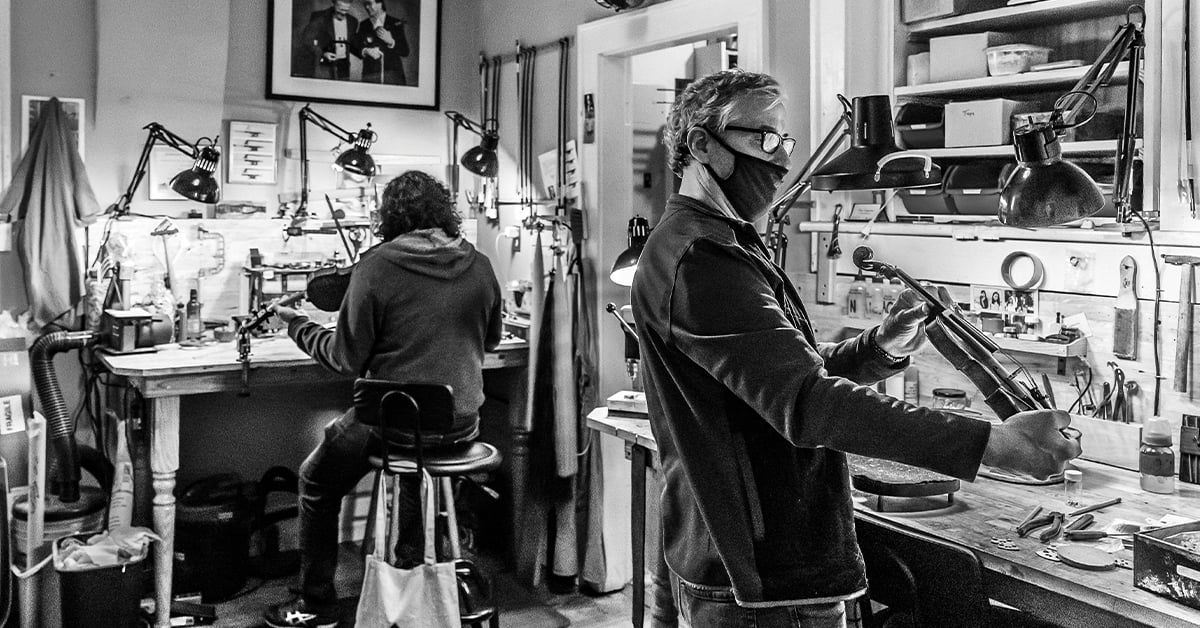
Providing a combination of sales, repairs, rentals, workshops, performances, and musical fellowship, The Violin Shop has been the choice of Nashville’s finest fiddlers for over 30 years. Meeting the needs of four- (and even five-) string devotees from bluegrass to classical, Celtic to old-time, The Violin Shop (at 2504 8th Avenue South or www.theviolinshop.com) has become a Nashville institution, and Fred Carpenter a Nashville fixture.
Soon after graduating high school, Fred left Maine and made his way to California to perform with the Tony Rice Unit. At the same time, he began a four-year repair apprenticeship at the Loveland Violin Shop in Santa Rosa, California. Fred then moved to Nashville in 1988 and set up a violin repair shop in a small room of his home. He then moved his growing business to a corner of Charlie Derrington’s guitar shop, and by 1993 Fred stopped touring and opened his own retail space in Bellevue. In 2005 he added a performance room, and by 2013 moved the shop to its current location on 8th Avenue.
Along the way Fred assembled a stellar team of like-minded artisan-entrepreneurs. Brian Christianson—now The Violin Shop’s general manager—started visiting The Violin Shop as a student. Leveraging the fiddle repair skills he had acquired from a year-long violin repair program at Minnesota State College in Redwing, MN, Brian started as a repairperson. Growing up at her father’s side, April [Carpenter] Campbell learned the business side of the shop and is now the administrative director. Jennifer Halenar heads up the violin repair when she is not building her own fiddles, Paige Park and Laura Epling handle sales and customer service and Tyler Andal handles the arcane process of bow rehairs, restoration and bow making.
In 2018, a shift occurred at The Violin Shop which had been in the making since 2005. “In 2004 and 2005 we were filming a lot of live shows,” Fred remembers. “This was before YouTube, and there just weren’t a lot of good roots music performance videos. Ian Panton was one of my frequent customers, and I showed him some of the videos. He was impressed and wanted to be involved in the effort. So, we brought him in as executive producer. Ian was essential in bringing fiddlers to town and helping make the three-volume DVD Fiddle Masters Concert Series a reality.” From that association, Fred and Ian became fast friends and started attending fiddle auctions, festivals, and other fiddle events. Although Ian (a native of Aberdeen, Scotland) had played fiddle all his life, he was intrigued with the business and became an integral part of The Violin Shop: “In 2008 I asked Ian if he wanted to be a partner in the business,” Fred recalls, “and he said ‘that works for me.’ ”


“In 2018,” Fred continues, “after I had been in this business for 30 years, we arranged that I would step back into sales and repair for four days a week, and Ian stepped forward as owner with Brian and April as on-site managers. That gave me more time to enjoy my grandkids and play my fiddle! For years I have always had to work any music around my shop schedule. Now all that has changed, and I’m looking forward to working my shop time around the music.” In addition, Fred notes: “One of the benefits I have gotten out of this place over the past 30 years is relationships: if I had just been another fiddler in town doing gigs, I would not have had the opportunity to see all the other fiddle players and have built so many great friendships.”
“It’s a close team, all of whom are incredibly good at what they do and all the staff—even the part-timers—are professional musicians,” Ian reports. “This last year has been hard, of course, but we’ve managed to get through it and are looking forward to 2021. And any business that has survived for 30 years, especially in the retail trade, has to be doing something right. This young team knows what fiddlers want and has been very successful in meeting that need.”
Essential to the success of The Violin Shop has been flexibility and focus: “we have always tried to do the things we knew how to do well,” Fred says. “While there’s a lot of things we can do online, there are other things—like rehairing a bow or setting up a fiddle—that just need to be done in person. We just try to be as sensible and smart about things as possible. As a team, it’s all about the chemistry and working together towards a common goal.”
In terms of products, the driving principle of the Violin Shop has always been to first understand what the player wants. Someone who primarily plays fiddle music (old time or bluegrass) has a fundamentally different requirement for an instrument than someone playing classical music. That recognition accounts for both the variety of instruments in the shop as well as its continually changing inventory. For student players, the Violin Shop offers a variety of great-sounding new instruments (including their Music City fiddles) for well under $2000. For more experienced players, the shop stocks a selection of “one-of-a-kind” older instruments, commonly French, German, and American, with special consideration for the historical importance and condition of these instruments. Regardless of the instrument’s provenance, the shop focuses on ensuring that each fiddle has the best possible sound and playability. Finally, should you have a specific violin need, over its 30-year history the shop has built a list of dependable colleagues to help in that search. But all that effort is founded on an open conversation with the player, focusing on and clarifying specific musical needs to tailor the artist-fiddle relationship.
If you can’t visit the Violin Shop in person (remember your mask!), you can always visit their website (www.theviolinshop.com) for a virtual Violin Shop experience (courtesy of Eli Bishop, their website and social media master) to view the current selection of student and fine violins, read about rental programs, and browse bows, strings, and other accessories.