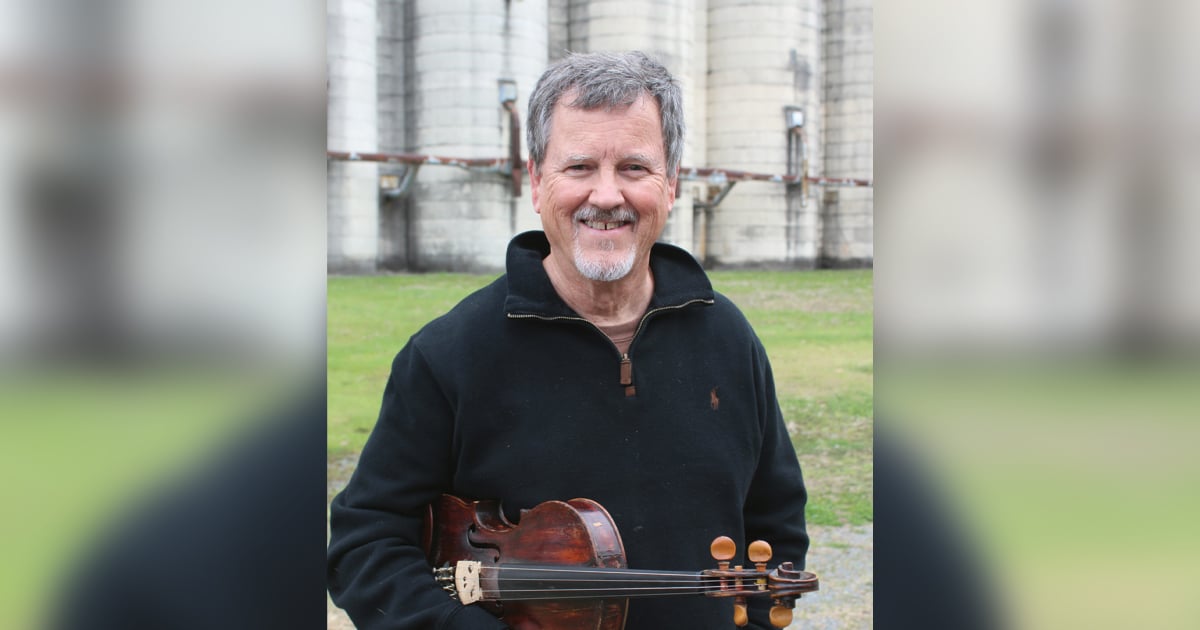
The Ultimate Road Dog
Photo by Daniel Coston
For nearly half a century, fiddling ace Mike Hartgrove of the Lonesome River Band has been traveling highways across America playing bluegrass and country music.
“Mike is a road pro,” says Lonesome River Band leader Sammy Shelor. “The guy has been on the road since he was 17 years old, about like myself. He’s got a lot of good old road stories. He keeps us entertained. I do a lot of night driving, and he’s a great shotgun guy to set up with me and talk to me at night. He’s always got some story to tell.”
“If you looked in the dictionary under road pro, there would be a picture of Mike Hartgrove,” says LRB lead singer/guitarist Brandon Rickman. “He’s one of the easiest guys you’ll ever travel with. He goes with the flow. He lightens up.”
That’s partly in keeping with Mike’s philosophy that he learned years ago from country legend George Jones’ steel guitar player, Gary Boggs.
“The rule of thumb is to leave your problems at the curb,” Hartgrove said. “Everybody’s got problems in life [but] I try to keep a good attitude because when you bring people down, that’s not healthy.”
Fellow sideman Jesse Smathers, mandolin/vocalist with LRB, says he had a different first impression of his bandmate.
“When you first meet Grove, he’s kind of quiet and laid back, but being on the road with him, [I discovered] he’s full of stories and funny one-liners,” says Smathers. He’s one of the funniest human beings I’ve ever met in my life. He’s one of my favorite people.”
“I appreciate these guys,” Hartgrove says of LRB members. “They’re a really fine bunch of people to work with and great musicians and singers. It’s an honor to play in this band.”
One adjective that repeats over and over again when other musicians describe Hartgrove is consistency.
“He’s as consistent as they get,” Rickman said. “He’s clean. He never plays a bad note. He has one of the greatest ears I’ve ever played with. I’ve always felt like Grove was a stylist. He has his very own thing. He puts everything into the right place every time. He’s one of my heroes.”
“Consistency is the main thing with him,” Shelor adds. “You know what you’re going to get. He’s very structured. You know that he knows where his part goes for the back-up. He’ll never miss a solo. He’s always there. When you turn around, you know he’s going to be there ready, and that speaks volumes to me.”
“Mike is one of the most consistent fiddler players,” Smathers agrees. “Of anybody I’ve ever met in this music, Mike has the best ear. He takes everything into consideration when laying down fiddle. He’s played behind some great singers, so he’s always thinking of the singers. You won’t ever hear him stepping on anybody’s toes.”
Hartgrove is a team player who says simply that he tries to play what he feels comfortable doing.
I don’t claim to
be a flashy player.
At the end of the day
I just want to be the
guy that’s played
in the band situation and tried to be tasteful and played a good tone.
Growing up in Shelbina, Missouri, in the cradle of many great old-time fiddler players, Hartgrove first started playing fiddle when he was 10-years-old.
“I was intrigued by the sound of it and the way the fiddle tunes they played sounded and watching these older guys play.”
Mesmerized by players like Pete McMahan, Taylor McBaine, Cleo Persinger, Jake Hockmeyer, and Henry Thompson, Hartgrove listened to records and attempted to emulate those fiddlers.
“They didn’t cut any corners. If you played something right, they would tell you. If you played something wrong, they would tell you. They didn’t pat you on the back unless you really played good. It’s an instrument you really have to have quite a bit of discipline and a lot of motivation to play.”
Classical violin player Ed Harding showed Hartgrove the proper way to hold the bow and later Fred Schade taught him to read music. He began entering fiddle contests alongside his guitar playing dad, but it wasn’t until he met Lyman Enloe with the Kansas City Bluegrass Association that Grove branched out to bluegrass fiddling. Also catching Hartgrove’s ear were Kenny Baker, Tommy Jackson, Paul Warren, Benny Martin, and Joe Meadows who worked with Jim and Jesse.
After graduating high school in 1974, Grove packed his bags for the Country Music Capital where he met Alan O’Bryant, now of Nashville Bluegrass Band fame, and Billy and, Terry Smith who is currently a member of The Grascals. They put together a band called Blue Haze that worked at a Nashville pub. Later on, Hartgrove heard auditions were open for a fiddle player at George Jones’ Possum Holler club. Jones’ band leader Tommy Williams, who had worked with Mel Tillis, Faron Young, and Ray Price, asked Hartgrove about his experience.
“He said, ‘I like your playing. Would you be willing to learn over 100 arrangements?’”
He began playing at the lower Broadway Nashville bar five nights a week until one evening another man in Jones’ organization asked him to join the legendary singer on the road.
“George was playing the Opry, and he had that song out ‘I’ll Just Take It Out in Love.’ I listened to the record and learned the arrangement. I went backstage and met George in the dressing room, and we went through the kick-off. We played the Opry, and we left [on the road] that night.”
From 1977 to 1979, Mike toured with Jones where he learned how to balance his fiddling behind one of the greatest country music singers ever.
“He was really singing good back then. The steel player told me ‘You’re overplaying a little bit. Honor thy singer.’ That was a very good education for me on how to learn to play back-up. He [Jones] played in some weird keys too, like A flat, but the band was good, and they were great guys. What an opportunity!”
“If I heard George spawn something improvisationally, I learned to listen and play around him, not on top of him. Listening to what the singer is doing is essential. I’ve been very lucky with that with singers.”
Jones, who called Mike “Snuffy” because back then he dipped tobacco, liked the way he played in a similar style to popular session musician, Tommy Jackson.
“He liked real tasteful stuff. He liked that kind of playing. He liked playing in the lower register. He didn’t like going third position, playing a lot of stuff high up the neck.”
After leaving Jones’ band, Hartgrove played for a short stint with the Bluegrass Cardinals, and in 1980 landed another pivotal job in country star Moe Bandy’s Good Ol’ Boys band.
“They were really hot. I went to work playing country, and I moved to Boerne, TX. We were working 200 plus days a year. I was lucky that I got in on the tail end of reallytraditional country music.”
That transition from bluegrass to country music came with a bit of a learning curve.
“You’re playing a lot more 4/4 shuffle, especially living out there. It’s maybe playing a little bit more in the middle of the beat where in bluegrass you’re more on top of the beat. Both are hard. There’s a lot more going on as far as being a fiddle player in bluegrass.”
After leaving Bandy’s band, Hartgrove again hooked up with the Bluegrass Cardinals and stayed for the next eight years. That’s where his next boss, Doyle Lawson, first heard him play. Lawson hired Hartgrove as the first full-time fiddler for the Quicksilver band.
“The thing you could count on with Mike is he never overplayed,” Doyle Lawson said. “He tried to play what fit the context of the song. It was not ‘Look at me. Look what I did.’ He was a team player. He played with the band. He was so careful (not to overplay) sometimes I would say, ‘Turn loose just a little bit more.’ He was ever mindful of not getting in the way of the vocals, always.”
In April of 1991, Hartgrove founded IIIrd Tyme Out with Russell Moore and Ray Deaton. Moore, who continues to lead the band, also played with Mike when they were with Lawson.
“I always loved watching him play just because of his right arm. It was unique the way he drew the bow across the strings. It was really refined. He’s the epitome of the three T’s in music: taste, timing and tone. When it comes to fiddle playing, he’s got all those qualities. He’s a great fiddle player.”
Longtime friend Terry Baucom also stood on stage with Hartgrove during their IIIrd Tyme Out days and with Quicksilver.
“In addition to all the great festivals we played, we got to work the Grand Ole Opry many times over the years,” Baucom said. “He is a true professional—always prepared at a very high level. I think one of his greatest talents is his ability to back up a vocalist to enhance their performance in a really tasteful way.”
Hartgrove stayed with IIIrd Tyme Out for 11 years until he joined Lonesome River Band.
“I was living in Virginia, and IIIrd Tyme Out is based out of Georgia. In 2001, Sammy Shelor called and asked me to go to work with him. He was regrouping at that time. He said he was looking for some road professionals, and he said you’re the first guy I thought of in my area.”
“I knew his work ethic as far as learning the material and being dependable on the road,” said Shelor. “When I was looking for a fiddle player, I made one call.”
Except for a brief hiatus, Hartgrove has been with the band for about 18 years. The respected fiddler has never had the desire to strike out on his own as a band leader, but in recent years he has added to his repertoire teaching and his own repair shop, Carolina House Violins in Albemarle, NC.
“There were moms bringing me real cheap fiddles,” Hartgrove explains about the start of his business. “A lady brought a fiddle in for her 8-year-old daughter. You could probably put a dime underneath the nut, and I looked at the bridge and thought, ‘Wow! They don’t even have a clue.’ I told them I really need to adjust this and this playing right.”
From there, Mike purchased a few books on repairing fiddles and began his studies.
“I found out learning how to do repair work is like learning how to play,” Mike said. “It’s not going to happen overnight. There’s quite an art to it.”
While he has a passion for helping others, his heart remains on the road with the Lonesome River Band. After 55 years playing his primary instrument, Hartgrove still strives to demand more of his fiddling.
“Every time I go on stage I try to give it a 120 percent. The older we get, you can’t plop your feet up, or I can’t. I have to play every day. The bar level has definitely risen. I try to listen to different styles of fiddle playing. I like it all. I try to listen to what’s going on now. I still love the pioneers, but I try to keep an open mind and listen to these young guys that are playing out here now. I don’t want to have an ego that stops me from learning because that’s not what it’s about with me.”