The Telluride Bluegrass Festival
Over 50 Years of Broadening Bluegrass Boundaries
Although bluegrass traditionalists may disagree, I feel that bluegrass music would not be as vibrant as it is today had the roots of the music not branched out in so many different directions. Had the music remained bound to the repertoire, presentation, and style of the founding fathers, I contend that it may have died on the vine years ago. While subtle branches started to grow out of Bill Monroe’s music early on in the form of the unique way that The Stanley Brothers, Flatt and Scruggs, Reno and Smiley, The Osborne Brothers, Jimmy Martin, Jim & Jesse McReynolds, Mac Wiseman, and others, interpreted and modified Monroe’s music, obvious early innovators and musical explorers that stretched a bit more far afield—like the Country Gentlemen, the Seldom Scene, John Hartford, New Grass Revival, David Grisman, Old and In The Way, Waldron and Emerson, and others—continued to form branches of their own that broadened the music in more varied directions. As a result, bluegrass music began to spread and reach a much wider audience. The early “progressive” bands led the way for others who would follow and forge their own pathways—like Alison Krauss, on one hand, and the jam bands like Leftover Salmon, Yonder Mountain String Band, and The String Cheese Incident on the other. All of these bands, and many others, took bluegrass in their own direction and excited new audiences.
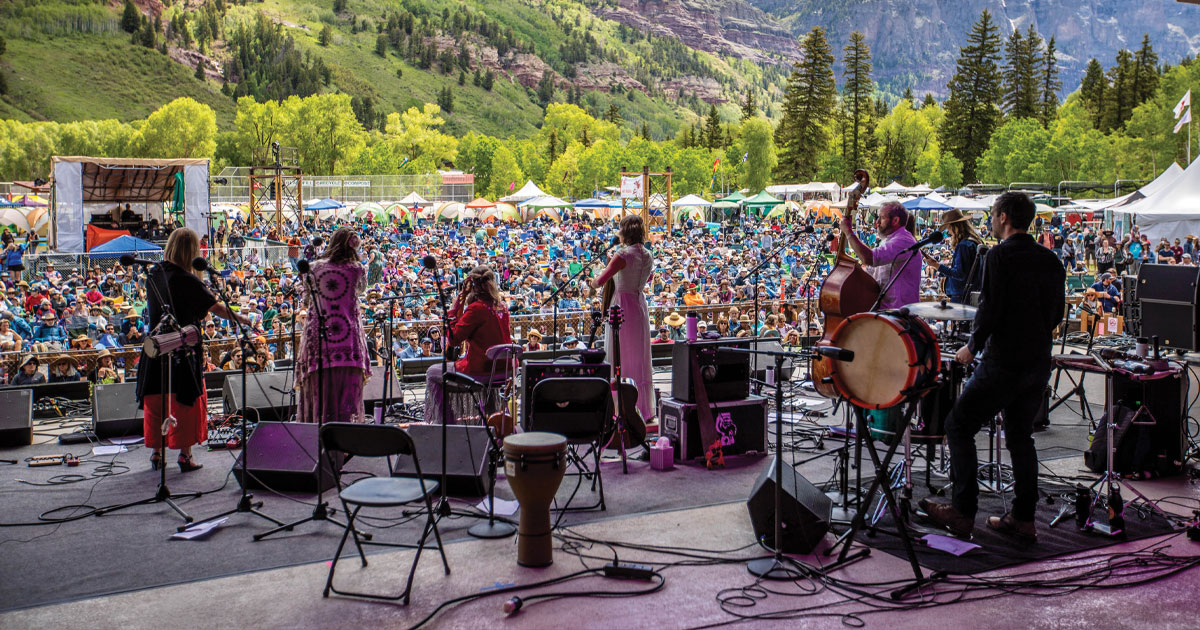
More times than not, fans connecting with one branch of the big bluegrass tree would follow those branches back to the roots and this helped strengthen those roots and ensure they would remain solid and strong. Many of today’s musicians and fans discovered bluegrass by first hearing The Grateful Dead, or New Grass Revival, or Alison Krauss, or David Grisman, or Yonder Mountain String Band, or Bela Fleck and the Flecktones, or the Punch Brothers, or Billy Strings. While traditionalists may not consider the music these bands play to fit their definition of “bluegrass,” it is the fans and musicians who do hear the bluegrass roots in the varied branches of the music—and accept and enjoy it for what it is—that has helped bluegrass prosper and keep the big bluegrass tree alive and vibrant. The fans and musicians who have done this are exactly also those who have helped keep one of America’s longest-running bluegrass festivals—the Telluride Bluegrass Festival—alive and well for over 50 years.

In The Beginning—1973
To celebrate the 40th year of the Telluride Bluegrass Festival a 217-page, full-color, coffee table-style book—titled Telluride Bluegrass Festival—Forty Years of Festivation—was published by Planet Bluegrass, the organization that now runs the festival. That book describes the festival’s founding like this, “I think the festival was cooked up on a long ride back from the Walnut Valley Festival in Winfield, Kansas.” Walnut Valley’s first festival was held in 1972. After members of the Colorado-based Fall Creek Band attended that first Walnut Valley Festival they decided that they should host a similar event in Colorado. The members of Fall Creek—Fred Shellman, Kooster McAllister, John “Picker” Herndon, and J.B. Matteotti—played at a Fourth of July event in Telluride in 1973 and they convinced the town to host eight Colorado bands to perform in the town in 1974, and thus the Telluride Bluegrass and Country Music Festival was born. Fall Creek’s Fred Shellman was the driving force behind the event and ran the festival for many years.
1975—New Grass Revival, the “Big Get”
For the 1975 event, the festival hired its first nationally touring act, the New Grass Revival. The promoters felt that the New Grass form of hippie rock n’ roll bluegrass would fit perfectly with their crowd and they were exactly right. The crowd loved New Grass and New Grass loved the town and the crowd. In the Forward to the above-mentioned Telluride book, Sam Bush explains that New Grass banjo player Courtney Johnson was not thrilled about driving all the way from Kentucky to Colorado for one gig.
After arriving in Telluride and meeting the members of Fall Creek, Sam remembers, “…we felt like we had immediately found a home. Brothers all. Our first appearance before the festival audience felt to us like the Rocky Mountains themselves—wide open and ready for anything. Courtney had the time of his life, as did we all. Imagine our youthful energy and excitement! Meeting, hanging, and picking with these great musicians, having discovered one of the most beautiful and magical places on earth. We started telling some of our closest musical friends about this place: John Hartford, Peter Rowan, Doc & Merle Watson, Bryan Bowers, Doug Dillard, Steve Goodman, Byron Berline and Sundance.”
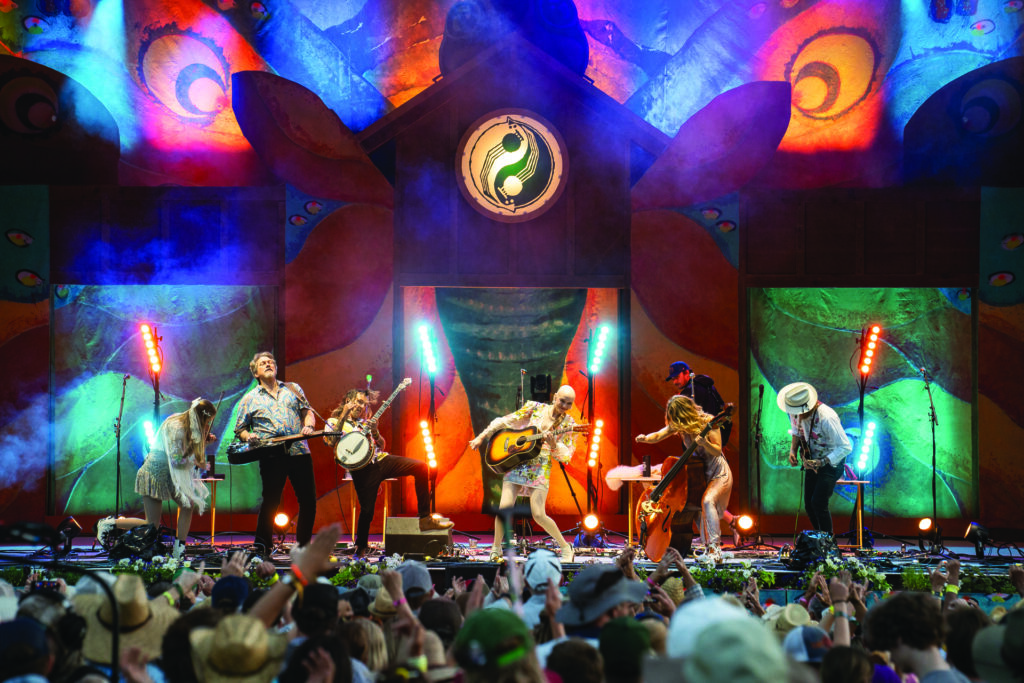
It is obvious that Sam Bush really did find a home at the Telluride Festival because he has played at every Telluride Festival since that first appearance in 1974, earning him the moniker “King of Telluride.” The friends who Sam told about his new home all started coming as well and became Telluride regulars. The 1976 lineup included John Hartford and Bryan Bowers. In 1977, those performers returned and Byron Berline and Sundance and Peter Rowan & Friends were added. In 1978 Vassar Clements, Dan Crary, the David Grisman Quintet, and Hot Rize joined the fun. 1979 saw the addition of Doc & Merle Watson, Country Gazette, Norman Blake, Doug Dillard Band with Byron Berline, and many others. After only six years the festival was drawing some of the biggest names in acoustic music. In 1980 Steve Goodman, John McEuen, Leon Russell, and Kate Wolf were added, and the festival’s reputation for coloring outside the lines of bluegrass continued to grow.
Since the 1970s, Telluride has brought in many of bluegrass music’s founding fathers—such as Bill Monroe, Ralph Stanley, and Earl Scruggs—to some of country, folk and acoustic rock’s elite—such as Nanci Griffith, James Taylor, Jackson Browne, Willie Nelson, Johnny Cash, Bruce Hornsby, Lyle Lovett, Vince Gill, Dan Fogelberg, John Prine, Little Feat, Dixie Chicks, Rosanne Cash, John Fogerty, k.d. lang, Elvis Costello, Chick Corea, David Crosby, Taj Mahal, Bonnie Raitt, Emmylou Harris, Linda Ronstadt, Robert Plant, Mary Chapin Carpenter, Michelle Shocked, Arlo Guthrie, David Bromberg, Rodney Crowell, Sarah McLachlan and many more. There is also a wide range of bands that fall under the umbrella of bluegrass that have performed at Telluride as well, everyone from Alison Krauss to Rhonda Vincent, from New Grass to the Johnson Mountain Boys, Hot Rize to the Yonder Mountain String Band, Nickel Creek to Crooked Still, the Carolina Chocolate Drops to Mumford and Sons, and everything in between.
The Fans Love of Music is Wide Open
You may look at the list of performers who have been at Telluride and think, “How can the same audience who loves Bill Monroe also sit through a show by some jam group or rock artist?” It comes down to the love of music versus the love of a genre of music. Craig Ferguson, who has been running the festival through Planet Bluegrass since 1988, said, “The audience are music lovers who are wide open and diverse.”
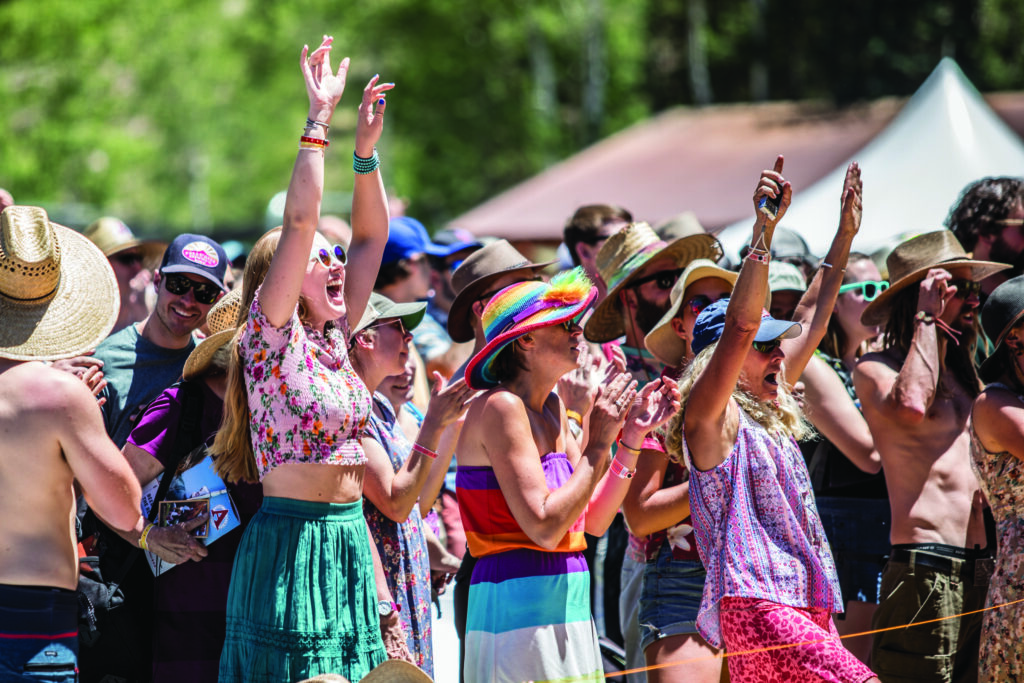
Two years after Craig Ferguson and Planet Bluegrass (who also run the Colorado festivals Rocky Grass and Rocky Mountain Folks Festival) took over running the Telluride festival they scored big in 1990 by bringing in James Taylor. The festival sold out. Ferguson said, “James Taylor brought people in and they kept coming back.” The festival has sold out to capacity every year since and the Telluride fans love the musical variety that the festival offers.
Regarding the Telluride audience, Sam Bush said, “That first year we made friends for life with the Fall Creek Band. We were the first group that they brought in that was not from Colorado and we just had the time of our lives. The audience was so accepting of all that we played and we started telling all of our buddies, like Peter Rowan, John Hartford, Steve Goodman, Bryan Bowers, Dan Crary, and Norman Blake about this place. From that word of mouth among the musicians we all wanted to go to this place.
“The festival was originally called the Telluride Bluegrass & Country Festival, so it was never engendered to be a strictly bluegrass festival and it certainly never has been by any means. But, it was also important to the Telluride promoters to find all kinds of music to present to the audience. That has included the greats in bluegrass and old-time and country.
“The people who ran it were music fans and musicians themselves. You have these wide open spaces—you are looking up at these mountains while you play—which is part of the feeling of the audience as well. The wide-open attitude of the audience was accepting of any kind of music. For us, who had only played festivals in the east and had only been as far west as Winfield, Kansas, it seemed like the wide-open spaces lent itself to the wide-open minds of the audiences.”
The Jam Bands
The wide-open spaces of Colorado and the wide-open minds of the Colorado music fans helped give birth to early bluegrass-rooted jam bands like Leftover Salmon, String Cheese Incident, and Yonder Mountain String Band. The success of those bands led to the success of The Infamous String Dusters, Railroad Earth, the Avett Brothers, Mumford and Sons, Greensky Bluegrass, and many others, following the jam band path.
When asked about the jam bands, Sam Bush said, “When you mention Salmon, Yonder, and String Cheese specifically, I think that New Grass Revival and Hot Rize, and later Strength in Numbers, were the bands that definitely influenced those guys to get up on stage and do it at Telluride too. And look how far they come. New Grass was the progressive bluegrass band that they hired, so in that way we were influential, and I think that it made a lot of difference when David Grisman would come there too with the Grisman Quintet.”
Chris Pandolfi, the banjo player for The Infamous Stringdusters and host of the “Inside the Musicians Brain” podcast, wrote a blog post in April of 2011 that came to be known as “The Bluegrass Manifesto.” Later that year the International Bluegrass Music Association (IBMA) asked Chris to be a keynote speaker at their annual convention. No doubt, the IBMA invitation was prompted by what Chris had written in the Manifesto, which he had originally titled, “Bluegrass?” In the Manifesto (which is posted on Chris’ website) he talked about all that led to the Stringdusters’ decision to follow the jam band path and in telling that story gave a very insightful view into the state of bluegrass music and the willingness of fans to accept progressive bluegrass, or not.
To date, Chris has posted just over 50 episodes of his podcast. Back in episode number three (posted in November 2019), he discusses the evolution of bluegrass music and the commercial success of jam bands. In that episode, regarding bluegrass fans, he says, “We really see two distinct worlds of bluegrass music, one more traditional with less commercial appeal and one more progressive with a much bigger fan base. My big theory about why things have shaken out this way is that traditional bluegrass fans are not like normal music fans. That is because a lot of traditional fans also play the music. It is not like rock and roll where you need drum kits and amps and a dedicated space. We can just pick up banjos and fiddles and play in the living room.
“With all of that invested time and energy comes an increased ownership over the style and so many opinions about what the music should be. So, on one side you have this growing and evolving style and all of these open-minded fans who are just discovering it for the first time, and on the other side you have a more traditional vibe where you have fans who are really deeply into the music and they get it and they know what they are talking about and they play it well, but they also know what they like and they care about preserving those core aesthetic values and they don’t necessarily value that evolution element.”
A bit later, he goes on to say, “Why would the traditional world need to open its arms to more progressive strains of the music? I would say that it is simply to shine a light on some of the incredible trad acts that are out there…the deep, quality old-school sounds that are still being produced today by so many quality acts that would love the possibility of that increased exposure. I would also say that it is the fans who really hold the key to this connection of these two worlds of bluegrass and by no means am I telling traditional fans what to do, but simply pointing out that this possibility is out there and also reiterating the fact that traditional artists, by and large, are absolutely in favor of it.”
When asked specifically about his take on Telluride, Chris said, “Bluegrass is awesome just because it is awesome. It is a really compelling deep form of music. I believe that some of that old-school bluegrass didn’t get the recognition that it deserved relative to the quality of the music. Telluride is amazing proof that when you play great traditional bluegrass for a music fan that doesn’t know much about bluegrass, the vast majority of the time the music really connects. There is a lot there to enjoy and to fall in love with for people who love music and the arts—especially for people who don’t come with the baggage that a lot of bluegrass fans have. There really is an update to the things that I said in the Bluegrass Manifesto because we are living in the time of Billy Strings now. It is a very different ballgame and the results of this tidal wave of appreciation and attention have yet to be seen.
“Telluride has always been the anomaly. It has always been unique in the landscape of festivals in the way that it is very well attended and always sold out and people are coming to Telluride to see what Telluride will put on display this year. Telluride is unique in that way and they still carry that banner with more authority than any of those festivals that are out there. They were doing it way back when, before it was cool, and they were part of what made it cool, and now they are riding that wave of this new reality that bluegrass is super popular. It is a testament to what a great event that they have been over the years and that if you take a chance on bluegrass, it really connects.
“Telluride is the only festival out there that when you are an up-and-coming band and you go out there to play your 1 pm slot—which at any other festival would have no fans there because everyone is waiting for later in the day—Telluride is going to be packed to the gills, because people do the tarp run, and you really feel that on stage and it means something. It is part of this cycle of fan appreciation and fan interaction that has been such a big part of this concept of integrating and elevating bluegrass that has always been happening at Telluride.”
The Telluride Bluegrass Festival has always been a place where traditional acts gain exposure to a much larger music fan base. It is a place where a James Taylor or Lyle Lovett fan could also hear Bill Monroe, Ralph Stanley, or Rhonda Vincent and fall in love with traditional bluegrass. That is the kind of thing that happens at Telluride and would not happen at a more traditional bluegrass event.
Artist Collaborations at Telluride
Something special that happens at Telluride every year is that artists and bands at the event will often sit-in with other artists and bands. These sit-ins are exciting for the artists and the crowd. The artists get to stretch out and challenge themselves to perform in unfamiliar situations. That is exciting for the artists and that excitement spills over into the audience.
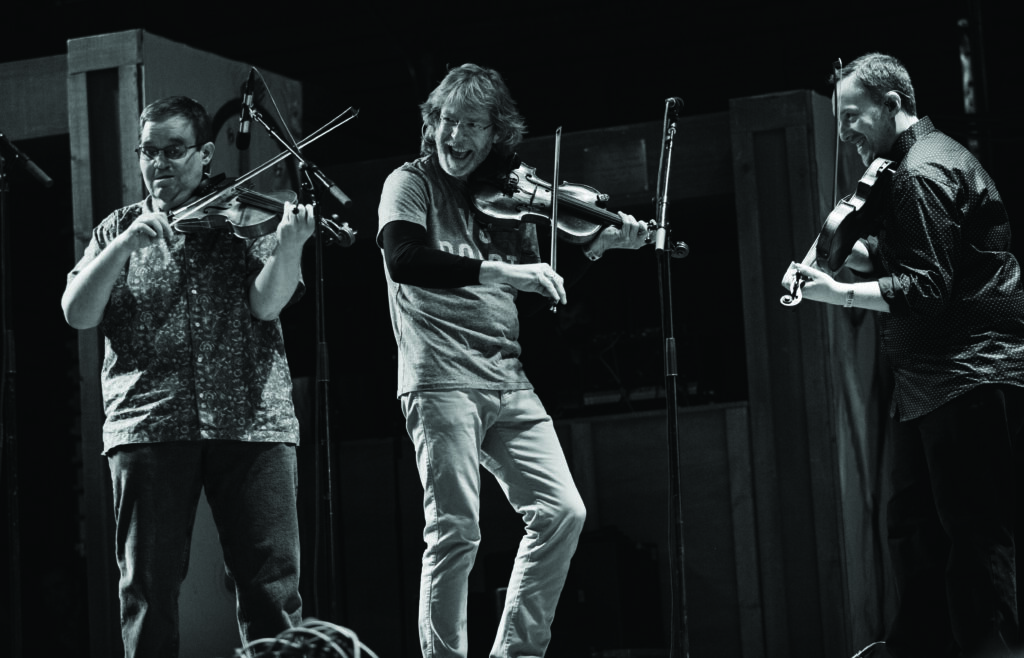
Sam Bush is not only the King of Telluride, he is also the King of Sit-Ins at Telluride. He said, “The festival has always lent itself to jamming and when I’m there I get to jam with a lot of bands when our band is not on stage. There is a feeling of camaraderie. I remember the first year that Béla was there in 1982 how enthused people in Telluride were to meet this young banjo wizard that we now had in the band. Within a couple of years, Béla was jamming with everyone on stage too. We eventually got a group that came to be known as Strength in Numbers (Sam Bush, Jerry Douglas, Béla Fleck, Edgar Meyer, Mark O’Connor). Edgar had formed us to play in Nashville at the Summer Life Festival, but we started doing it in Telluride too. At first, somebody named us the Telluride All-Stars. We weren’t comfortable with that because there were many great pickers there and we were just five of them. But, it did mean a lot that we were able to play at that festival with those five people, and made us realize that we did want to make a record together and tour together.” [Strength in Numbers played Telluride in 1989, 1990, 1991, and 1993.]
In 1998, Sam formed another supergroup to perform that was billed as Thunder Jam and featured Sam Bush, Jerry Douglas, Béla Fleck, Tim O’Brien, Tony Rice, and Mark Schatz. Later, he put together a new group that has been performing at the festival for years. Sam explained, “Now we have been doing it with Edgar, Jerry, Béla and me and Stuart Ducan and Bryan Sutton—for years we have been known as the Telluride House Band. We always have a set. We play once a year at Telluride. We definitely feature bluegrass songs on our set. We have this groove that when we play, one of the first things that we do is fall into a bluegrass tune. As progressive as we all play, we are one of the representatives of bluegrass music. Bluegrass is our common ground.
“It is kind of a tradition now that on Thursday morning at noon, Chris Thile starts the festival off with a solo set and then sometime through the course of the weekend the Telluride House Band is going to play and Chris will be there with Punch Brothers. So, it has evolved into some of us getting to keep coming back. I feel very fortunate that I am one of them.”
Sarah Jarosz is a highly successful artist who was “discovered” at Telluride and benefited greatly from artists who were willing to get up on stage with her. She tells the story, “I had been going to Rocky Grass every summer and because we fell in love with Rocky Grass, my parents also found out about Telluride and we started going to Telluride in 2003 or 2004. I would have been 13 or 14. The Planet Bluegrass festivals became such an important part of our lives. Basically, as the story goes, I was singing ‘Blue Moon of Kentucky’ somewhere on the grounds of Rocky Grass Academy, and Craig’s daughter heard me and said, ‘You have to come sing for my dad.’ So, I wandered across the field at Rocky Grass and I sang for him and he said, ‘Do you want to do a tweener at the festival this weekend?’ So, I ended up doing a couple of songs in-between sets and he offered me a set of my own at Telluride in 2007, so I had just turned 16 years old. It was wild! It was totally surreal and incredible. I didn’t have a band so Mike Marshall and Ben Sollee accompanied me and Abigail Washburn and Noam Pickelny sat in. It was incredibly special and that was where Gary Paczosa heard me sing for the first time and it eventually led to him signing me with Sugar Hill Records and I made my first four records with Gary and it was a totally life-changing day.” Incidentally, Sarah’s group I’m With Her (with Sara Watkins and Aoife O’Donovan) first formed at Telluride.
Tim O’Brien on Telluride
If Sam Bush is the “King of Telluride,” Tim O’Brien comes as close to the king as anyone else. The first year New Grass played Telluride, Tim O’Brien was there with the Ophelia Swing Band and Tim has been at every Telluride festival since, save only three. Sam Bush remembers, “Tim and I met the first year New Grass Revival played the festival in 1975. Tim was the fiddle player in a band called the Ophelia Swing Band. The Ophelia Swing Band featured a guitar player named Dan Sadowsky. Dan became a very important factor in the festival as he developed a radio personality that he would play called ‘Pastor Mustard.’ He was the pastor of the church of the Nifty Blue Chrysler. Pastor Mustard became the festival MC for thirty-plus years. Dan and Tim were the main two characters in the Ophelia Swing Band. So, Tim has been to almost every Telluride himself.”
When asked about how Telluride differs from other festivals, Tim said, “There is a special quality that derives from its location—its dramatic scenery and high altitude. It is close to the solstice, so it has the longest daylight hours of the year, so it is a traditional time of celebration. It is also the place where a certain strata of acoustic music kind of coalesced. A group of people found each other there. It was a place where that could happen. Younger bluegrass enthusiasts and aficionados could find common ground with the rest of the music world. Those are the elements that make it unique. It is the location, the time of year, and the kind of music that it spawned. It was a magnet for that kind of thing and served as a catalyst of the kind of music that came after it.”
Regarding the Telluride fans, Tim said, “The fans are part of that equation. They have the same viewpoint of what they want as the musicians themselves. It is like, ‘We like good music. We want to push something forward that is fresh and also rootsy. We want that for our celebration. A lot of people save up their yearly vacation time for that event. People around the country have different festivals that they go to, but Telluride is a big one. It stands for a certain thing and, if you are a certain type of person, it is not to be missed.”
Musical collaborations on stage amongst artists who do not usually perform together help create part of the excitement at Telluride. Regarding these collaborations, Tim said, “Sam Bush is the ‘King of Telluride’ and year after year people that Sam was friends with would come and start performing there and became regulars…people like John Hartford, Steve Goodman, Byron Berline, Bela Fleck, Edgar Meyer, Jerry Douglas and on and on. Hot Rize was part of that too early on. All of the members of that regular crowd would mix with the people who were showing up there to play for the first time. Jerry Douglas and I were part of a band that backed up Dan Fogelberg one year. It was that kind of thing. Russell Smith from the Amazing Rhythm Aces came and played a show with Levon Helm and it was a wonderful mix of that roots rock stuff with bluegrass. Vince Gill was there with David Grisman’s Bluegrass Experience—I think it was called Here Today at that time. So here is a Sunday morning at the gospel program, which in those days was really informal, and Russell Smith, Vince Gill, and I and the people from Aspen in the group Liberty were singing gospel music, throwing together gospel music on stage and it was just right. For the Telluride House Band and Strength in Numbers, it was kind of like that. You pick the main guys that jam with everyone at Telluride and make a band out of them. Then, they make a recording and call it Strength in Numbers.”
Sam Bush, who will be playing at his 51st consecutive Telluride Festival this year, sums up the Telluride experience by saying, “There is a feeling of coming home. There is a feeling of family. I still see a few of the people that we met the first year we came and now I know their children and their grandchildren. We’ve made these friendships that are hard to describe. For me, it is a feeling of friendship and family and incredible love.”