The Space Between
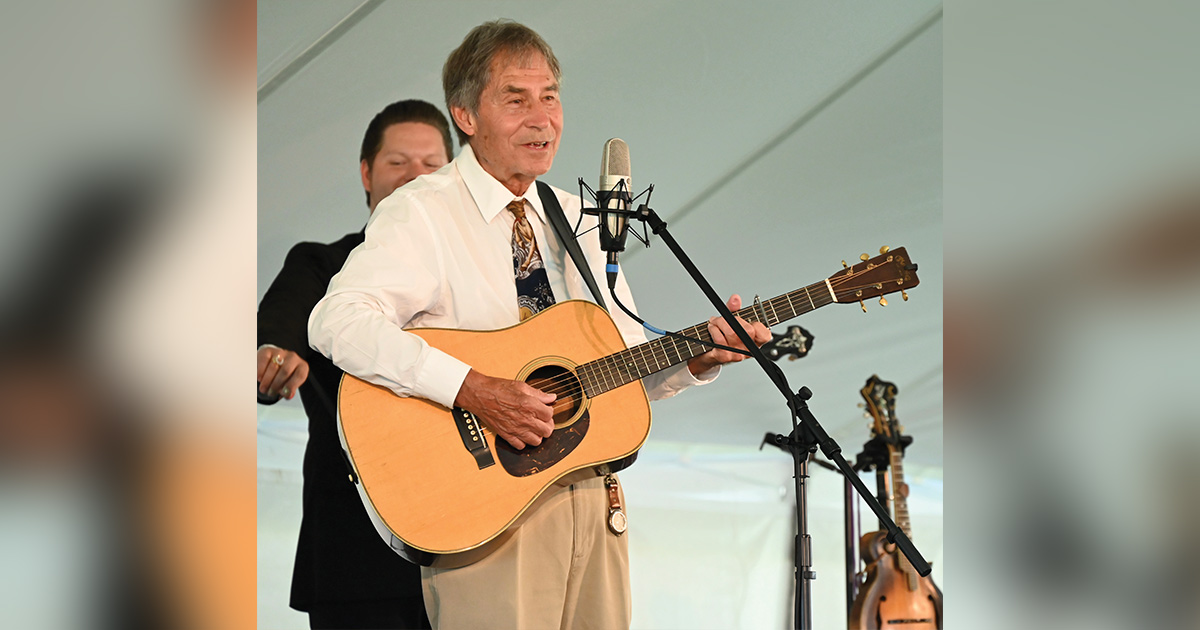
I called Ron Thomason on his eightieth birthday, September 5th, to schedule an interview for Bluegrass Unlimited. I had just recently reviewed his latest album, Ancient Songs Et Al. I had also watched the recent documentary about Ron and the Dry Branch Fire Squad, The Court Jester. I had read numerous articles highlighting Thomason’s many accomplishments, both on and off stage. Ron is basically bluegrass royalty, working many of what he likes to call “prestige gigs,” playing 50-60 bluegrass festivals a year with Dry Branch Fire Squad (DBFS). He is reputed as one of the most memorable emcee’s of any live show you’ll ever see; a comedian, a philosopher, and an excellent storyteller. Needless to say, I had a daunting task ahead of me, or so it seemed.
The moment I spoke to Ron, I was positively tickled to death. He sounded and talked just like he did on stage. The Court Jester, Hillbilly Philosopher persona is not an act, it’s just Ron. Immediately I was at ease, due to his young-at-heart sense of cheerfulness and eagerness to tell me whatever I wanted to know. The first thing Ron told me was, “I generally don’t know what I’m doing,” an extremely modest statement with a most endearing self-deprecation—because he knows exactly what he’s doing.
Ron has successfully battled cancer, continued riding horses despite numerous injuries and twenty three broken bones, along with playing festivals, with no signs of stopping anytime soon. Ron and his partner, fiddler Heidi Clare, had just been baling hay up in the Colorado mountains of their 186 acre ranch Equus Aerie (meaning Eagle’s Nest) before the day of our interview. We talked at length for an hour and a half—we could’ve easily talked for twice that long. A week went by and I was still reeling from our conversation. What a wealth of information! There are layers and depth to this genuine kind-hearted soul that go far beyond his musical endeavors. But let’s start from the beginning.
Ron was born in Columbus, Ohio, and grew up in Honaker, in southwest Virginia. His family was like most in the area; his grandfather worked as a coal miner and his father was a training sergeant in the Army. Ron developed two of his lifelong passions from an early age; riding horses and playing music. He loves and appreciates lots of early rock, soul, and jazz, but as you might have guessed, he gravitated towards bluegrass. His mother did not approve. Years later, she would work at one of the festivals Ron helped organize. “When people asked my mother, ‘What does your son do?’ she would say ‘he’s a farmer!’ She didn’t say nothin’ about me being a musician,” Ron told me with a chuckle. The first strings Ron picked were banjo strings, which would soon be followed by guitar and mandolin.
“In college, I could make more money playing drums than mandolin,” Thomason spoke of his early years. “I even tried to play saxophone but I wasn’t worth a nickel at it.” Ron was quite the athlete as well, competing in several sports in high school which got him a few scholarships, taking him to Ohio University, where he played football and competed in gymnastics. Howard Aldridge, DBFS band member Brian Aldridge’s father, fed young Thomason supper often during the college years. He was an influential figure, as were Ron’s teachers. “One of my teachers told me never to borrow money,” Ron told me. This would be important advice to young Thomason, who to this day has never taken a bank loan.
Ron’s biggest passion during this time, despite the music, sports, and horse, was teaching. “I knew I wanted to be an English teacher,” Ron said. This would also be a definitive decision, not only to Thomason’s personal life, but also his stage persona as well. He constantly makes cheeky references to authors like T.S. Elliot during his live performances. He is also known for his unique vocabulary and catch phrases. I certainly heard “told you that to tell you this” during our conversation a couple times.
Ron never really had a full time music teacher, per say. He learned from observation, a keen eye and an even keener ear. Speaking of one his first encounters with Bill Monroe, Ron said, “Bill always played his F-5 mandolin with the E strings just a shade sharp, and one time we were at a festival in Michigan and the E string broke on his mandolin, so I tuned my E strings up just a little bit and handed it to him. And then from that time on, I swear if anything like that happened Bill would ask ‘find that little boy, the one with the mandolin that looks like mine.’” Ron told me this with a great impression of Monroe’s voice.
On top of masterfully playing guitar, mandolin, banjo, and even drums, Ron picked up a little art form called hambone. There’s a great bit about this in the documentary Court Jester. He saw a young black kid doing some hambone one day, making a beat with smooth and rhythmic slapping of his thigh, shoulders, and such, while singing. He knew he had to learn how to do it. It’s yet another tradition that Thomason is happy to help preserve. “Whenever someone asks me to do hambone at a show I’m happy to do it. It’s not my music, it’s black people’s music, but by golly it’s good music.”
By the late sixties Ron was in full swing as a musician, teacher, and horse trainer. His musical efforts and involvement in the bluegrass community eventually landed him a gig playing with Ralph Stanley and the Clinch Mountain Boys, which would last for several years and inspire him to become a band leader and start making records of his own. Simultaneously, Ron and his wife at the time had bought a ranch in Ohio and started training horses. Ron, since childhood, had a special bond with horses that endures to the present day. He has a soft spot for any song about horses, of course, which led him to make recordings such as “The Pearl of Them All,” with partner Heidi Clare. But also, he was a teacher starting in 1967, teaching math and English for thirty years. He mainly taught at secondary schools, but also taught for a spell at Wright University in Dayton, Ohio. He was inducted into the Ohio Educator’s Hall of Fame in 2010.
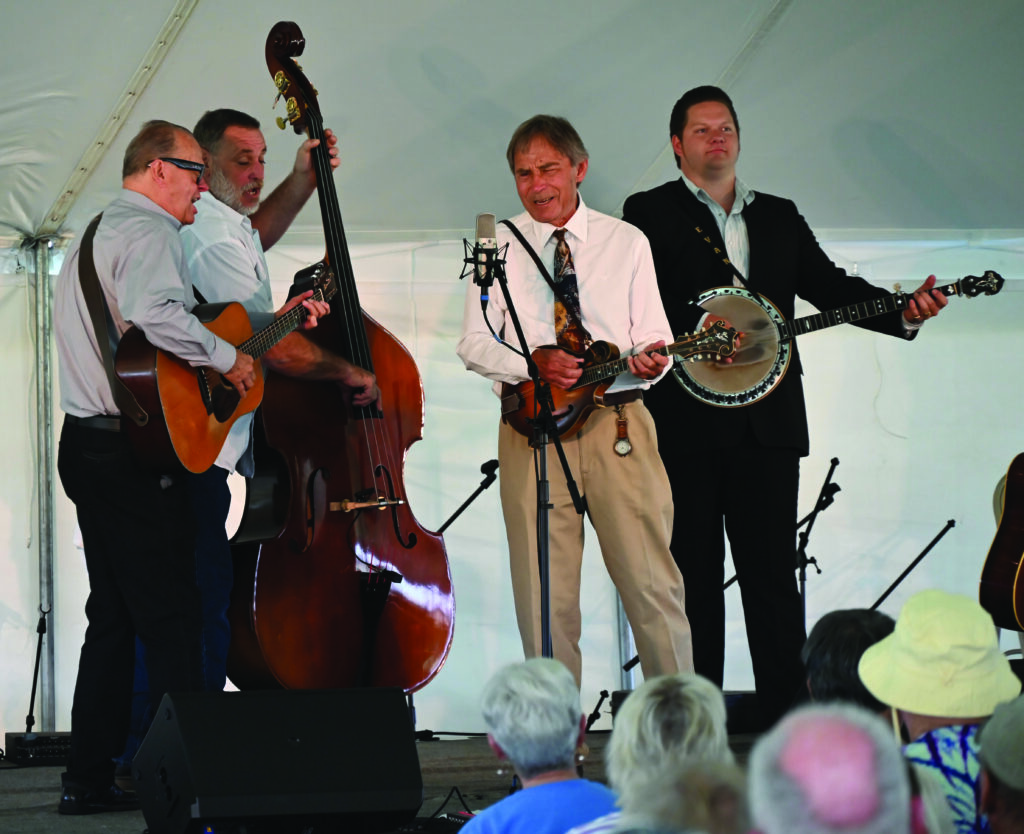
Although he could’ve easily made careers out of just teaching or horse training, the call of bluegrass music was just too great. This led to the fated gig at the Crying Cowboy Saloon in 1976, when Ron decided to start Dry Branch Fire Squad. In a 2022 podcast, Dan Miller asked Thomason, “Why’d you name the band Dry Branch Fire Squad?” to which Ron promptly replied, “Well, the Rolling Stones was already took!” Ron has been leading DBFS ever since, nearly fifty years now! The current line up of DBFS is Evan Lanier, Brian Aldridge, Jeff Byrd and Ron. With the exception of Jeff Byrd on bass, the other three musicians trade off on instruments during recordings and live shows.
The group’s line up has changed a few times, including folks like Bill Evans, Adam McIntosh, and Tom Boyd. On occasion Heidi joins the group on stage with some of her world class fiddling. The band hosts Grey Fox and High Mountain Hay Fever Festival every year. They also play at Gettysburg, Hardly Strictly Bluegrass and many more.
The High Mountain Hay Fever, held in Westcliffe, Colorado, is a volunteer operated festival Ron started with other like-minded folks to raise funding for healthcare, scholarships and to better the lives of people in the surrounding area. “We get to do what we love and we have a lot fun doing it,” Ron told me with great pride, to which Heidi chimed in “and then we sleep for three days.” Ron also mentioned to me that DBFS has only missed two shows in their entire career, some of Ron’s horses had gotten sick and needed tending to.
Ron is probably one of the best emcees in the biz, both in regards of wholesomeness and humor. Whether it’s a quote from Shakespeare or an antidote all his own making, Ron is sure to leave an impression on the audience. Oftentimes he’s seen as quite the rambler, but he thinks and feels deeply about music and life. “Like Jazz, bluegrass suffers from the fact that it’s also really great music,” Ron told me. “I put way more into what I’m going to say than what I’m going to play to an audience. Because it’s the space between that’s important.”
I had also heard that Thomason is quite the historian, and being ever curious about the nature of bluegrass I commented to Ron, “Traditionally, there’s no percussion, but bluegrass is very much a percussion driven art.” Ron was happy to respond, “If you go back to the start of bluegrass music, which obviously it’s Bill Monroe’s music, there were two or three things that happened at once. One is that bluegrass music jumped into the world fully formed, without much percussion. The lesson I learned from Ralph Stanley was that when Flatt and Scruggs were with Bill Monroe, that’s kinda when the mandolin chop came in. If you listen to those early records, they didn’t have any mandolin chop, but it came in slowly but surely. No way of telling if that mandolin chop came in with Bill or with Earl, but it came and it’s never left. Mandolin chop is like the back beat on the kick drum, it’s always when your foot is in the air. There wouldn’t have been rock n’ roll if there hadn’t been that mandolin chop.” I was delighted by this story. It’s important to remember the building blocks, like the mandolin chop, that shaped the popular music of today.
Speaking on his early recordings: “First album I ever did was after I left Ralph Stanley’s band around 1970, I gathered some people together—Brian’s Father (Howard Aldridge), Tom Boyd and other folks living in that area—and we did a record, that was six years before I started Dry Branch Fire Squad. Then there were four records we did at a radio station in Yellow Springs, Ohio. Same place where the wonderful old timey singer, Hazel Dickens lived. The first album that I ever played with my F-5 was on one of Hazel and Alice Gerrard’s albums, so that was kinda singular for me. Rounder Records picked us (The Dry Branch Fire Squad) up around 1979, and we probably did around 20-30 albums, starting out with vinyl, then on to CD’s and whatever was in between.” DBFS has gone on to make dozens of records, including the gospel record Golgotha, up to Ancient Songs Et Al, which I had the pleasure of reviewing recently.
I told Ron how much I enjoyed the album, particularly the Willie Nelson cover “Ride Me on Home,” because Willie’s album Redheaded Stranger is an all-time favorite of mine. “Well you can imagine how that stuff gets me, as a horse man. I knew we were doing this (interview), so I got up early enough today to get to the barn to feed the horses this morning, of course I feed them in the morning and Heidi feeds them in the evening. All of my horses are really, really fast, and some of them are pretty famous for the things they’ve done. For instance, one of them is twice the Canadian national champion, so there’s no junk in the barn. But my favorite horse, I say favorite because he’s beat me up the most; I let him out of the stall but he didn’t want to leave, he just stood there like (as if he was telling Ron) ‘You can get this done. Don’t worry about me.’ There’s just a certain way of talking back and forth to horses, when you need them the best. And Willie’s a part of that way of life.”
Ron, for many years, has been one of the finest horse trainers in the country. Saalo Nazeer and Saalo Supreme were champions in numerous events like Halter, Endurance and English Pleasure Riding. His mare Czem, is an Endurance Champion, and mare Kaz, is a Texas English Pleasure Champion. Ron and Heidi, with her Endurance champion, Bartali, have competed in and won several Endurance races.
Heidi is also a Ride n’ Tie world champion. Ron and Heidi keep a Wall of Honor in his barn, which commemorates their champion horses, some of whom have “gone up home to green pastures.” Ron fosters and cares for many breeds and rescues, such as his orphan Dazzle, who was unable to compete due to a rough upbringing in his youth. To say that he shares a deep connection with horses is an understatement. He loves and cares for them as if they were his own flesh and blood. When Ron started training champions, a horse trainer came and started to mistreat the horse. Ron told Chris Stuart in the 2011 issue of BU; “I certainly wasn’t going to let anyone smack my horses.”
As a teacher, Ron has an equal devotion and care for educating the youth. Although teaching paid nowhere near what he could make training horses or playing music festivals, the passion to educate was too great to simply phase out of Thomason’s life. Mary and George Doub, lifelong friends of Thomason and co-founders of Grey Fox Festival, didn’t have to do too much convincing before Ron agreed to host the festival, which DBFS continues to do so to this day. What’s very special about this and other festivals, such as High Mountain Hay Fever, is that proceeds go to creating scholarships and fostering the bluegrass community.
Another fateful meeting was when Warren Hellman’s doctor told him he ought to meet Ron because of their mutual love for horses and traditional bluegrass. Warren Hellman started Hardly Strictly Bluegrass, which continued under operation of Hellman’s children after his passing. Hardly Strictly is now one of the largest bluegrass festivals in the country, and it’s free to the public.
Ron shared something really special about his philanthropic endeavors, while doing his best not to get choked up. “Two of the things that make me the proudest, I’ve never felt that I or anyone else in the band are special, but we’ve done a couple special things. One of them is, when we did Grey Fox, after the second festival, I threw the money on the floor and looked at it a while, and thought this isn’t going to make any difference in our lives, but we can make a difference in other people’s lives. So we started, and we’ve never stopped, giving scholarships to three or four people, and we’ve been doing that for nearly forty years now.
“The other thing is about 25 years ago we had a health clinic that had been built in Westcliffe, Colorado. There’s about 2500 people living in the area that can’t afford healthcare. So, we started the High Mountain Hay Fever festival, and as of this year we’ve raised 900,000 dollars to help folks with medical, dental, and nobody who works for us has taken a nickel. Heidi helped start a group called High Mountain Hay Seeds, some of them are only 3-4 years old and we give them all ukuleles, and they even do all their own emcee work! But when you see all these kids on stage, well there’s nothing like it.”
Sometimes our discussions strayed far off topic, but delightfully so. There was one story Ron told me about John Hartford, Bill Monroe, and Earl Scruggs meeting out in the country after shows to have a contest to see who could sing the highest. Ron said John Hartford told him, “I don’t know if people came for miles around or not,” but it was surely a sight, this impromptu battle of the band’s, if you will, of the bluegrass greats. Ron spoke very highly of Ralph Stanley, both as a musician and humanitarian.
On and on I could go, but in a nutshell, it was an immensely enjoyable experience. Even though I’ve never seen the Dry Branch Fire Squad in person, I feel that I got the full experience talking to Ron. I was in stitches with laughter, I was in tears hearing about his nurturing and caring for the community around him. I hope that he continues down this righteous path of excellence for years to come.