The Songwriting of Ola Belle Reed
“High on a mountain, wind blowing free
Thinking about the days that used to be
High on a mountain, standing all alone
Wondering where the years of my life have flown” 1
These iconic lyrics by Ola Belle Reed are a right of passage for any bluegrass singer or band.
“I’ve endured, I’ve endured, How long can one endure”
Every musician who comes through the Junior Appalachian Musicians (JAM) program learns the song “I’ve Endured” as an essential piece of repertoire. It’s also a theme song for the Black gospel group The Legendary Ingramettes, defying a single genre.
“Tear down the fences that fence us all in
Fences created by such evil men
Then we can tear down the fences that fence us all in
And we can walk together again.” 2
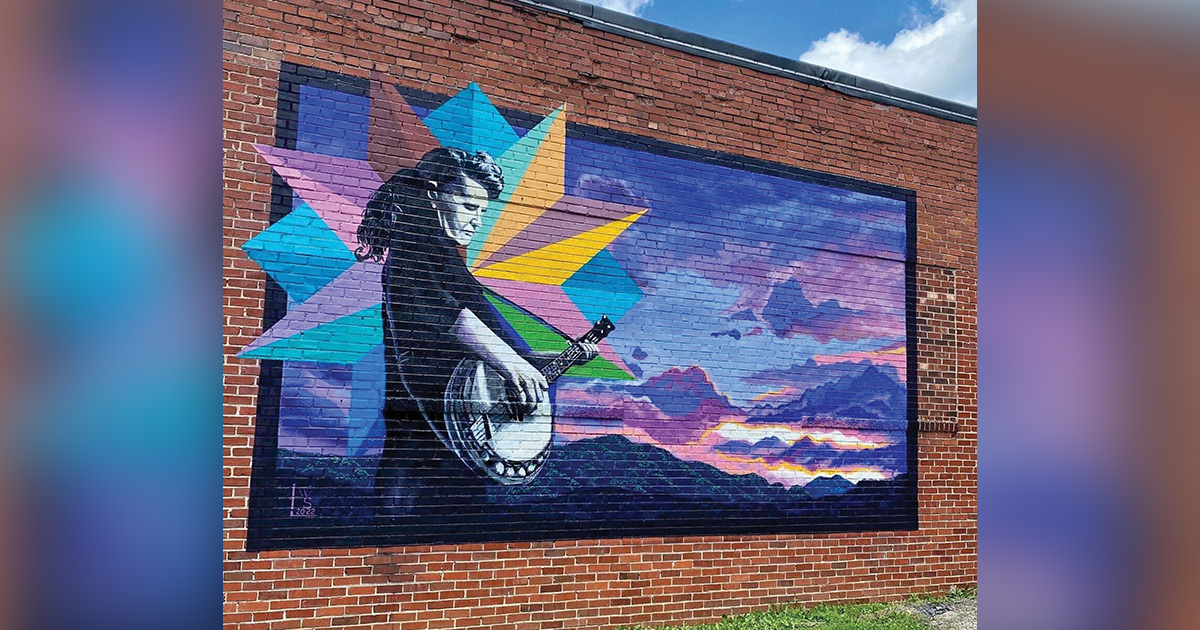
The songwriting of Ola Belle Reed combines the best of her humble upbringing in Ashe County, North Carolina, full of mountain ballads, dance tunes and haunting stories with her experiences in the North, particularly Rising Sun, Maryland, as a humanist, Christian and independently minded musical creator. Ola Belle managed to take the best of all of her worlds and sift through them to speak truth to power, tell a love story or simply have a little fun. Bluegrass can do all of those things. Of course, Ola Belle was not a bluegrass musician. Her unique style of old-time banjo playing was truly her own. She was a rock solid rhythm guitar player. But she won the heart of the bluegrass world when Del McCoury recorded “High on a Mountain” in 1962, summoning the high lonesome sound of Bill Monroe with the longing for the mountains and the past, which can create a heartache for any displaced mountain person.
Back in those days, the parking lot picking of a bluegrass festival included audience, campers and performers alike. This is where friends were made, bands were formed, and songs were tossed around. Not many people were writing brand new songs like “High on a Mountain,” a song with all the best elements of old, new and harmony that makes the hair on your arms stand up.
So it was that a young Del McCoury and Ola Belle Reed happened upon the same parking lot jam session. Ola Belle asked Del if she could sing him some of her songs to consider for his new recording. Del turned on his reel-to-reel tape machine so he could remember them and “High on a Mountain” struck the right chord for him. Ola Belle told him, “Now you take that and do it up in your own fashion.” He did. So did Hot Rize, Kelsey Waldon, the Demolition String Band and country rock/bluegrass legend, Marty Stuart. Given the hundreds of recordings of “High on a Mountain” and Marty’s number one country single of the song, I vote it goes into the Rock and Roll Hall of Fame.
Ola Belle’s history is well documented in books, and awards: University of Maryland Honorary Doctorate (1978), National Heritage Fellowship Award (1986), IBMA Award (1988), and more. So, here, I plan to dig deep into her songwriting.
Ola Belle was not a one-song writer. Most importantly, her songs have stood the test of time. They stay on the top of current bluegrass repertoire for bands of all ages. Not only were her songs informed by family and regional tradition, but as one of the entrepreneurs of a few country music venues, New River Ranch and Sunset Park, she heard the best and brightest of country, bluegrass, folk and old-time up close and personal. She became friends with every artist from Bill Monroe to the Stoneman Family, from Ralph Stanley to Hank Williams. Roy Acuff loved her songs, but suggested that if he published them with Acuff Rose, Nashville would ruin them. Zane Campbell said Acuff also offered Ola Belle a spot on the Grand Ole Opry. She turned it down. When asked why she said, “I ain’t gonna take orders from no man.”
She kept on writing. Let’s look at a few of her lesser known songs for some insights into her desire to say what she means, regardless of commercial potential of a song.
Anyone who spent time with Ola Belle understood her command of family, household and agenda. While warm and generous, she was not about to take crap from anyone. Not a stranger, not a relative, not anyone. She once told me a hilarious story about being a teen in Grassy Creek, North Carolina. She played banjo at a square dance and overheard some guy talking to a friend. He pointed to her and said, “I’m gonna take that out.” He walked over and invited her out. She gave him directions to her house. The man had a fancy car and Ola Belle gave him a route guaranteed to scratch off half the paint on his fancy car. By the time he got to her house, he understood that he’d been had.
Only The Leading Role Will Do
I have always held a second place
In a heart that I loved so dear
Waiting oh so long just to see a trace
Or a tiny sign that you care
They say that time will heal a broken heart
And I prayed that you’d love me too
But I just can’t play that second part
Only the leading role will do
You had another love before I came along
How she hurt you I just don’t know
I can’t fill the shoes of your other love
So for God’s sake let me go
No I just can’t let play that second part
Lord knows I’ve tried not to let it show
Either love me now take me in your heart
Or for God’s sake let me go 3
In 1952, Jay Miller wrote “It Wasn’t God Who Made Honky Tonk Angels” as an answer song to Hank Thomspon’s “The Wild Side of Life.” It was recorded by Kitty Wells and launched her career. The door was open for women to take a leading role on recording, on stage and in the lyrics they sang.
In 1952, Betty Amos wrote the song “Second Fiddle” with the lyrical hook, “I’m tired of playing second fiddle to an old guitar.” Betty was a guitarist and rare female bluegrass banjo player, playing the Barn Dance circuit and also leading an all girl band. She, like Ola Belle, recorded for Starday Records. The song was recorded by Jean Shepard in 1964, on the cusp of the women’s movement. Where did the song go between 1952 and 1964? Your guess is as good as mine.
Did Ola Belle write “Only The Leading Role Will Do” from personal experience? Or was she telling a story to make a point? Happily married to Bud Reed from 1949 until her passing in 2002, it’s likely she was identifying with women whose men were two-timing them and writing their story. People shared their problems with Ola Belle on a regular basis and she had plenty of material for storytelling. The bridge of the song tells the story, saying, I gave it a good whirl here and I’m done.
I think one of Ola Belle’s most beautiful songs is “My Epitaph.” The song is on a Smithsonian Folkways Record of the same title, released in 1976.
My Epitaph
When I go from this life, let me go in peace
I don’t want your marble at my head and feet
Don’t gather around me oh just to weep and moan
Where that I’m going I won’t be alone
The flowers you give me, please give them today
Don’t waste their beauty on cold lifeless clay
One rose with love could do so much good
And I think all would give it if they just understood
Now God gives life freely, then he takes away
What we do for each other oh let us do it today
We have no promise that tomorrow will come
Don’t sing my praises after I’m gone
When life has departed its not me any more
Just a form that has suffered, a still heart that was sore
For the soul that has blossomed, oh it don’t need you anymore
So let it go freely till God’s evermore 4
Listen to Ola Belle sing this song. The accompaniment is simple, bluesy guitar and Ola Belle’s haunting vocal over it. In the liner notes to the album, she tells a detailed story about a young boy who had a lot of hard luck. She came close to taking him in when his mother left him behind, and instead, helped him with a placement at his grandmother’s house. But the boy died in a car wreck and at the viewing and funeral, everyone showed up acting like they had cared a lot about him the whole time. Ola Belle felt the funeral was a big show with silk and satin and people who never cared while the boy was alive and this disturbed her. In her words, “Nobody can bother him anymore it’s over, why don’t they just hush and leave him alone. So, I got up one morning in my house about four o’clock and I wrote ‘My Epitaph.’”
Without the liner notes to the album, it would be easy to assume that Ola Belle was writing this song about herself, her own take on “Give Me The Roses.” But in fact, she was mourning the death of someone who deserved a better life and digging deeper into the meaning of life and death and the importance of acting upon your faith and feelings in real time. That’s the centerpiece of everything Ola Belle stood for, acting upon your faith and feelings in real time.
The song “Fortunes” is her response to the frustrations of her activism, writing state and local representatives to try to make them aware of problems that need fixing and of people who need help. Responses like this one angered her, “We were glad to get your letter, and I know you realize that the governor is a very busy man, and if there’s anyway in which we can assist you…” Where was the representation and who really cared?
Fortunes
There are fortunes in a lifetime
That all our money cannot buy
Like a tiny little snowflake
Slowly floating from the sky
There are wonders never ceasing
Created by our masters hand
But the greatest of all our fortunes
Is in God’s promised land.
Chorus:
Oh the rich man with all of his money
All of his silver and all his gold
He can’t buy one breath of life
Or a home for his weary soul
For it is bought and it is paid for
By the blood of the blessed lamb
But the greatest of all our fortunes
Is in god’s promised land
There are fortunes in a teardrop
There are fortunes in a smile
In the face of a weary pilgrim
Or the face of a little child
There are fortunes in your bible
If you’ll read it, you’ll understand
But the greatest of all our fortunes
Is in God’s promised land 5
You have to believe that songs like these influenced the next generation of socially conscious, bluegrass loving female songwriters such as Alice Gerrard and Hazel Dickens, who spent plenty of time with Ola Belle through the years. The contemporary Tall Poppy String Stringband recently recorded “Fortunes” with Cameron DeWhitt on banjo, George Jackson on fiddle and Morgan Harris on guitar. Ola Belle would have LOVED that band, and their self-assuredness to present as themselves; a mix of straight, trans, queer musicians for whom the music is the centerpiece. I guarantee you that Ola Belle wouldn’t have cared if a male bluegrass musician showed up at her home in a skirt, or if she was unclear about anyone’s orientation. She was clear that what was important was what is in your heart, and how you act to others.
The last song I’ll discuss is very personal. My partner Marcy Marxer and I made many trips to visit Ola Belle and Bud Reed in Rising Sun. We’d listened to her recordings, seen her perform at festivals and we felt like royalty getting to visit in person at their home, instruments in hand. Each visit, Ola Belle would insist we eat homemade bread and some soup, we’d chat, and then there’d be some music. Marcy and I would play our versions of some of Ola Belle’s songs. She often responded with a smile and, “You have your own way of doing things, don’t you?”
As we were leaving one day, she said, “Wait up. I have a song I want to give you that I’ve never recorded.” We walked back into the house and sat down. Ola Belle sang us, “Hopelessly In Love With You.” The song sounded as commercial country as it gets. The imagery was beautiful and the sentiment clear. It was a love song to Bud, and a great love song for anyone to sing. We recorded that song and it became one of Bud’s favorites. He invited us to sing it for their 50th wedding anniversary celebration at the Rising Sun VFW Hall. In this song, you can hear the influence of commercial writers Ola Belle had hosted at Sunset Park and New River Ranch. You could hear a little Hank, a little Kitty, a little Roy. And while the lyrics are of a lost love song, underneath it all, was the love of Ola Belle and Bud. There was no achin’ heart, but indeed, the deepest, deep blue sea.
Hopelessly
You can measure the tallest, tallest tree
Just how far to the stars up in the blue
Can you fathom the deepest, deep blue sea
That’s how much I’m hopelessly in love with you
Chorus:
Yes I’m hopelessly in love with you
Though you’ll never know the pain that I go through
So I’ll content this achin’ heart
For it was hopeless from the start
Yes I’m hopelessly in love with you
You have heard of that road that has no end
How many raindrops fall into the sea
How many times does that weeping willow bend
Count them all and that’s how much you mean to me
Chorus:
Yes I’m hopelessly in love with you
Though you’ll never know the pain that I go through
So I’ll content this achin’ heart
For it was hopeless from the start
Yes I’m hopelessly in love with you 6
I love looking at songs that stand the test of time. We’ve created an entire songwriting retreat in honor of Ola Belle Reed with the Ashe County Arts Council to keep her name prominent in the community, along with the Annual Ola Belle Reed homecoming Festival in Lansing, North Carolina. This year’s festival will feature both songwriting contests and performance contests of Ola Belle’s songs. Without a high powered agent or management team, the music of Ola Belle Reed is destined to last as long as the bluegrass grows.