The Quest for Tone
The ToneSlabs Story
At some point in their musical life—after acquiring a basic chord vocabulary and conquering the down-up picking pattern—most mandolinists or guitarists who play with a pick begin to think about how a pick’s shape, thickness and composition contribute to the sound they want to create. It’s just another worrisome concern if you choose to think about it. That choice is one of the great things about playing guitar or mandolin or any instrument: it can contribute to the enjoyment of making music.
Realistically, most folks are aghast at the idea of paying any more than 50 cents or a dollar (if that) for a guitar or mandolin pick: “a pick is a pick.” True enough. A pack of 60 celluloid teardrop picks is readily available from your local music store or online for $4 or $5, dropping that per-pick price down to around 30 cents. There’s a tremendous variety at that price-point: vibrant colors and patterns, a range of thicknesses, choice of materials, and interesting shapes. Sometimes picks are just free: your local music store might encourage you to use a pick emblazoned with their name and logos or picking buddies may share their choice of picks. After playing for a few years you probably have a bowl with a substantial pick collection.
Sometime in that process you learn that your guitar-hero-du-jour uses a specific brand of pick in a distinctive shape made from a particular material: “It’s a custom 1.45mm large blue clown-barf rounded corner triangle with a right-hand speed bevel made from discarded and laminated puffin beaks.” Ah! That’s what you need to play like them, and those picks are only $85 each. It’s the magic feather that enabled Dumbo to fly.
No. They’ve just spent a lot more time on the fingerboard developing their craft. The pick is a tool, a personal choice that produces a particular tone. They would probably sound much the same using another pick.
All that said, if tone is a significant part of your personal musical quest, you have probably already realized this and are exploring some of the esoteric higher-end picks, like the ToneSlabs. The January 2023 issue of Bluegrass Unlimited had a review of these picks, but we thought it might be interesting to discuss the how and why of ToneSlabs with their originators, Frank Solivan (of Frank Solivan & Dirty Kitchen) and David Welch (of Uproot Hootenanny). As working musicians, both Frank and David are focused on the quality of their sound and how to maximize it, which began their ToneSlabs journey.
Bluegrass Unlimited: What was the impetus behind the development of ToneSlabs?
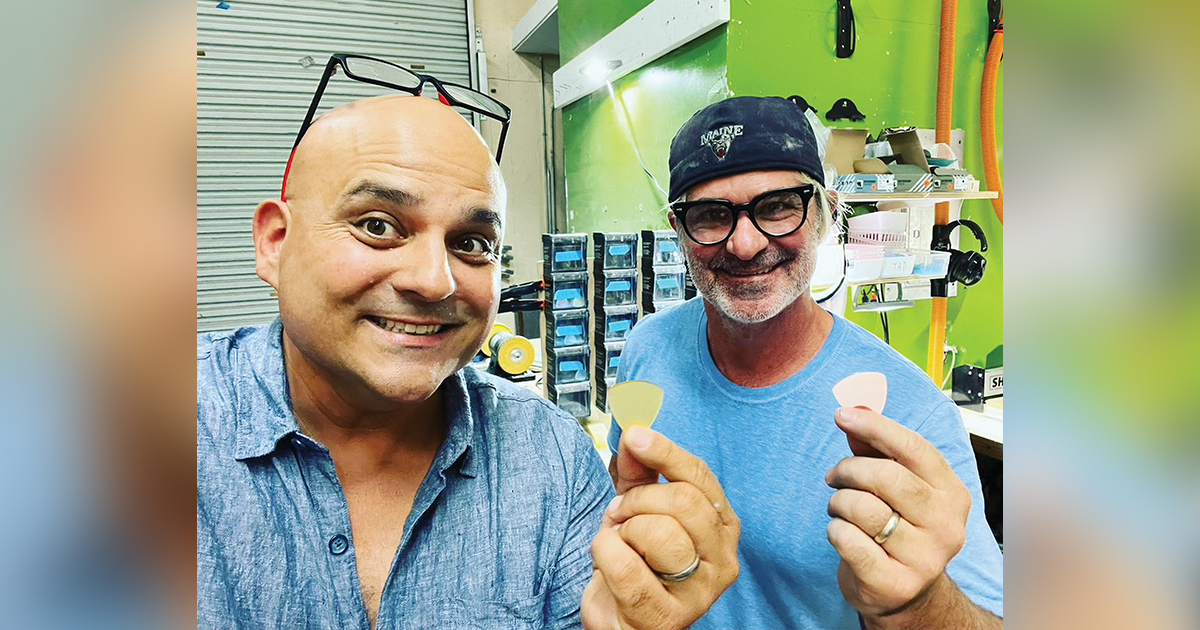
Frank Solivan: During the pandemic David [Welch] and I were making picks independently of each other. We found that we were often bidding against each other for the same products on eBay. Eventually we connected on social media and finally called each other. After that we started sending finished picks to each other, which soon became sending different raw materials back and forth to see which sustainable materials might make the best plectrums.
David would have suggestions on shapes and I would have suggestions on beveling. Over 18 months—and a lot of different materials mailed back and forth—that exchange evolved into the idea of a pick company. It took a lot of materials testing and quality control to get there, and we are still trying to push the tone envelope.
David Welch: It’s been a pretty intense search for the right combination of density, stiffness and thickness for the materials we use now for the DarthTone and our regular picks. We are still exploring materials, but our focus on serving the artist/customer with the right tool for the right tone is still front and center.
BU: Your DarthTone does have a nice ring when dropped on a granite surface.
FS: Antique tortoise shell is the benchmark sound for that drop test, and our goal is to match or exceed those tonal qualities. I think we’ve come pretty close. The material we use is polyetherimide or PEI and is the highest grade of Ultem that you can get. PEI also is slightly hydrophobic, which means it repels some moisture and stays between your fingers nicely. That was an unexpected benefit. We use PEI in the DarthTone picks and use a proprietary material for the colored picks.
BU: So you didn’t start with polyetherimide?
FS: No. We tried different acrylics, we tried casein, we even considered an exotic glass-filled PEI which requires really high temperatures to bind the glass to the polymer. Incredibly difficult to work with but so hard and inflexible that it actually wore the bronze off strings! For maximum effectiveness a pick has to have a little bit of give. Nothing else provided the ease of play coupled with the tonal response we were able to get with PEI. In that materials exploration we also discovered the proprietary stuff we use for the colored picks. Much like tortoise shell—most picker’s favorite tonal material—our proprietary material can sometimes require some minor maintenance to keep that factory-smooth bevel. We sell a buffing pad with 1000, 2000, and 5000 grit, which basically polishes the pick’s playing edge. Buffing and polishing picks is a practice I’ve had for years, and it seemed logical to provide that for our customers. That kind of maintenance is not necessary with the PEI, with the DarthTone picks.
Anyway, so after about a year-and-a-half of back-and-forth mail-based research and development between Florida and Virginia, David and I are getting into a rhythm with manufacturing picks, sharing samples with fellow musicians, dabbling in social media, and planning to sell the picks online. In June of 2022 we launched our website (www.toneslabs.com) that somehow went live early. David was flying from Maine to Florida and when he landed we already had a bunch of orders to fill. So we were in the pick business!
BU: Your manufacturing facility is down in Florida?
FS: David runs the main shop, overseeing production, programming the CNC machines, and doing a lot of the polishing and beveling handwork. When I get to go down to the shop in Florida we brainstorm new ideas, new refinements for quality, consistency, and tone. I also make picks in the “satellite shop” I’ve set up in my garage.
DW: Since the beginning we’ve really refined our production process. We’ve always used CNC machines to cut the material to shape, and production initially involved a lot of hand work—as much as an hour—to thickness the picks and then polish and bevel them. The CNC machines can now thickness the picks, but we still polish and bevel the picks by hand. We are always looking at production to figure out how to be more efficient, how to make each pick just a little bit faster.
BU: Which would be ultimately reflected in your pick price.
DW: Exactly. That’s why we were able to decrease our pick price to $35 on January first!
BU: You mentioned using social media to promote ToneSlabs.
DW: We have used Instagram and Facebook, but largely it’s been word of mouth across our network of musical friends. We’re building up a great group of artists who play ToneSlabs and help let folks know about the picks. Some of our “early adaptors” like C.J. Lewandowski have been really great field-testers, since C.J. plays hard and all the time, which really tests a pick’s durability. Working musicians like C.J. and Trey Hensley, Rick Faris, Chris Luquette, Jon Stickley, Addie Levy, Nate Lee, Don Stiernberg and—of course—Frank are helping us to move forward.
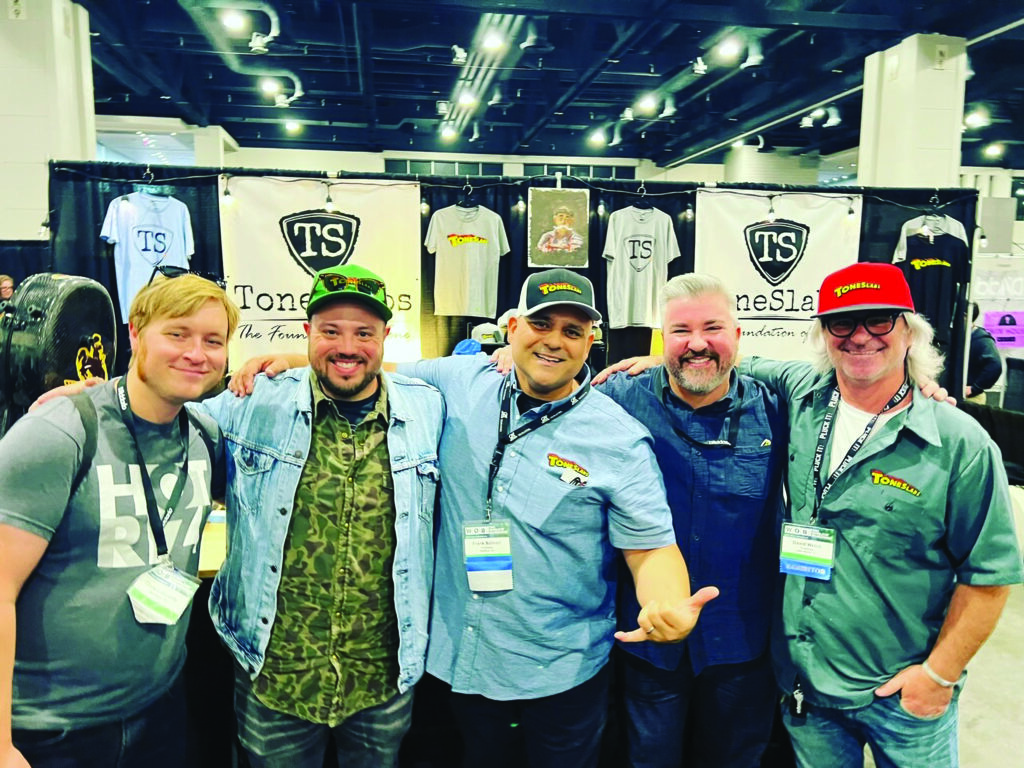
FS: This last September we were in Raleigh as part of the IBMA vendor trade show. A lot of folks visited the booth and played ToneSlabs. Our message was simple: we want to get the right pick into a musician’s hand. If you buy a pick and it just doesn’t work for you, we work with you to determine what you do need, and we’ll get that pick to you. We’re musicians making tools for other musicians and customer service is number one. We value our customers’ loyalty to our product and do what we can to earn it.
DW: I recall we had one customer who went through about eight picks of various sizes and shapes. We worked with him exchanging picks until he found just the right one, and he promptly ordered three more.
BU: Absolutely a focus on customer service. So what’s next on the ToneSlabs horizon?
FS: We’re always exploring ways to manufacture more efficiently. We’ve got some interesting materials we might use for different picks, and we are always looking to build retail partnerships with artists who use ToneSlabs as well as retailers like Banjo Ben’s, the Acoustic Shoppe and Elderly Instruments. One of the projects we’ve just started on is a thumb pick. We’re working out a partnership with our good friend Jaroslav Prucha, the banjo and mandolin maker from the Czech Republic. He’s a high-end tool-and-die guy who also supplies a lot of banjo and mandolin makers with parts and we’ve been scratching the surface of how to create a ToneSlabs thumb pick.
BU: Thanks for spending the time to talk with us. Any last thoughts?
FS: Tone is a subjective thing, but if you play your favorite tortoise or Dunlop or even a Blue Chip against ours, there will be a difference. And then you get to decide if that’s the pick that produces the tone you want.
For further information, browse to www.toneslabs.com.