
The Ome Banjo Finds a New Home with The Gold Tone Group
Photos Courtesy of The Gold Tone Group
In 1961 Chuck Ogsbury and friends started the Ode Banjo Company and made banjos under that name until 1966 when the company was sold to Baldwin Piano. In the summer of 1971, Chuck and three other partners—Ed Woodward, Kelly McNish and Ken Whelpton—started the Ome Banjo Company. Their original shop was located northwest of Boulder, Colorado on Gold Hill, a snow-swept ridge overlooking Rocky Mountain National Park. During the first two years they built over 500 banjos and out-grew the original shop. They then moved to a new facility on the eastern edge of Boulder and were able to increase production. From those beginnings they grew into one of the most highly respected banjo companies in the world, especially known for their open-back models.
Chuck Ogsbury, who was raised in Louisville, Kentucky, had moved to Boulder, Colorado in 1956 to attend college at the University of Colorado’s School of Engineering. In 1960, Chuck—who played guitar and banjo–started buying pawn shop instruments and repairing them for resale. This experience led him to believe that he could make a cheaper banjo using an aluminum pot assembly. He sand-cast the first aluminum pot at the University machine shop. He then teamed up with a woodworker, Tony Jacobs, and together they started making Ode Banjos. Upon graduation from engineering school, Chuck was more interested in making better banjos than looking for any other job. In an article in the October 1962 issue of Bluegrass Week magazine Chuck was referred to as “the Henry Ford of banjos.”
In 1963 Kix Stewart came through Colorado looking for a job and struck up a friendship with Chuck. The two worked together to revise the Ode instruments and also started selling banjo parts such as tailpieces and tone rings. Kix left Ode in 1964 and moved back to Ohio where he later became the founding partner of the Stewart-MacDonald Guitar Company. After Kix left, Chuck decided to sell the company to Baldwin Piano and Organ. Baldwin kept the company in Colorado for the first few years and Chuck worked there for six months to help them get set up. After a couple of years in Colorado, the Baldwin Ode Banjos were produced in Arkansas until they discontinued operation in 1982. Chuck later re-acquired the Ode name and today Ode banjos are being built by Chuck’s son, Zen Ogsbury, and Zoe Hatch.
When Chuck sold the company to Baldwin, he agreed not to make banjos for five years and he thought he would never make them again. After he met Ken Whelpton and the two started talking banjos, Chuck’s interest was rekindled. The two set up shop and Ed Woodward and Kelly McKnish joined in. As mentioned above, the four partners started building banjos under the Ome name in 1971. By 1975 they were building 750 banjos a year. About that time they also started making Ome mandolins, built by Mike Kemnitzer, who later made mandolins under the name Nugget.
In 1980, Whelpton relocated to the east coast and Woodward retired to Maine, where he died of cancer in 1991. Chuck Ogsbury continued to run the company up through just a year or two ago when he decided to put Ome Banjos up for sale. Ogsbury built Ome Banjos for over 50 years and from the start the brand built and maintained a reputation for their high quality and innovation in the production of open back, resonator and plectrum banjos. Chuck Ogsbury’s daughter, Tanya, was the operations and sales manager for Ome from August of 1997 through April of 2023.
Gold Tone Banjos
Anyone involved in bluegrass music who plays the banjo knows the name Gold Tone. If you don’t own one, you’ve either played one or know someone who owns one. Of the four private banjo students that I currently teach, two of them play Gold Tone banjos. Gold Tone makes some of the finest instruments available today at their price point. With Gold Tone you get exceptional, playable instruments without paying a lot of money.
The Gold Tone story starts back in 1978 when Wayne and Robyn Rogers, who were active folk musicians in the 1970s, decided to open a music store—called Strings N’ Things Music Center—in Titusville, Florida. Wayne describes the store as a “full-line music store.” In addition to stringed instruments, they also carried pianos and band instruments and had a teaching studio. The store built a strong customer base and was quite successful until tragedy struck on January 28th, 1986. On that date the Space Shuttle Challenger disaster occurred. Subsequent to that event, NASA laid off 2400 local employees and the tourism industry that the Space Shuttle launches brought to the area greatly declined. Wayne said, “Our thriving store suffered.”
Necessity being the mother of invention, Wayne began thinking about a product that he could build and sell nationally that would not rely on the local economy. He came up with a design for a travel banjo. He said, “I was looking through a guitar magazine and saw an ad for a travel guitar. I thought, ‘Why not a travel banjo?’” He built a few travel banjos at his store and started selling them through the mail. Soon after, Janet Davis Music became interested in carrying the travel banjo and Banjo Newsletter printed a positive review. More orders started coming in.
When music stores began to inquire about carrying the banjo Wayne knew that he could not afford to build the banjos at home and sell them for a wholesale price to stores, so in 1990 he aligned with a factory in Korea. Wayne said, “Back then, the banjos sold through the mail for $299. The dealer’s wanted the normal dealer discount, which was fifty percent. Now we had to make them for $150 and make some sort of margin on that. That wasn’t possible to do in our shop. At first the factory in Korea was just making me necks and they were better necks than what we were making. So we said, ‘Go ahead and make the bodies.’ Eventually we said, ‘Just go ahead and make the whole banjo.’ When the banjos would come in, I would spend maybe an hour polishing the frets, making sure the neck angle was right and making sure they had American strings rather than Korean strings.” The next product that Gold Tone added to their line was a full size 5-sting banjo. They began building those in 1991.
Wayne and Robyn incorporated Gold Tone Banjos (Gold Tone Music Group) in 1993. Regarding the name of the business, Wayne said, “The first year we sold the travel banjos they had no name on them. I started looking through catalogs to try and figure out a name. I was looking at a catalog and saw the name Silvertone.” Seeing the name Silvertone inspired naming his banjos Gold Tone. Eventually the company also started producing 6-string banjos and mandolins and they continued to add new products. Today Gold Tone produces an impressive line of acoustic instruments, including a partnership with Paul Beard to build resonator guitars. Wayne said, “The bodies are made off-shore and we buy the cone and spider from Paul Beard and assemble the guitars over here.” Early on, Wayne had traveled to Korea and spent four months teaching them how to make the Gold Tone banjos and mandolins. Later, in about 2005, Korean labor prices were increasing, and the Korean-owned company moved their factory to China. Today there are two factories in China that exclusively produce Gold Tone products.
One feature that Gold Tone provided to individual customers and music stores that other companies selling off-shore instruments did not provide is exceptional instrument set-ups. When Gold Tone received the instruments in from Korea, their luthiers in Florida would do set up work on each instrument before it was shipped out. Wayne said that having worked in a music store he had experience receiving instruments from off-shore companies with horrible set up work. He was determined to provide his customers with an instrument that was of high quality and easily playable right out of the box. He said, “With our instruments, the store owner does not have to worry about doing any set-ups. That has been one of our main selling points.”

Starting with the travel banjo in the late 1980s, Gold Tone has continued to grow and gained their reputation of offering high quality instruments at affordable prices. The instruments are affordable due to the fact that they are made off-shore, the high quality comes from Wayne’s innovativeness and his insistence that every instrument that leaves the shop in Florida has an exceptional set up and quality check by a professional luthier. Regarding the Gold Tone instruments that he sells in his store, John Chapman of the Acoustic Shoppe in Springfield, Missouri said, “Gold Tone is very good at creating affordable high-quality instruments with good set-ups. When we sell a Gold Tone instrument, we don’t have to worry about customers returning them to the store.”
The Gold Tone Group and Ome Banjos
This story starts with banjo player Mark Horowitz. Horowitz was described in our article about the Gold Tone “Bluegrass Heart” Béla Fleck Signature banjo, in our October 2022 issue, as “pro banjoist, musical instrument industry veteran, banjo tinkerer and Bela Fleck’s second banjo teacher.” When Horowitz found out that Chuck Ogsbury was interested in selling Ome Banjos, he called Wayne Rogers in the summer of 2023 to let him know about it. Wayne said, “Part of our plan at Gold Tone was to start making USA products and I have known Chuck Ogsbury for about thirty years. Chuck had at least a dozen buyers who were interested in the company, but there was no one who had banjo or instrument building experience. Chuck chose us because he knew that we would continue in the Ome tradition of building top notch banjos using his designs.”
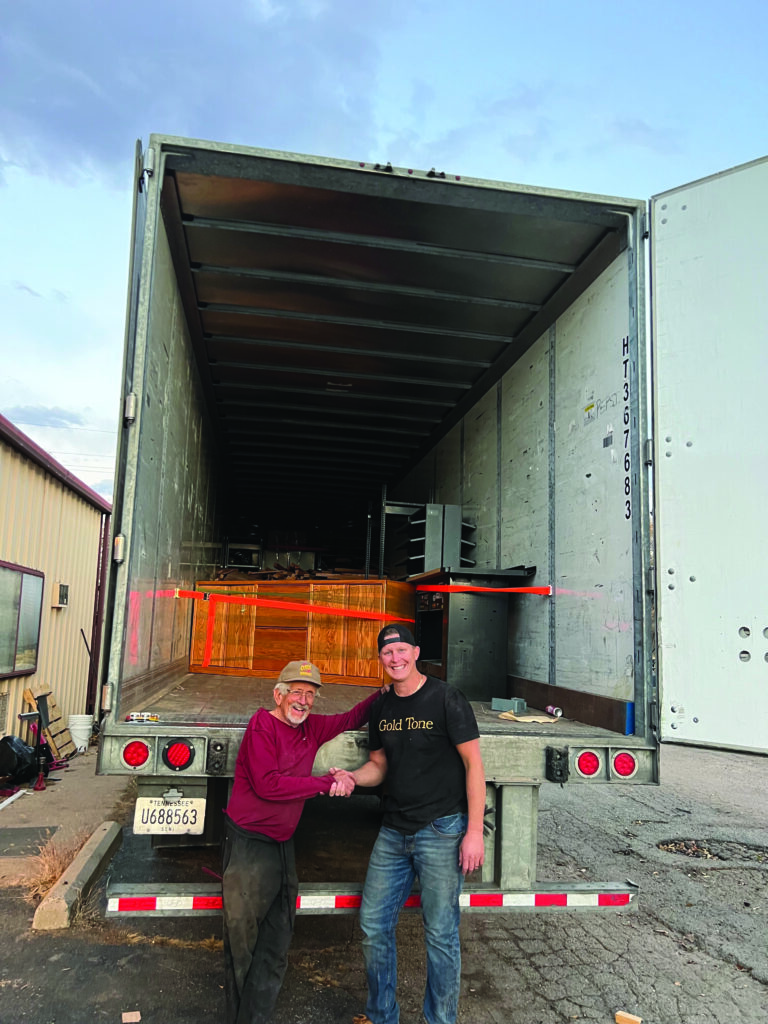
After Rogers started building his travel banjo in the mid-1980s, he had purchased a building near his music store to set up shop. After a year the business grew to the point where he needed more space, so he bought another building. He was soon employing a half a dozen luthiers to work on setting up and quality checking the Gold Tone instruments. Fifteen years ago he purchased a third and current location. It was an empty 14,000 square foot building and he began working to design it to be an efficient space to build instruments. After purchasing Ome Banjos, Wayne sent his operations manager, Justin Grizzle to Colorado with a 53-foot semi to pack up all of Ome’s tools, machines, jigs, banjos, and banjo parts and pieces and move it all into his newest facility in Titusville. He said, “We are set up to duplicate exact Ome banjos.”
In addition to their Gold Tone banjo models—which for bluegrass players include the Mastertone™ Bluegrass Heart Béla Fleck Signature model, the Gold Tone ML-1 Missing Link Béla Fleck Baritone Banjo, the Gold Tone Mastertone™ Orange Blossom line (the OB Standard, OB-3 “Twanger,” OB-2 Bowtie, OB-Grandee, OB-250 and OB-300) and the less expensive Cripple Creek line (CC-100, CC-50, the CC-Banjitar) and for old-time players include the High Moon HM-100, CC-Carlin, CB-100 banjos, Gold Tone has already started to produce Ome’s top selling open back model, the Ome Tupelo. They are also getting geared up to produce four other Ome open-back models and, eventually, Ome resonator models. Additionally, they also are offering four Gold Hill model plectrum banjos that Ogsbury already had in production at the time of the sale.
Gold Tone is also currently working to develop new models under the Gold Tone name. The Béla Fleck signature model has been a great success and they are currently working with other bluegrass artists to develop new models. Gold Tone’s Operations Manager said, “Last year we developed twelve new instruments. A couple of our top sellers would be the OB-2 Bowtie and the OB-3 Twanger. Those gave us a lot of recognition in the bluegrass community. Professional players have looked at those and said, ‘Wow, this is something that I’d be proud to stand on stage and play.’ We also just came out with a banjo called the Grandee, which is a homage to the Granada-style banjo.” Although the banjos are made overseas, Justin said that they outfit the banjos with high-end parts once the banjo arrives in Florida, such as Prucha tailpieces, Rickard Cyclone Tuners, Snuffy Smith bridges, etc.
Over the past nearly 40 years, Gold Tone has built a solid reputation for building high quality off-shore instruments. Now they are taking what was developed at Ome over the course or fifty years and applying their resourcefulness and know-how to building American-made banjos in Florida. It is an exciting new development in the banjo world.