
The Mountain City Fiddlers’ Convention Celebrates 100 Years
Photo Courtesy of Roy M. Andrade
The tiny Appalachian town of Mountain City, Tennessee (population around 2,500), sits in the northeastern corner of the state, about halfway between Bristol, Tennessee, and Boone, North Carolina. At 2,418 feet, it is the highest incorporated town in Tennessee, and the county seat for Johnson County, in one of the state’s most rural and rugged areas. In the early twentieth century, the remote hills at the convergence of Tennessee, Virginia, and North Carolina rang with the sounds of fiddles, guitars, and banjos when homegrown music was the predominant source of entertainment. By the mid-1920s, with the advent of radio and live performance programs such as the WLS National Barn Dance in Chicago and WSM’s Grand Ole Opry in Nashville, this “hillbilly” music was poised to go mainstream. In July 1927, Victor’s Ralph Peer traveled to Bristol to make the first recordings of future stars such as the Carter Family and Jimmie Rodgers. Those Bristol Sessions are now regarded as the “Big Bang of Country Music.”
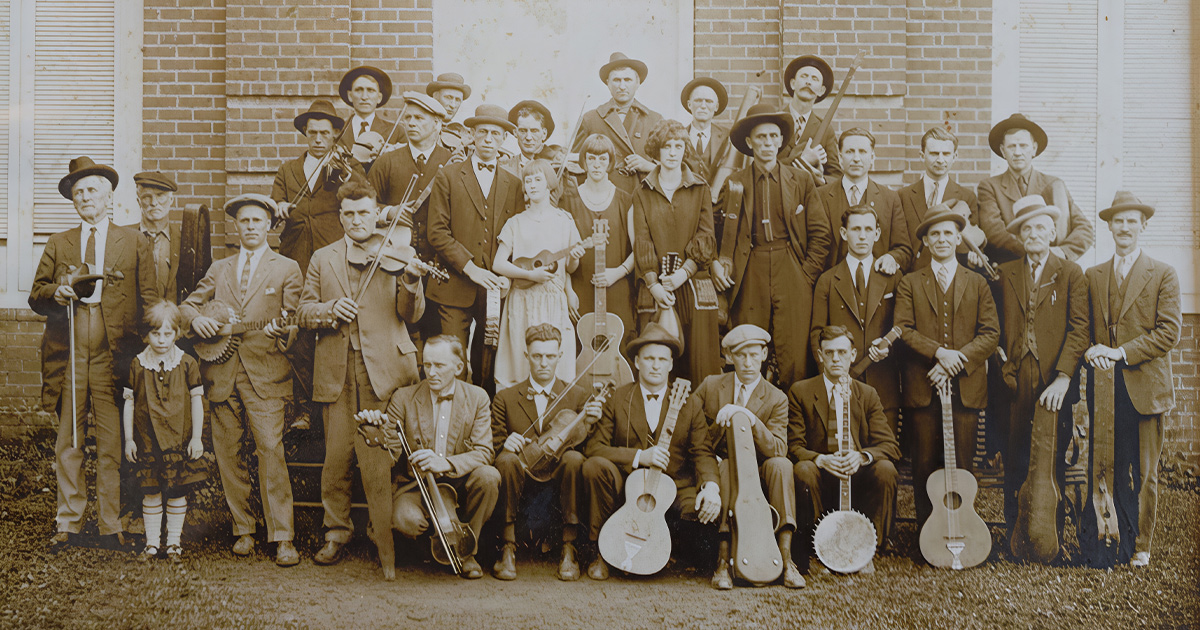
Two years earlier, in May of 1925, some of the best musicians in the area had converged on Mountain City to compete in the original Mountain City Fiddlers’ Convention. A number of these players, including G.B. Grayson, Fiddlin’ John Carson, and Clarence “Tom” Ashley, while relatively unknown at the time, are now regarded as legends of old-time music. A collection of their music can be heard on an album entitled A Fiddlers’ Convention in Mountain City, Tennessee, released by County Records in 1972. The album cover shows a photo of thirty musicians who competed in the 1925 contest.
This year, on the first weekend in October, the town will celebrate the 100th anniversary of that historic event. But the fiddlers’ convention might not have survived if not for the dedication and hard work of Mountain City’s own bluegrass star, Kody Norris, and his wife, Mary Rachel Nalley-Norris. We caught up with Kody to discuss the event and plans for the centennial celebration.
PP: What is the history of the first Mountain City Fiddlers’ Convention?
KN: It was held in May 1925, in the Mountain City High School auditorium, which has now been remodeled into the Heritage Hall Theater. So many of the people who performed there, from Charlie Bowman to Dud Vance to Tom Ashley, G.B. Grayson, Fiddlin’ John Carson, would become major stars within just a few years after this convention. Joe Wilson [long-time Executive Director of the National Council for the Traditional Arts] was from Mountain City, and he compiled a lot of information about the convention. The best I can figure, in 1925, they competed for a total of forty dollars in prize money, with the first prize being a twenty-dollar double-eagle gold piece. We don’t honestly know that the winners were in any particular order, but the first, second, and third place winners were G.B. Grayson with “Cumberland Gap,” Dud Vance with “Twinkle Little Star,” and Charlie Bowman with “Sally Ann.” Of course, everybody here pretty much claims that G.B. Grayson won [first place], since he was the hometown boy, but I don’t know that to be a fact. I think the bulk of everything was, naturally, centered around the fiddle, so I don’t honestly know that there were multiple categories, but in the field recordings from that era, those people were [playing multiple instruments].
PP: Where did the contestants come from, and how did they find out about it?
KN: They did an immense amount of newspaper advertising, from what I understand. Also, the Buster Brown Shoe Company was instrumental in sponsoring the first Mountain City Convention. So I figure, especially with having traveling salesmen, they would have been very good at getting the word around. They probably printed up handbills and things along those lines. People came from Washington County, Tennessee, and as far away as Virginia, Georgia, and South Carolina. So, for 1925, it was quite the trip. Even Washington County is two counties over. That was probably a far greater distance than most people would have ever traveled from home at that time.
PP: Would you say that the 1925 fiddlers’ convention was a precursor to the Bristol Sessions in 1927?
KN: Most definitely. I think this was something that kind of got the ball bouncing for rural music being recorded. There was a guy named Tony Alderman who had a portable radio station, and he’d go around and give demonstrations. G.B. Grayson was one of the first ones that came and wanted to play over that [station], so it’s obvious what he already had in mind, wanting to take his music further. I think this kind of planted the seed to give everybody the bug of wanting to be recorded, and to be able to monetize that.
PP: How did the event evolve over the years?
KN: We don’t have a lot of info from the thirties, forties, fifties, and sixties. In the seventies, the Rotary Club took the event on, and they had it at different locations. Then, about thirty-five years ago, it moved to Laurel Bloomery, Tennessee, and they’d have it at the high school football field and different places. But it pretty much found its home in Laurel Bloomery, at the Old Mill Music Park, owned by Doug and Jackie Warden. Doug Warden actually played in Clint Howard’s Blue Ridge Mountain Boys, and he played on an album that Clint and Doc Watson cut together in the eighties. Laurel Bloomery is five miles from Mountain City. And where they held the convention is only about a half a mile from where G.B. Grayson lived, literally on the other side of the hill. And Jackie Warden worked so hard, even after the passing of her husband, to keep that going. But then, after COVID came in, it wasn’t feasible to come back, and she sold the park. Several other organizations in Mountain City were approached about taking it over, but they just had too much going on. The county came to Mary Rachel and me, and we certainly didn’t have time to take it on, but I refused to let it die. It’s too special. It didn’t happen for three years, from 2020 through 2022. We became involved in 2023.
PP: What does the fiddlers’ convention mean to you, and what will it be like this year?
KN: I want people from all walks of life to get to experience what I experienced there. I attended the Laurel Bloomery Fiddlers Convention every year, all through the nineties. I played a lot of music there, all hours of the night, when I was a kid. I looked so forward to that. Actually, my parents would sign me out of school at noon on that Friday so I could get over there early, the whopping five-mile trip that it was. But I thought I had to be there before anyone else. There was just such a wonderful sense of community there. Everybody was always welcoming. Parents could go and take their kids, and if they didn’t see their kids for three hours, they didn’t ever have to worry about it. It was very special.
Keeping it going was extremely important to me and Mary Rachel, and I can take very little credit. She does everything. It would not happen without her. My name’s tied to it, and it says, “The Kody Norris Show presents,” but that’s strictly a marketing thing. Mary Rachel doesn’t have any ties to Mountain City, but she’s gotten so on board with this, and it’s a project of passion for her. Mary Rachel’s a marketing genius. She’s so smart, and she’s such an independent woman, and she will tackle anything, anytime, and that’s why I love her so much. She and her good friend, Sheila Caldwell, who is the Johnson County Tourism Coordinator, they’ve worked so, so hard to bring this thing back and to help me revive a dream.
I knew when we took this on, with the Old Mill Music Park in Laurel Bloomery no longer being an option, there’s no way to ever recreate that. When Mary Rachel and I sat down and talked about this, she said, “Well, how about Heritage Hall, since that’s the building that it started in?” So we have changed the concept up. It’s more of a one-day event, on Saturday, October 4. And it’s just really unique to be back in that same building, where that thing happened a hundred years ago. But, in addition to the contests, we have performances from some nationally known bluegrass, old-time, and Americana bands. In times past, we’ve had the Little Roy and Lizzy Show, Appalachian Road Show, Ralph Stanley Two, and the Tennessee Bluegrass Band. We’ve had some really good talent. This year, the lineup will be Larry Sparks, Wyatt Ellis, and the Kody Norris Show.
Another artist that we have coming this year is a fiddler named Pete Denahy, from Australia, and we’re excited to have him. The international recognition that we’ve been able to bring in on this thing has just been wonderful. Of course, I talk it up on all our shows, wherever we go. But the fact that people have been willing to come across the water has been amazing to me.
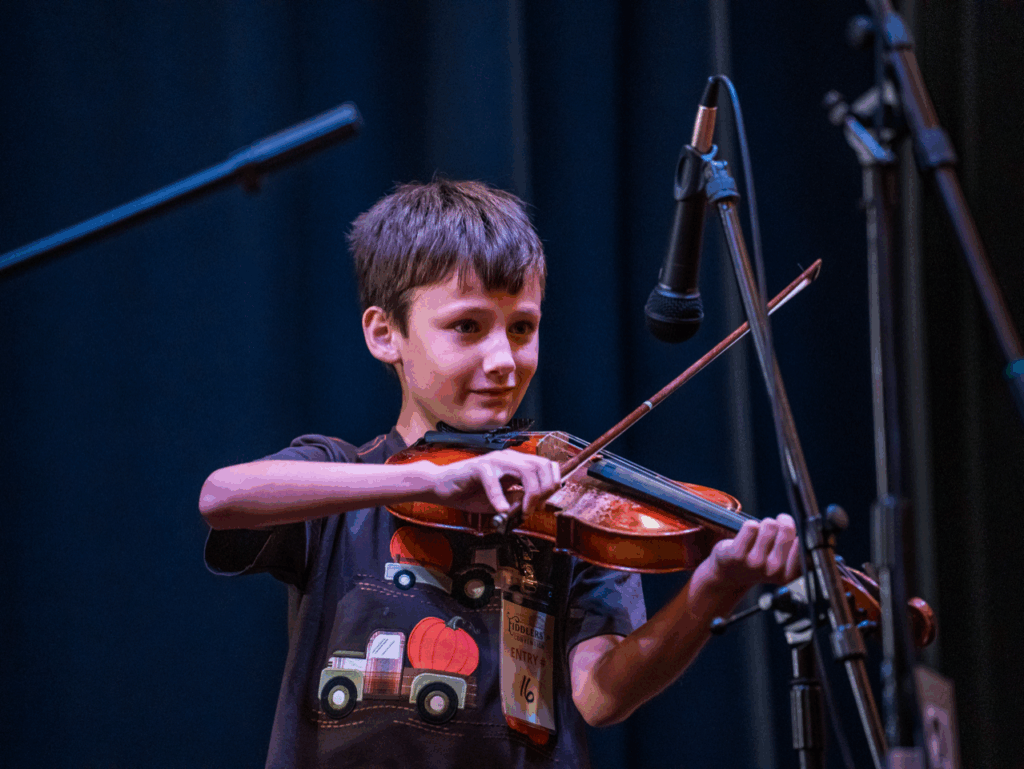
In the past, the focus had always been strictly on old-time music. I opened it up to bluegrass as well. To me, good music is good music. I’ve judged a lot of contests, all over the country, and sometimes some of the rules have never made sense to me. If someone can really play the fiddle, or they can really play the banjo, I don’t care how they go about doing it. A lot of the tunes that were played in these conventions, back a hundred years ago, weren’t old-time tunes; they were popular tunes of the day. What they were hearing at the time, that’s what they were playing. So I want everybody to feel welcome, and to open it up to everybody in bluegrass, old-time, however you play your instrument. If you play it tastefully and you play it well, I want you to be in this contest. For categories, we’ve had fiddle, banjo, mandolin, guitar, bass, Dobro, band, and then a novelty [category] for harmonicas and things like that. We take the top three fiddlers in the junior and senior division, and at the end of the night, they come back and play another round for a fiddle-off for our grand prize. This year we’ll be recording all the contestants, as well.
PP: What are the prizes?
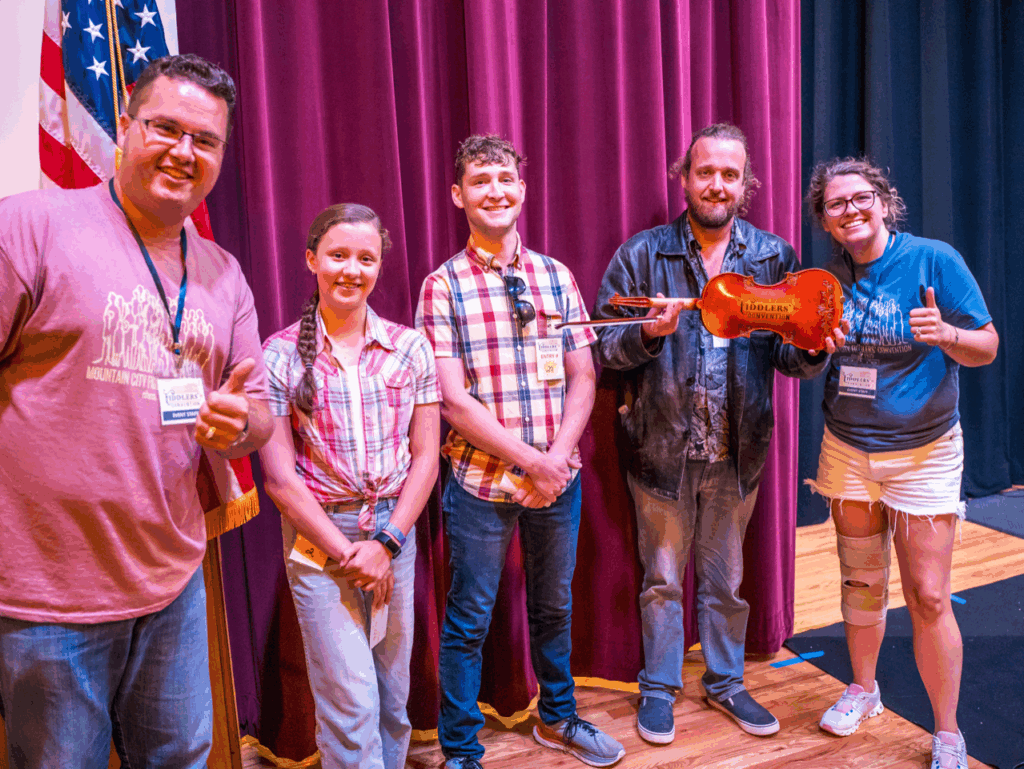
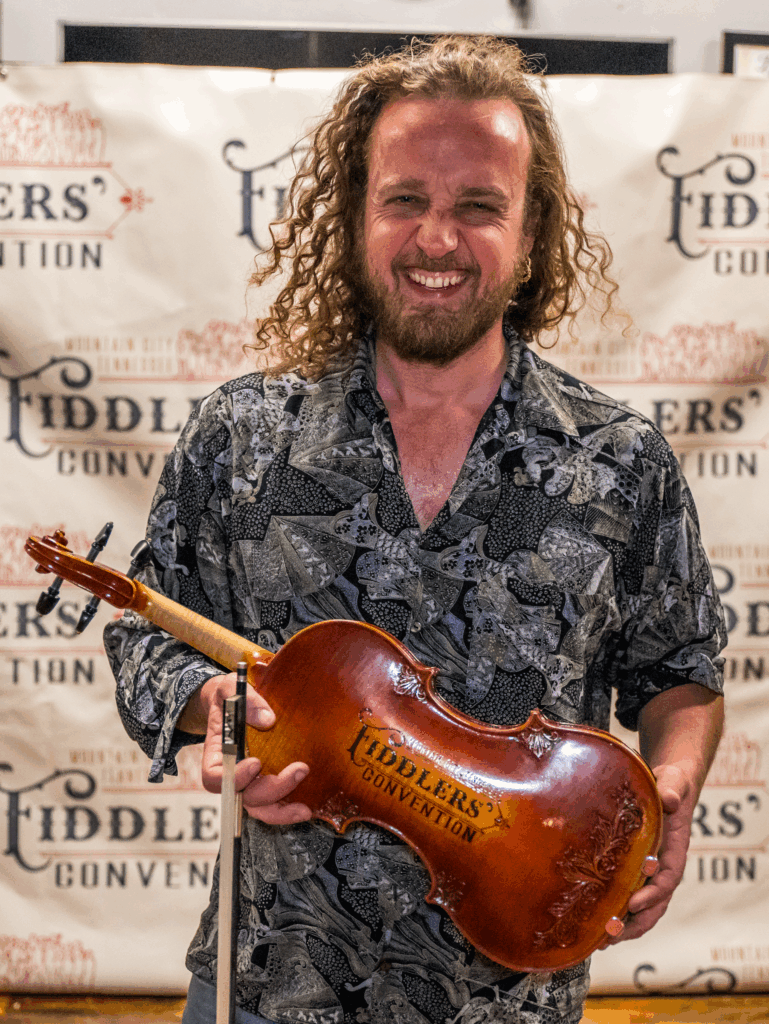
KN: We gave custom fiddles away for the grand prize up to this point, and last year, a wonderful fiddler from Rotterdam, Netherlands, came over and won that, so that was pretty neat. The grand prize this year is a 1925 twenty-dollar gold piece, just as they gave away in 1925. That prize is now worth over $3,000, for that double-eagle, just in the gold value. That’s a substantial prize for fiddling, so I’m very excited about that. The rest will be the normal cash prizes. Last year, the first-place band category paid about $1200, so it was well worth folks putting a band together and coming over. The last couple of years, Tim Norris at Castle Ford Studios in Boone donated a session to the winning band, so that they could come and cut a record. And Heritage Hall Theater, also for the winning band, has allowed them to book a show date there, to open for someone. So that’s been a really good thing, to get their name out there.
PP: What is your vision for the event, going forward?
KN: This year, the fiddlers’ convention will be free to spectators. There’ll still be a little entry fee, given the level of the prize money, for the competitors, but the spectators will be able to come for free. We’ve got numerous sponsors. Skyline National Bank, the Johnson County Community Foundation, and the East Tennessee Foundation, they’ve all been wonderful partners to work with. I want to turn this thing into something that will go on for many, many years. Mary Rachel envisions it maybe kind of branching into a small folk festival, while still retaining the original feel. I always want the contest to be at center stage, to let people be involved, and younger players to get to experience that. So many young musicians in this area are coming on, and I want them to have that feeling of sitting in school all morning on Friday and just chomping at the bit to get to the fiddlers’ convention.
This year, we’re moving the stage outside, into the parking lot, but we’ll still be presenting the prizes on the same stage where it started. Within two years, we’ve already outgrown that 400-seat auditorium. From the first convention to the second, all of our numbers were up. We had more competitors, more spectators, more sponsorship, so it’s going in the right direction. The band performances will be on the main stage, outside, and workshops will be inside. I’ve always wanted to move this thing to a cooler time of the year, because every one that we ever had was hot. There’s not a more beautiful place on the planet than Mountain City in October, with the foliage.
PP: Are there other ways you’re going to commemorate the 100th anniversary?
KN: We’ve got lots of neat things. Mary Rachel and Sheila have put a lot of time into taking the original photo from 1925 of all the musicians that were there, and through the help of A.I., they’ve made everything very realistic looking, where people can see the way these folks would have looked. And those photos are going on the flagpoles, all down Main Street of Mountain City, so those will be up for a good while, before and after the contest. And we plan to recreate that photo, with this year’s contestants. There’ll be some souvenir-type things that we’ll do to commemorate it. Given that our main prize is a coin, if you look closely at all the event artwork, you’ll see evidence of a coin, like the circular things, and the way the edge of a coin is designed.
PP: On October 3rd, County Records will reissue the 1972 album that features some of the original competitors from 1925. County and Rebel Records head Mark Freeman had this to say about the new release: “When Kody approached me about reissuing County LP 525 A Fiddlers’ Convention in Mountain City, Tennessee (1924–1930 Recordings), saying ‘yes’ was easy. Appalachian old-time music was my dad’s first love, and County Records was the label he founded. So this album isn’t just a tribute to the historic convention; it’s also a deeply personal way to honor my father, David Freeman.”
KN: Yes, I’m super excited about that. I knew that they had released that record for County already, because those were floating around a lot when I was a kid. I’m sure there were probably more of those sold in Mountain City than anywhere else. I was so happy that Mark Freeman was receptive to the idea of re-releasing that. The recording will be on both LP and CD. It includes artists who performed at the 1925 fiddlers’ convention, and recordings of them within about a seven-year period. So County was able to capture what they would have been playing like at that time. Some of the artists include Dudley Vance, Charlie Bowman, Will McNamara, Fiddlin’ John Carson, G.B. Grayson, Tom Ashley, Fiddlin’ Powers, Tony Alderman, Earl Johnson, and the list goes on. I’m excited to be able to have that to take with me on the road, to spread that message a little further.
PP: Is there anything else that you’d like to add?
KN: We really hope that folks will recognize the impact of an event like this, the fact that it’s still around, a hundred years after it started, and realize the need to get out and support it. It’s very, very important, because things like this go away every day. And this is one thing I just couldn’t see that happening to. This was never meant to be a money-maker, in any way. But, as long as it can always support itself, we’ll hang in there with it, and I hope we keep this thing going for a long time.
And the other thing this year, in East Tennessee, with all the devastation from Hurricane Helene, this is just a little way to give back, and let everybody come out and get back to what our heritage is. Rebuilding is rough, and rebuilding is more than just hammers and nails sometimes. We’ve got to rebuild our souls, and what better way to do that than with some good old-time country music.
For more information, visit: www.mountaincityfc.com
Can you publish the key to the 30 or so fiddler’s in that 1925 picture?